Question 14 Marks
Solve the pairs of linear equation by the elimination method and the substitution method:$\frac{x}{2} + \frac{{2y}}{3} = - 1\,and\,x - \frac{y}{3} = 3$
Answer
- By Elimination method
The given system of equation is
$\frac { x } { 2 } + \frac { 2 y } { 3 } = - 1...............(1)$
$x - \frac { y } { 3 } = 3....................(2)$
Multiplying equation $(2)$ by $2,$ we get
$2 x - \frac { 2 y } { 3 } = 6......................(3)$
Adding equation $(1)$ and equation $(2),$ we get
$\frac { 5 } { 2 } x = 5 \Rightarrow x = \frac { 5 \times 2 } { 5 } \Rightarrow \quad x = 2$
Substituting this value of $x$ in equation$(2),$ we get
$2 - \frac { y } { 3 } = 3 \Rightarrow \frac { y } { 3 } = 2 - 3 = - 1 \Rightarrow \quad y = - 3$
So, the solution of the given system of equation is
$x = 2, y = -3$
- By substitution method
The given system of equation is
$\frac { x } { 2 } + \frac { 2 y } { 3 } = - 1...............(1)$
$x - \frac { y } { 3 } = 3....................(2)$
From equation $(2),$
$x = \frac { y } { 3 } + 3....................(3)$
Substituting this value of $x$ in $(1),$
$\frac { 1 } { 2 } \left( \frac { y } { 3 } + 3 \right) + \frac { 2 y } { 3 } = - 1$
$\Rightarrow \quad \frac { y } { 6 } + \frac { 3 } { 2 } + \frac { 2 y } { 3 } = - 1 \Rightarrow \quad \frac { 5 y } { 6 } = - 1 - \frac { 3 } { 2 }$
$\Rightarrow \quad \frac { 5 y } { 6 } - - \frac { 5 } { 2 } \Rightarrow y = - 3$
Substituting this value of $y$ in equation $(3),$ we get
$x = - \frac { 3 } { 3 } + 3 = - 1 + 3 - 2$
So, the solution of the given system of equations is $x = 2, y = -3$
Verification: Substituting $x = 2, y = -3,$ we find that both the equation $(1)$ and $(2)$ are satisfied as shown below:
$\frac { x } { 2 } + \frac { 2 y } { 3 } = \frac { 2 } { 2 } + \frac { 2 ( - 3 ) } { 3 } = 1 - 2 = - 1$
View full question & answer→Question 24 Marks
Solve the given pair of linear equation by the elimination method and the substitution method: $3x – 5y – 4 = 0$ and $9x = 2y + 7$
Answer
- By Elimination method,
The given system of equations is :
$3 x - 5 y - 4 = 0............(1)$
$9 x = 2 y + 7$
$9 x - 2 y - 7 = 0.............(2)$
Multiplying equation $(1)$ by $3,$ we get
$9 x - 15 y - 12 = 0.............(3)$
Subtracting equation $(3)$ from equation $(2) ,$ we get
$13 y + 5 = 0$
$\Rightarrow \quad 13 y = - 5 \Rightarrow y = \frac { - 5 } { 13 }$
Substituting this value of $y$ in equation $(1),$ we get
$3 x - 5 \left( \frac { - 5 } { 13 } \right) - 4 = 0$
$\Rightarrow \quad 3 x + \frac { 25 } { 13 } - 4 = 0 \Rightarrow 3 x - \frac { 27 } { 13 } = 0$
$\Rightarrow \quad 3 x = \frac { 27 } { 13 } \Rightarrow x = \frac { 9 } { 13 }$
So, the solution of the given system of equation is
$x = \frac { 9 } { 13 } , y = \frac { - 5 } { 13 }$
- By Substitution method:
The given system of equation is:
$3 x - 5 y - 4 = 0.............(1)$
$9 x = 2 y + 7...................(2)$
From equation $(2),$
$x = \frac { 2 y + 7 } { 9 }..................(3)$
Substituting this value of x in equation(1), we get
$3 \left( \frac { 2 y + 7 } { 9 } \right) - 5 y - 4 = 0$
$\Rightarrow \quad \frac { 2 y + 7 } { 3 } - 5 y - 4 = 0$
$\Rightarrow \quad 2 y + 7 - 15 y - 12 = 0$
$\Rightarrow -13y - 5 = 0$
$\Rightarrow 13y = -5$
$\Rightarrow \quad y = \frac { - 5 } { 13 }$
Substituting this value of $y$ in equation$(3),$ we get
$x = \frac { 2 \left( \frac { - 5 } { 13 } \right) + 7 } { 9 } = \frac { - \frac { 10 } { 13 } + 7 } { 9 } = \frac { - 10 + 91 } { 117 } = \frac { 81 } { 117 } = \frac { 9 } { 13 }$
View full question & answer→Question 34 Marks
Solve the given pair of linear equation by the elimination method and the substitution method: $3x + 4y = 10$ and $2x – 2y = 2$
Answer
- By Elimination method,
The given system of equation is :
$3 x + 4 y = 10 ...................(1)$
$2 x - 2 y = 2 ...................(2)$
Multiplying equation$(2)$ by $2,$ we get
$4 x - 4 y = 4 ...................(2)$
Adding equation $(1)$ and equation $(3),$ we get
$7 x = 14$
$\therefore \quad x = \frac { 14 } { 7 } = 2$
Substituting this value of $x$ in equation $(2),$ we get
$2(2) - 2y = 2$
$\Rightarrow \quad 4 - 2 y = 2$
$\Rightarrow \quad 2 y = 4 - 2$
$\Rightarrow \quad 2 y = 2$
$\Rightarrow \quad y =\frac22=1$
So, the solution of the given system of equation is
$x = 2, y = 1$
- By Substitution method,
The given system of equation is:
$3 x + 4 y = 10.................(1)$
$2 x - 2 y = 2....................(2)$
From equation$(1)$
$3 x=10-4 y$
$x=\left(\frac{10-4 y}{3}\right)$
Put value of $x$ in equation $(2),$
$2 x-2 y=2$
$2\left(\frac{10-4 y}{3}\right)-2 y=2$
$\frac{2(10-4 y)-2 y(3)}{3}=2$
$20-8 y-6 y=6$
$-14 y=-14$
$y = 1$
Putting value of $y = 1$ in equation $(2)$
$2x - 2 = 2$
$x = 2$
Therefore, $x = 2, y = 1$ is the solution.
Verification: Substituting $x = 2, y = 1,$ we find that both the
equation$(1)$ and $(2)$ are satisfied shown below:
$3 x + 4 y = 3 ( 2 ) + 4 ( 1 ) = 6 + 4 = 10$
$2 x - 2 y = 2 ( 2 ) - 2 ( 1 ) = 4 - 2 = 2$
Hence, the solution is correct.
View full question & answer→Question 44 Marks
Solve the given pair of linear equation by the elimination method and the substitution method: $x + y = 5$ and $2x - 3y = 4$
Answer$y = 5 .......... (1)$
$2x - 3y=4 ............. (2)$
- Elimination method:
Multiplying equation $(1)$ by $2,$ we get equation $(3)$
$2x +2y =10 ............. (3)$
$2x−3y =4 ........... (2)$
Subtracting equation $(2)$ from $(3),$ we get
$5y =6 ⇒ y = \frac{6}{5}$
Putting value of $y$ in $(1),$ we get
$x + \frac{6}{5}=5$
$⇒ x =5− \frac{6}{5} = \frac{{19}}{5}$
Therefore,$ x = \frac{{19}}{5}$ and $y = \frac{6}{5}$
- Substitution method:
$x +y =5 .......................... (1)$
$2x−3y =4 ......................... (2)$
From equation $(1),$ we get,
$x =5−y$
Putting this in equation $(2),$ we get
$2(5−y )−3y =4$
$⇒ 10−2y−3y =4$
$⇒ 5y =6$
$⇒ y = \frac{6}{5}$
Putting value of $y$ in $(1),$ we get
$x =5−\frac{6}{5}$=$\frac{{19}}{5}$
Therefore, $x = \frac{{19}}{5}$ and $y = \frac{6}{5}$
View full question & answer→Question 54 Marks
A fraction becomes $\frac { 9 } { 11 }$ if $2$ is added to both numerator and denominator. If $3$ is added to both numerator and denominator it becomes $ \frac { 5 } { 6 }$. Find the fraction by substitution method.
AnswerLet the numerator be $x$ and denominator be $y$ if $2$ is added to both numerator and denominator, the fraction becomes $\frac { 9 } { 11 }$
$\frac { x + 2 } { y + 2 } = \frac { 9 } { 11 }$
$11(x + 2) = 9( y + 2) = 11x + 22 = 9y + 18 or,$
$ 11x + 22 - 9y - 18 = 0 $
or, $11 x - 9 y + 4 = 0 ........(i)$
If $3$ is added to both numerator and denominator the fraction becomes $\frac { 5 } { 6 }$ and $\frac { x + 3 } { y + 3 } = \frac { 5 } { 6 }$
$6(x+3) = 5(y+3)$
$ 6x +18 = 5y + 15$ or,
$6x + 18 - 5y - 15 = 0$ or,
$6x -5y + 3 = 0 ...(ii)$
On comparing with $ax + by + c = 0$
we get $a _ { 1 } = 11 , b _ { 1 } = -9 , c _ { 1 } = 4$
$a _ { 2 } = 6 , b _ { 2 } = - 5 \text { and } c _ { 2 } = 3$
Now, $\frac { x } { b _ { 1 } c _ { 2 } - b _ { 2 } c _ { 1 } } = \frac { y } { c _ { 1 } a _ { 2 } - c _ { 2 } a _ { 1 } } = \frac { 1 } { a _ { 1 } b _ { 2 } - a _ { 2 } b _ { 1 } }$
$\frac { x } { (-9 ) ( 3 ) - ( - 5 ) ( 4 ) } = \frac { y } { ( 4 ) ( 6 ) - ( 3 ) ( 11 ) } =\frac{1}{(11)(-5)-(6)-(9)}$
$\frac { x } { - 27 + 20 } = \frac { y } { 24 - 33 } = \frac { 1 } { - 55 + 54 }$
$\Rightarrow \quad \frac { x } { - 7 } = \frac { y } { - 9 } = \frac { 1 } { - 1 }$
$\Rightarrow \quad \frac { x } { - 7 } = -1$ or, $x = 7$
Hence, $x=7, y=9$
$\therefore$ Fraction $=\frac { 7 } { 9 }$
View full question & answer→Question 64 Marks
The taxi charges in a city consist of a fixed charge together with the charge for the distance covered. For a distance of $10\ km,$ the charge paid is $₹\ 105$ and for a journey of $15\ km$ the charge paid is $₹\ 155.$ What are the fixed charges and the charge per km? How much does a person have to pay for travelling a distance of $25\ km?$ Find them by substitution method.
AnswerLet fixed charge be $₹x$ and the charge per km be $₹y.$
For a distance of $10\ km,$ the charge paid is $₹105$ .
$x + 10y = 105 ....(i)$
For a journey of $15\ km$ the charge paid is $₹155$
$x + 15y = 155 .... (ii)$
From eqn. $(i), x = 105 -10y ...(iii)$
On substituting $x$ from eqn. $(iii)$ in eqn. $(ii),$
$105 - 10y + 15y = 155$
$\Rightarrow 5y = 155 - 105$
$\Rightarrow 5y = 50$
$\Rightarrow y = 10$
Put $y = 10$ in $(iii)$
$x = 105 - 10(10)$
$\Rightarrow x = 105 - 100$
$\therefore x = 5$
Hence, fixed charges $= ₹5$
Rate per km $= ₹10$
Amount to be paid for travelling $25\ km$
$= ₹5 + ₹10 \times 25$
$= ₹5 + ₹250$
$= ₹255$
View full question & answer→Question 74 Marks
The coach of a cricket team buys $7$ bats and 6 balls for $₹\ 3800$. later, she buys $3$ bats and $5$ balls for $₹\ 1750$. Find the cost of each bat and each ball by substitution method.
AnswerLet the cost of each bat and each ball be $Rs.x$ and $Rs. y$ respectively. Then, according to the equation, The pair of linear equations formed is
$7x + 6y = 3800 ....... (1)$
$3x + 5y = 1750 ...... (2)$
From equation $(2), 5y = 1750 - 3x$
$y = \frac { 1750 - 3 x } { 5 } ......... (3)$
Substitute this value of $y$ in equation $(1),$ we get
$7 x + 6 \left( \frac { 1750 - 3 x } { 5 } \right) = 3800$
$\Rightarrow \quad 35 x + 10500 - 18 x = 19000$
$\Rightarrow \quad 17 x + 10500 = 19000$
$\Rightarrow \quad 17 x = 19000 - 10500$
$\Rightarrow \quad 17 x = 8500$
$\Rightarrow \quad x = \frac { 8500 } { 17 } = 500$
Substituting this value of $x$ in equation $(3),$ we get
$y = \frac { 1750 - 3 ( 500 ) } { 5 } = \frac { 1750 - 1500 } { 5 } = \frac { 250 } { 5 } = 50$
Hence, the cost of each bat and each ball is $Rs.500$ and $Rs.50$ respectively.
Verification,
Substituting $x = 500$ and $y = 50,$ we find that both the equations $(1)$ and $(2)$ are satisfied as shown below:
$7 x + 6 y = 7 ( 500 ) + 6 ( 50 )$
$= 3500 + 300 = 3800$
$3 x + 5 y = 3 ( 500 ) + 5 ( 50 )$
$= 1500 + 250 = 1750$. This verifies the solution.
View full question & answer→Question 84 Marks
Solve $2x + 3y = 11$ and $2x – 4y = –24$ and hence find the value of m for which $y = mx + 3.$
AnswerThe given pair of linear equations
$2x + 3y = 11 ...... (1)$
$2x - 4y = -24 ....... (2)$
From equation $(1), 3y = 11 - 2x$
$\Rightarrow \quad y = \frac { 11 - 2 x } { 3 }$
Substituting this value of $y$ in equation $(2),$ we get
$2 x - 4 \left( \frac { 11 - 2 x } { 3 } \right) = - 24$
$\Rightarrow 6 x - 44 + 8 x = - 72$
$\Rightarrow 14 x - 44 = - 72$
$\Rightarrow 14 x = 44 - 72$
$\Rightarrow 14 x = - 28$
$\Rightarrow x = - \frac { 28 } { 14 } = - 2$
Substituting this value of $x$ in equation $(3),$ we get
$y = \frac { 11 - 2 ( - 2 ) } { 3 } = \frac { 11 + 4 } { 3 } = \frac { 15 } { 3 } = 5$ Verification,
Substituting $x = -2$ and $y = 5,$ we find that both the equations $(1)$ and $(2)$ are satisfied as shown below:
$2 x + 3 y = 2 ( - 2 ) + 3 ( 5 ) = - 4 + 15 = 11$
$2 x - 4 y = 2 ( - 2 ) - 4 ( 5 ) = - 4 - 20 = - 24$
This verifies the solution,
Now, $y = axe + 3$
$\Rightarrow 5 = m ( - 2 ) + 3$
$\Rightarrow - 2 m = 5 - 3$
$\Rightarrow - 2 m = 2$
$\Rightarrow \mathrm { m } = \frac { 2 } { - 2 } = - 1$
View full question & answer→Question 94 Marks
Solve the pair of linear equations by substitution method: $\frac { 3 x } { 2 } - \frac { 5 y } { 3 } = - 2$; $\frac { x } { 3 } + \frac { y } { 2 } = \frac { 13 } { 6 }$
Answer$\frac { 3 x } { 2 } - \frac { 5 y } { 3 } = - 2 ; \frac { x } { 3 } + \frac { y } { 2 } = \frac { 13 } { 6 }$
The given system of linear equation is
$\frac { 3 x } { 2 } - \frac { 5 y } { 3 } = - 2 \quad \dots \ldots \ldots \ldots ( 1 )$
$\frac { x } { 3 } + \frac { y } { 2 } = \frac { 13 } { 6 }....... (2)$
$\Rightarrow \quad 9 x - 10 y = - 12........ (3)$
$2x + 3y = 13 ...... (4)$
From equation $(3)$
$9x - 10y = -12$
$9x = 10y - 12$
$x = \frac { 10 y - 12 } { 9 }$
Substituting the value of $y$ in equation $(4),$ we get
$2 \left( \frac { 10 y - 12 } { 9 } \right) + 3 y = 13$
$20 y - 24 + 27 y = 117$
$47 y = 117 + 24$
$y = \frac { 141 } { 47 }$
$y = 3$
Substituting the value of $y$ in equation $(4),$ we get
$2 x + 3 \times 3 = 13$
$2 x + 9 = 13$
$2 x = 13 - 9$
$x = \frac { 4 } { 2 } = 2$
Therefore, the solution is
$x = 2, y = 3$
Verification, Substituting $x = 2$ and $y = 3,$ we find that both the equations $(1)$ and $(2)$ are satisfied as shown below:
$\frac { 3 } { 2 } x - \frac { 5 y } { 3 } = \frac { 3 } { 2 } ( 2 ) - \frac { 5 } { 3 } ( 3 ) = 3 - 5 = - 2$
$\frac { x } { 3 } + \frac { y } { 2 } = \frac { 2 } { 3 } + \frac { 3 } { 2 } = \frac { 13 } { 6 }$
This verifies the solution.
View full question & answer→Question 104 Marks
Draw the graphs of the equations $x – y + 1 = 0$ and $3x + 2y – 12 = 0.$ Determine the coordinates of the vertices of the triangle formed by these lines and the $x-$axis, and shade the triangular region.
AnswerThe given equations are
$x - y + 1 = 0 ...(1)$
$3x + 2y - 12 = 0 ...(2)$
Let us draw the graphs of equations $(1)$ and $(2)$ by finding two solutions for each of these equations. These two solutions of these equations $(1)$ and $(2)$ are given below in table $1$ and table $2$ respectively.
For equation $(1) x - y + 1 = 0$
$\Rightarrow y = x + 1$
Table 1 of solutions
For equation $(2) 3x + 2y - 12 = 0 \Rightarrow y = \frac{{12 - 3x}}{2}$
Table 2 of solutions
We plot the points $A(0, 1)$ and $B(-1, 0)$ on a graph paper and join these points to form the line $AB$ representing the equation $(1)$ as shown in the figure. Also, we plot the points $C(4, 0)$ and $D(0, 6)$ on the same graph paper and join these points to form the line $CD$ representing the equation $(2)$ and shown in the same figure.
In the figure, we observe that the coordinates of the vertices of the triangle formed by these given lines and the $x-$axis are $E(2, 3 ), B(-1, 0)$ and $C(4, 0)$
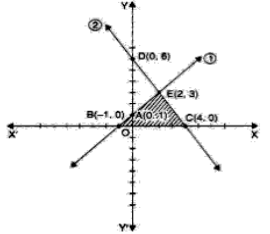
The triangular region $EBC$ has been shaded and the area of triangular region $EBC = \frac12 (5)(3)=\frac{15}{2}$ View full question & answer→Question 114 Marks
Half the perimeter of a rectangular garden, whose length is $4\ m$ more than its width, is $36\ m.$ find the dimensions of the garden.
AnswerLet the dimensions (i.e., length and width) of the garden be $x$ and $y\ m$ respectively.
Then, $x = y + 4$ and $\frac{1}{2}$
$(2x + 2y) = 36$
$\Rightarrow x - y = 4 ...(1)$
$x + y = 36 ...(2)$
Let us draw the graphs of equations $(1)$ and $(2)$ by finding two solutions for each of the equations. These two solution of the equations $(1)$ and $(2)$ are given below in table 1 and table 2 respectively.
For equation $(1)$
$x - y = 4$
$\Rightarrow y = x - 4$
Table $1$ of solutions
For equation $(2) x + y = 36$
$\Rightarrow y = 36 - x$
Table $2$ of solutions
| $x$ |
$20$ |
$16$ |
| $y$ |
$16$ |
$20$ |
We plot the points $A(4, 0)$ and $B(2, -2)$ on a graph paper and join these points to form the line $AB$ representing. The equation $(1)$ as shown in the figure.
Also, we plot the points $C(20, 16)$ and $D(16, 20)$ on the same graph paper and join these points to form the line $CD$ representing the equation $(2)$ as shown in the same figure.
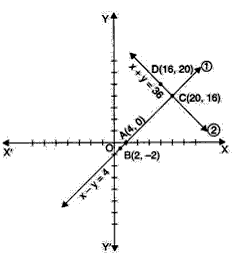
In the figure, we observe that the two lines intersect at the point $C(20, 16)$ So $x = 20, y = 16$ is the required solution of the pair of linear equations formed. i.e., the dimensions of the garden are $20\ m$ and $16\ m.$
Verification : substituting $x = 20$ and $y = 16$ in $(1)$ and $(2),$ we find that both the equations are satisfied as shown below:
$20 - 16 = 4$
$20 + 16 = 36$
This verifies the solution. View full question & answer→Question 124 Marks
Is the pair of linear equation consistent/inconsistent$?$ If consistent, obtain the solution graphically:$ 2x + y - 6 = 0; 4x - 2y - 4 = 0$
Answer$2x + y - 6 = 0 ...(1)$
$4x - 2y - 4 = 0 ...(2)$
$\text { Here, } a_1=2, b_1=1, c_1=-6 $
$ a_2=4, b_2=-2, c_2=-4$
We see that $\frac{{{a_1}}}{{{a_2}}} \ne \frac{{{b_1}}}{{{b_2}}}$
Hence, the lines represented by the equations $(1)$ and $(2)$ are intersecting.
Therefore equation $(1)$ and $(2)$ have exactly one $($unique$)$ solution i.e., the given pair of linear equation is consistent. Graphical representation. We draw the graphs of the equations $(1)$ and $(2)$ by finding two solutions for each of the equations.
These two solution of the equations $(1)$ and $(2)$ given below in table $1$ and $2$ respectively.
For equation $(1)$
$2x + y - 6 = 0$
$\Rightarrow y = -2x + 6$
Table $1$ of solutions
For equation $(2)$
$4x - 2y - 4 = 0$
$\Rightarrow 2y = 4x - 4$
$\Rightarrow y = \frac{{4x - 4}}{2} \Rightarrow y = 2x - 2$
Table $2$ of solutions
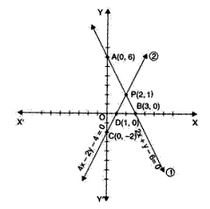
We plots the points $A(0, 6)$ and $B(3, 0)$ on a graph paper and join these points to form the line $AB$ representing the equation $(1)$ as shown in the figure.
Also. we plot the points $C(0, -2)$ and $D(1, 0)$ on the same graph paper and join these points to form the line $CD$ representing the equation $(2)$ as shown in the same figure. In the figure, we observe that the same lines intersect
at the point $P(2, 1).$ So $x = 2$ and $y = 1$ is the required unique solution of the pair of linear equations formed.
Verification : substituting $x = 2$ and $y = 1$ in $(1)$ and $(2)$ we find that both the equations are satisfied as shown below:
$2x + y - 6 = 2(2) + 2 = 6$
$4x - 2y - 4 = 4(2) - 2(2) - 4 = 0$
This verifies the solution. View full question & answer→Question 134 Marks
Is the pair of linear equation consistent/inconsistent? If consistent, obtain the solution graphically: $x + y = 5, 2x + 2y = 10$
Answer$x + y = 5 ...(1)$
$2x + 2y = 10 ...(2)$
$\text { Here, } a_1=1, b_1=1, c_1=-5$
$ a_2=2, b_2=2, c_2=-10$
We see that $\frac{{{a_1}}}{{{a_2}}} = \frac{{{b_1}}}{{{b_2}}} = \frac{{{c_1}}}{{{c_2}}}$
Hence, the lines represented by the equations $(1)$ and $(2)$ are coincident.
Therefore, equations $(1)$ and $(2)$ have infinitely many common solutions, i.e., the given pair of linear equations is consistent.
Graphical Representation, we draw the graphs of the equations $(1)$ and $(2)$ by finding two solutions for each if the equations. These two solutions of the equations $(1)$ and $(2)$ are given below in table $1$ and table $2$ respectively.
For equation $ (1) x + y = 5 \Rightarrow y = 5 - x$
Table $1$ of solutions
For equations $(2) x + 2y = 10$
$\Rightarrow 2y = 10 - 2x$
$\Rightarrow y = \frac{{10 - 2x}}{2} \Rightarrow y = 5 - x$
Table $2$ of solutions
We plot the points $A(0, 5)$ and $B(5, 0)$ on a graph paper and join these points to form the line $AB$ representing the equation $(1)$ as shown in the figure, Also, we plot the points $C(1, 4)$ and $D (2, 3)$ on the same graph paper and join these points to form the line $CD$ representing the equation $(2)$ as shown in the same figure.
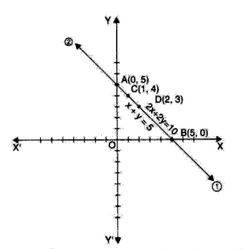
In the figure we observe that the two lines $AB$ and $CD$ coincide. View full question & answer→Question 144 Marks
Form the pair of linear equations in the problem, and find it's solution graphically.
$10$ students of class $X$ took part in Mathematics quiz. If the number of girls is $4$ more than the number of boys, find the number of boys and girls who took part in the quiz.
AnswerFormulation: Let the number of girls be $x$ and the number of boys be $y.$
It is given that total ten students took part in the quiz.
$\therefore$ Number of girls $+$ Number of boys $= 10$
i.e. $x + y =10$
It is also given that the number of girls is $4$ more than the number of boys.
$\therefore$ Number of girls= Number of boys $+\ 4$
i.e. $x = y+4$
or, $x-y = 4$
Thus, the algebraic representation of the given situation is
$x + y=10 ........(i)$
$x - y =4 ..........(ii)$
Add $(i)$ and $(ii)$ we get
$x + y + x - y = 10 + 4$
$2x = 14$
$x = 7$
Put $x = 7$ in $(i)$
$x + y = 10$
$7 + y = 10$
$y = 10 -7$
$y = 3$
So, value of $x = 7$ and $y = 3$
Graphical Representation: Now putting $y = 0$ in $x + y = 10,$ we get
$x = 10.$ Similarly, by putting $x = 0$ in $x + y = 10,$ we get $y = 10.$
Thus, two solution of equation $(i)$ are:
| $x$ |
$10$ |
$0$ |
| $y$ |
$0$ |
$10$ |
Similarly, two solutions of equation $(ii)$ are:
putting $y = 0$ in $x - y = 4,$ we get
$x = 4.$ Similarly, by putting $x = 0$ in $x + y = 10,$ we get $y = -4.$
Now, we plot the points $A (10, 0), B (0, 10), P (4, 0)$ and $Q (0, -4)$ corresponding to these solutions on the graph paper and draw the lines $AB$ and $PQ$ representing the equations $x + y = 10$ and $x - y - 4$ as shown in Fig. 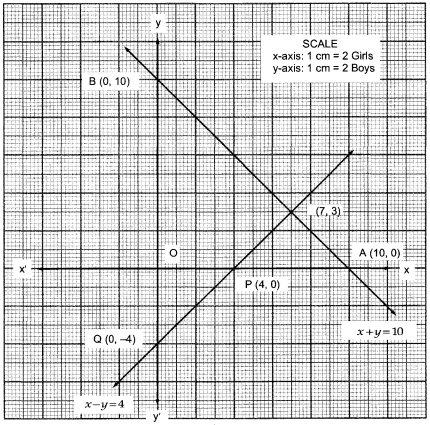
We observe that the two lines representing the two equations are intersecting at the point $(7, 3).$ View full question & answer→Question 154 Marks
The sum of a two-digit number and the number obtained by reversing the digits is $66.$ If the digits of the number differ by $2, $ find the number. How many such numbers are there$?$
AnswerSuppose, the digit at units and tens place of the given number be $x$ and $y$ respectively.
$\therefore$ the number is $10y + x$
After interchanging the digits, the number becomes $10x + y$
Given: The sum of the numbers obtained by interchanging the digits and the original number is $66.$
Thus, $(10x + y) + (10y + x) =66$
$\Rightarrow$ $10x + y + 10y + x = 66$
$\Rightarrow$ $11x +11y =66$
$\Rightarrow$ $11(x + y) = 66$
$\Rightarrow x + y = \frac{{66}}{{11}}$
$\Rightarrow$ $x + y = 6 .....(i)$
Also given, the two digits of the number are differing by $2.$
$\therefore$ we have $x - y = ±2....(ii)$
So, we have two systems of simultaneous equations,
$x - y = 2, \;x + y = 6$
$x - y = -2, \;x + y = 6$
Here x and y are unknowns. We have to solve the above systems of equations for $x$ and $y.$
- First, we solve the system
$x - y = 2$
$x + y = 6$
Adding the two equations,
$\Rightarrow(x - y) + (x + y) = 2 + 6$
$\Rightarrow$ $x - y + x + y = 8$
$\Rightarrow$ $2x = 8$
$\Rightarrow x = \frac{8}{2} $
$\Rightarrow$ $x = 4$
Substituting the value of $x$ in the first equation, we have
$4 - y = 2$
$\Rightarrow$ $y = 4 - 2$
$\Rightarrow$ $y = 2$
Hence, the number is $10 \times 2 + 4 = 24$
- Now, we solve the system
$x - y= -2$
$x + y = 6$
Adding the two equations, we have
$(x - y) + (x + y) = -2 + 6$
$\Rightarrow$ $x - y + x + y = 4$
$\Rightarrow$ $2x = 4$
$\Rightarrow x = \frac{4}{2} $
$\Rightarrow x = 2$
Substituting the value of $x$ in the first equation,
$\Rightarrow 2 - y = -2$
$\Rightarrow$ $y = 2 + 2$
$\Rightarrow y = 4$
Hence, the number is $10 \times 4 + 2 = 42$
Thus, the two numbers are $24$ and $42.$
View full question & answer→