MCQ 11 Mark
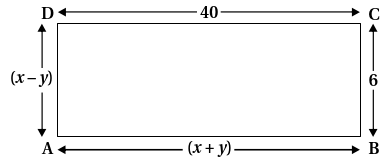
In the following figure, the measurements of side of rectangular ABCD is given. Find the values of $x$ and $y$.
- ✓
$x=23, y=17$
- B
$x=12, y=28$
- C
$x=14, y=30$
- D
$x=10, y=25$
AnswerCorrect option: A. $x=23, y=17$
$x=23, y=17$
View full question & answer→MCQ 21 Mark
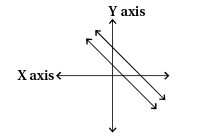
In the following graph two lines are given
- A
Their solution is infinite.
- B
The solution of pair of equations is unique.
- C
By changing one variable in 10 another variable in solving pair of linear conditions is called method of substitution.
- ✓
View full question & answer→MCQ 31 Mark
The sum of the ages of son and father before $5$ years was $30$ years. After $3$ years the sum of their ages will be ............
View full question & answer→MCQ 41 Mark
Which of the following method is used for the solution of pair of linear equations in two variables ?
MCQ 51 Mark
The ones of two digit is $x$ and tens is $y$, then the double of that digit is ..............
- A
$10 x+2 y$
- B
$2 y+20 x$
- ✓
$20 y+2 x$
- D
$2 x+10 y$
AnswerCorrect option: C. $20 y+2 x$
$20 y+2 x$
View full question & answer→MCQ 61 Mark
Kinjal is asking to Dipti that before $3$ years the sum of their ages were $36$, then tell me that after $4$ years what will be the sum of their ages?
- A
$53$ years
- B
$43$ years
- C
$39$ years
- ✓
$50$ years
AnswerCorrect option: D. $50$ years
$50$ years
View full question & answer→MCQ 71 Mark
The ones of two digit is $y$ and tens is $x$, then that number (digit) is ...........
- A
$10 y+x$
- ✓
$10 x+y$
- C
$10 x-y$
- D
$10 y-x$
AnswerCorrect option: B. $10 x+y$
$10 x+y$
View full question & answer→MCQ 81 Mark
By which number we have to multiply the equation $x+y=5$ into equation (i) and $2 x-3 y=4$ from equation to eliminate $y$ ?
View full question & answer→MCQ 91 Mark
The graph of pair of Linear equations in two variables $2 x+3 y-9=0$ and $4 x+6 y-18=0$ is
View full question & answer→MCQ 101 Mark
Which one of the following shows the coinciding lines?
MCQ 111 Mark
Which one is true for the linear pair of equation's graph when we have two intersecting lines and unique solution ?
- ✓
$\frac{a_1}{a_2} \neq \frac{b_1}{b_2}$
- B
$\frac{a_1}{a_2}=\frac{b_1}{b_2}$
- C
$\frac{a_1}{a_2}=\frac{b_1}{b_2}=\frac{c_1}{c_2}$
- D
$\frac{a_1}{a_2}=\frac{b_1}{b_2} \neq \frac{c_1}{c_2}$
AnswerCorrect option: A. $\frac{a_1}{a_2} \neq \frac{b_1}{b_2}$
$\frac{a_1}{a_2} \neq \frac{b_1}{b_2}$
View full question & answer→MCQ 121 Mark
How we can show the pair of linear equation $\frac{x}{2}+\frac{y}{3}=1$ in a standard form ............
- A
$2 x+3 y=1$
- B
$2 x+3 y-1=0$
- C
$3 x+2 y=6$
- ✓
$3 x+2 y-6=0$
AnswerCorrect option: D. $3 x+2 y-6=0$
$3 x+2 y-6=0$
View full question & answer→MCQ 131 Mark
If $17 x+23 y=40$ and $23 x+17 y=80$, then $x+y=\ldots \ldots \ldots .$.
View full question & answer→MCQ 141 Mark
At present, the age of mother is $x$ and that of a daughter is $y$ then which one is true ?
- A
$\frac{1}{x}>\frac{1}{y}$
- B
$\frac{1}{x} \geq \frac{1}{y}$
- C
$\frac{1}{y} \geq \frac{1}{x}$
- ✓
$\frac{1}{y}>\frac{1}{x}$
AnswerCorrect option: D. $\frac{1}{y}>\frac{1}{x}$
$\frac{1}{y}>\frac{1}{x}$
View full question & answer→MCQ 151 Mark
The equation of line which is coincident to the line $x+2 y-4=0$ is ..............
- A
$2 x+4 y-4=0$
- ✓
$3 x+6 y-12=0$
- C
$2 x+y-4=0$
- D
$x+4 y-8=0$
AnswerCorrect option: B. $3 x+6 y-12=0$
$3 x+6 y-12=0$
View full question & answer→MCQ 161 Mark
In a two digit number, the sum of the digits is equal to the product of the digits Find the number.
MCQ 171 Mark
The equation of line which is parallel to the line $2 x+3 y-8=0$ is ...............
- ✓
$4 x+6 y-12=0$
- B
$2 x-3 y+8=0$
- C
$x+2 y-4=0$
- D
$6 x+9 y-2 y=0$
AnswerCorrect option: A. $4 x+6 y-12=0$
$4 x+6 y-12=0$
View full question & answer→MCQ 181 Mark
$\quad 2 x-3 y=7$ and $(a+b) x-(a+b-3) y=4 a+b$ represent the same lines then ..............
- A
$a+5 b=0$
- B
$5 a+b=d$
- ✓
$a-5 b=0$
- D
$5 a-b=0$
AnswerCorrect option: C. $a-5 b=0$
$a-5 b=0$
View full question & answer→MCQ 191 Mark
If $a m \neq b l$ then the equations $a x+b y=0$ and $l x+m y=n$ have ............... solution.
View full question & answer→MCQ 201 Mark
If the solution set of the equations $p x+3 y=p-3$ and $12 x+p y=p$ is an infinite set then $p=$ ...............
View full question & answer→MCQ 211 Mark
If the linear equations in two Variables are consistent, then the lines are
- A
- B
- C
- ✓
Intersecting or coincident
AnswerCorrect option: D. Intersecting or coincident
Intersecting or coincident
View full question & answer→MCQ 221 Mark
The graph of the equations $5 x-3 y+9=0$ and $10 x-6 y+18=0$ represents .............. lines.
View full question & answer→MCQ 231 Mark
If the graph of the equations $a_1 x+b_1 y+c_1=0$ and $a_2 x+b_2 y+c_2=0$ is two parallel lines then out of the following which is true .........
- A
$\frac{a_1}{a_2} \neq \frac{b_1}{b_2}$
- ✓
$\frac{a_1}{a_2}=\frac{b_1}{b_2} \neq \frac{c_1}{c_2}$
- C
$\frac{a_1}{a_2}=\frac{b_1}{b_2}=\frac{c_1}{c_2}$
- D
AnswerCorrect option: B. $\frac{a_1}{a_2}=\frac{b_1}{b_2} \neq \frac{c_1}{c_2}$
$\frac{a_1}{a_2}=\frac{b_1}{b_2} \neq \frac{c_1}{c_2}$
View full question & answer→MCQ 241 Mark
Out of the following, which is true for $a x+b y+c=0$ ..........
- A
$a, b=0$
- B
$a+b=0$
- ✓
$a^2+b^2 \neq 0$
- D
$a^2+b^2=0$
AnswerCorrect option: C. $a^2+b^2 \neq 0$
$a^2+b^2 \neq 0$
View full question & answer→MCQ 251 Mark
Out of the following, which is the solution of the equation $2 x+3 y=7=$ ............... .
- A
$(1,2)$
- ✓
$(2,1)$
- C
$(-1,-2)$
- D
$(-2,-1)$
AnswerCorrect option: B. $(2,1)$
$(2,1)$
View full question & answer→MCQ 261 Mark
Graphical form is _______ of $2 x-4 y=6$ and $4 x-8 y=12$.
View full question & answer→MCQ 271 Mark
If $\frac{a_1}{a_2}=\frac{b_1}{b_2}=\frac{c_1}{c_2}$ in a pair of linear equations in two variables then equation has solutions.
View full question & answer→MCQ 281 Mark
In $ a_1 x+b_1 y+c_1=0$ and $a_2 x+b_2 y+c_2=0$ _______ relation can get infinite many solutions.(where, $a_1^2+b_i^2 \neq 0$ )
- A
$\frac{a_1}{a_2} \neq \frac{b_1}{b_2} \neq \frac{c_1}{c_2}$
- ✓
$\frac{a_1}{a_2}=\frac{b_1}{b_2}=\frac{c_1}{c_2}$
- C
$\frac{a_1}{a_2}=\frac{b_1}{b_2} \neq \frac{c_1}{c_2}$
- D
$\frac{a_1}{a_2} \neq \frac{b_1}{b_2}=\frac{c_1}{c_2}$
AnswerCorrect option: B. $\frac{a_1}{a_2}=\frac{b_1}{b_2}=\frac{c_1}{c_2}$
$\frac{a_1}{a_2}=\frac{b_1}{b_2}=\frac{c_1}{c_2}$
View full question & answer→MCQ 291 Mark
In pair of linear equations in two variables $\frac{a_1}{a_2}=\frac{b_1}{b_2} \neq \frac{c_1}{c_2}$ then its graphical form is _______.
View full question & answer→MCQ 301 Mark
In pair of linear equations in two variables $\frac{a_1}{a_2} \neq \frac{b_1}{b_2}$ then, its graphical form is _______ .
View full question & answer→MCQ 311 Mark
If for a pair of linear equation $\frac{a_{1}}{a_{2}} = \frac{b_{1}}{b_{2}} = \frac{c_{1}}{c_{2}}$ then, their graphs are
View full question & answer→MCQ 321 Mark
Formula to find solution of quadratic equation known as quadratic formula was given by mathematician.........
MCQ 331 Mark
Which of the following is a solution of the equation $3 x+5 y=8$ ?
- A
$x=1, y=0$
- B
$x=0, y=1$
- ✓
$x=1, y=1$
- D
$x=0, y=0$
AnswerCorrect option: C. $x=1, y=1$
(c): The given equation is $3 x+5 y=8$
(a) L.H.S. $-3(1)+5(0)-3 \neq$ R.H.S.
(b) L.H.S. $=3(0)+5(1)=5 \neq$ R.H.S
(c) L.H.S. $=3(1)+5(1)=8=$ R.H.S.
(d) L.H.S. $=3(0)+5(0)=0 \neq$ R.H.S.
$\therefore$x1, y1 is the solution of given equation.
View full question & answer→MCQ 341 Mark
Which of the following is not a solution of the equation $3 x+2 y=5$ ?
- A
$x=1, y=1$
- B
$x=3, y=-2$
- C
$x=-1, y=4$
- ✓
$x=1, y=-2$
AnswerCorrect option: D. $x=1, y=-2$
(d): The given equation is $3 x+2 y=5$
(a) L.H.S. $=3(1)+2(1)=5=$ R.H.S.
(b) L.H.S. $=3(3)+2(-2)=5-$ R.H.S.
(c) L.H.S, $=3(-1)+2(4)=5=$ R.H.S.
(d) L.H.S, $=3(1)+2(-2)=-1 \neq$ R.H.S.
$\therefore$x = 1,y = 2 is not the solution of the given equation.
View full question & answer→MCQ 351 Mark
$x=3, y=4$ is a solution of the linear equation
- A
$2 x+3 y-17=0$
- ✓
$3 x+2 y-17=0$
- C
$2 x-3 y+17=0$
- D
$2 x+3 y+17=0$
AnswerCorrect option: B. $3 x+2 y-17=0$
(b) : (a) L.H.S. $=2(3)+3(4)-17=1 \neq$ R.H.S.
(b) L.H.S. $-3(3)+2(4)-17=0=$ R.H.S.
(c) L.H.S. $=2(3)-3(4)+17=11 \neq$ R.H.S.
(d) L.H.S. $=2(3)+3(4)+17=35 \neq$ R.H.S.
$\therefore$x3,y 4 is the solution of the equation 3x+2y-17-0
View full question & answer→MCQ 361 Mark
$x=2, y=1$ is a solution of the linear equation
- ✓
$2 x+7 y=11$
- B
$4 x-2 y=5$
- C
$x-3 y=5$
- D
$3 x-4 y=8$
AnswerCorrect option: A. $2 x+7 y=11$
(a) : (a) L.H.S. $=2(2)+7(1)=11=$ R.H.S.
(b) L.H.S, $-4(2)-2(1)=6 \neq$ R.H.S.
(c) L.H.S. $=2-3(1)=-1 \neq$ R.H.S.
(d) L.H.S. $=3(2)-4(1)=2 \neq$ R.H.S.
$\therefore x=2, y=1$ is the solution of the equation $2 x+7 y=11$
View full question & answer→MCQ 371 Mark
The point of intersection of the lines represented by $3 x-2 y=6$ and the $x$-axis is
- ✓
$(2,0)$
- B
$(0,-3)$
- C
$(-2,0)$
- D
$(0,3)$
AnswerCorrect option: A. $(2,0)$
(a): We have, $3 x-2 y=6$$\ldots(i)$
Equation of $x$-axis is $y=0$
Putting $y=0$ in (i), we get $3 x-2(0)=6$
$\Rightarrow x=2$
$\therefore$ Required point of intersection is $(2,0)$.
View full question & answer→MCQ 381 Mark
The value of $a$ so that the point $(3, a)$ lies on the line represented by $2 x-3 y=5$, is
- A
$\frac{1}{2}$
- ✓
$\frac{1}{3}$
- C
$-\frac{1}{2}$
- D
$-\frac{1}{3}$
AnswerCorrect option: B. $\frac{1}{3}$
Since, $(3, a)$ lies on the line $2 x-3 y=5$
$\therefore 2(3)-3(a)=5$
$\Rightarrow 6-3 a=5 $
$\Rightarrow 3 a=1 $
$\Rightarrow a=1 / 3$
View full question & answer→MCQ 391 Mark
If a pair of linear equations in two variables is inconsistent, then the lines represented by two equations are
- A
- ✓
- C
- D
intersecting or coincident
Answer(b) : When a pair of linear equations is inconsistent, then the lines represented by two equations are parallel.
View full question & answer→MCQ 401 Mark
The pair of equations $x+3 y+5=0$ and $-3 x-9 y+2=0$ has
- A
- B
- C
infinitely many solutions
- ✓
Answer(d): The given equations are $x+3 y+5=0$ and $-3 x-9 y+2=0$.
Here, $a_1=1, b_1=3, c_1=5, a_2=-3, b_2=-9, c_2=2$
Now, $\frac{a_1}{a_2}=\frac{-1}{3}, \frac{b_1}{b_2}=\frac{3}{-9}=\frac{-1}{3}$ and $\frac{c_1}{c_2}=\frac{5}{2} \Rightarrow \frac{a_1}{a_2}=\frac{b_1}{b_2} \neq \frac{c_1}{c_2}$
$\therefore \quad$ The given pair of equations has no solution.
View full question & answer→MCQ 411 Mark
The pair of equations $2 x-3 y+4=0$ and $2 x+y-6=0$ has
- ✓
- B
- C
infinitely many solutions
- D
Answer(a) : The given pair of equations is
$2 x-3 y+4=0$ and $2 x+y-6=0$
Here, $a_1=2, b_1=-3, c_1=4, a_2=2, b_2=1, c_2=-6$
Now, $\frac{a_1}{a_2}=\frac{2}{2}=1, \frac{b_1}{b_2}=\frac{-3}{1}=-3, \frac{c_1}{c_2}=\frac{4}{-6}=\frac{-2}{3}$
Since, $\frac{a_1}{a_2} \neq \frac{b_1}{b_2}$
$\therefore \quad$ The given equations has a unique solution.
View full question & answer→MCQ 421 Mark
The pair of equations $9 x+3 y+5=0$ and $6 x+2 y+7=0$ represents lines which are
- ✓
- B
intersecting at one point
- C
- D
perpendicular to each other
Answer(a): The given pair of equations is $9 x+3 y+5=0$ and $6 x+2 y+7=0$
Here, $a_1=9, b_1=3, c_1=5, a_2=6, b_2=2, c_2=7$.
$\therefore \quad \frac{a_1}{a_2}=\frac{9}{6}=\frac{3}{2}, \frac{b_1}{b_2}=\frac{3}{2}, \frac{c_1}{c_2}=\frac{5}{7}$
Since, $\frac{a_1}{a_2}=\frac{b_1}{b_2} \neq \frac{c_1}{c_2}$
$\therefore \quad$ The given pair of equations represents parallel lines.
View full question & answer→MCQ 431 Mark
The pair of equations $y=3$ and $y=8$ has
- A
- B
- C
infinitely many solutions
- ✓
Answer(d): Both the lines represented by the equations $y=3$ and $y=8$ are parallel to $x$-axis. So, parallel to each other.
$\therefore \quad$ The given pair of equations has no solution.
View full question & answer→MCQ 441 Mark
The pair of equations $x=1$ and $y=1$ represents
- A
- B
- ✓
intersecting lines which are perpendicular
- D
intersecting lines but not perpendicular
AnswerCorrect option: C. intersecting lines which are perpendicular
(c) : $x=1$ represents a line parallel to $y$-axis at a distance of 1 unit from $y$-axis and $y=1$ represents a line parallel to $x$-axis at a distance of 1 unit from $x$-axis.
$\therefore \quad$ The pair of equations intersect each other at $(1,1)$ and are perpendicular.
View full question & answer→MCQ 451 Mark
If $a m \neq b l$, then the pair of equations $a x+b y=c, l x+m y=n$
- ✓
- B
- C
has infinitely many solutions
- D
may or may not have a solution
Answer(a): Given equations of lines are $a x+b y-c=0$ and $l x+m y-n=0$.
Since, $a m \neq b l \Rightarrow \frac{a}{l} \neq \frac{b}{m}$
$\therefore$ The pair of equations has a unique solution.
View full question & answer→MCQ 461 Mark
The value of $k$ for which the system of equations $x+3 y-3=0$ and $4 x+k y+7=0$ has no solution, is
Answer(d): The given equations are $x+3 y-3=0$ and $4 x+k y+7=0$.
Here, $a_1=1, b_1=3, c_1=-3, a_2=4, b_2=k, c_2=7$
The system of equations has no solution, if
$\frac{a_1}{a_2}=\frac{b_1}{b_2} \neq \frac{c_1}{c_2} \Rightarrow \frac{1}{4}=\frac{3}{k} \Rightarrow k=12$
View full question & answer→MCQ 471 Mark
The point of the intersection of the lines $x-3=0$ and $y-5=0$ is
- A
$(-3,5)$
- ✓
$(3,5)$
- C
$(0,-5)$
- D
$(3,-5)$
AnswerCorrect option: B. $(3,5)$
(b): The given lines are
$x-3=0 \Rightarrow x=3$, which is parallel to $y$-axis. and $y-5=0 \Rightarrow y=5$, which is parallel to $x$-axis.
Hence, the lines intersect at $(3,5)$.
View full question & answer→MCQ 481 Mark
Find the conditions to be satisfied by coefficients for which the following pair of equations $a x+b y+c=0, d x+e y+f=0$ represent coincident lines.
- A
$a b=e d ; b f=c e$
- B
$a e=b d ; b c=e f$
- C
$a d=b c ; b f=c e$
- ✓
$a e=b d ; b f=c e$
AnswerCorrect option: D. $a e=b d ; b f=c e$
(d) : The given pair of equations is
$a x+b y+c=0$ and $d x+c y+f=0$
For coincident lines,
$\frac{a_1}{a_2}=\frac{b_1}{b_2}=\frac{c_1}{c_2} \Rightarrow \frac{a}{d}=\frac{b}{e}=\frac{c}{f} \Rightarrow a e=b d \text { and } b f=c e$
View full question & answer→MCQ 491 Mark
The difference between two numbers is $24$ and one number is three times the other number. Find them.
- ✓
$36,12$
- B
$30,10$
- C
$40,14$
- D
$33,11$
AnswerCorrect option: A. $36,12$
Let the two numbers be $x$ and $y$, where $x>y$.
According to the question,
$x-y=24\ldots(i)$
$\text { and } x=3 y $
$\Rightarrow x-3 y=0\ldots(ii)$
Subtracting $(ii)$ from $(i),$ we get $2 y=24 $
$\Rightarrow y=12$
$\therefore x=3 y=3 \times 12=36$
View full question & answer→MCQ 501 Mark
The larger of two complementary angles exceeds the smaller by 16 degrees. Find them.
- A
$58^{\circ}, 32^{\circ}$
- ✓
$53^{\circ}, 37^{\circ}$
- C
$64^{\circ}, 26^{\circ}$
- D
$29^{\circ}, 63^{\circ}$
AnswerCorrect option: B. $53^{\circ}, 37^{\circ}$
(b): Let the two angles be $x$ and $y$, where $x>y$.
According to the question,
$x+y=90^{\circ}\ldots(i)$
and $x-y=16^{\circ}$$\ldots(ii)$
Adding (i) and (ii), we get $2 x=106^{\circ} \Rightarrow x=53^{\circ}$
Substituting the value of $x$ in (i), we get
$y=90^{\circ}-53^{\circ}=37^{\circ}$
View full question & answer→


