Questions

1 Marks Question

🎯

Test yourself on this topic

10 questions · timed · auto-graded

Question 11 Mark
Find a quadratic polynomial, the sum and product of whose zeroes are $0,\sqrt 5 $ respectively.
Answer
Let the polynomial be $ax^2+ bx + c,$
and its zeroes be $\alpha $ and $\beta $.
Then, $\alpha + \beta = 0 = - \frac { b } { a } \text { and } \alpha \beta = \sqrt { 5 } = \frac { c } { a }$
If $a = 1,$ then $b = 0$ and $c = \sqrt { 5 }$.
So, one quadratic polynomial which fits the given conditions is $x ^ { 2 } + \sqrt { 5 }$ .
View full question & answer
Question 21 Mark
Find a quadratic polynomial of $4, 1$ as the sum and product of its zeroes respectively.
Answer
Let the polynomial be $ax^2+ bx + c,$
and is zeroes be $\alpha $ and $\beta $.
Then, $\alpha + \beta = 4 = - \frac { b } { a } \text { and } \alpha \beta = 1 = \frac { c } { a }$
If $a = 1$, then $b = -4$ and $c = 1.$
So one quadratic polynomial which fits
the given conditions is $x^2- 4x + 1.$
View full question & answer
Question 31 Mark
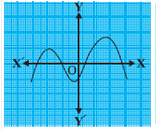
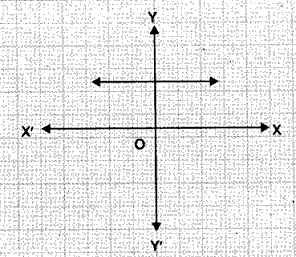
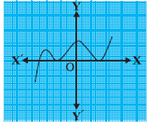
The graph of $y = p(x)$ in a figure given below, for some polynomial $p(x)$. Find the number of zeroes of $p(x)$.
Answer
The number of zeroes is $3$ as the graph given in the question intersects the $x$-axis at $3$ points.
View full question & answer
Question 41 Mark
The graph of $y = p(x)$ in a figure given below, for some polynomial $p(x)$. Find the number of zeroes of $p(x)$.
Answer
The number of zeroes is $4$ as the graph given in the question intersects the $x$-axis at $4$ points.
View full question & answer
Question 51 Mark
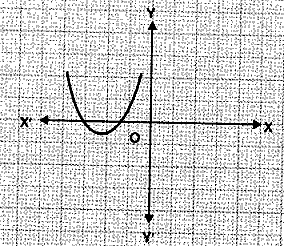
The graph of $y = p(x)$ in a figure given below, for some polynomial $p(x)$. Find the number of zeroes of $p(x)$.
Answer
The number of zeroes is $2$ as the graph intersects the $x$-axis at two points.
View full question & answer
Question 61 Mark
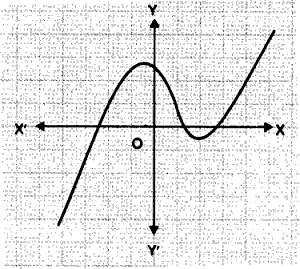
The graph of $y = p(x)$ in a figure given below, for some polynomial $p(x)$. Find the number of zeroes of $p(x)$.
Answer
The number of zeroes is $3$ as the graph intersects the $x$-axis at three points.
View full question & answer
Question 71 Mark
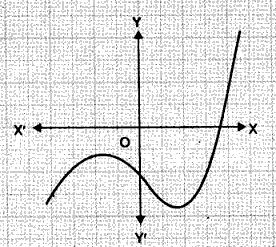
The graph of $y = p(x)$ in a figure given below, for some polynomial $p(x)$. Find the number of zeroes of $p(x)$.
Answer
The number of zeroes is $1$ as the graph intersects the $x$-axis at one point only.
View full question & answer
Question 81 Mark
The graph of $y = p(x)$ in a figure given below, for some polynomial $p(x)$. Find the number of zeroes of $p(x)$.
Answer
There is no zero as the graph does not intersect the x-axis at any point.
View full question & answer
Question 91 Mark
Find a quadratic polynomial, the sum and product of whose zeroes are $-3$ and $2$ respectively.
Answer
The standard form of quadratic polynomial be given as: $ax^2+ bx + c,$ and its zeroes will be $\alpha$ and $\beta$.
We have
$\alpha+\beta=-3=\frac{-b}{a}$
and $\alpha \beta=2=\frac{c}{a}$
If $a = 1$, then $b = 3$ and $c = 2$. So, one quadratic polynomial which fits the given conditions is $x^2+ 3x + 2$
View full question & answer
Question 101 Mark
Find a quadratic polynomial each with $1,1$ as the sum and product of its zeroes.
Answer
Sum of the polynomial, $S = 1$
Product of the polynomial, $P = 1$
$\therefore$ Required polynomial is
$p(x) = K[x^2 – Sx + P]$
$= x^2 – 1x + 1$
$p(x) = x^2 – x + 1$
View full question & answer
1 Marks Question - Maths STD 10 Questions - Vidyadip