MCQ 11 Mark
If $\alpha$ and $\beta$ are zeroes of $P (x)=x^2-3 x+2 k$ and $\alpha+\beta=\alpha \cdot \beta$ then $k=$ _______
- A
$3$
- B
$-3$
- C
$1$
- ✓
$\frac{3}{2}$
AnswerCorrect option: D. $\frac{3}{2}$
$\frac{3}{2}$
View full question & answer→MCQ 21 Mark
In figure, the graph of a polynomial $p(x)$ is shown. Find the number of zeroes of $p(x)$.
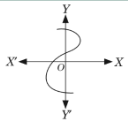
Answer(b) : The number of zeroes of the polynomial $p(x)$ is one, as the graph intersects the $x$-axis at only one point.
View full question & answer→MCQ 31 Mark
In the figure, graph of a polynomial $p(x)$ is given. Find the zeroes of $p(x)$.
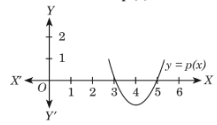
Answer(b) : Since, the graph of the polynomial $p(x)$ intersects the $x$-axis at two points i.e, $x=3$ and $x=5$. Therefore, 3 and 5 are the zeroes of $p(x)$.
View full question & answer→MCQ 41 Mark
The number of zeroes of the polynomial shown in the graph are
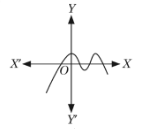
Answer(b) : The number of zeroes of the polynomial shown in the graph is four, as the graph intersects the $x$-axis at four distinct points.
View full question & answer→MCQ 51 Mark
In the given figure, the number of zeroes of the polynomial $f(x)$ are
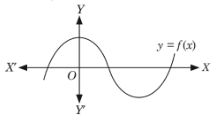
Answer(c) : The number of zeroes of the polynomial $f(x)$ is 3 , as the graph intersects the $x$-axis at three distinct points.
View full question & answer→MCQ 61 Mark
The number of zeroes lying between -4 and 4 of the polynomial $f(x)$ whose graph is given, is
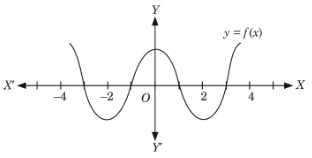
Answer(c) : The number of zeroes of the polynomial $f(x)$ lying between -4 and 4 is 4 . As between -4 and 4 , the graph intersects the $x$-axis at four distinct points.
View full question & answer→MCQ 71 Mark
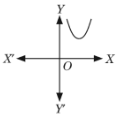
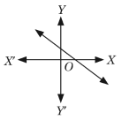
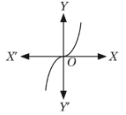
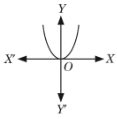
Which of the following figure represents the graph of linear polynomial?
Answer(b) : We know, graph of linear polynomial is a straight line. Only in option (b), the graph is a straight line. So, it represents linear polynomial
View full question & answer→MCQ 81 Mark
The zeroes of the quadratic polynomial $x^2+25 x+156$ are
- A
- ✓
- C
one positive and one negative
- D
Answer(b) : Let $\alpha$ and $\beta$ be the zeroes of $x^2+25 x+156$.
Then, $\alpha+\beta=-25$ and $\alpha \beta=156$
This happens when $\alpha$ and $\beta$ are both negative.
View full question & answer→MCQ 91 Mark
If one root of the polynomial $f(x)=3 x^2+11 x+p$ is reciprocal of the other, then the value of $p$ is
Answer(b) : Let $\alpha$ and $\frac{1}{\alpha}$ be the roots of $f(x)=3 x^2+11 x+p$
$\therefore \quad$ Product of roots $=\alpha \cdot \frac{1}{\alpha}=\frac{p}{3} \Rightarrow p=3$
View full question & answer→MCQ 101 Mark
If the sum of the zeroes of the quadratic polynomial $k x^2+4 x+3 k$ is equal to their product, then the value of $k$ is
- A
$-\frac{3}{4}$
- B
$\frac{3}{4}$
- C
$\frac{4}{3}$
- ✓
$-\frac{4}{3}$
AnswerCorrect option: D. $-\frac{4}{3}$
(d) : Let $\alpha$ and $\beta$ be the zeroes of polynomial $k x^2+4 x+3 k$
According to question,
$\alpha+\beta=\alpha \beta \Rightarrow-\frac{4}{k}=\frac{3 k}{k} \Rightarrow-\frac{4}{k}=3 \Rightarrow k=-\frac{4}{3}$
View full question & answer→MCQ 111 Mark
The zeroes of the quadratic polynomial $x^2+k x+k$, where $k>0$
Answer(b) : Let $\alpha$ and $\beta$ be the zeroes of $x^2+k x+k$.
Then, $\alpha+\beta=-k$ and $\alpha \beta=k$.
This is possible only when $\alpha$ and $\beta$ are both negative.
View full question & answer→MCQ 121 Mark
If $\alpha, \beta$ are the zeroes of $f(x)=2 x^2+8 x-8$, then
- ✓
$\alpha+\beta=\alpha \beta$
- B
$\alpha+\beta>\alpha \beta$
- C
$\alpha+\beta<\alpha \beta$
- D
$\alpha+\beta+\alpha \beta=0$
AnswerCorrect option: A. $\alpha+\beta=\alpha \beta$
(a) : Since $\alpha, \beta$ are the zeroes of $2 x^2+8 x-8$.
$\therefore \alpha+\beta=-\frac{8}{2}=-4 \text { and } \alpha \beta=-\frac{8}{2}=-4$
Hence, $\alpha+\beta=\alpha \beta$
View full question & answer→MCQ 131 Mark
The sum and product of zeroes of a quadratic polynomial are 0 and $\sqrt{3}$ respectively. The quadratic polynomial is
- A
$x^2-\sqrt{3}$
- ✓
$x^2+\sqrt{3}$
- C
$x^2-3$
- D
$x^2+3$
AnswerCorrect option: B. $x^2+\sqrt{3}$
(b) : It is given that sum of zeroes $=0$
Product of zeroes $=\sqrt{3}$
$\therefore \quad$ The required polynomial is $x^2$ - (sum of the zeroes) $x$+ (product of the zeroes)
$=x^2-(0) x+\sqrt{3} \text { i.e., } x^2+\sqrt{3}$
View full question & answer→MCQ 141 Mark
If the sum of the zeroes of the polynomial $p(x)=\left(p^2-23\right) x^2-2 x-12$ is 1 , then $p$ takes the value(s) are
AnswerCorrect option: D. $\pm 5$
(d) : Let $\alpha$ and $\beta$ be the zeroes of the polynomial $p(x)=\left(p^2-23\right) x^2-2 x-12$.
Then $\alpha+\beta=-\frac{(-2)}{p^2-23}=\frac{2}{p^2-23}$
Also, sum of zeroes $=\alpha+\beta=1$[Given]
$\Rightarrow p^2-23=2 \Rightarrow p^2=25 \Rightarrow p= \pm 5$
View full question & answer→MCQ 151 Mark
The zeroes of the polynomial $x^3-x$ are
- A
$0, \pm 2$
- ✓
$0, \pm 1$
- C
$0, \pm 3$
- D
$0, \pm 4$
AnswerCorrect option: B. $0, \pm 1$
(b) : Let $f(x)=x^3-x$
$
=x\left(x^2-1\right)=x(x-1)(x+1)
$
$f(x)$ is zero, when $x=0$ or $x-1=0$ or $x+1=0$
i.e., $x=0,1,-1$.
View full question & answer→MCQ 161 Mark
If one of the zeroes of the quadratic polynomial $b x^2+c x+d$ is 0 , then the other zero is
- A
$-\frac{b}{d}$
- ✓
$-\frac{c}{b}$
- C
$\frac{b}{d}$
- D
$\frac{c}{b}$
AnswerCorrect option: B. $-\frac{c}{b}$
(b): Let $\alpha, \beta$ be the zeroes of $b x^2+c x+d$.
$\therefore$ Sum of zeroes $=-\frac{c}{b}$
Now one zero $=0$ [Given]
$\therefore \quad$ Other zero $=-\frac{c}{b}$
View full question & answer→MCQ 171 Mark
The zeroes of polynomial $x^2-5 x+6$ are
Answer(c) : The given polynomial is $x^2-5 x+6$$
=x^2-3 x-2 x+6=(x-3)(x-2)$
So, $x^2-5 x+6=0$ when $x=3$ or $x=2$.
Hence, zeroes of $x^2-5 x+6$ are 3 and 2 .
View full question & answer→MCQ 181 Mark
For what value of $p, 1$ is a zero of the polynomial $f(x)=2 x^2+5 x-(3 p+1) ?$
AnswerSince $1$ is a zero of the polynomial
$f(x)=2 x^2+5 x-(3 p+1)$ then $f(1)=0$
$\text { i.e., } 2(1)^2+5(1)-(3 p+1)=0$
$\Rightarrow 2+5-3 p-1=0$
$\Rightarrow p=2$
View full question & answer→MCQ 191 Mark
The zeroes of the polynomial $f(x)=x^2-2 \sqrt{2} x-16$ are
AnswerCorrect option: B. $4 \sqrt{2},-2 \sqrt{2}$
The zeroes of $f(x)=x^2-2 \sqrt{2} x-16$ are given by
$f(x)=0 \text { i.e., } x^2-2 \sqrt{2} x-16=0$
$\Rightarrow x^2-4 \sqrt{2} x+2 \sqrt{2} x-16=0$
$\Rightarrow x(x-4 \sqrt{2})+2 \sqrt{2}(x-4 \sqrt{2})=0$
$\Rightarrow \quad(x+2 \sqrt{2})(x-4 \sqrt{2})=0$
$\Rightarrow x=4 \sqrt{2} \text { or } x=-2 \sqrt{2}$
View full question & answer→MCQ 201 Mark
The zeroes of the polynomial $f(x)=x^2+x-\frac{3}{4}$ are
- A
$-\frac{1}{2}, \frac{3}{2}$
- ✓
$\frac{1}{2},-\frac{3}{2}$
- C
$1,-\frac{3}{2}$
- D
$1, \frac{\sqrt{3}}{2}$
AnswerCorrect option: B. $\frac{1}{2},-\frac{3}{2}$
The zeroes of the polynomial $f(x)=x^2+x-\frac{3}{4}$ are given by $f(x)=0$.
$\Rightarrow x^2+x-\frac{3}{4}=0 $
$\Rightarrow 4 x^2+4 x-3=0$
$\Rightarrow 4 x^2+6 x-2 x-3=0 $
$\Rightarrow 2 x(2 x+3)-1(2 x+3)=0$
$\Rightarrow(2 x-1)(2 x+3)=0 $
$\Rightarrow 2 x-1=0 \text { or } 2 x+3=0$
$\Rightarrow x=\frac{1}{2} \text { or } x=-\frac{3}{2} .$
View full question & answer→MCQ 211 Mark
If one zero of the quadratic polynomial $2 x^2-8 x-m$ is $5 / 2$, then find the other zero.
- A
$\frac{1}{2}$
- ✓
$\frac{3}{2}$
- C
$\frac{-3}{2}$
- D
$\frac{-1}{2}$
AnswerCorrect option: B. $\frac{3}{2}$
Let $\alpha, \beta$ be two zeroes of $2 x^2-8 x-m$, where $\alpha=5 / 2$.
$\therefore \alpha+\beta=\frac{(- \text { Coefficient of } x)}{\text { Coefficient of } x^2}$
$\Rightarrow \frac{5}{2}+\beta=\frac{8}{2} $
$\Rightarrow \beta=\frac{8}{2}-\frac{5}{2}=\frac{3}{2}
$
View full question & answer→MCQ 221 Mark
If one of the zeroes of the quadratic polynomial $(k-1) x^2+k x+1$ is -3 , then the value of $k$ is
- ✓
$\frac{4}{3}$
- B
$\frac{-4}{3}$
- C
$\frac{2}{3}$
- D
$\frac{-2}{3}$
AnswerCorrect option: A. $\frac{4}{3}$
(a) : Let $p(x)=(k-1) x^2+k x+1$
Given that, one of the zeroes is -3 , then $p(-3)=0$
$\begin{aligned} & \Rightarrow \quad(k-1)(-3)^2+k(-3)+1=0 \\ & \Rightarrow 9(k-1)-3 k+1=0 \Rightarrow 6 k-8=0 \Rightarrow k=4 / 3\end{aligned}$
View full question & answer→MCQ 231 Mark
If zeroes of the quadratic polynomial $a x^2+b x+c, c \neq 0$ are equal, then
- A
$c$ and $a$ have opposite signs
- B
$c$ and $b$ have opposite signs
- ✓
$c$ and $a$ have the same sign
- D
$c$ and $b$ have the same sign
AnswerCorrect option: C. $c$ and $a$ have the same sign
(c) : The zeroes of the given quadratic polynomial $a x^2+b x+c$ where $c \neq 0$, are equal, if coefficient of $x^2$ and constant term have the same sign i.e. $c$ and $a$ have the same sign. While $b$ i.e, coefficient of $x$ can be positive or negative but not zero.
View full question & answer→MCQ 241 Mark
If one of the zeroes of a quadratic polynomial of the form $x^2+a x+b$ is negative of the other. then it
- ✓
has no linear term and the constant term is negative.
- B
has no linear term and the constant term is positive.
- C
can have a linear term but the constant term is negative.
- D
can have a linear term but the constant term is positive.
AnswerCorrect option: A. has no linear term and the constant term is negative.
(a) : Let $p(x)=x^2+a x+b$
and by given condition the zeroes are $\alpha$ and $-\alpha$ (say)
$\therefore$ Sum of the zeroes $=\alpha-\alpha=0$
$\Rightarrow a=0 \Rightarrow p(x)=x^2+b$, which cannot be linear and product of zeroes $=\alpha(-\alpha)=b \Rightarrow-\alpha^2=b$
which is only possible when $b<0$.
Hence, it has no linear term and the constant term is negative.
View full question & answer→MCQ 251 Mark
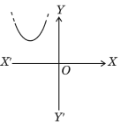
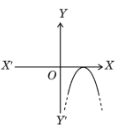
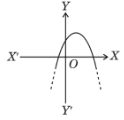
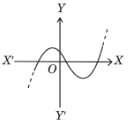
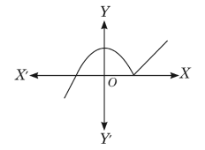
Which of the following is not the graph of a quadratic polynomial?
Answer(d) : For any quadratic polynomial $a x^2+b x+c, a \neq 0$, the graph of the corresponding equation $y=a x^2+b x+c$ has one of the two shapes either open upwards like $\cup$ or open downwards like $\cap$ depending on whether $a>0$ or $a<0$. So, option (d) cannot be possible.
Also, the curve of a quadratic polynomial crosses the $x$-axis at most two point but in option (d), the curve crosses the $x$-axis at the three points, so it does not represent the quadratic polynomial.
View full question & answer→MCQ 261 Mark
Is $x=-2$ a zero of the polynomial $p(x)=x^2-2 x+8$ ?
AnswerIf $x=-2$ is a zero of $p(x)=x^2-2 x+8$, then $p(-2)$
$=0$.
$\therefore p(-2)=(-2)^2-2(-2)+8$
$=4+4+8=16 \neq 0$
Thus, $x=-2$ is not a zero of $p(x)$.
View full question & answer→MCQ 271 Mark
If $1$ is a zero of the polynomial $p(x)=a x^2-3(a-1) x-1$, then find the value of $a$.
AnswerSince it is given that, 1 is a zero of polynomial
$p(x)=a x^2-3(a-1) x-1 . $
$\therefore p(1)=0$
$\Rightarrow p(1)=a(1)^2-3(a-1)(1)-1=0$
$\Rightarrow a-3 a+3-1=0 $
$\Rightarrow-2 a=-2 $
$\Rightarrow a=1$
View full question & answer→MCQ 281 Mark
If one zero of the polynomial $x^2-5 x+3+\sqrt{3}$ is $2+\sqrt{3}$, then the other zero is
- A
$1-\sqrt{3}$
- B
$2-\sqrt{3}$
- ✓
$3-\sqrt{3}$
- D
$2+\sqrt{3}$
AnswerCorrect option: C. $3-\sqrt{3}$
Let $\alpha$ and $\beta$ be two zeroes of polynomial
$x^2-5 x+3+\sqrt{3}$
$\therefore \alpha+\beta=-\frac{(-5)}{1} $
$\Rightarrow 2+\sqrt{3}+\beta=5\ [\because \alpha=2+\sqrt{3} \text { (Given) }]$
$\Rightarrow \beta=5-2-\sqrt{3}=3-\sqrt{3}$
View full question & answer→MCQ 291 Mark
If $\alpha, \beta$ are the zeroes of the polynomial $2 y^2+5 y+3$, then the value of $\alpha+\beta+\alpha \beta$ is
Answer(d): Since $\alpha, \beta$ are the zeroes of the polynomial $2 y^2+5 y+3$
$\therefore \quad \alpha+\beta=-\frac{5}{2}$ and $\alpha \beta=\frac{3}{2}$
Now, $\alpha+\beta+\alpha \beta=-\frac{5}{2}+\frac{3}{2}=\frac{-5+3}{2}=\frac{-2}{2}=-1$
View full question & answer→MCQ 301 Mark
If the product of zeroes of the quadratic polynomial $f(x)=x^2-4 x+k$ is $3 ,$ then the value of $k$ is
AnswerThe given polynomial is $f(x)=x^2-4 x+k$
$\therefore$ Product of zeroes $=\frac{k}{1}=3$
$[\because$ Product of zeroes $=3 \text { (Given)] }$
$\Rightarrow k=3$
View full question & answer→MCQ 311 Mark
If the product of zeroes of the polynomial $a x^2-6 x-6$ is $4 ,$ then the value of $'a\ '$ is
- A
$\frac{2}{3}$
- B
$\frac{3}{2}$
- ✓
$\frac{-3}{2}$
- D
$-\frac{2}{3}$
AnswerCorrect option: C. $\frac{-3}{2}$
The given polynomial is $a x^2-6 x-6$
$\therefore$ Product of its zeroes $=-\frac{6}{a}$
$\Rightarrow \frac{-6}{a}=4 \ [\because$ Product of zeroes $=4 \text { (Given) }]$
$\Rightarrow a=-\frac{3}{2}$
View full question & answer→MCQ 321 Mark
If $\alpha$ and $\beta$ are the zeroes of the polynomial $2 x^2+4 x+5$, then find the value of $\alpha^3+\beta^3$.
Answer(b) : Given $\alpha$ and $\beta$ are the zeroes of $2 x^2+4 x+5$.
$\Rightarrow \alpha+\beta=-\frac{4}{2}=-2 \text { and } \alpha \beta=\frac{5}{2}$
Now, $\left(\alpha^3+\beta^3\right)=(\alpha+\beta)^3-3 \alpha \beta(\alpha+\beta)$$
=(-2)^3-3 \times \frac{5}{2} \times(-2)=-8+15=7$
View full question & answer→MCQ 331 Mark
Find the other zero of the polynomial $f(x)=x^2-7 x-8$, if one of the zeroes is -1 .
Answer(a) : We have, $f(x)=x^2-7 x-8$
Now, sum of the zeroes $=7$
Since one of the zeroes is -1 .
$\therefore$ Other zero $=7-(-1)=7+1=8$
View full question & answer→MCQ 341 Mark
Degree of polynomial $y^3-2 y^2-\sqrt{3} y+\frac{1}{2}$ is
Answer(c) : Degree is 3 , because it is the highest power of variable in the polynomial $y^3-2 y^2-\sqrt{3} y+\frac{1}{2}$.
View full question & answer→MCQ 351 Mark
The value of $k$ such that the quadratic polynomial $x^2-(k+6) x+2(2 k+1)$ has sum of the zeroes as half of their product, is
Answer(d) : $\alpha+\beta=\frac{-\{-(k+6)\}}{1}=k+6$
$
\alpha \beta=\frac{2(2 k+1)}{1}=2(2 k+1)$
But $\frac{\alpha \beta}{2}=\alpha+\beta($ Given $) \Rightarrow \frac{2(2 k+1)}{2}=k+6 \Rightarrow k=5$
View full question & answer→MCQ 361 Mark
If one zero of the polynomial $f(x)=\left(k^2+4\right) x^2+13 x+4 k$ is reciprocal of the other, then $k$ is equal to
AnswerLet $\alpha$ and $1 / \alpha$ be the roots of
$ f(x)=\left(k^2+4\right) x^2+13 x+4 k$
where $\alpha+\frac{1}{\alpha}=\frac{-13}{k^2+4} \ldots (i)$ and $\alpha \cdot \frac{1}{\alpha}=\frac{4 k}{k^2+4}..(ii)$
From $(ii),$
$k^2+4=4 k$
$\Rightarrow k^2-2 k-2 k+4=0 $
$\Rightarrow k(k-2)-2(k-2)=0$
$\Rightarrow (k-2)^2=0 $
$\therefore k=2 .$
View full question & answer→MCQ 371 Mark
The graph of $y=x^3-4 x$ cuts $x$-axis at $(-2,0)$, $(0,0)$ and $(2,0)$. The zeroes of $x^3-4 x$ are
- A
$0,0,0$
- B
$-2,2,2$
- ✓
$-2,0,2$
- D
$-2,-2,2$
AnswerCorrect option: C. $-2,0,2$
(c) : Since graph intersects $x$-axis at 3 points.
$\therefore \quad x$ coordinates of the points are zeroes.
$\Rightarrow$ zeroes are $-2,0,2$.
View full question & answer→MCQ 381 Mark
Answer(b) : Since the graph of $y=p(x)$ intersects the $x$-axis at 2 points. So, the number of zeroes of $p(x)$ is 2 .
View full question & answer→MCQ 391 Mark
It the sum of the zeroes of a polynomial is $-\frac{1}{6}$ and product of the zeroes of the polynomial is -2 , then the polynomial is
- A
$x^2-\frac{1}{6} x-2$
- B
$x^2+\frac{1}{6} x+2$
- ✓
$x^2+\frac{1}{6} x-2$
- D
AnswerCorrect option: C. $x^2+\frac{1}{6} x-2$
(c) : It is given that, sum of zeroes $=-\frac{1}{6}$ and product of zeroes $=-2$.
Hence, the required polynomial is $x^2$ (sum of zeroes) $x$+ (product of zeroes)
$=x^2-\left(-\frac{1}{6}\right) x+(-2)$ i.e., $x^2+\frac{1}{6} x-2$
View full question & answer→MCQ 401 Mark
If $(x-4)$ is the factor of quadratic polynomial $p(x)$ and 2 is a zero of $p(x)$, then find the polynomial $p(x)$.
- A
$x^2+6 x+8$
- ✓
$x^2-6 x+8$
- C
$x^2+x+8$
- D
$x^2-x+8$
AnswerCorrect option: B. $x^2-6 x+8$
(b) : Since 2 is a zero of quadratic polynomial $p(x)$.
$\therefore \quad(x-2)$ is a factor of $p(x)$.
$(x-4)$ is also a factor of $p(x)$.
$\therefore \quad p(x)=(x-2)(x-4)=x^2-6 x+8$
View full question & answer→MCQ 411 Mark
If $\alpha, \beta$ are the zeroes of the polynomial $x^2+5 x+c$, and $\alpha-\beta=3$, then find $c$.
Answer(c) : Since $\alpha, \beta$ are zeroes of the polynomial
$\begin{aligned}
& x^2+5 x+c \\
\therefore \quad & \alpha+\beta=-5\ldots(i)
\end{aligned}$
and $\alpha-\beta=3$(Given)$\ldots(ii)$
Solving (i) and (ii), we have $\alpha=-1$ and $\beta=-4$
Now, product of zeroes $=\alpha \beta=(-1)(-4)=4$
$\Rightarrow \quad c=4$
View full question & answer→MCQ 421 Mark
If $\alpha$ and $\beta$ be the zeroes of the polynomial $a x^2+b x+c$, then the value of $\sqrt{\frac{\alpha}{\beta}}+\sqrt{\frac{\beta}{\alpha}}$ is
- A
$b$
- ✓
$\frac{-b}{\sqrt{a c}}$
- C
$-\frac{\sqrt{b}}{a c}$
- D
$\frac{1}{a c}$
AnswerCorrect option: B. $\frac{-b}{\sqrt{a c}}$
(b) : We have, $\alpha+\beta=-b / a$ and $\alpha \beta=c / a$
$\sqrt{\frac{\alpha}{\beta}}+\sqrt{\frac{\beta}{\alpha}}=\frac{\alpha+\beta}{\sqrt{\alpha \beta}}=\frac{-\frac{b}{a}}{\sqrt{\frac{c}{a}}}=\frac{-b}{\sqrt{a c}}$
View full question & answer→MCQ 431 Mark
Twice the product of the zeroes of the polynomial $23 x^2-26 x+161$ is $14 p$. Find $p$.
Answer(a) : Product of zeroes $=161 / 23=7$
Now, $2 \times$ product of zeroes $=14 p$
$\Rightarrow 2 \times 7=14 p \quad \therefore p=\frac{14}{14} \Rightarrow p=1$
View full question & answer→MCQ 441 Mark
Zeroes of a quadratic polynomial are in the ratio $2: 3$ and their sum is 15 . The product of zeroes of this polynomial is
Answer(c) : Let zeroes of polynomial be $2 \alpha$ and $3 \alpha$
$\Rightarrow 2 \alpha+3 \alpha=15 \Rightarrow \alpha=3$
$\therefore \quad$ Zeroes are 6 and 9
Hence product of zeroes $=54$
View full question & answer→MCQ 451 Mark
The graph of a polynomial $p(x)$ cuts the $x$-axis at two places and touches it at the three places. Find the number of zeroes of $p(x)$.
Answer(d) : Total number of zeroes $=2+3=5$
View full question & answer→MCQ 461 Mark
The sum and product of zeroes of $p(x)=63 x^2-7 x-9$ are $S$ and $P$ respectively.Find the value of $27 S +14 P$.
Answer(b) : $S=-\left(\frac{-7}{63}\right)=\frac{1}{9}$ and $P=-\frac{9}{63}=-\frac{1}{7}$
$\therefore \quad 27 S+14 P=27 \times \frac{1}{9}+14 \times \frac{-1}{7}=3-2=1$
View full question & answer→MCQ 471 Mark
A quadratic polynomial has not the signal real root then its graph ...... .
Answerdoes not intersect at $X$-axis.
View full question & answer→MCQ 481 Mark
When polynomial of degree 4 is divided by quadratic polynomial then power of remainder polynomial is _________
MCQ 491 Mark
$\alpha, \beta$ and $\gamma$ are the roots of cubic polynomial $a x^3+b x^2+c x+d$ then $\frac{1}{\alpha \beta}+\frac{1}{\beta \gamma}+\frac{1}{\gamma \alpha}=\ldots \ldots$.
- ✓
$\frac{b}{d}$
- B
$\frac{d}{b}$
- C
$\frac{c}{d}$
- D
$-\frac{c}{d}$
AnswerCorrect option: A. $\frac{b}{d}$
$\frac{b}{d}$
View full question & answer→MCQ 501 Mark
Give zeroes of quadratic polynomial $x^2+2 x-15$.
View full question & answer→