Question 12 Marks
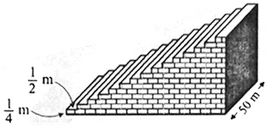
A small terrace at a football ground comprises of $15$ steps each of which is $50$ m long and built of solid concrete.
Each step has a rise of $\frac{1}{4}$m and a tread of $\frac{1}{2}$m. (see figure). Calculate the total volume of concrete required to build the terrace.
$[$Hint: Volume of concrete required to build the first step = $\frac 14 \times \frac 12 \times 50 m^3$
AnswerVolume of concrete required to build the first step, second step and third step (in $m^2$)
= $\frac{1}{4} \times \frac{1}{2} \times 50,\left( {2 \times \frac{1}{4}} \right) \times \frac{1}{2} \times 50,\left( {3 \times \frac{1}{4}} \right) \times \frac{1}{2} \times 50$
= $ \frac{{50}}{8},2 \times \frac{{50}}{8},3 \times \frac{{50}}{8},.....$
$\therefore $ Total volume of concrete required = $\frac{{50}}{8} + 2 \times \frac{{50}}{8} + 3 \times \frac{{50}}{8} + ....$
$ = \frac{{50}}{8}\left[ {1 + 2 + 3 + .......} \right]$
$S_n= \frac{{n}}{2}$ [(2a + (n - 1)d]
$S_{15}= \frac{{50}}{8} \times \frac{{15}}{2}\left[ {2 \times 1 + (15 - 1) \times 1} \right]\left[ {\because n = 15} \right]$
$ = \frac{{50}}{8} \times \frac{{15}}{2} \times 16$
$= 750 m^3$
View full question & answer→Question 22 Marks
The houses of a row are numbered consecutively from $1$ to $49$. Show that there is a value of $x$ such that the sum of the numbers of the houses preceding the house numbered $x$ is equal to the sum of the numbers of the houses following it. Find this value of $x$.
$[$Hint: $S_{x-1}= S_{49}- S_x]$
AnswerAccording to the question,we have to find the value of $x$. We are given an AP, namely $1,2,3,..., (x -1), x, (x +1),..., 49$
such that $1 + 2 + 3 +... + (x -1) = (x +1) + (x + 2) +... + 49.$
Thus, we have $S_{x-1}= S_{49}- S_x... (i)$
Using the formula, $S_n=\frac{n}{2} (a + l)$ in (i), we have,
$\frac { ( x - 1 ) } { 2 } \cdot \{ 1 + ( x - 1 ) \} = \frac { 49 } { 2 } \cdot ( 1 + 49 ) - \frac { x } { 2 } \cdot ( 1 + x )$
$\Rightarrow$$\frac { x ( x - 1 ) } { 2 } + \frac { x ( x + 1 ) } { 2 } = 1225$
$\Rightarrow 2x^2=2450 \Rightarrow x^2=1225 \Rightarrow x=\sqrt {1225} =35$
Hence, $x = 35.$
View full question & answer→Question 32 Marks
Which term of the AP: $121, 117, 113, ....$is its first negative term?
[Hint: Find n for $a_n < 0$]
AnswerGiven: $121, 117, 113, .......$
Here $a = 121, d = 117 - 121 = 4$
Now, $a_n= a + (n - 1)d$
$= 121 + (n - 1) (-4) = 121 - 4n + 4 = 125 - 4n$
For the first negative term, $a_n < 0$
$ \Rightarrow 125 - 4n < 0 \Rightarrow 125 < 4n \Rightarrow \frac{{125}}{4} < n$
$ \Rightarrow 31\frac{1}{4} < n$
n is an integer and $n > 31\frac{1}{4}$.
Hence, the first negative term is $32^{nd}$ term
View full question & answer→Question 42 Marks
Find the sum of first $51$ terms of an $AP$ whose second and third terms are $14$ and $18$ respectively.
AnswerThe general term of an $AP$ is given by $a_n=a+(n-1)d$ and $S_n=\frac{n}{2}[2a+(n-1)d].$
Given that $a_2=14$ and $a_3=18$
So, $d=a_3-a_2=18-14=4$
Now, $a_2=14$ $\Rightarrow$a+4=14 $\Rightarrow a=10$
Also,$S_{51}=\frac{{51}}{2}[2(10)+(50)4]$
$\Rightarrow S_{51}=\frac{{51}}{2}[20+200]$
$\Rightarrow S_{51}=\frac{{51}}{2}[220]$
$\Rightarrow S_{51}=51\times110$
$\Rightarrow S_{51}=5610$
View full question & answer→Question 52 Marks
The first and the last terms of an $A.P$ are $17$ and $350$ respectively. If the common difference is $9$, how many terms are there and what is their sum?
AnswerLet their be $n$ terms in the given $AP$.
First term, $a = 17$
Last term, $l = 350$
Common difference,$ d=9$
Now, $T_n= 350$
$\Rightarrow a + (n-1)d = 350$
$\Rightarrow 17 + (n-1) 9 = 350$
$\Rightarrow (n-1)(9) = 333$
$\Rightarrow n-1 = 37$
$\Rightarrow n = 38$
Therefore,there are $38$ terms in the $AP$
Now, $S_n= \frac{n}{2}$ $[a+l]$
$\Rightarrow$ $S_{38}=$ $\frac{{38}}{2}$$ [17+350] = 19$$\times$$367 = 6973.$
View full question & answer→Question 62 Marks
In an $AP: a = 3, n = 8, s = 192$, find $d$.
AnswerHere, $a = 3$
$n = 8$
$S = 192$
We know that
$S = \frac{n}{2}[2a + (n - 1)d]$
$ \Rightarrow 192 = \frac{8}{2}\left[ {2(3) + (8 - 1)d} \right]$
$ \Rightarrow 192 = 4[6 + 7d]$
$ \Rightarrow \frac{{192}}{4} = 6 + 7d$
$ \Rightarrow $ $48 = 6 + 7d$
$ \Rightarrow $ $48 - 6 = 7d$
$ \Rightarrow $ $42 = 7d$
$ \Rightarrow $ $7d = 42$
$ \Rightarrow d = \frac{{42}}{7}$
$ \Rightarrow $ $d = 6$
View full question & answer→Question 72 Marks
Find the sum of $34 + 32 + 30 + … + 10.$
AnswerHere, $a = 34$
$d = 32 - 34 = -2$
$l = 10$
Let the number of terms of the $AP$ be $n$.
We know that,
$l = a + (n - 1)d$
$ \Rightarrow $ $10 = 34 + (n - 1) (-2)$
$ \Rightarrow $ $(n - 1) (-2) = - 24$
$ \Rightarrow $ $n - 1 = \frac{{ - 24}}{{ - 2}} = 12$
$ \Rightarrow n = 13$
Again, we know that,
${S_n} = \frac{n}{2}(a + l)$
$ \Rightarrow {S_{13}} = \frac{{13}}{2}(34 + 10)$
$ \Rightarrow {S_{13}} = 286$
Hence, the required sum is $286$.
View full question & answer→Question 82 Marks
Find the sum of the APs: $\frac{1}{{15}},\frac{1}{{12}},\frac{1}{{10}},.....$ to $11$ terms.
AnswerHere, $a = \frac{1}{{15}}$
$d = \frac{1}{{12}} - \frac{1}{{15}} = \frac{1}{{60}}$
$n = 11$
We know that
$ \Rightarrow {S_n} = \frac{n}{2}\left[ {2a + (n - 1)d} \right]$
$ \Rightarrow {S_{11}} = \frac{{11}}{2}\left[ {2\left( {\frac{1}{{15}}} \right) + (11 - 1)\left( {\frac{1}{{60}}} \right)} \right]$
$ \Rightarrow {S_{11}} = \frac{{11}}{2}\left[ {\frac{2}{{15}} + \frac{1}{6}} \right]$
$ \Rightarrow {S_{11}} = \frac{{11}}{2}\left[ {\frac{3}{{10}}} \right]$
$ \Rightarrow {S_{11}} = \frac{{33}}{{20}}$
So, the sum of the first $11$ terms of the given $AP$ is $\frac{{33}}{{20}}$.
View full question & answer→Question 92 Marks
If the $3^{rd}$ and the $9^{th}$ terms of an $AP$ are $4$ and - $8$ respectively, then which term of the given $AP$ will be zero?
AnswerIt is given that $a_3=4$ and $a_9=-8$
$a_3=a+2 d=4 .....(i)$
$a_9=a+8 d=-8 .....(ii)$
Subtracting $eq^n$ $(i)$ from $eq^n$ $(ii)$ we get;
$a + 8d - a - 2d = -8 - 4 = -12$
$6d = -12$
$d = - 2$
Substituting the value of $d$ in $\mathrm{eq}^{\mathrm{n}}$ (i), we get
$a + 2 (-2) = 4$
$a - 4 = 4$
$a = 8$
Now; $0 = a + (n - 1)d$
$0 = 8 + (n - 1)(-2)$
$(n - 1)(- 2) = - 8$
$n - 1 = 4$
$n = 5$
Thus,$5^{th}$ term of the given $AP$ is zero.
View full question & answer→Question 102 Marks
Find the number of terms in $AP. 18,$ $15\frac{1}{2}$, $13, ….., – 47.$
Answer$18,15\frac{1}{2},13,..., - 47$
Here, $a = 18$
$d = 15\frac{1}{2} - 18 = \frac{{31}}{2} - 18 = - \frac{5}{2}$
$a_n= -47$
Let the number of terms be $n$.
Then,
$a_n= -47$
$ \Rightarrow a + (n - 1)d = -47$
$ \Rightarrow 18 + (n - 1)\left( { - \frac{5}{2}} \right) = - 47$
$ \Rightarrow - \frac{5}{2}(n - 1) = - 47 - 18$
$ \Rightarrow - \frac{5}{2}(n - 1) = - 65$
$ \Rightarrow \frac{5}{2}(n - 1) = 65$
$ \Rightarrow n - 1 = \frac{{65 \times 2}}{5}$
$ \Rightarrow n - 1 = 26$
$ \Rightarrow n = 26 + 1$
$ \Rightarrow n = 27$
Hence, the number of terms of the given $AP$ is $27$.
View full question & answer→Question 112 Marks
Find the number of terms in $AP:$ $7, 13, 19, …., 205$
Answer$7, 13, 19, ...., 205$
Here $a = 7$
$d = 13 - 7 = 6$
$a_n= 205$
Let the number of terms be $n$.
Then, $a_n= 205$
$ \Rightarrow a + (n - 1)d = 205$
$ \Rightarrow 7 + (n - 1)6 = 205$
$ \Rightarrow 6(n - 1) = 205 - 7$
$ \Rightarrow 6(n - 1) = 198$
$ \Rightarrow n - 1 = \frac{{198}}{6}$
$ \Rightarrow n - 1= 33$
$ \Rightarrow n = 33 + 1$
$ \Rightarrow n = 34 $
Hence, the number of terms of the given $AP$ is $34$.
View full question & answer→Question 122 Marks
Which term of the AP$: 3, 8, 13, 18, ………..,$ is $78$
AnswerThe given AP is $3, 8, 13, 18, .....$
Here $a = 3$
$d = 8 - 3 = 5$
Let the nth term of the $AP$ be $78$.
then, $a_n= a + (n - 1) d$
$ \Rightarrow 78 = 3 + (n - 1) (5)$
$ \Rightarrow 5(n - 1) = 78 - 3$
$ \Rightarrow 5(n - 1) = 75$
$ \Rightarrow n - 1 = \frac{{75}}{5}$
$ \Rightarrow n - 1 = 15$
$ \Rightarrow n = 15 + 1$
$ \Rightarrow n = 16 $
View full question & answer→Question 132 Marks
In the $AP, –4, ?, ?, ?, ?, 6$ find the missing terms?
AnswerLet the common difference of the given $AP$ be $d$.
$a = -4$
$6th$ term $= 6$
$ \Rightarrow $ $-4 + (6 - 1)d = 6$ $\because {a_n} = a + \left| {a - 1} \right|d$
$ \Rightarrow $ $-4 + 5d = 6$
$ \Rightarrow $ $5d = 6 + 4$
$ \Rightarrow $ $5d = 10$
$ \Rightarrow d = \frac{{10}}{5}$
$ \Rightarrow $ $d = 2$
Therefore,
Second term $= -4 + 2 = -2$
Third term $= -2 + 2 = 0$
Fourth term $= 0 + 2 = 2$
Fifth term $= 2 + 2 = 4$
Hence, the missing terms are $-2, 0, 2, 4$
View full question & answer→Question 142 Marks
In the $AP, 5,?,?,$ $9\frac{1}{2}$ find the missing terms?
AnswerLet the common difference of the given $AP$ be $d$.
$a = 5$
$4th$ term $ = 9\frac{1}{2}$
$ \Rightarrow 5 + (4 - 1)d = \frac{{19}}{2}\left[ {\because {a_n} = a + (n - 1)d} \right]$
$ \Rightarrow 3d = \frac{{19}}{2} - 5$
$ \Rightarrow 3d = \frac{9}{2}$
$ \Rightarrow d = \frac{3}{2}$
Therefore,
Second term $ = 5 + \frac{3}{2} = \frac{{13}}{2} = 6\frac{1}{2}$
and, third term $ = \frac{{13}}{2} + \frac{3}{2} = 8$
Hence, the missing terms in the boxes are $6\frac{1}{2}$ and 8.
View full question & answer→Question 152 Marks
In the $AP, ?, 13, ?, 3$ find the missing terms?
AnswerLet the first term and the common difference of
the given $AP$ be $a$ and $d$ respectively.
Second term $= 13$
$ \Rightarrow $ $a + (2 - 1)d = 13$
$ \Rightarrow $ $a + d = 13 ....... (1)$
Fourth term $= 3$
$ \Rightarrow $ $a + (4 - 1) d = 3$
$ \Rightarrow $ $a + 3d = 3 .......... (2)$
Solving $(1)$ and $(2)$, we get
$a = 18$
$d = -5$
Therefore,
Third term $= a + (3 - 1) d$
$= a + 2d$
$= 18 + 2(-5)$
$= 18 - 10$
$= 8$
Hence, the missing terms are $18$ and $8$.
View full question & answer→Question 162 Marks
Ramkali saves $₹5$ in the first week of a year and then increased her weekly savings by $₹1.75$. If in the nth week, her weekly savings becomes $₹20.75$, then find $n$.
AnswerHere, $a = ₹ 5$
$ d=₹ 1.75 $
$ a_n=₹ 20.75$
$\text { We know that }$
$ \mathrm{a}_{\mathrm{n}}=\mathrm{a}+(\mathrm{n}-1) \mathrm{d} $
$ \Rightarrow 20.75=5+(\mathrm{n}-1) \mathrm{d} $
$ \Rightarrow(\mathrm{n}-1)(1.75)=20.75-5 $
$ \Rightarrow(\mathrm{n}-1)(1.75)=15.75 $
$ \Rightarrow n-1=\frac{15.75}{1.75} $
$ \Rightarrow \mathrm{n}-1=9 $
$ \Rightarrow \mathrm{n}=10$
Hence, the required value of $n$ is $10.$
View full question & answer→Question 172 Marks
Two $APs$ have the same common difference. The difference between their $100th$ terms is $100$, what is the difference between their $1000th$ terms?
AnswerLet the common difference of two AP's be d, their first terms as $a$ and $a'$ nth term of both the $AP's$ will be given by
$a_n= a + (n-1) d$ and
$a'_n= a' + (n - 1)d$, respectively
Now $100$ th term of 1st AP will be given by: $a_{100}= a + (100 - 1) d = a + 99d$
$100th$ term of second AP will be given by: $a'_{100}= a + (100 - 1)d = a' + 99d$
Now given, $a_{100}- a'_{100}= (a + 99d) - (a' + 99d) = 100$
$\Rightarrow a_{100}-a^{\prime}_{100}=\left(a-a^{\prime}\right)=100$
So, difference does not depend on number of terms.Thus, $a_{1000}-a_{1000}^{\prime}=100=a_{100}-a^{\prime}_{100}$,
Hence, the difference between their 1000 th terms is $100.$
View full question & answer→Question 182 Marks
Which term of the AP $: 3, 15, 27, 39, ......$ will be $132$ more than its $54^{th}$ term?
AnswerHere, first term $= a = 3$ and common difference $= d = 15 – 3 = 12$
Let nth term of the given $AP$ be $132$ more than its $54^{th}$ term, then
$a_n= a_{54}+ 132$
$\Rightarrow a + (n – 1)d = a + (54 – 1)d + 132$
$\Rightarrow (n – 1) d = (54 – 1)d + 132$
$\Rightarrow (n – 1) 12 = (53)12 + 132$
$\Rightarrow (n – 1) 12 = 768$
$\Rightarrow (n – 1) = 64$
$\Rightarrow n = 65$
Hence, the $65th$ term will be $132$ more than the $54th$ term.
View full question & answer→Question 192 Marks
The $17th$ term of an $AP$ exceeds its $10th$ term by $7$. Find the common difference.
AnswerLet the first term and the common difference of the $AP$ be $a$ and $d$ respectively.
Given that, $a_{17}= a_{10}+7$
$ \Rightarrow a + (17 - 1) d = a + (10 - 1)d + 7 [\because a_n= a +(n - 1)d]$
$ \Rightarrow a + 16d = a + 9d + 7$
$ \Rightarrow 16d - 9d = 7$
$ \Rightarrow 7d = 7$
$ \Rightarrow d = \frac{7}{7} = 1$
Hence, the common difference is $1.$
View full question & answer→Question 202 Marks
Is the given series: $0, -4, -8, -12, ....$forms an AP? If it forms an $AP$, then find the common difference d and write three more terms.
AnswerHere: $a_2-a_1=-4-0=-4$
$a_3-a_2=-8+4=-4$
$a_4-a_3=-12+8=-4$, since $a_{k+1}-a_k$ is same for all values of $k$
Hence, this is an $AP$.
The next three terms can be calculated as follows:
$ a_5=a+4 d=0+4(-4)=-16 $
$ a_6=a+5 d=0+5(-4)=-20 $
$ a_7=a+6 d=0+6(-4)=-24$
Thus, the next three terms are: $-16,-20$ and $-24$
View full question & answer→Question 212 Marks
Is this $3,3 + \sqrt 2 ,3 + 2\sqrt 2 ,3 + 3\sqrt 2$, ..... an $AP$? If it forms an $AP,$ find the common difference $d$ and write three more terms.
Answer$3,3 + \sqrt 2 ,3 + 2\sqrt 2 ,3 + 3\sqrt 2 ,....$
${a_2} - {a_1} = (3 + \sqrt 2 ) - 3 = \sqrt 2 $
${a_3} - {a_2} = (3 + 2\sqrt 2 ) - (3 + \sqrt 2 ) = \sqrt 2 $
${a_4} - {a_3} = (3 + 3\sqrt 2 ) - (3 + 2\sqrt 2 ) = \sqrt 2 $
i.e. $a_{k+1}- a_k$ is the same every time.
So, the given list of numbers forms an $AP$ with the common differenced d = $\sqrt 2 $
The next three terms are:
$(3 + 3\sqrt 2 ) + \sqrt 2 = 3 + 4\sqrt 2 ,$ $(3 + 4\sqrt 2 ) + \sqrt 2 = 3 + 5\sqrt 2 $ and $(3 + 5\sqrt 2 ) + \sqrt 2 = 3 + 6\sqrt 2 $
View full question & answer→Question 222 Marks
Is this $–10, –6, –2, 2, ....$ an AP? If it forms an $AP$, find the common difference $d$ and write three more terms.
Answer$ -10,-6,-2,2, \ldots $
$ a_2-a_1=-6-(-10)=-6+10=4 $
$ a_3-a_2=-2-(-6)=-2+6=4 $
$ a_4-a_3=2-(-2)=2+2=4$
i.e. $a_{k+1}-a_k$ is the same every time.
So, the given lists of numbers form an AP with the common difference $d=4$.
The next three terms are:
$2+4=6,6+4=10 \text { and } 10+4=14$
View full question & answer→Question 232 Marks
Is this $–1.2, –3.2, –5.2, –7.2, ….$ an $AP$? If it forms an $AP$, find the common difference $d$ and write three more terms.
Answer$-1.2, -3.2, -5.2, -7.2, ....$
$a^2-a^1=-3.2-(-1.2)=-3.2+1.2=-2.0 $
$ a^3-a^2=-5.2-(-3.2)=-5.2+3.2=-2.0 $
$ a^4-a^3=-7.2-(-5.2)=-7.2+5.2=-2.0$
i.e. $a_{k+1}- a_k$ is the same everytime, So, the given list of numbers form an $AP$ with the common differenced $d = -2.0$
The next three terms are:
$-7.2 + (-2.0) = -9.2$
$-9.2 + (-2.0) = -11.2$
and $-11.2 + (-2.0) = -13.2$
View full question & answer→Question 242 Marks
Is the given sequence: $1^2, 5^2, 7^2, 73 \ldots \ldots$ forms an $AP?$ If it forms an $AP$, then find the common difference $d$ and write the next three terms.
AnswerWe have given the numbers as follows: $1^2, 5^2, 7^2, 73 \ldots \ldots$
now find
$ a_2-a_1=5^2-1=25-1=24 $
$ a_3-a_2=7^2-5^2=49-25=24 $
$ a_4-a_3=73-7^2=73-49=24$
As, the common difference is the same. The sequence is in $A.P$.
Next three terms are: $a_5=a_4+d=73+24=97$
$ a_6=a_5+d=97+24=121 $
$ a_7=a_6+d=121+24=145$
View full question & answer→Question 252 Marks
Is this $\sqrt 2 ,\sqrt 8 ,\sqrt {18} ,\sqrt {32} ,...$ an $AP?$ If it forms an $AP$, find the common difference $d$ and write three more terms.
Answer$\sqrt 2 ,\sqrt 8 ,\sqrt {18} ,\sqrt {32} ,...$
${a_2} - {a_1} = \sqrt 8 - \sqrt 2 = 2\sqrt 2 - \sqrt 2 = \sqrt 2 $
${a_3} - {a_2} = \sqrt {18} - \sqrt 8 = 3\sqrt 2 - 2\sqrt 2 = \sqrt 2 $
${a_4} - {a_3} = \sqrt {32} - \sqrt {18} = 4\sqrt 2 - 3\sqrt 2 = \sqrt 2 $
i.e. $a_{k+1}-a_k$ is the same every time.
So, the given list of numbers forms an $AP$ with the common difference $d = \sqrt 2 .$
The next three terms are:
$\sqrt {32} + \sqrt 2 = 4\sqrt 2 + \sqrt 2 = 5\sqrt 2 = \sqrt {50} $
$5\sqrt 2 + \sqrt 2 = 6\sqrt 2 = \sqrt {72} $
and $6\sqrt 2 + \sqrt 2 = 7\sqrt 2 = \sqrt {98} $
View full question & answer→Question 262 Marks
Is the given sequence: $a^1, a^2, a^3, a^4,...$ forms an $AP?$ If it forms an $AP$, then find the common difference $d$ and write the next three terms.
AnswerHere, it is given that the exponent is increasing in each subsequent term:
$ a_4=a^4, a_3=a^3, a_2=a^2, a_1=a^1 $
$ a_2-a_1=a^2-a^1 $
$ a_3-a_2=a^3-a^2$
$ a_4-a_3=a^4-a^3$
Since, the common difference is not same, since $a_{k+1}-a_k$is not same for all values of $k$
Hence, the given sequence does not forms an AP. So,we can not find next three terms.
View full question & answer→Question 272 Marks
Is the given sequence $a, 2a, 3a, 4a,...$ forms an $AP?$ If it forms an $AP$, then find the common difference $d$ and write the next three terms.
Answerfrom the given sequence, we can have
$a_{2}-a_{1}=2 a-a=a$
$a_{3}-a_{2}=3 a-2 a=a$
$ a_{4}-a_{3}=4 a-3 a=a$
since$a_{k+1}-a_{k}$ i.e. the common difference is the same for all values of $k$
Hence, the given sequence forms an $AP$.
Now the next three terms are:
$a_5= a + 4d = a + 4a = 5a$
$a_6= a + 5d = a + 5a = 6a$
$a_7= a + 6d = a + 6a = 7a$
Next three terms are: $5a, 6a$ and $7a$
View full question & answer→Question 282 Marks
The amount of air present in a cylinder when a vacuum pump removes $\frac{1}{4}{/tex} of the air remaining in the cylinder at a time. Is this situation make an arithmetic progression and why?
AnswerLet the volume of the cylinder be 16 litres$(a_1).$
Air removed by pump = ${1 \over 4} \times 16 = 4~litres$
Air present after first removal $= 16 - 4 = 12$ litres$(a_2)$
Air again removed = ${1 \over 4} \times 12 = 3$ litres
Air present after second removal $= 12 - 3 = 9$ litres$(a_3)$
The amount of air present in the cyinder is the series
$16,12,9.....$
$ a_2-a_1=12-16=-4 $
$ a_3-a_2=9-12=-3 $
Since the difference is not same. This is not $A.P$.
View full question & answer→Question 292 Marks
The taxi fare after each km when the fare is $₹\ 15$ for the first km and $₹\ 8$ for each additional km. Is this situation make an arithmetic progression and why?
AnswerTaxi fare for $1\ km = Rs\ 15 = a_1$
Taxi Fare for $2 kms$
$= R s\ 15 + R s\ 8 = R s\ 23 = a _ { 2 }$
Taxi fare for $3 km s$
$= R s\ 23 + R s 8 = R s\ 31 = a _ { 3 }$
Taxi fare for $4\ kms$
$= R S\ 31 + R s\ 8 = R S\ 39 = a _ { 4 }$
and so on
$a _ { 2 } - a _ { 1 } = R s .23 - R s .15 = R s 8$
$a _ { 3 } - a _ { 2 } = R s 31 - R s \cdot 23 = R s 8$
$a _ { 4 } - a _ { 3 } = R s 39 - R s 31 = R s 8$ So, the arithmetic progression formed is:- i.e.,$a_{k+1}-a_k$ is the same every time.
So, this list of numbers form an arithmetic
Progression with the first term $a = Rs\ 15$ and
the common difference $d = Rs\ 8.$
View full question & answer→Question 302 Marks
Determine the $AP$ whose $3\ rd$ term is $5$ and the $7\ th$ term is $9$.
AnswerWe have
$a_3= a + (3 – 1) d = a + 2d = 5 ....(i)$
and $a_7= a + (7 – 1) d = a + 6d = 9 .....(ii)$
Solution by substitution method: Now from equation $(i)$, value of $a = 5 - 2d .....(iii)$
put value of a from equation $(iii)$ in equation $(ii)$, we get
$5 - 2d + 6d = 9$
$4d = 9 - 5$
$4d = 4$
$d = 1$
now put value of d in equation $(iii)$, we get
$a = 5 - 2\times1$
$a = 3$
Hence, the required AP is $3, 4, 5, 6, 7,...$
View full question & answer→Question 312 Marks
Which term of the A.P $21, 18, 15, . . .$ is $– 81?$ Also, is any term $0?$ Give reason for your answer.
AnswerHere, $a=21, d=18-21=-3$ and $a_n=-81$, and we have to find $n$.
As $a_n=a+(n-1) d$,
we have $-81=21+(n-1)(-3)$
$ -81=24-3 n$
$ -105=-3 n $
$ \text { So, } n=35$
Therefore, the $35\ th$ term of the given $A.P$ is $-81$ .
Next, we want to know if there is any n for which an $=0$. If such an n is there, then
$ 21+(n-1)(-3)=0$
$ \text { i.e., } 3(n-1)=21$
$ \text { i.e., } n=8$
So, the eighth term is $0$ .
View full question & answer→Question 322 Marks
Are the given numbers form an $AP?$ If they form an $AP,$ write the next two terms: $1, 1, 1, 2, 2, 2, 3, 3, 3, ...$
AnswerFrom the given numbers,we can have
$ a_2-a_1=1-1=0 $
$ a_3-a_2=1-1=0 $
$ a_4-a_3=2-1=1$
$\text { Here, } a_2-a_1=a_3-a_2 \text { but } a_3-a_2 \neq a_4-a_3$
So, the given list of numbers does not form an $AP$. Thus we cannot find two terms.
View full question & answer→Question 332 Marks
Are the given numbers form an AP? If they form an AP, write the next two terms: $ -2, 2, -2, 2, -2, ...$
AnswerFrom the given numbers,we can have
$ a_2-a_1=2-(-2)=2+2=4 $
$ a_3-a_2=-2-2=-4$
$\text { As } a_2-a_1 \neq a_3-a_2 $,
i.e. the common difference is not same, so the given list of numbers does not form an $AP$. Thus, we cannot find the next two terms.
View full question & answer→Question 342 Marks
Are the given numbers form an $AP$? If they form an $AP$, write the next two terms: $1, -1, -3, -5, ...$
AnswerFrom the given numbers, we have
$ a_2-a_1=-1-1=-2 $
$ a_3-a_2=-3-(-1)=-3+1=-2$
$ a_4-a_3=-5-(-3)=-5+3=-2$
$\text { i.e., } a_{k+1}-a_k $ is the same every time
So, the given list of numbers forms an $AP$ with the common difference $d = –2$
The next two terms are:
$-5 + (-2) = -7$ and
$-7 + (-2) = -9$
View full question & answer→Question 352 Marks
Are the given numbers form an $AP$? If they form an $AP$, write the next two terms: $4, 10, 16, 22, ...$
AnswerFrom the given numbers, we can have
$ a_2-a_1=10-4=6 $
$ a_3-a_2=16-10=6 $
$ a_4-a_3=22-16=6$
$\text { i.e., } a_{k+1}-a_k $ is the same every time
So, the given list of numbers forms an $AP$ with the common difference $d = 6.$
The next two terms are:
$22 + 6 = 28$ and
$28 + 6 = 34$
View full question & answer→Question 362 Marks
Find the sum of the first $n$ positive integers or natural numbers.
AnswerAs per the given statement we have to find $S_n= 1 + 2 + 3 +......+n$
Here $a = 1$ and the last term $l$ is $n$.
we know that, $S_{n}=\frac{n(a+l)}{2} $ or $S_{n}=\frac{n(1+n)}{2}$
So, the sum of the first n positive integers is given by
$S_{n}=\frac{n(n+1)}{2}$
View full question & answer→Question 372 Marks
How many terms of the given AP$: 24, 21, 18, . . .$ must be taken so that their sum becomes $78?$
AnswerHere it is given that $a = 24, d = 21 – 24 = –3, Sn = 78,$ We need to find $n$.
We know that $S_{n}=\frac{n}{2}[2 a+(n-1) d]$
So,$78=\frac{n}{2}[48+(n-1)(-3)]=\frac{n}{2}[51-3 n]$
or $3 n^2-51 n+156=0 $
$ n^2-17 n+52=0 $
$(n – 4)(n – 13) = 0$
$n = 4$ or $13$
Both values of $n$ are admissible. So, the number of terms is either $4$ or $13$
View full question & answer→Question 382 Marks
If the sum of the first $14$ terms of an $A.P.$ is $1050$ and its first term is $10$ find its $20^{th}$ term.
AnswerSOLUTION Given, $\mathrm{a}=10$, and $\mathrm{S}_{14}=1050$
Let the common difference of the $A.P.$ be $d$
$ \therefore \quad S_n=\frac{n}{2}[2 a+(n-1) d] $
$ \therefore \quad S_{14}=\frac{14}{2}[2 \times 10+(14-1) d] $
$ 1050=7(20+13 d) $
$ 20+13 d=\frac{1050}{7} $
$ 20+13 d=150 $
$ 13 d=150-20 $
$ 13 d=130 $
$ d=\frac{130}{13}=10 $
$ a_{20}=a+(n-1) d $
$ =10+(20-1) 10 $
$ =10+19 \times 10 $
$ =10+190 $
$ =20$
Hence, $a_{20}=200$
View full question & answer→Question 392 Marks
Find the 10th term from the last term of the A .P,:3,8,13,....,253.
AnswerThe given A.P. is 3,8,13,...,253.
Here, the first term (a) is 3, the last term (l) is 253, and the common difference (d) is 8−3=5.
The formula to find the $n^{t h}$ term from the last term is:
$n^{t h}$ term from the last =l−(n−1)d
We need to find the 10th term from the last, so n=10.
10th term from the last =253−(10−1)5
=253−(9)5
=253−45
=208
The 10th term from the last term of the A.P. is 208.
View full question & answer→