Question 13 Marks
A ladder has rungs $25\ cm$ apart. The rungs decrease uniformly in length from $45\ cm$ at the bottom to $25\ cm$ at the top. If the top and bottom rungs are $2\frac 12m$ apart, what is the length of the wood required for the rungs?
$[$Hint: Number of rungs $= \frac{250}{25} + 1]$
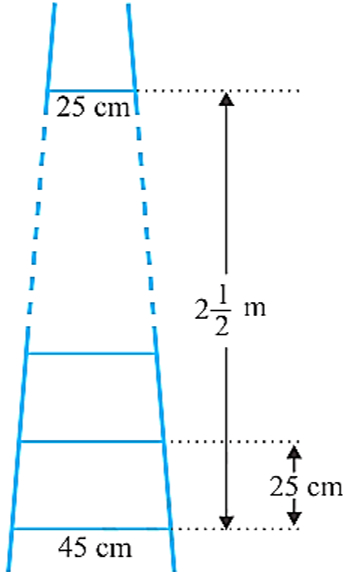
AnswerIt is given that the gap between two consecutive rungs is $25\ cm$ and the top and bottom rungs are $2.5$ metre i.e., $250 cm$ apart.
$\therefore$ Number of rungs $= \frac { 250 } { 25 } + 1 = 10 + 1 = 11.$
It is given that the rungs are decreasing uniformly in length from $45\ cm$ at the bottom to $25 cm$ at the top.
Therefore, lengths of the rungs form an A.P. with first term $a = 45\ cm$ and $11^{th}$ term $l = 25\ cm. n = 11$
$\therefore$ Length of the wood required for rungs $=$ Sum of $11$ terms of an A.P. with first term $45\ cm$ and last term is $25\ cm$
$= \frac { 11 } { 2 }( 45 + 25 )\ cm \left[ \because S _ { n } = \frac { n } { 2 } ( a + l ) \right]$
$= \frac { 11 } { 2 }(70)\ cm$
$= 11 (35)\ cm$
$= 385\ cm$
Length of the wood required for rungs $= \frac{385}{100} = 3.85$ metres $ (\because 100\ cm = 1\ m)$
The length of the wood required for the rungs is $3.85$ metres.
View full question & answer→Question 23 Marks
The sum of the third and the seventh terms of an $AP$ is $6$ and their product is $8.$ Find the sum of the first sixteen terms of the $AP.$
AnswerLet the first term and the common difference of the $AP$ be $a$ and $d$ respectively.
According to the question,
Third term $+$ seventh term $= 6$
$ \Rightarrow [a + (3 - 1)d] + [a + (7 - 1)d] = 6 = a + (n - 1)d$
$ \Rightarrow (a + 2d) + (a + 6d) = 6 \Rightarrow 2a + 8d = 6$
$ \Rightarrow a + 4d = 3 ..... (1)$
Dividing throughout by $2$ &
$($third term$) ($seventh term$) = 8$
$ \Rightarrow (a + 2d) (a + 6d) = 8$
$ \Rightarrow (a + 4d - 2d) (a + 4d + 2d) = 8$
$ \Rightarrow (3 - 2d) (3 + 2d) = 8$
$ \Rightarrow 9 - 4d^2= 8$
$ \Rightarrow 4{d^2} = 1 \Rightarrow {d^2} = \frac{1}{4} \Rightarrow d + \pm \frac{1}{2}$
Case I, when $d = \frac{1}{2}$
Then from (1), $a + 4\left( {\frac{1}{2}} \right) = 3$
$ \Rightarrow a + 2 = 3 \Rightarrow a = 3 - 2 \Rightarrow a = 1$
$\therefore $ Sum of first sixteen terms of the $AP = S_{16}$
$ = \frac{{16}}{2}[2a + (16 - 1)d]$ $\because {S_n} = \frac{n}{2}[2a + (n - 1)d]$
$= 8[2a + 15d]$
$ = 8[2(1) + 15(\frac{1}{2})]$
$ = 8[12 + \frac{{15}}{2}]$
$ = 8[\frac{{19}}{2}]$
$ = 4 \times 19 = 76$
Case II. When $d = - \frac{1}{2}$
Then from (1),
$a + 4\left( { - \frac{1}{2}} \right) = 3$
$ \Rightarrow a - 2 = 3 \Rightarrow a = 3 + 2 \Rightarrow a = 5$
$\therefore $ Sum of first sixteen terms of the $AP = S_{16}$
$ = \frac{{16}}{2}[2a + (16 - 1)d]$ $\because {S_n} = \frac{n}{2}[2a + (n - 1)d]$
$ = 8[2a + 15d] = 8\left[ {2(5) + 15\left( { - \frac{1}{2}} \right)} \right] = 8\left[ {10 - \frac{{15}}{2}} \right] = 8\left[ {\frac{5}{2}} \right] = 20$
View full question & answer→Question 33 Marks
If the sum of the first $7$ terms of an $A.P.$ is $49$ and that of the first $17$ terms is $289,$ find the sum of its first $n$ terms.
Answer$S_n=\frac n2[2a + (n - 1)d]$
$S_7= \frac 72(2a + 6d) = 49$
or, $a + 3d = 7...........(i)$
$S_{17}= \frac{17}{2}(2a + 16d) = 289$
or, $a + 8d = 17..........(ii)$
On subtracting $(i)$ from $(ii),$ we get
or, $5d = 10$ or, $d = 2$
Put $d = 2$ in $(i)$
$a + 3d = 7$
$a + 2(3) = 7$
$a + 6 = 7$
and $a = 1$
$S _ { n } = \frac { n } { 2 } [ 2 \times 1 + ( n - 1 ) 2 ]$
$= \frac { n } { 2 } [ 2 + 2 n - 2 ] $
$= \frac { n } { 2 } [ 2 n ] $
$= n ^ { 2 }$
Hence, sum of $n$ terms $= n^2$
View full question & answer→Question 43 Marks
Find the sum of first $22$ terms of an $AP$ in which $d = 7$ and $22nd$ term is $149.$
AnswerHere, $d = 7$
$a_{22}= 149$
Let the first term of the $AP$ be $a.$
We know that
$ a_n=a+(n-1) d $
$ \Rightarrow a_{22}=a+(22-1) d $
$ \Rightarrow a_{22}=a+21 d$
$ \Rightarrow 149=a+(21)(7) $
$ \Rightarrow 149=a+147 $
$ \Rightarrow a=2$
$\text { Again, we know that }$
$ S_n=\frac{n}{2}[2 a+(n-1) d]$
$ \Rightarrow S_{22}=\frac{22}{2}[2(2)+(22-1) 7]$
$ \Rightarrow S_{22}=(11)[4+147]$
$ \Rightarrow S_{22}=(11)(151) $
$ \Rightarrow S_{22}=1661$
Hence, the sum of the first $22$ terms of the $AP$ is $1661.$
View full question & answer→Question 53 Marks
The first term of an $AP$ is $5,$ the last term is $45$ and the sum is $400$. Find the number of terms and the common difference.
AnswerHere, $a = 5$
$l = 45$
$S = 400$
We know that
$S = \frac{n}{2}(a + l)$
$ \Rightarrow 400 = \frac{n}{2}(5 + 45)$
$ \Rightarrow 400 = \frac{n}{2}(50)$
$ \Rightarrow 400 - 25n$
$ \Rightarrow n = \frac{{400}}{{25}}$
$ \Rightarrow n = 16$
Hence, the number of terms is $16.$
Again, we know that
$l = a + (n - 1)d$
$ \Rightarrow 45 = 5 + (16 - 1)d$
$ \Rightarrow 45 = 5 + 15d$
$ \Rightarrow 40 = 15 d$
$ \Rightarrow d = \frac{{40}}{{15}} = \frac{8}{3}$
Hence, the common difference is $\frac{8}{3}$.
View full question & answer→Question 63 Marks
How many terms of the $AP : 9, 17, 25, …. $ must be taken to give a sum of $636?$
AnswerThe given $AP$ is $ 9, 17, 25,...$
Here, $a = 9$
$d = 17 - 9 = 8$
Let $n$ terms of the $AP$ must be taken
Then, $S_n= 636$
$ \Rightarrow \frac{n}{2}\left[ {2a + (n - 1)d} \right] = 636$
$ \Rightarrow \frac{n}{2}\left[ {2(9) + (n - 1)8} \right] = 636$
$ \Rightarrow n[9 + (n - 1)4] = 636$
$ \Rightarrow n[9 + 4n - 4] = 636$
$ \Rightarrow n[(4n + 5)] = 636$
$\Rightarrow 4 n^2+5 n-636=0 $
$ \Rightarrow 4 n^2+53 n-48 n-636=0$
$ \Rightarrow n(4n + 53) - 12(4n + 53) = 0 $
$ \Rightarrow (4n + 53) (n - 12) = 0 $
$ \Rightarrow 4n + 53 = 0 or n - 12 = 0$
$ \Rightarrow n = - \frac{{53}}{4}$ or $n = 12$
$n = - \frac{{53}}{4}$ is in admissible as n, being the number of terms, is a natural number
$\therefore n = 12$
Hence, $12$ terms of the $AP$ must be taken.
View full question & answer→Question 73 Marks
In an $AP$: $a_n= 4, d = 2, S_n= -14,$ find $n$ and $a$.
AnswerHere, $a_n= 4$
$d = 2$
$S_n= -14$
We know that
$a_n= a + (n - 1)d$
$ \Rightarrow 4 = a + (n - 1)d$
$ \Rightarrow 4 = a + 2n - 2$
$ \Rightarrow 4 + 2 = a + 2n$
$ \Rightarrow 6 = a + 2n$
$ \Rightarrow a + 2n = 6 ...... (1)$
Again, we know that
${S_n} = \frac{n}{2}\left[ {2a + (n - 1)d} \right]$
$ \Rightarrow - 14 = \frac{n}{2}\left[ {2a + (n - 1)2} \right]$
$ \Rightarrow -14 = n[a + (n - 1)]$
$ \Rightarrow -14 = n (a + n - 1)$
$ \Rightarrow -14 = n (6 - n - 1) .......$From$ (1)$, $(a + 2n = 6$ $ \Rightarrow $ $a + n = 6 - n)$
$ \Rightarrow -14 = n(-n + 5)$
$ \Rightarrow -14 = -n^2+ 5n$
$ \Rightarrow n^2- 7n + 2n - 14 = 0$
$ \Rightarrow n(n - 7) + 2(n - 7) = 0$
$ \Rightarrow (n - 7) (n + 2) = 0$
$ \Rightarrow n - 7 = 0$ or $n + 2 = 0$
$ \Rightarrow n = 7$ or $n = -2$
$ \Rightarrow n = - 2 $ is in admissible as $n$, being the number of terms, is a natural number.
$\therefore n = 7$
Putting $n = 7$ in equation $(1)$, we get
$a + 2(7) = 6$
$ \Rightarrow a + 14 = 6$
$ \Rightarrow a = 6 - 14$
$ \Rightarrow a = -8$
View full question & answer→Question 83 Marks
In an AP:$ a = 8, a_n= 62, S_n= 210,$ find $n$ and $d$.
AnswerHere, $a = 8$
$a_n= 62$
$S_n= 210$
We know that
$a_n= a + (n - 1)d$
$ \Rightarrow 62 = 8 + (n - 1)d$
$ \Rightarrow 62 - 8 = (n - 1)d$
$ \Rightarrow 54 = (n - 1)d$
$ \Rightarrow (n - 1)d = 54 ........ (1) $
Again we know that
${S_n} = \frac{n}{2}\left[ {2n + (n - 1)d} \right]$
$ \Rightarrow 210 = \frac{n}{2}\left[ {2(8) + (n - 1)d} \right]$
$ \Rightarrow 210 = \frac{n}{2}\left[ {16 + (n - 1)d} \right]$
$ \Rightarrow 210 = \frac{n}{2}\left[ {16 + 54} \right]$$ .........$ Using $(1)$
$ \Rightarrow 210 = \frac{n}{2}(70)$
$ \Rightarrow 210 = 35n$
$ \Rightarrow n = \frac{{210}}{{35}}$
$ \Rightarrow n = 6$
Putting $n = 6$ in equation $(1)$, we get
$(6 - 1)d = 54$
$ \Rightarrow 5d = 54$
$ \Rightarrow d = \frac{{54}}{5}$
View full question & answer→Question 93 Marks
In an AP: $a = 2, d = 8, S_n= 90,$ find $n$ and $a_n$.
AnswerHere,$ a = 2$
$ d=8 $
$ S_n=90$
We know that
$ S_n=\frac{n}{2}[2 a+(n-1) d] $
$ \Rightarrow 90=\frac{n}{2}[2(2)+(n-1) 8] $
$ \Rightarrow 90=n[2+(n-1) 4] $
$ \Rightarrow 90=n[2+4 n-4] $
$ \Rightarrow 90=n[4 n-2] $
$ \Rightarrow 90=2 n[2 n-1] $
$ \Rightarrow 45=n[2 n-1] $
$ \Rightarrow 45=2 n^2-n $
$ \Rightarrow 2 n^2-n-45=0 $
$ \Rightarrow 2 n^2-10 n+9 n-45=0 $
$ \Rightarrow 2 n(n-5)+9(n-5)=0 $
$ \Rightarrow(n-5)(2 n+9)=0 $
$ \Rightarrow n-5=0 \text { or } 2 n+9=0 $
$ \Rightarrow n=5 \text { or } n=-\frac{9}{2}$
$n=-\frac{9}{2}$ is in admissible as $n$, being the number of terms, is a natural number.
$\therefore \mathrm{n}=5$
Again, we know that
$ a_n=a+(n-1) d $
$ \Rightarrow a_n=2(5-1) 8 $
$ \Rightarrow a_n=2+(4) 8 $
$ \Rightarrow a_n=2+32 $
$ \Rightarrow a_n=34$
View full question & answer→Question 103 Marks
In an AP: $d = 5, S_9= 75,$ find $a$ and $a_9$.
AnswerHere, $d = 5$
$S_9= 75$
We know that
${S_n} = \frac{n}{2}\left[ {2a + (n - 1)d} \right]$
$ \Rightarrow {S_9} = \frac{9}{2}\left[ {2a + (9 - 1)d} \right]$
$ \Rightarrow {S_9} = \frac{9}{2}\left[ {2a + 8d} \right]$
$ \Rightarrow {S_9} = 9\left[ {a + 4d} \right]$
$ \Rightarrow {S_9} = 9\left[ {a + 4 \times 5} \right]$
$ \Rightarrow S_9= 9[a + 20]$
$ \Rightarrow 75 = 9a + 180$
$ \Rightarrow 9a = 75 - 180 $
$ \Rightarrow 9a = -105$
$ \Rightarrow a = - \frac{{105}}{9}$
$ \Rightarrow a = - \frac{{35}}{3}$
Again, we know that
$ a_n=a+(n-1) d$
$ \Rightarrow a_9=a+(9-1) d $
$\Rightarrow a_9=a+8 d$
$ \Rightarrow {a_9} = - \frac{{35}}{3} + 8(5)$
$ \Rightarrow {a_9} = - \frac{{35}}{3} + 40$
$ \Rightarrow {a_9} = \frac{{ - 35 + 120}}{3}$
$ \Rightarrow {a_9} = \frac{{85}}{3}$
View full question & answer→Question 113 Marks
In an AP: $\mathrm{a}_3=15, \mathrm{~S}_{10}=125$, find $d$ and $\mathrm{a}_{10}$.
AnswerHere, $a_3=15$
$\mathrm{S}_{10}=125$
We know that
$ a_n=a+(n-1) d $
$ \Rightarrow a_3=a+(3-1) d $
$ \Rightarrow a_3=a+2 d $
$ \Rightarrow 15=a+2 d $
$ \Rightarrow a+2 d=15 \ldots \ldots$
Again, we know that
$ S_n=\frac{n}{2}[2 a+(n-1) d] $
$ \Rightarrow S_{10}=\frac{10}{2}[2 a+(10-1) d] $
$ \Rightarrow S_{10}=5(2 \mathrm{a}+9 \mathrm{~d}) $
$ \Rightarrow 125=5(2 \mathrm{a}+9 \mathrm{~d}) $
$ \Rightarrow 25=2 \mathrm{a}+9 \mathrm{~d} $
$ \Rightarrow 2 \mathrm{a}+9 \mathrm{~d}=25 \ldots \ldots .$
Solving equation $(1)$ and equation $(2)$, we get
$ a=17 $
$ d=-1$
Now an $=a+(n-1) d$
$ \Rightarrow a_{10}=a+(10-1) d $
$ \Rightarrow a_{10}=a+9 d $
$ \Rightarrow a_{10}=17+9(-1) $
$ \Rightarrow a_{10}=17-9 $
$ \Rightarrow a_{10}=8$
View full question & answer→Question 123 Marks
In an $AP$: $a_{12}= 37, d = 3,$ find a and $S_{12}$.
AnswerHere,$a_{12}= 37$
$d = 3$
We know that
$a_n= a + (n - 1)d$
$ \Rightarrow a_{12}= a + (12 - 1)d$
$ \Rightarrow a_{12}= a + 11d$
$ \Rightarrow 37 = a + 33$
$ \Rightarrow a = 37 - 33 = 4$
Again, we know that
${S_n} = \frac{n}{2}\left[ {2a + (n - 1)d} \right]$
$ \Rightarrow {S_{12}} = \frac{{12}}{2}\left[ {2a + (12 - 1)d} \right]$
$ \Rightarrow {S_{12}} = 6\left[ {2a + 11d} \right]$
$ \Rightarrow {S_{12}} = 6\left[ {2 \times 4 + 11 \times 3} \right]$
$ \Rightarrow {S_{12}} = 6\left[ {8 + 33} \right]$
$ \Rightarrow {S_{12}} = 6 \times 41$
$ \Rightarrow {S_{12}} = 246$
View full question & answer→Question 133 Marks
In an AP: $a = 7, a_{13}= 35$, find $d$ and $S_{13}.$
AnswerHere, $a = 7$
$ a_{13}=35 $
$ a_n=a+(n-1) d $
$ \Rightarrow a_{13}=a+(13-1) d $
$ \Rightarrow a_{13}=a+12 d $
$ \Rightarrow 35=7+12 d $
$ \Rightarrow 12 d=35-7 $
$ \Rightarrow 12 d=28$
$ \Rightarrow d = \frac{{28}}{{12}}$
$ \Rightarrow d = \frac{7}{3}$
Again, we know that
${S_n} = \frac{n}{2}\left[ {2a + (n - 1)d} \right]$
$ \Rightarrow {S_{13}} = \frac{{13}}{2}\left[ {2a + (13 - 1)d} \right]$
$ \Rightarrow {S_{13}} = \frac{{13}}{2}\left[ {2a + 12d} \right]$
$={S_{13}} = \frac{{13}}{2}\left[ {2(7) + 12\left( {\frac{7}{3}} \right)} \right]$
$ \Rightarrow {S_{13}} = \frac{{13}}{2}(14 + 28)$
$ \Rightarrow {S_{13}} = \frac{{13}}{2}(42)$
$ \Rightarrow {S_{13}} = (13)(21)$
$ \Rightarrow {S_{13}} = 273$
View full question & answer→Question 143 Marks
In an AP: $a = 5, d = 3, a_n= 50,$ find $n$ and $S_n$.
AnswerHere, $a = 5, d = 3, a_n= 50$
We know that
$ a_n=a+(n-1) d $
$ \Rightarrow 50=5+(n-1) 3 $
$ \Rightarrow(n-1) 3=50-5 $
$ \Rightarrow(n-1) 3=45 $
$ \Rightarrow n-1=\frac{45}{3} $
$ \Rightarrow n-1=15 $
$ \Rightarrow n=15+1 $
$ \Rightarrow n=16$
$\text { Again, we know that }$
$ S_n=\frac{n}{2}[2 a+(n-1) d] $
$ \Rightarrow S_n=\frac{16}{2}[2(5)+(16-1) 3] $
$ \Rightarrow S_n=8[10+45] $
$ \Rightarrow S_n=8(55) $
$ \Rightarrow S_n=440$
View full question & answer→Question 153 Marks
Find the sum of $-5 + (-8) + (-11) + …. + (-230).$
AnswerLet $\mathrm{S}_{\mathrm{n}}=-5+(-8)+(-11)+\ldots .+(-230)$
Clearly, the terms of the sum form an $A.P.$
with, $a=-5$
$ d=-8-(-5)=-8+5=-3 $
$ l=-230$
Let the number of terms of the $AP$ be $n$
We know that
$ \mathrm{I}=\mathrm{a}+(\mathrm{n}-1) \mathrm{d} $
$ \Rightarrow-230=-5+(\mathrm{n}-1)(-3) $
$ \Rightarrow(\mathrm{n}-1)(-3)=-230+5 $
$ \Rightarrow(\mathrm{n}-1)(-3)=-225 $
$ \Rightarrow \mathrm{n}-1=\frac{-225}{-3}=75 $
$ \Rightarrow \mathrm{n}=75+1 $
$ \Rightarrow \mathrm{n}=76$
Again, we know that
$ S_n=\frac{n}{2}(a+l) $
$ \Rightarrow S_{76}=\frac{76}{2}[(-5)+(-230)] $
$ \Rightarrow S_{76}=38(-235) $
$ \Rightarrow S_{76}=-8930$
Hence, the required sum is $-8930 .$
View full question & answer→Question 163 Marks
Find the sum of $7 + 10\frac{1}{2} + 14..... + 84$.
AnswerClearly, the terms of the given sum form an $A.P,$
with, $a = 7$
$d = 10\frac{1}{2} - 7 = 3\frac{1}{2} = \frac{7}{2}$
Let the number of terms of the AP be n.
We know that
$l = a + (n - 1)d$
$ \Rightarrow 84 = 7 + (n - 1)\frac{7}{2}$
$ \Rightarrow (n - 1)\frac{7}{2} = 84 - 7$
$ \Rightarrow (n - 1)\frac{7}{2} = 77$
$ \Rightarrow (n - 1) = 22$
$ \Rightarrow n = 22 + 1$
$ \Rightarrow n = 23$
Again, we know that
${S_n} = \frac{n}{2}(a + l)$
$ \Rightarrow {S_{23}} = \frac{{23}}{2}(7 + 84)$
$ \Rightarrow {S_{23}} = \frac{{2093}}{2}$
$ \Rightarrow {S_{23}} = \frac{{2093}}{2}$
$ \Rightarrow {S_{23}} = 1046\frac{1}{2}$
Hence, the required sum is $1046\frac{1}{2}$
View full question & answer→Question 173 Marks
In a potato race, a bucket is placed at the starting point, which is $5\ m$ from the first potato, and other potatoes are placed $3\ m$ apart in a straight line. There are n potatoes in the line (See Fig.).

A competitor starts from the bucket, picks up the nearest potato, runs back with it, drops it in the bucket, runs back to pick up the next potato, runs to the bucket to drop it in, and she continues in the same way until all the potatoes are in the bucket. What is the total distance the competitor has to run?
$[$Hint: To pick up the first potato and the second potato, the total distance (in metres) run by a competitor is $2$ $ \times$ $5$ + $2$ $ \times$ $(5 + 3)]$ Answer
Let $d_1=$ Distance run by the competitor to pick up first potato $= 2 \times 5 m$
$d_2=$ Distance run by the competitor to pick up second potato $= 2 (5 + 3) m$
$d_3=$ Distance run by the competitor to pick up third potato $= 2 (5 + 2 \times 3) m$
$d_4=$ Distance run by the competitor to pick up fourth potato $= 2 (5 + 3 \times 3) m .....$
$d_n=$ Distance run by the competitor to pick up $n^{th}$ potato $= 2 {5 + (n -1) \times 3} m$
Therefore, total distance run by the competitor to pick up $n$ potatoes
$=d_1+d_2+d_3+\ldots+d_n$
$= 2 \times 5 + 2(5 + 3) + 2 (5 + 2 \times 3) + 2 (5 + 3 \times 3) +.....+2{5 + (n - 1) \times 3}$ metres
$= 2 [5 + {5 + 3} + {5 + (2 \times 3)} + {5 + (3 \times 3} +....+ {5 + (n - 1) \times 3}]$
$= 2\left[ {(5 + \mathop {5 + \cdots + }\limits_{n - times} 5) + \{ 3 + (2 \times 3) + (3 \times 3) + \cdots + (n - 1) \times 3\} } \right]$
$ = 2 [ 5 n + 3 \{ 1 + 2 + 3 + \cdots + ( n - 1 ) \} ]$
$ = 2 \left[ 5 n + 3 \left( \frac { n - 1 } { 2 } \right) \{ 1 + ( n - 1 ) \} \right]$$ \left[ \mathrm { U } \operatorname { sing } : \mathrm { S } _ { n } = \frac { n } { 2 } ( a + l ) \right]$
$ = 2 \left\{ 5 n + \frac { 3 n ( n - 1 ) } { 2 } \right\}= [10n + 3n (n - 1)] = 3n^2+ 7n = n(3n + 7)$ metres View full question & answer→Question 183 Marks
$200$ logs are stacked in the following manner: $20$ logs in the bottom row, $19$ in the next row, $18$ in the row next to it and so on (see Fig.). In how many rows are the $200$ logs placed and how many logs are in the top row?

View full question & answer→Question 193 Marks
A spiral is made up of successive semicircles, with centres alternately at $A$ and $B$, starting with centre at $A$, of radii $0.5\ cm, 1.0\ cm, 1.5\ cm, 2.0\ cm, ...$ as shown in Figure. What is the total length of such a spiral made up of thirteen consecutive semicircles? $(Take\; \pi = \frac { 22 } { 7 } )$
$[$Hint: Length of successive semicircles is $l_1, l_2, l_3, l_4,...$ with centres at $A, B, A, B, ...$ respectively.$]$
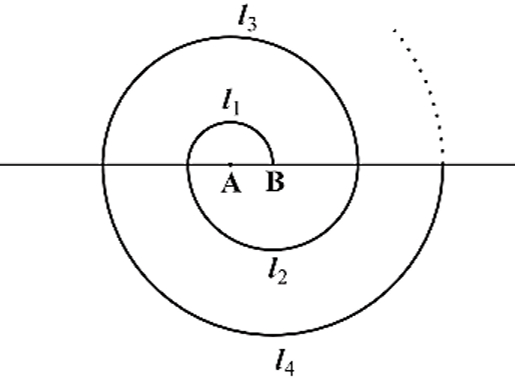
AnswerAccording to question we are given that a spiral is made up of successive semi-circles, with centres alternately at $A$ and $B$ , starting with centre at $A$, of radii $0.5 \mathrm{~cm}, 1.0 \mathrm{~cm}, 1.5 \mathrm{~cm}, 2.0 \mathrm{~cm}, \ldots$ as shown in Fig. Let $\mathrm{l}_1, \mathrm{l}_2, \mathrm{l}_3, \mathrm{l}_4,..., \mathrm{l}_{13}$ be the lengths (circumferences) of semi-circles of radii $\mathrm{r}_1=0.5 \mathrm{~cm}, \mathrm{r}_2=1.0 \mathrm{~cm}, \mathrm{r}_3=1.5 \mathrm{~cm}, \mathrm{r}_4=2.0 \mathrm{~cm}, \mathrm{r}_5=2.5 \mathrm{~cm}, \ldots$ respectively.
Now, Semi-perimeter of circle = $\pi\cdot r $
Therefore,
$l _ { 1 } = \pi r _ { 1 } = \pi \times 0.5 = \frac { \pi } { 2 } \mathrm { cm }$
$l _ { 2 } = \pi r _ { 2 } = \pi \times 1 = 2 \left( \frac { \pi } { 2 } \right) \mathrm { cm }$
$l _ { 3 } = \pi r _ { 3 } = \pi \times \frac { 3 } { 2 } = 3 \left( \frac { \pi } { 2 } \right) \mathrm { cm }$
$l _ { 4 } = \pi r _ { 4 } = \pi \times 2 = 4 \left( \frac { \pi } { 2 } \right) \mathrm { cm }$
and
$l _ { 13 } = \pi r _ { 13 } = \pi \times \frac { 13 } { 2 } \mathrm { cm } = 13 \left( \frac { \pi } { 2 } \right) \mathrm { cm }$
Therefore total length of the spiral $= l_1+ l_2+ l_3+...+ l_{13}$
$\bf= \left\{ \frac { \pi } { 2 } + 2 \left( \frac { \pi } { 2 } \right) + 3 \left( \frac { \pi } { 2 } \right) + \dots + 13 \left( \frac { \pi } { 2 } \right) \right\} $
$\bf= \frac { \pi } { 2 } ( 1 + 2 + 3 + \cdots + 13 ) $
$\bf= \frac { \pi } { 2 } \times \frac { 13 } { 2 } ( 1 + 13 ) \quad \left[ \text { Using } S _ { n } = \frac { n } { 2 } ( a + l ) \right]$
$\bf= \frac { \pi } { 2 } \times \frac { 13 } { 2 } \times 14$ = $\bf\frac { 1 } { 2 } \times \frac { 22 } { 7 } \times 13 \times 7$ = $\bf {143 cm}$
which is required length of the spiral made up of thirteen consecutive semi-circles. View full question & answer→Question 203 Marks
In a school, students thought of planting trees in and around the school to reduce air pollution. It was decided that the number of trees, that each section of each class will plant, will be the same as the class, in which they are studying, e.g., a section of Class $I$ will plant $1$ tree, a section of Class $II$ will plant $2$ trees and so on till Class $XII$. There are three sections of each class. How many trees will be planted by the students?
AnswerSince each section of each class plants the same number of trees as the class number and there are three sections of each class.
Three sections of class $I$ will plant $= 1 \times 3 = 3$
Three sections of class $II$ will plant $= 2 \times 3 = 6$
Three sections of class $III$ will plant $= 3 \times 3 = 9 $ and so on.
Three sections of class $XII$ will plant $= 12 \times 3 = 36$
So, we get an $A .P.$ $3, 6, 9, ..., 36.$
Here $a = 3$ and $d = 6 -3 = 3$
$a_n= 36$
We know that, $a_n= a +(n -1) d$
$3 + (n - 1) 3 = 36$
$(n - 1) 3 = 33$
$(n - 1) = 11$
$n = 11+ 1$
$n = 12$
Sn $= \frac { n } { 2 } (a_1 +a_n) = \frac { 12 } { 2 } (3+ 36)= 234$
View full question & answer→Question 213 Marks
A sum of $₹ 700$ is to be used to give seven cash prizes to students of a school for their overall academic performance. If, each prize is $₹ 20$ less than its preceding term, find the value of each of the prizes.
AnswerIt is given that the sum of seven cash prizes is equal to $₹ 700.$
And, each prize is $₹ 20$ less than its preceding term.
Let the value of first prize $= ₹ a$
Let the value of second prize $=₹ (a−20)$
Let the value of third prize $= ₹ (a−40)$
So, we have a sequence of the form:
$a, a−20, a−40, ...................$
It is an arithmetic progression because the difference between consecutive terms is constant.
First term = a, Common difference $= d = (a − 20) − a= −20$
$n = 7$ (Because there are total of seven prizes)
$S_7= ₹ 700$ {given}
Applying formula, ${S_n} = \frac{n}{2}\left[ {2a + (n - 1)d} \right]$ to find sum of n terms of $AP,$ we get
${S_7} = \frac{7}{2}\left[ {2a + (7 - 1)( - 20)} \right]\;\;$
$\Rightarrow 700 = \frac{7}{2}[2a - 120]$
$\Rightarrow 200 = 2a− 120$
$\Rightarrow 320 = 2a$
$\Rightarrow a =160$
Therefore, value of first prize $= ₹ 160$
Value of second prize $= 160 - 20= ₹ 140$
Value of third prize $= 140 - 20= ₹ 120$
Value of fourth prize $= 120 - 20 = ₹ 100$
Value of fifth prize $= 100 - 20 = ₹ 80$
Value of sixth prize $= 80 - 20 = ₹ 60$
Value of seventh prize $= 60 - 20 = ₹ 40$
View full question & answer→Question 223 Marks
A contract on construction job specifies a penalty for delay of completion beyond a certain date as follows:
$₹ 200$ for the first day, $₹ 250$ for the second day, $₹ 300$ for the third day, etc; the penalty for each succeeding day being $₹50$ more than for the preceding day. How much does a delay of $30$ days cost the contractor?
AnswerSince the penalty for each succeeding day is $₹ 50$ more than for the preceding day.
Therefore, amount of penalty for different days forms an $A.P.$ with first term $a = 200$ and common difference $d = 250 - 200= 50.$
We have to find how much does a delay of $30$ days cost the contractor.
In other words, we have to find the sum of $30$ terms of the $A.P.$
$n = 30, a = 200$ and $d= 50$
$\therefore $ Required sum $= \frac { 30 } { 2 } \{ 2 \times 200 + ( 30 - 1 ) \times 50 \}$$\left[ \because S _ { n } = \frac { n } { 2 } [ 2 a + ( n - 1 ) d ] \right]$
$\Rightarrow $ Required sum $= 15 (400 + 29$ $\times$ $50)$
$\Rightarrow $ Required sum $= 15 (400 + 1450)$
$\Rightarrow $ Required sum $= 15$ $\times$ $1850 = 27750$
Thus, a delay of 30 days will cost the contractor of $₹ 27750.$
View full question & answer→Question 233 Marks
Find the sum of the odd numbers between $0$ and $50$.
AnswerThe odd numbers between $0$ and $50$ are $1, 3, 5, 7, ....., 49.$
Here, $a_2-a_4=3-1=2$
$ a_3-a_2=5-3=2 $
$ a_4-a_3=7-5=2$
i.e. $a_{k+1}-a_k$ is the same everytime.
So, the above list of numbers forms an $AP$.
Here, $a=1$
$ d=2 $
$ l=49$
Let the number of terms of the $AP$ be $n$.
$ \text { Then, } \mathrm{l}=\mathrm{a}+(\mathrm{n}-1) \mathrm{d} $
$ \Rightarrow 49=1+(\mathrm{n}-1) \mathrm{d} $
$ \Rightarrow(\mathrm{n}-1) 2=48 $
$ \Rightarrow \mathrm{n}-1=\frac{48}{2} $
$ \Rightarrow \mathrm{n}-1=24 $
$ \Rightarrow \mathrm{n}=24+1 $
$ \Rightarrow \mathrm{n}=25$
Hence, the number of terms of the $AP$ be $25$.
$\therefore$ Sum of the odd numbers between $0$ and $50=S_{25}$
$ = \frac{{25}}{2}(a + l)$ ......$\because {S_n} = \frac{n}{2}(a + l)$
$ = \left( {\frac{{25}}{2}} \right)(1 + 49)$
$ = \left( {\frac{{25}}{2}} \right)(50)$
$= (25) (25)$
$= 625$
View full question & answer→Question 243 Marks
Find the sum of the first $15$ multiples of $8$.
AnswerThe first $15$ multiples of 8 are $8, 16, 24, 32,....$
$ \text { Here, } a_2-a_4=16-8=8 $
$a_3-a_2=24-16=8 $
$ a_4-a_3=32-24=8$
$\text { i.e. } a_{k-1}-a_k \text { is the same everytime. }$
So, the above list of numbers forms an $AP$.
Here, $a = 8$
$d = 8$
$n = 15$
$\therefore $ Sum of first $15$ multiples of $8 =S_{15}$
$ = \frac{{15}}{2}\left[ {2a + (15 - 1)d} \right]$ ......... $\because {S_n} = \frac{n}{2}\left[ {2a + (n - 1)d} \right]$
$ = \frac{{15}}{2}\left[ {2a + 14d} \right]$
$= 15 (a + 7d)$
$ = (15)(8 + 7 \times 8)$
$= (15) (8 + 56)$
$= (15) (64)$
$= 960$
View full question & answer→Question 253 Marks
Find the sum of the first $40$ positive integers divisible by $6$.
AnswerThe first $40$ positive integers divisible by 6 are $6, 12, 18, 24, .....$
Here, $a_2- a_1= 12 - 6 = 6$
$a_3- a_2= 18 - 12 = 6$
$a_4- a_3= 24 - 18 = 6$
i.e.$ a_{k+1} - a_k$ is the same every time.
So, the above list of numbers form an $AP$.
Here, $a = 6$
$d = 6$
$n = 40$
$\therefore $ Sum of the first $40$ positive integers = $S_{40}$
$ = \frac{{40}}{2}\left[ {2a + (40 - 1)d} \right]$ .........${\{\because {S_n} = \frac{n}{2}\left[ {2a + (n - 1)d} \right]}\}$
$= 20[2a + 39d]$
$ = (20)[2 \times 6 + 39 \times 6]$
$= (20) (246)$
$= 4920$
View full question & answer→Question 263 Marks
If the sum of the first n terms of an $A.P.$ is $4 n-n^2$, what is the first term? What is the sum of first two terms? What is the second term? Similarly, find the third, the tenth and the nth term.
AnswerGiven that,
$S_n=4 n-n^2$
First term, $a=S_1=4(1)-(1)^2=4-1=3$
Sum of first two terms $=\mathrm{S}_2$
$=4(2)-(2)^2=8-4=4$
Second term, $\mathrm{a}_2=\mathrm{S}_2-\mathrm{S}_1=4-3=1$
$ d=a_2-a=1-3=-2 $
$ a_n=a+(n-1) d $
$ =3+(n-1)(-2) $
$ =3-2 n+2 $
$ =5-2 n$
Therefore, $a_3=5-2(3)=5-6=-1$
$a_{10}=5-2(10)=5-20=-15$
Hence, the sum of first two terms is $4$ .
The second term is $1.3^{\text {rd }}, 10^{\text {th }}$ and $n^{\text {th }}$ terms are $-1,-15$, and $5-2 n$ respectivey.
View full question & answer→Question 273 Marks
Show that $a_1, a_2, \ldots$, an, ...... form an $AP$ where $a_n= 9 - 5n.$
AnswerWe have $a_n= 9 - 5n$
Put $n = 1, 2, 3, 4,....$ in succession, we get
$ a_1=9-5(1)=9-5=4 $
$ a_2=9-5(2)=9-10=-1 $
$ a_3=9-5(3)=9-15=-6 $
$ a_4=9-5(4)=9-20=-11 $
$: : :$
$\therefore a_2-a_1=-1-4=-5$
$ a_3-a_2=-6-(-1)=-6+1=-5 $
$ a_4-a_5=-11-(-6)=-11+6=-5$
i.e. $a_{k+1}-a_k$ is the same everytime
So, $a_1, a_2, \ldots$, $an, ......$ form an $AP$
Here, $a=a_1=4$
$a=a_2-a_1=-5$
$\therefore $ Sum of the first $15$ terms $= S_{15}$
$ = \frac{{15}}{2}\left[ {2a + (n - 1)d} \right]$ $\because {S_n} = \frac{n}{2}[2a + (n - 1)d]$
$ = \frac{{15}}{2}\left[ {2 \times a + (15 - 1)d} \right]$
$ = \frac{{15}}{2}\left[ {2a + 14d} \right]$
$= 15(a + 7d)$
$= (15) [4 + 7(-5)]$
$= (15) (4 - 35)$
$= (15) (-31)$
$= -465$
View full question & answer→Question 283 Marks
Show that $a_1, a_2, ........., a_n$, form an AP where $a_n= 3 + 4n.$
AnswerPut $n = 1, 2, 3, 4, .....$ in succession, we get
$ a_1=3+4(1)=3+4=7 $
$ a_2=3+(2)=3+8=11 $
$ a_3=3+4(3)=3+12=15 $
$ a_4=3+4(4)=3+16=19 $
$ ::: $
$ \therefore a_2-a 1=11-7=4 $
$ a_3-a_2=15-11=4 $
$ a_4-a_3=19-15=4$
i.e. $a_{k+1}-a_k$ is the same every time.
So, $a_1, a_2, \ldots .. , an, ...$ from an $AP.$
Here, $a=a_1=7$
$d=a_2-a_1=4$
$\therefore$ Sum of the first $15$ terms $=\mathrm{S}_{15}$
$ = \frac{{15}}{2}\left[ {2a + (15 - 1)d} \right]$ $\because {S_n} = \frac{n}{2}\left[ {2a + (n - 1)d} \right]$
$ = \frac{{15}}{2}\left[ {2a + 14d} \right]$
$= 15(a + 7d)$
$ = (15)(7 + 7 \times 4)$
$= (15) (7 + 28)$
$= (15) (35)$
$= 525$
View full question & answer→Question 293 Marks
An $AP$ consists of $50$ terms of which $3^{rd}$ term is $12$ and the last term is $106.$ Find the $29^{th}$ term.
AnswerAn $AP$ consists of $50$ terms and the $50^{\text {th }}$ term is equal to $106$ and $a_3=12$
Using formula $a_n=a+(n-1) d$, to find $n^{\text {th }}$ term of arithmetic progression,
$ a_{50}=a+(50-1) d \text { And } a_3=a+(3-1) d $
$ \Rightarrow 106=a+49 d \text { and } 12=a+2 d$
These are equations consisting of two variables.
Using equation $106=a+49 d$, we get $a=106-49 d$
Putting value of $a$ in the equation $12=a+2 d$,
$12=106-49 d+2 d \Rightarrow 47 d=94 \Rightarrow d=2$
Putting value of $d$ in the equation, $a=106-49 d$,
$a=106-49(2)=106-98=8$
Therefore, First term $=\mathrm{a}=8$ and Common difference $=\mathrm{d}=2$
To find $29^{\text {th }}$ term, we use formula $a_n=a+(n-1) d$ which is used to find $n^{\text {th }}$ term of arithmetic progression, $a_{29}=8+(29-1) 2=8+56=64$
Therefore, $29$ th term of $A P$ is equal to $64 .$
View full question & answer→Question 303 Marks
Find the $31^{st}$ term of an $AP$ whose $11^{th}$ term is 38 and the $16^{th}$ term is $73.$
AnswerLet the first term and the common difference of the $AP$ be a and d respectively.
Then,
$11th$ term $= 38 .......$ Given
$ \Rightarrow a + (11 - 1)d = 38 \because {a_n} = a + (n - 1)d$
$ \Rightarrow a + 10d = 38 ........ (1)$
and, $16th$ term $= 73$
$ \Rightarrow a + (16 - 1)d = 73 \because {a_n} = a + (n - 1)d$
$ \Rightarrow a + 15d = 73 .......... (2)$
Solving $(1)$ and $(2)$, we get
$a = -32$
$d = 7$
Therefore, $31^{st}$ term
$= a + (31 - 1)d$
$= a + 30d$
$= -32 + (30) (7)$
$= - 32 + 210 = 178$
Hence, the $31^{st}$ term of the $AP$ is $178.$
View full question & answer→Question 313 Marks
Check whether $–150$ is a term of the $AP: 11, 8, 5, 2, …..$
AnswerThe given list of numbers is $11, 8, 5, 2,.....$
$ a_2-a_1=8-11=-3 $
$ a_3-a_2=5-8=-3 $
$ a_4-a_3=2-5=-3$
i.e. $a_{k+1}- a_k$ is the same every time.
So, the given list of numbers forms an $AP$ with first term $a = 11$ and the common difference $d = -3.$
Let $-150$ be the nth term of the given $AP$
Then, $a_n= -150$
$ \Rightarrow a + (n - 1) d = -150 $
$ \Rightarrow 11+ (n - 1)(-3) = -150$
$ \Rightarrow (-3) (n - 1) = -150 - 11$
$ \Rightarrow (-3) (n - 1) = -161$
$ \Rightarrow 3(n - 1) = 161$
$ \Rightarrow n - 1 = \frac{{161}}{3}$
$ \Rightarrow n = \frac{{161}}{3} + 1$
$ \Rightarrow n = \frac{{164}}{3}$
But $n$ should be a positive integer. So, $-150$ is not a term of $11, 8, 5, 2,....$
View full question & answer→Question 323 Marks
In the $AP, 38, ? , ? , ? , –22,$ find the missing terms$?$
AnswerLet the first terms and the common difference of the given $AP$ be a and d respectively.
$ \Rightarrow a + (2 - 1)d = 38 \because {a_n} = a + (n - 1)d$
$ \Rightarrow a + d = 38 ....... (1)$
Sixth term $= -22$
$ \Rightarrow a + (6 - 1) d = -22$
$ \Rightarrow a + 5d = -22 ......... (2)$
Solving $(1)$ and$ (2)$, we get
$a = 53$
$d = -15$
Therefore,
Third term $= 53 + (3 - 1) (-15) \because {a_n} = a + (n - 1)d$
$= 53 - 30$
$= 23$
Fourth term $= 53 + (4 - 1) (-15) \because {a_n} = a + (n - 1)d$
$= 8$
Fifth $= 53 + (5 - 1) (-15) \because {a_n} = a + (n - 1)d$
$= -7$
Hence, the missing terms in the boxes are $53, 23, 8, -7$
View full question & answer→Question 333 Marks
Suba Rao started work in $1995$ at an annual salary of $₹5000 $ and received a $₹200$ raise each year. In what year did his annual salary will reach $₹7000?$
AnswerAnnual salary received by Suba Rao in $1995, 1996, 1997,...$ is
$₹5000, ₹5200, ₹5400,.......,......7000.$
Clearly, it is an arithmetic progression with first term $a = 5000$ and common difference $d = 200.$
Suppose Suba Rao's annual salary reaches to $₹7000$ in nth years. Then,
$n^{th}$ term of the above $A.P. = ₹7000$
$\Rightarrow a + (n -1) d = 7000$
$\Rightarrow 5000 + ( n - 1 ) \times 200 = 7000$
$\Rightarrow ( n - 1 ) \times 200 = 2000$
$\Rightarrow \quad n - 1 = \frac { 2000 } { 200 } \Rightarrow n - 1 = 10 \Rightarrow n = 11$
Thus, $11th$ annual salary received by Suba Rao will be $₹7000.$ This means that after $10$ years i.e., in the year $2005$ his annual salary will reach to $₹7000.$
View full question & answer→Question 343 Marks
The sum of the $4th$ and $8th$ terms of an $AP$ is $24$ and the sum of the $6th$ and $10th$ term is $44$. Find the first three terms of the $AP.$
AnswerLet the first term and the common difference of the $AP$ be a and d respectively.
Then,
$4th$ term $= a + (4 - 1)d = a + 3d \because {a_n} = a + (n - 1)d$
$8th$ term $= a + (8 - 1)d = a + 7d \because {a_n} = a + (n - 1)d$
$6th$ term $= a + (6 - 1)d = a + 5d \because {a_n} = a + (n - 1)d$
and $10th$ term $= a + (10 - 1)d = a + 9d \because {a_n} = a + (n - 1)d$
According to the question,
$4^{th}$ term $+ 8^{th}$ term $= 24$
$ \Rightarrow (a + 3d) + (a + 7d) = 24$
$ \Rightarrow 2a + 10d = 24 $
$ \Rightarrow a + 5d = 12 .......... (1) ($Dividing throughout by $2)$
$6th$ term $+$ $10th$ term $= 24$
$ \Rightarrow (a + 5d) + (a + 9d) = 44$
$ \Rightarrow 2a + 14d = 44$
$ \Rightarrow a + 7d = 22 .......... (2) ($Dividing throughout by $2)$
Solving $(1)$ and $(2),$ we get
$a = -13$
$d = 15$
So, First term $= -13$
Second term $= -13 + 5 = -8$
Third term $= -8 + 5 = -3$
Hence, the first three terms of the given $AP$ are $-13, -8$ and $-3.$
View full question & answer→Question 353 Marks
Find the $20th$ term from the last term of the $AP : 3, 8, 13, …., 253.$
AnswerThe given $AP$ is $3, 8, 13, ..., 253$
Here, $a = 3$
$d = 8 - 3 = 5$
$l = 253$
Let the number of terms of the $AP$ be $n.$
Term, nth term $= l$
$ \Rightarrow 3 + (n - 1)5 = 253 \because {a_n} = a + (n - 1)d$
$ \Rightarrow (n - 1)5 = 253 - 3$
$ \Rightarrow (n - 1)5 = 250 $
$ \Rightarrow n - 1 = \frac{{250}}{5}$
$ \Rightarrow n - 1 = 50 $
$ \Rightarrow n = 50 + 1$
$ \Rightarrow n = 51$
So, there are $51$ terms in the given $AP.$
Now, $20th$ term from the last term
$= (51 - 20 + 1)th$ term from the beginning
$= 32th$ term from the beginning
$= 3 + (32 - 1)5 \because {a_n} = a + (n - 1)d$
$= 3 + 155$
$= 158$
Hence, the $20th$ term from the last term of the given $AP$ is $158.$
Aliter. Let us write the given $AP$ in the reverse order.
Then the $AP$ becomes $253, 248, 243, ...., 3$
Here, $a = 253$
$d = 248 - 253 = -5$
Therefore, required term
$= 20th$ term of the $AP$
$= 253 + (20 - 1) (-5) \because {a_n} = a + (n - 1)d$
$= 253 - 95$
$= 158$
Hence, the $20th$ term from the last term of the given $AP$ is $158.$
View full question & answer→Question 363 Marks
For what value of $n,$ are the nth terms of two $APs: 63, 65, 67, ….$ and $3, 10, 17, …. $ equal$?$
AnswerFirst $APs$
$63, 65, 67, ......$
Here, $a = 63$
$d = 65 - 63 = 2$
$\therefore nth$ term $= 63 + (n - 1)2 \because a_n= a + (n - 1)d$
Second $APs$
$3, 10, 17, .....$
Here, $a = 3$
$d = 10 - 3 = 7$
$\therefore nth$ term $= 3 + (n - 1)7 \because a_n= a+(n - 1)d$
If the $n\ th$ terms of two $APs$ are equal then
$63 + (n - 1)2 = 3 + (n - 1)7$
$ \Rightarrow (n - 1)2 - (n - 1)7 = 3 - 63$
$ \Rightarrow (n - 1) (2 - 7) = -60$
$ \Rightarrow (n - 1) (-5) = -60$
$ \Rightarrow n - 1 = \frac{{ - 60}}{{ - 5}}$
$ \Rightarrow n - 1 = 12$
$ \Rightarrow n = 12 + 1$
$ \Rightarrow n = 13$
Hence, for $n = 13th$ terms of the two $APs$ are equal
View full question & answer→Question 373 Marks
How many multiples of $4$ lie between $10$ and $250?$
AnswerThe multiples of $4$ that lie between $10$ and $250$ are:
$12, 16, 20, 24, ...., 248$
$a_2-a_1=16-12=4$
$ a_3-a_2=20-16=4 $
$ a_4-a_3=24-20=4$
$\text { As } a_{k+1}-a_k \text { is the same for } k=1,2,3 \text {, etc. }$
The above list of numbers forms an $AP$ with the first term $a = 12$
and the common difference $d = 4$
Last term $(l) = 248$
Let there be $n$ term $s$ in this $AP.$ Then, nth term $= l$
$ \Rightarrow a + (n - 1)d = 248$
$ \Rightarrow 12 + (n - 1)4 = 248 $
$ \Rightarrow (n - 1)d = 248 - 12$
$ \Rightarrow (n - 1) = 236$
$ \Rightarrow n - 1 = \frac{{236}}{4}$
$ \Rightarrow n - 1 = 59$
$ \Rightarrow n = 59 + 1$
$ \Rightarrow n = 60$
Hence, $60$ multiples of $4$ lie between $10$ and $250.$
View full question & answer→Question 383 Marks
Fill in the blanks in the following table, given that a is the first term, d is the common difference and $a_n$ is the $n^{th}$ term of the AP:
| |
$a$ |
$d$ |
$n$ |
$a_n$ |
| $i$ |
$7$ |
$3$ |
$8$ |
$...$ |
| $ii$ |
$-18$ |
$...$ |
$10$ |
$0$ |
| $iii$ |
$...$ |
$-3$ |
$18$ |
$-5$ |
| $iv$ |
$-18.9$ |
$2.5$ |
$...$ |
$3.6$ |
| $v$ |
$3.5$ |
$0$ |
$105$ |
$...$ |
Answer
- Given:$ a = 7, d = 3$ and $n = 8,$
$a_n= ?$
We know that $a_n= a + (n – 1)d$
Thus, $a_8= 7 + (8 – 1)3 = 7 + 21 = 28$
- Given: $a = - 18, n = 10, a_n= 0, d = ?$
We know that $a_n= a + (n – 1)d$
Thus,$ 0 = - 18 + (10 – 1)d$
$0 = -18 + 9d$
or, $9d = 18$
$d = 18/9 = 2$
- Given: $d = - 3, n = 18, a_n= - 5, a = ?$
We know that $a_n= a + (n – 1)d$
$-5 = a + (18 - 1) (-3)$
$-5 = a - 51$
or $a = -5 + 51 = 46$
- Given: $a = -18.9, d = 2.5, a_n= 3.6, n = ?$
We know that $a_n= a + (n – 1)d$
$3.6 = – 18.9 + (n – 1)2.5$
or, $2.5(n – 1) = 3.6 + 18.9 = 22.5$
$n – 1 = 22.5/2.5 = 9$
$n = 9 + 1 = 10$
- Given:$ a = 3.5, d = 0, n = 105, a_n= ?$
We know $a_n= a + (n - 1)d$
$a_{105}= 3.5 + (105 - 1)0$
$a_{105}= 3.5 + 0$
$a_{105}= 3.5$
View full question & answer→Question 393 Marks
Is the given series: $2, \frac{5}{2}, 3, \frac{7}{2}, \dots$ form an $AP?$ If It forms an $AP,$ then find the common difference d and write the next three terms.
AnswerAs per the question:
$a_1= 2$
$a_2=\frac{5}{2}$
$a_3= 3$
$a_4= {7\over 2}$
now check the common difference $(d)$
${a_2} - {a_1} = \frac{5}{2} - 2 = \frac{1}{2}$
${a_3} - {a_2} = 3 - \frac{5}{2} = \frac{1}{2}$
${a_4} - {a_3} = \frac{7}{2} - 3 = \frac{1}{2}$
we can see that the common difference is the same everywhere, so the given series forms an $AP.$
now next three terms are: ${a_5} = \frac{7}{2} +\frac{1}{2}= 4$
${a_6}= 4+\frac{1}{2} = \frac{9}{2}$
${a_7}= \frac{9}{2} +\frac{1}{2} = 5$
View full question & answer→Question 403 Marks
Is the given series $2, 4, 8, 16, ......$ form an AP? If It forms an AP, then find the common difference d and write the next three terms.
AnswerIf $a_{k+1}-a_k$ is same for different values of $k$, then the series is in the form of an AP.
here, we have $a_1=2, a_2=4, a_3=8$ and $a_4=16$
$ a_4-a_3=16-8=8 $
$ a_3-a_2=8-4=4$
$a_2-a_1=4-2=2$
Here, $a_{k+1}-a_k$ i.e. the common difference is not same for all values of $k$
Hence, the given series does not form an AP.
View full question & answer→Question 413 Marks
The amount of money in the account every year, when $₹ 10000$ is deposited at compound interest at $8\%$ per annum. Is this situation make an arithmetic progression and why$?$
AnswerAmount of money after $1$ year $ = Rs10000\left( {1 + \frac{8}{{100}}} \right) = {a_1}$
Amount of money after $2 $ year $ = Rs10000{\left( {1 + \frac{8}{{100}}} \right)^2} = {a_2}$
Amount of money after $3$ year $ = Rs10000{\left( {1 + \frac{8}{{100}}} \right)^3} = {a_3}$
Amount of money after $4$ year $ = Rs10000{\left( {1 + \frac{8}{{100}}} \right)^4} = {a_4}$
${a_2} - {a_1} = Rs10000{\left( {1 + \frac{8}{{100}}} \right)^2} - Rs10000\left( {1 + \frac{8}{{100}}} \right)$
$ = Rs10000\left( {1 + \frac{8}{{100}}} \right)\left( {1 + \frac{8}{{100}} - 1} \right)$
$= 10000(1 + {8 \over {100}})({8 \over {100}})$
$a_3-a_2$
$=10000{\left( {1 + \frac{8}{{100}}} \right)^2} - 10000\left( {1 + \frac{8}{{100}}} \right)$
$ = 10000\left( {1 + \frac{8}{{100}}} \right)\left( {1 + \frac{8}{{100}} - 1} \right)$
$ = 10000\left( {1 + \frac{8}{{100}}} \right)\left( {\frac{8}{{100}}} \right)$
Since.${a_{^3}} - {a_2} \ne {a_2} - {a_1}$.It does not form $AP.$
View full question & answer→Question 423 Marks
The cost of digging a well after every metre of digging, when it costs $₹\ 150$ for the first metre and rises by $₹\ 50$ for each subsequent metre. Is this situation make an arithmetic progression and why$?$
AnswerCost of digging the well after $1$ metre of digging $= Rs\ 150 = a_1$
Cost digging the well after $2$ metres of digging
$= Rs\ 150 + Rs\ 50 = Rs\ 200 = a_2$
Cost of digging the well after $3$ metres of digging
$= Rs\ 200 + Rs\ 50 = Rs\ 250 = a_3$
Cost of digging the well after $4$ metres of digging
$= Rs\ 250 + Rs\ 50 = Rs\ 300 = a_4$
and so on.
$a_2– a_1= Rs\ 200 – Rs\ 150 = Rs\ 50$
$a_3– a_2= RS\ 250 – Rs\ 200 = Rs\ 50$
$a_4– a_3= Rs\ 300 – Rs\ 250 = Rs\ 50$
i.e. $a_{k+1}– a$ is the same everytime.
So this list of numbers forms an $AP$ with the first term $a = Rs\ 150$
and the common difference $d = Rs\ 50.$
View full question & answer→Question 433 Marks
A sum of $₹\ 1000$ is invested at $8\%$ simple interest per year. Calculate the interest at the end of each year. Do these interests form an $AP?$ If so, find the interest at the end of $30$ years making use of this fact.
AnswerLet $P$ be the principle, $R$ rate of interest and $I_n$ be the interest at the end of $n$ year
We know that
$I_n= \frac { P R n } { 100 }$ $\left[ \text { Using : Interest } = \frac { P R T } { 100 } \right]$
A sum of $₹1000$ is invested at $8\%$ simple interest per annum.
Here, we have
$P = ₹1000,$ and $R = 8\%$ per annum
$\therefore I_n= ₹ \left( \frac { 1000 \times 8 \times n } { 100 } \right)= ₹ 80n$
Putting $n = 1,2,3,...,$ we have
$ I_n=80 n $
$I_1=80 \times 1=₹ 80$
$ I_2=80 \times 2=₹ 160$
$ I_3=80 \times 3=₹ 240 $
$ I_4=80 \times 4=₹ 320 \text { and so on. }$
Since, $I_n$ is a linear expression in $n.$
Therefore, the sequence of interest forms an $A.P.$ with common difference $80.$
Hence, the sequence of interests is an $A.P.$
Also, Interest at the end of $30$ years $= I_{30}= 80n = ₹ (80 \times 30) = ₹ 2400$
View full question & answer→Question 443 Marks
Check whether $301$ is a term of the given list of numbers: $5, 11, 17, 23,...?$
AnswerWe have :
$a_2– a_1= 11 – 5 = 6, a_3– a_2= 17 – 11 = 6, a_4– a_3= 23 – 17 = 6$
As $a_{k+1}– a_k$ is the same for $k = 1, 2, 3,$ etc., so the given list of numbers are in $AP.$
Now, $a = 5$ and $d = 6.$
Let $301$ be a term, say, the $^{th}$ term of this $AP.$
We know that
$a_n= a + (n – 1) d$
So, $301 = 5 + (n – 1) \times 6$
i.e.,$ 301 = 6n – 1$
So,$n=\frac{302}{6}=\frac{151}{3}$, since $n$ is in the form of fraction ,thus $301$ is not the term of given $AP$
View full question & answer→Question 453 Marks
Elpis Technology is a $TV$ manufacturer company. It produces smart $TV$ sets not only for the Indian market but also exports them to many foreign countries. Their $TV$ sets have been in demand every time but due to the Covid$-19$ pandemic, they are not getting sufficient spare parts especially chips to accelerate the production. They have to work in a limited capacity due to the lack of raw material.

They produced $600$ sets in the third year and $700$ sets in the seventh year. Assuming that the production increases uniformly by a fixed number every year, find:
- the production in the $1st$ year $(2)$
- the production in the $10th$ year $(1)$
- the total production in first $7$ years $(1)$
View full question & answer→