Question 13 Marks
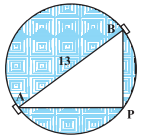
A pole has to be erected at a point on the boundary of a circular park of diameter $13$ metres in such a way that the difference of its distances from two diametrically opposite fixed gates $A$ and $B$ on the boundary is $7$ metres. Is it possible to do so? If yes, at what distances from the two gates should the pole be erected?
Answer
View full question & answer→Let $P$ be the position of the pole and$ A B$ be the opposite fixed gates. Let, $BP = x$ metres.
$\therefore AP = x + 7$
In right triangle APB,
$ A P^2+B P^2=A B^2 $
$ \Rightarrow(x+7)^2+x^2=13^2 $
$ \Rightarrow x^2+49+14 x+x^2=169 $
$ \Rightarrow 2 x^2+14 x+49-169=0 $
$ \Rightarrow 2 x^2+14 x-120=0 $
$ \Rightarrow 2\left(x^2+7 x-60\right)=0 $
$ \Rightarrow x^2+7 x-60=0 $
$ \Rightarrow x^2+12 x-5 x-60=0 $
$ \Rightarrow x(x+12)-5(x+12)=0 $
$ \Rightarrow(x+12)(x-5)=0$
Either $x+12=0$, then $x=-12$ which is not possible being negative or $x-5=0$, then $x=5$.
Thus $P$ is at a distance of 5 m from $B$ and $5+7=12 m$ from $A$.
$\therefore AP = x + 7$
In right triangle APB,
$ A P^2+B P^2=A B^2 $
$ \Rightarrow(x+7)^2+x^2=13^2 $
$ \Rightarrow x^2+49+14 x+x^2=169 $
$ \Rightarrow 2 x^2+14 x+49-169=0 $
$ \Rightarrow 2 x^2+14 x-120=0 $
$ \Rightarrow 2\left(x^2+7 x-60\right)=0 $
$ \Rightarrow x^2+7 x-60=0 $
$ \Rightarrow x^2+12 x-5 x-60=0 $
$ \Rightarrow x(x+12)-5(x+12)=0 $
$ \Rightarrow(x+12)(x-5)=0$
Either $x+12=0$, then $x=-12$ which is not possible being negative or $x-5=0$, then $x=5$.
Thus $P$ is at a distance of 5 m from $B$ and $5+7=12 m$ from $A$.