Questions

4 Marks Questions

🎯

Test yourself on this topic

8 questions · timed · auto-graded

Question 14 Marks
A pole has to be erected at a point on the boundary of a circular park of diameter $13$ metres in such a way that the difference of its distances from two diametrically opposite fixed gates $A$ and $B$ on the boundary is $7$ metres. Is it possible to do so$?$ If yes, at what distances from the two gates should the pole be erected$?$
Answer
Let $P$ be the position of the pole and $A\ \&\ B$ be the opposite fixed gates. Let, $BP = x$ metres.
$\therefore AP = x + 7$
In right triangle $APB,$
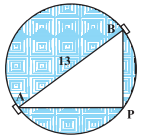
$ A P^2+B P^2=A B^2 $
$ \Rightarrow(x+7)^2+x^2=13^2 $
$ \Rightarrow x^2+49+14 x+x^2=169 $
$ \Rightarrow 2 x^2+14 x+49-169=0 $
$ \Rightarrow 2 x^2+14 x-120=0 $
$ \Rightarrow 2\left(x^2+7 x-60\right)=0 $
$ \Rightarrow x^2+7 x-60=0 $
$ \Rightarrow x^2+12 x-5 x-60=0 $
$ \Rightarrow x(x+12)-5(x+12)=0 $
$ \Rightarrow(x+12)(x-5)=0$
Either $x+12 = 0,$ then $x = -12$ which is not possible being negative or $x - 5 = 0,$ then $x = 5.$
Thus $P$ is at a distance of $5m$ from $B$ and $5+7 = 12m$ from $A.$
View full question & answer
Question 24 Marks
Is it possible to design a rectangular park of perimeter $80 \ m$ and area $400 \ m^2?$ If so, find its length and breadth.
Answer
Let the length and breadth of the park be $l$ and $b.$
Perimeter $= 2(l+ b) = 80$
$l + b = 40 ~or,~ b = 40 - l$
Area $= l \times b = l(40 - l)$
$= 40l - l^{2} = 400$ Given
$l^{2}-40l+400=0$
Comparing this equation with $al^2 + bl + c = 0,$ we obtain
$a = 1, b = -40, c = 400$
Discriminant $D = b^2 - 4ac = (-40)^2 - 4(1) (400) = 1600 - 1600 = 0$
As $b^2 - 4ac = 0$
Therefore, this equation has equal real roots and hence, this situation is possible.
Root of this equation,
$l=-\frac{b}{2 a}$
$l=-\frac{(-40)}{2(1)}=\frac{40}{2}=20$
Therefore, length of park, $l = 20 \ m$
And breadth of park, $b = 40 - l = 40 - 20 = 20 \ m$
View full question & answer
Question 34 Marks
Is the following situation possible? If so, determine their present ages. The sum of the ages of two friends is $20$ years. Four years ago, the product of their ages in years was $48.$
Answer
Let the present age of one friend be $x$ years. Also, sum of ages of both friends $= 20$ years hence age of $2^{nd}$ friend will be $(20 - x)$ years. $4$ years ago, age of $1^{st}$ friend $= (x - 4 )$ years.
age of $2^{nd}$ friend$= (20-x)- 4 = (16-x)$ years. According to the question;
$(x - 4 )( 1 6 - x ) = 48 \Rightarrow  x^2 - 20x + 112 = 0$
Let $D$ be the discriminant of this quadratic. Then,
$D =b^2-4ac  = 400 - 448 = -48 < 0. ($here, $a=1 b=-20, c=112)$
So, above equation does not have real roots. Hence, the given situation is not possible.
View full question & answer
Question 44 Marks
Find the value of $k$ for the quadratic equation $kx(x − 2) + 6 = 0,$ so that they have two equal roots.
Answer
$kx(x − 2) + 6 = 0$
$\Rightarrow kx^2 − 2kx + 6 = 0$
Comparing quadratic equation $kx^{2 }− 2kx + 6 = 0$ with general form $ax^2 + bx + c = 0,$ we get $a = k, b = -2k$ and $c = 6$
Discriminant $= b^{2 }− 4ac = (−2k)^2 - 4(k)(6) = 4k^{2 }− 24k$
We know that two roots of quadratic equation are equal only if discriminant is equal to zero.
Putting discriminant equal to zero
$4k^2−24k =0$
$\Rightarrow 4k(k − 6) \Rightarrow k = 0, 6$
The basic definition of quadratic equation says that quadratic equation is the equation of the form $ax^2 + bx + c = 0,$ where $a \neq 0$
Therefore, in equation $kx^{2 }− 2kx + 6 = 0,$ we cannot have $k = 0.$
Therefore, we discard $k = 0.$
Hence the answer is $k = 6.$
View full question & answer
Question 54 Marks
A cottage industry produces a certain number of pottery articles in a day. It was observed on a particular day that cost of production of each article (in rupees) was 3 more than twice the number of articles produced on that day. If, the total cost of production on that day was ₹ 90, find the number of articles produced and the cost of each article.
Answer
Let cost of production of each article be Rs x
We are given total cost of production on that particular day = Rs 90
Therefore, total number of articles produced that day = 90/x
According to the given conditions,
$ x = 2 \left( \frac { 90 } { x } \right) + 3$
$\Rightarrow x = \frac { 180 } { x } + 3$
$\Rightarrow x = \frac { 180 + 3 x } { x }$
$\Rightarrow x ^ { 2 } = 180 + 3 x$
$\Rightarrow x ^ { 2 } - 3 x - 180 = 0$
$\Rightarrow x ^ { 2 } - 15 x + 12 x - 180 = 0$
⇒ x (x − 15) + 12 (x − 15) = 0
⇒ (x − 15) (x + 12) = 0 ⇒ x = 15, −12
Cost cannot be in negative, therefore, we discard x = − 12
Therefore, x = Rs 15 which is the cost of production of each article.
Number of articles produced on that particular day = $ \frac { 90 } { 15 }$ = 6
View full question & answer
Question 64 Marks
The altitude of a right triangle is $7 \ cm$ less than its base. If the hypotenuse is $13 \ cm,$ find the other two sides.
Answer
Let the base of the right triangle be $x \ cm.$
Then altitude $= (x - 7) \ cm$ Hypotenuse $= 13 \ cm$ By Pythagoras theorem $($Base$)^2 + ($Altitude$)^2 = ($Hypotenuse$)^2 $
$\implies x^2 + (x-7)^2 = (13)^2 $
$\implies x^2 + x^2 -14x + 49 = 169 $
$\implies 2x^2 -14x -120 = 0 $
$\implies 2(x^2 - 7x -60) = 0$ or $x^2 - 7x -60 = 0 $
$\implies x^2 - 12x + 5x -60 = 0 $
$\implies x ( x - 12) +5 ( x - 12) = 0 $
$\implies (x + 5) (x - 12) = 0$
Either $ x + 5 = 0$ or $x -12 = 0 $
$\implies x = -5, 12$ Since side of the triangle cannot be negative.
So, $x =12 \ cm$ and $x = - 5$ is rejected.
Hence, length of the other two sides are $12\ cm, (12 - 7) = 5\ cm.$
 
View full question & answer
Question 74 Marks
Product of the ages of Parth $6$ years ago and $6$ years later is $288$. Find his present age.
Answer
Let the present age of Parth be $x$ years.
So, his age $6$ years ago was $(x-y)$ years and his age $6$ years hence will be $(x+6)$ years.
The product of ages $6$ years ago and after $6$ years is $288$ .
$\therefore(x-6)(x+6)=288$
$\therefore x^2-36=288$
$\therefore x^2=288+36$
$\therefore x^2=324$
$\therefore x=18$ or $ x=-18 .$
Now, since $x$ represents the present age of Parth, it cannot be negative.
$\therefore x=-18$ is not possible.
$\therefore x=18$
Thus the present age of Parth is $18$ years.
View full question & answer
Question 84 Marks
Find two consecutive positive integers, sum of whose squares is 365.
Answer
Let the two consecutive positive integers be x and x+1 According to the question x2 + (x+1)2 = 365 $\implies$x2 + x2 + 2x + 1 = 365 $\implies$2x2 + 2x - 364 = 0 $\implies$2(x2 + x - 182) = 0 or x2 + x - 182 = 0 $\implies$x2 + 14x -13x -182 = 0 $\implies$x (x+14) -13 (x+14) = 0 $\implies$(x-13) (x+14) = 0 Either x-13 = 0 or x + 14 = 0 $\implies$x = 13, -14 Since the numbers are positive. so x = - 14 is rejected. Hence the required consecutive positive integers are 13, 13+1 =14.
View full question & answer
4 Marks Questions - Maths STD 10 Questions - Vidyadip