Question 13 Marks
During a sale, colour pencils were being sold in packs of $24$ each and crayons in packs of $32$ each. If you want full packs of both and the same number of pencils and crayons, how many of each would you need to buy$?$
AnswerNumber of color pencils in one pack $= 24$
No of crayons in pack $= 32$
$\therefore$ The least number of both colors to be purchased
$=$ LCM of $24$ and $32$
$= 2 × 2 × 2 × 2 × 2 × 3$
$\therefore$ Number of packs of pencils to be bought $= \frac{96}{24} = 4$
And number of packs of crayon to be bought $= \frac{96}{32} = 3$
View full question & answer→Question 23 Marks
The length, breadth and height of a room are $8m\ 25cm,\ 6m\ 75cm$ and $4m\ 50cm,$ respectively. Determine the longest rod which can measure the three dimensions of the room exactly.
AnswerLength of room $= 8\ m\ 25\ cm = 825\ cm$
Breadth of room $= 6\ m\ 75\ cm = 675\ cm$
Height of room $= 4\ m\ 50\ cm = 450\ cm$
$\therefore$ The required longest rod
$= HCF$ of $825, 675$ and $450$
First consider $675$ and $450$
By applying Euclid’s division lemma
$675 = 450 × 1 + 225$
$450 = 225 × 2 + 0$
$\therefore HCF$ of $675$ and $450 = 225$
Now consider $225$ and $825$
By applying Euclid’s division lemma
$825 = 225 × 3 + 150$
$225 = 150 × 1 + 75$
$150 = 75 × 2 + 0$
$H.C.F$ of $825, 675$ and $450 = 75$
View full question & answer→Question 33 Marks
Prove that the square of any positive integer is of the form $5q, 5q + 1, 5q + 4$ for some integer $q.$
AnswerLet a be the positive integer, and Let $a=5 \mathrm{~m}$, then
$ a^2=(5 m)^2=25 m^2 $
$ =5\left(5 m^2\right)=5 q $
$ \text { Where } q=5 m^2$
and $a=(5 m+1)$ then
$ a^2=(5 m+1)^2 $
$ =25 m^2+10 m+1 $
$ =5\left(5 m^2+2 m\right)+1 $
$ =5 q+1 \text { where } q=5 m^2+2 m$
and let $a=5 m+4$, then
$ a^2=(5 m+4)^2=25 m^2+40 m+16 $
$ =25 m^2+40 m+15+1 $
$ =5\left(5 m^2+8 m+3\right)+1 $
$ =5 q+1 \text { where } q=5 m^2+8 m+3$
and $a=5 m+2$, then
$ a^2=(5 m+2)^2 $
$ =25 m^2+20 m+4 $
$ =5\left(5 m^2+4 m\right)+4 $
$ =5 q+4 \text { where } q=5 m^2+4 m$
and $a=5 m+3$, then
$ a^2=(5 m+3)^2=25 m^2+30 m+9 $
$ =25 m^2+30 m+5+4 $
$ =5\left(5 m^2+6 m+1\right)+1 $
$ =5 q+4 \text { where } q=5 m^2+6 m+1$
Hence proved.
View full question & answer→Question 43 Marks
Find the $HCF$ of the following pairs of integers and express it as a linear combination of them.
$963$ and $657$
AnswerBy applying Euclid’s division lemma$ 963 = 657 × 1 + 306 …..(i)$
Since remainder $≠ 0,$ apply division lemma on divisor $657$ and remainder 3$06$
$657 = 306 × 2 + 45 …..(ii)$
Since remainder ≠ 0, apply division lemma on divisor $306$ and remainder $4.$
$306 = 45 × 6 + 36 …..(iii)$
Since remainder $≠ 0$, apply division lemma on divisor $45$ and remainder $36.$
$45 = 36 × 1 + 9 …..(iv)$
Since remainder $ ≠ 0,$ apply division lemma on divisor $36$ and remainder $9.$
$36 = 9 × 4 + 0$
Therefore, $H.C.F = 9$
Now $9 = 45 – 36 × 1 [f$rom$ (iv)]$
$= 45 - [306 – 45 × 6] × 1 [$from $(iii)]$
$= 45 - 306 × 1 + 45 × 6$
$= 45 × 7 - 306 × 1$
$= 657 × 7 - 306 × 14 - 306 × 1 [$from$ (ii)]$
$= 657 × 7 - 306 × 15$
$= 657 × 7 - [963 – 657 × 1] × 15 [$from $(i)]$
$= 657 × 22 - 963 × 15$
View full question & answer→Question 53 Marks
Show that the following numbers are irrational.
$3-\sqrt{5}$
AnswerLet assume that $(3-\sqrt{5})$ is rational than there exist co-prime a and b such that
$(3-\sqrt{5})=\frac{\text{a}}{\text{b}}\ \dots(1)$
$\Rightarrow\ \sqrt{5}=3-\frac{\text{a}}{\text{b}}$
$\Rightarrow\ \sqrt{5}=\frac{3\text{b}-\text{a}}{\text{b}}\ \dots(2)$
Education $(2)$ shows that $\sqrt{5}$ is rational. This is centradiction
Thus, $(3-\sqrt{5})$ is irrational.
View full question & answer→Question 63 Marks
Prove that $2-3\sqrt{5}$ is an irrational number.
Answer Let us assume that $2-3\sqrt{5}$ is rational.
Then, there exist positive co primes a and b such that,
$2-3\sqrt{5}=\frac{\text{a}}{\text{b}}$
$2-\frac{\text{a}}{\text{b}}=3\sqrt{5}$
$\frac{2\text{b}-\text{a}}{\text{b}}=3\sqrt{5}$
$\frac{2\text{b}-\text{a}}{3\text{b}}=\sqrt{5}$
This contradicts the fact that $\sqrt{5}$ is an irrational number.
Hence $2-3\sqrt{5}$ is irrational.
View full question & answer→Question 73 Marks
A circular field has a circumference of $360\ km$. Three cyclists start together and can cycle $48, 60$ and $72\ km$ a day, round the field. When will they meet again?
AnswerWe need to find $LCM$ of no. of days taken by cyclist to cover $360$ days.
We will find the time taken by each cyclist in covering the distance in order to calculate the time when they meet again$?$
Number of days $1^{st}$ cyclist took to cover $360\text{km}= \frac{\text{Total distance}}{\text{Distance covered in 1 day}}$
$=\frac{360}{48} = \frac{15}{2}$
Number of days $2^{nd}$ cyclist took to cover $360\text{km}= \frac{360}{60} = 6$
Number of days $3^{rd}$ cyclist took to cover $360\text{km}= \frac{360}{72} = 5$
$LCM$ of $(15/2, 6$ and $5)= \frac{\text{LCM of numerators}}{\text{HCF of denominators}}$
$= \frac{30}{1} = 30$
Thus, all of them will meet after $30$ days.
View full question & answer→Question 83 Marks
A positive integer is of the form $3q + 1, q$ being a natural number. Can you write its square in any form other than $3m + 1, 3m$ or $3m + 2$ for some integer m$?$ Justify your answer.
AnswerNo, by Euclid’s Lemma, $b = aq + r, 0 ≤ r < a$
Here, $b$ is any positive integer
$a = 3, b = 3q + r$ for $0 ≤ r < 3$
So, this must be in the form $3q, 3q + 1$ or $ 3q + 2$
Now, $(3 q)^2=9 q^2=3 m\left[\right.$ here, $\left.m=3 q^2\right]$
and $(3 q+1)^2=9 q^2+6 q+1$
$=3\left(3 q^2+2 q\right)+1=3 m+1$
[where, $m=3 q^2+2 q$ ]
Also, $(3 q+2)^2=9 q^2+12 q+4$
$=9 q^2+12 q+3+1$
$=3\left(3 q^2+4 q+1\right)+1$
$=3 m+1\left[\right.$ here, $\left.m=3 q^2+4 q+1\right]$
Hence, square of a positive integer is of the form $3q + 1$ is always in the form $3m + 1$ for some integer m.
View full question & answer→Question 93 Marks
Show that the square of an odd positive integer is of the form $8q + 1,$ for some integer $q.$
AnswerTo Prove: that the square of an odd positive integer is of the form $8q + 1,$ for some integer q. Proof: Since any positive integer n is of the form $4m + 1$ and $4m + 3$
$ \text { if } n=4 m+1$
$\Rightarrow n^2=(4 m+1)^2$
$\Rightarrow n^2=(4 m)^2+8 m+1$
$\Rightarrow n^2=16 m^2+8 m+1$
$\Rightarrow n^2=8 m(2 m+1)+1$
$\Rightarrow n^2=8 q+1(q=m(2 m+1))$
$\text { If } n=4 m+3$
$\Rightarrow n^2=(4 m+3)^2$
$\Rightarrow n^2=16 m^2+24 m+9$
$\Rightarrow n^2=8\left(2 m^2+3 m+1\right)+1$
$\Rightarrow n^2=8 q+1\left(q=\left(2 m^2+3 m+1\right)\right)$
$ \text { Hence } n^2 \text { integer is of the form } 8 q+1 \text {, for some integer } q \text {. }$
View full question & answer→Question 103 Marks
Show that the following numbers are irrational.
$\frac{1}{\sqrt{2}}$
AnswerLet, us assume that $\frac{1}{\sqrt{2}}$ is rational.
Then, there exist positive co primes a and b such that,
$\frac{1}{\sqrt{2}}=\frac{\text{a}}{\text{b}}$
$\frac{1}{\sqrt{2}}=\Big(\frac{\text{a}}{\text{b}}\Big)^2$
$\Rightarrow\ \frac{1}{2}=\frac{\text{a}^2}{\text{b}^2}$
$\Rightarrow\ \text{b}^2=2\text{a}^2$
$\Rightarrow\ 2|\text{b}^2(\because2|2\text{a}^2)$
$\Rightarrow\ 2|\text{b}$
$\Rightarrow\ \text{b}=2\text{c}$ for some positive integer c
$\Rightarrow\ 2\text{a}^2=\text{b}^2$
$\Rightarrow\ 2\text{a}^2=4\text{c}^2\ (\because\text{a}=\text{pc})$
$\Rightarrow\ \text{a}^2=2\text{c}^2$
$\Rightarrow\ 2|\text{a}^2\ (\because2|2\text{c}^2)$
$\Rightarrow\ 2|\text{b}$
$\Rightarrow\ 2|\text{b and 2|b}$
This contradicts the fact that a and b are co-primes.
Hence $\frac{1}{\sqrt{2}}$ is irrational
View full question & answer→Question 113 Marks
Find the smallest number which when increased by $17$ is exactly divisible by both $520$ and $468.$
Answergiven that the smallest member which when increased by $17$ is $($exactly$)$ by both $520$ and $468.$
Prime factors of $520$ and $468$ are
$ 520=2^3 \times 5 \times 13 $
$ 468=2^2 \times 3^2 \times 13 $
$ \text { L.C.M }(520,468)=2^3 \times 3^2 \times 5 \times 13 $
$ =8 \times 9 \times 65 $
$ =4680$
Number is increased by $17$ so, smallest number will be
$= L.C.M (520, 468) - 17$
$= 4680 - 17$
$= 4663$
Thus, the required number is $4663.$
View full question & answer→Question 123 Marks
An army contingent of $616$ members is to march behind an army band of $32$ members in a parade. The two groups are to march in the same number of columns. What is the maximum number of columns in which they can march$?$
AnswerWe are given that an army contingent of $616$ members is to march behind an army band of $32$ members in a parade. The two groups are to march in the same number of columns. We need to find the maximum number of columns in which they can march.
Members in army $= 616$
Members in band $= 32.$
Therefore,
Maximum number of columns $= H.C.F$ of $616$ and $32.$
By applying Euclid’s division lemma
$616 = 32 × 19 + 8$
$32 = 8 × 4 + 0$
Therefore, $H.C.F = 8$
Hence, the maximum number of columns in which they can march is $8.$
View full question & answer→Question 133 Marks
$144$ cartons of Coke Cans and $90$ cartons of Pepsi Cans are to be stacked in a Canteen. If each stack is of the same height and is to contain cartons of the same drink, what would be the greatest number of cartons each stack would have$?$
AnswerGiven that $144$ cartons of coke cans and $90$ cartons of Pepsi cans are to be stacked in a canteen. If each stack is of the same height and contains cartons of the same drink We need to find the greatest number of cartons, each stack would have.
Given that,
Number of cartons of coke cans $= 144.$
Number of cartons of Pepsi cans $= 90.$
Therefore, the greatest number of cartons in one stack $= H.C.F.$ of $144$ and $90.$
By applying Euclid’s division lemma
$144 = 90 × 1 + 54$
$90 = 54 × 1 + 36$
$36 = 18 × 2 + 0$
$H.C.F = 18.$
Hence, the greatest number cartons in one stack $18.$
View full question & answer→Question 143 Marks
Prove that following numbers are irrationals:
$\frac{2}{\sqrt{7}}$
AnswerLet us assume that $\frac{2}{\sqrt{7}}$ is rational.
Then, there exist positive co primes a and b such that,
$\frac{2}{\sqrt{7}}=\frac{\text{a}}{\text{b}}$
$\sqrt{7}=\frac{2\text{b}}{\text{a}}$
$\sqrt{7}$ is rational number which is a contradication.
Hence $\frac{2}{\sqrt{7}}$ is irrational
View full question & answer→Question 153 Marks
If the $HCF$ of $657$ and $963$ is expressible in the form $657x + 963x - 15,$ find $x.$
Answer$9 = 45 - 36$
$= 45 - (306 - 45 × 6)$
$= 45 - 306 + 45 × 6$
$= 45 × 7 - 306 = [657 - (306 × 2)] × 7 - 306$
$= 657 × 7 - 306 × 14 - 306$
$= 657 × 7 - 306 × 15$
$= 657 × 7 - (963 - 657) × 15$
$= 657 × 7 - 963 × 15 + 657 × 15$
$= 657 × 22 - 963 × 15$
$= 657 × 22 + 963 × (-15)$
$= 657 × x + 963 × (-15)$
Comparing, we get
$x = 22$
View full question & answer→Question 163 Marks
A merchant has $120$ litres of oil of one kind, $180$ litres of another kind and $240$ litres of third kind. He wants to sell the oil by filling the three kinds of oil in tins of equal capacity. What should be the greatest capacity of such a tin$?$
AnswerQuantity of oil $A = 120$ litres
Quantity of oil $B = 180$ litres
Quantity of oil $A = 240$ litres
we want to fill oils $A, B,$ and $C$ in tins of the some capacity.
Therefore The greatest capacity of the in the tins at can hold oil. $A, B,$ and $C = H.C.F.$ of $120, 180$ and $240.$
By fundamental Theorem of Arithematic,
$ 120=2^3 \times 3 \times 5 $
$ 180=2^2 \times 3^2 \times 5 $
$ 240=2^4 \times 3 \times 5 $
$ \text { H.C.F }=2^2 \times 3 \times 5=4 \times 3 \times 5=60 \text { litres. }$
The greatest capacity of tin $= 60$ litres.
View full question & answer→Question 173 Marks
For any positive integer n, prove that $\mathrm{n}^3-\mathrm{n}$ is divisible by $6.$
AnswerLet $n = 6q$ or $6q + 1, 6q + 2, 6q + 3 ... 6q + 5$
If $n = 6q,$ then
Then $n^3-n=(6 q)^3-6 q=216 q^3-6 q$
$=6\left(36 q^3-q\right)$
Which is divisible by $6$
If $\mathrm{n}=6 \mathrm{q}+1$, then
$ n^3-n=(6 q+1)^3-(6 q+1) $
$ =216 q^3+108 q^2+18 q+1-6 q-1 $
$ =216 q^3+108 q^2+12 q $
$ =6\left(36 q^3+18 q^2+2 q\right)$
Which is also divisible by $6$
$ \text { If } n=6 q+2 \text {, then } $
$ n^3-n=(6 q+2)^3-(6 q+2) $
$ =216 q^3+216 q^2+72 q+8-6 q-2 $
$ =216 q^3+216 q^2+66 q+6 $
$ =6\left(36 q^3+36 q^2+11 q+1\right)$
Which is divisible by $6$
Hence we can similarly, prove that $\mathrm{n}^2-\mathrm{n}$ is divisible by $6$ for any positive integer $n $. Hence proved.
View full question & answer→Question 183 Marks
Show that the square of an odd positive integer can be of the form $6q + 1$ or $6q + 3$ for some integer$?$
AnswerWe know that any positive integer can be of the form $6m, 6m + 1, 6m + 2, 6m + 3, 6m + 4$ or $6m + 5,$ for some integer $m.$
Thus, an odd positive integer can be of the form $6m + 1, 6m + 3,$ or $6m + 5$ Thus we have:
$(6 m+1)^2=36 m^2+12 m+1=6\left(6 m^2+2 m\right)+1=6 q+1, q$ is an integer.
$(6 m+3)^2=36 m^2+36 m+9=6\left(6 m^2+6 m+1\right)+3=6 q+3, q$ is an integer.
$(6 m+5)^2=36 m^2+60 m+25=6\left(6 m^2+10 m+4\right)+1=6 q+1, q$ in an integer.
Thus, the square of an odd positive integer can be of the form $6q + 1$ or $6q + 3.$ View full question & answer→Question 193 Marks
Find the largest number which exactly divides $280$ and $1245$ leaving remainders $4$ and $3,$ respectively.
AnswerWe need to find the largest number which exactly divides $280$ and $1245$ leaving remainders $4 $ and $3,$ respectively.
The required number when divides $280$ and $1245,$ leaves remainder $4$ and $3,$ this means $280 - 4 = 276$ and $1245 - 3 = 1242$ are completely divisible by the number.
Therefore, the required number $= H.C.F.$ of $276$ and $1242.$
By applying Euclid’s division lemma.
$1242 = 276 × 4 + 138$
$276 = 138 × 2 + 0$
Therefore, $H.C.F. = 138.$
Hence, the required number is $138.$
View full question & answer→Question 203 Marks
Show that the following numbers are irrational.
$7\sqrt{5}$
AnswerLet us assume that $7\sqrt{5}$ is rational.
Then , there exist positive co primes a and b such that,
$7\sqrt{5}=\frac{\text{a}}{\text{b}}$
$\sqrt{5}=\frac{\text{a}}{7\text{b}}$
We know that $\sqrt{5}$ is an irrational number.
Here we see that $\sqrt{5}$ is a rational number which is a contradiction.
View full question & answer→Question 213 Marks
Show that the following numbers are irrational.
$6+\sqrt{2}$
AnswerLet us assume that $6+\sqrt{2}$ is a rational number.
$\therefore\ 6+\sqrt{2}=\frac{\text{a}}{\text{b}}$ where, a and b are positive co-primes numbers.
$\Rightarrow\sqrt{2}=\frac{\text{a}}{\text{b}}-6$
$\Rightarrow\sqrt{2}=\frac{\text{a}-6\text{b}}{\text{b}}$
We know that $\sqrt{2}$ is an irrational number.
This contradicts our assumption that $6+\sqrt{2}$ is a rational number.
Hence, $\sqrt{2}$ must be irrational.
View full question & answer→Question 223 Marks
A rectangular courtyard is $18\ m\ 72\ cm$ long and $13\ m\ 20\ cm$ broad. it is to be paved with square tiles of the same size. Find the least possible number of such tiles.
AnswerLength of the yard $= 18\ m\ 72\ cm = 1800\ cm + 72\ cm = 1872\ cm$
Breadth of the yard $= 13\ m\ 20\ cm = 1300\ cm + 20\ cm = 1320\ cm$
Area of the yard $= 1872 × 1320 = 2471040$
The size of the square tile of same size needed to the pave the rectangular yard is equal the $HCF$ of the length and breadth of the rectangular yard.
Prime factorisation of length and breadth
$ \therefore 1872=2^4 \times 3^2 \times 13 $
$\therefore 1320=2^3 \times 3 \times 5 \times 11$
$\text { HCF of } 1872 \text { and } 1320=2^3 \times 3=24$
Therefore, length of side of the square tile $= 24\ cm$
Area of the tile $= 24 × 24 = 576cm^2$
Number of tiles required $=\frac{\text{Area of courtyard}}{\text{Area of each tile}}$
$= \frac{2471040}{576} = 4290.$
View full question & answer→Question 233 Marks
Find the greatest number which divides $285$ and $1249$ leaving remainders $9$ and $7$ respectively.
AnswerThe require number when divides $285$ and $1249,$ leaves remainder $9$ and $7,$ this means $285 - 9 = 276$ and $1249 - 7 = 1242$ are completely divisible by the number
$\therefore$ The required number $= HCF$ of $276$ and $1242$
$1242 = 276 × 4 + 138$
$276 = 138 × 2 + 0$
$\therefore H.C.F = 138$
Hence remainder is $= 0$
Hence required number is $138$
View full question & answer→Question 243 Marks
Show that $5-2\sqrt{3}$ is an irrational number.
AnswerLet us assume that $5-2\sqrt{3}$ is a rational number.
$\therefore\ 5-2\sqrt{3}=\frac{\text{a}}{\text{b}}$ where, a and b are positive co-prime number.
$\Rightarrow\ 5-\frac{\text{a}}{\text{b}}=2\sqrt{3}$
$\Rightarrow\ \frac{5\text{b}-\text{a}}{\text{b}}=2\sqrt{3}$
$\Rightarrow\ \frac{5\text{b}-\text{a}}{2\text{b}}=\sqrt{3}$
We know that $\sqrt{3}$ is an irrational number.
This contradicts our assumption that $5-2\sqrt{3}$ is a rational number.
Hence, $5-2\sqrt{3}$ must be irrational.
View full question & answer→Question 253 Marks
Find the smallest number which leaves remainders $8$ and $12$ when divided by $28$ and $32$ respectively.
AnswerTo Find: The smallest number which leaves remainders $8$ and $12$ when divided by $28$ and $32$ respectively.
$L.C.M$ of $28$ and $32.$
$ 28=2^2 \times 7 $
$ 32=2^5$
$\text { L.C.M of } 28 \text {, and } 32=2^5 \times 7$
$= 224$
Hence $224$ is the least number which exactly divides $28$ and $32$ i.e. we will get a remainder of $0$ in this case. But we need the smallest number which leaves remainders $8$ and $12$ when divided by $28$ and $32$ respectively.
Therefore,
$= 224 - 8 - 12$
$= 204$
Hence $= 204$ is the smallest number which leaves remainders $8$ and $12$ when divided by $28$ and $32$ respectively.
View full question & answer→Question 263 Marks
Prove that for any prime positive integer $\text{p},\sqrt{\text{p}}$ is an irrational number.
AnswerGiven that $p$ is a prime positive integer.
Let us assume $p$ is rational number and there exist two positive integer a and b which are co-prime such that
$\sqrt{\text{p}}=\frac{\text{a}}{\text{b}}\ \dots(1)$
squaring both sides,
$\Rightarrow\ \text{p}=\frac{\text{a}^2}{\text{b}^2}$
$\Rightarrow\ \text{pb}^2=\text{a}^2\ \dots(2)$
$\Rightarrow\ \text{p|a}^2$
$\Rightarrow\ \text{p|a}\ \dots(3)$
Let $a = pc$ some positive integer $c.$
put $a = pc$ in equation $(2)$
$\Rightarrow\ \text{pb}^2=\text{p}^2\text{c}^2$
$\Rightarrow\ \text{b}^2=\text{pc}^2$
$\Rightarrow\ \text{p|b}^2$
$\Rightarrow\ \text{p|b}\ \dots(4)$
From equation $(3)$ and $(4), p$ is common factor of $a$ and $b.$
This is the constraction of our assumption because $a$ and $b$ are co-prime $($no common factor other than.$)$
Thus, $\sqrt{\text{p}}$ is an irrational numbers.
View full question & answer→Question 273 Marks
Prove that the square of any positive integer of the form $5q + 1$ is of the same form.
AnswerLet $n = 5q + 1$ where q is a positive integer
$\therefore n^2=(5 q+1)^2$
$ =25 q^2+10 q+1$
$ =5\left(5 q^2+2 q\right)+1$
$= 5m + 1,$ where m is some integer
Hence, the square of any positive integer of the form $5q + 1$ is of the same form.
View full question & answer→Question 283 Marks
Prove that following numbers are irrationals:
$4+\sqrt{2}$
AnswerLet us assume that $4+\sqrt{2}$ is rational number.
$\therefore\ 4+\sqrt{2}=\frac{\text{a}}{\text{b}}$ where, a and b are positive co-prime numbers.
$\Rightarrow\ \sqrt{2}=\frac{\text{a}}{\text{b}}-4$
$\Rightarrow\ \sqrt{2}=\frac{\text{a}-4\text{b}}{\text{b}}$
We know that $\sqrt{2}$ in an irratonal.
This contradicts our assumption that $4+\sqrt{2}$ is a rational number.
Hence, $4+\sqrt{2}$ must be irrational.
View full question & answer→Question 293 Marks
Find the $LCM$ and $HCF$ of the following integer by applying the prime factorisation method.
$84, 90$ and $120$
Answer$84, 90$ and $120$
Prime factor of $84, 90$ and $120$ are,
$ 84=2 \times 2 \times 3 \times 7=2^2 \times 3 \times 7$
$90=2 \times 3 \times 3 \times 5=2 \times 3^2 \times 5 $
$ 120=2 \times 2 \times 2 \times 3 \times 5=2^3 \times 3 \times 5$
For $H.C.F:$
|
Common prime factor
|
Least component
|
|
$2$
|
$1$
|
|
$3$
|
$1$
|
$H.C.F (84, 90, 120) = 2 × 3 = 6$
For $L.C.M:$
|
Prime factor of $84, 90, 120$
|
Greatest component
|
|
$2$
|
$3$
|
|
$3$
|
$2$
|
|
$5$
|
$1$
|
|
$7$
|
$1$
|
$L.C.M (84, 90, 120) = 2^3× 3^2× 5 × 7$
$= 72 × 35$
$= 2520$
Thus, $H.C.F = 6 $ and $ L.C.M= 2520$ View full question & answer→Question 303 Marks
Find the greatest number which divides $2011$ and $2623$ leaving remainders $9$ and $5$ respectively.
AnswerThe required number when divides $2011$ and $2623$ leaves remainders $9$ and $5$ this means $2011 - 9 = 2002$ and $2623 - 5 = 2618$ are completely divisible by the number.
Therefore, the required number $= H.C.F.$ of $2002$ and $2618$
By applying Euclid’s division lemma
$2618 = 2002 × 1 + 616$
$2002 = 616 × 3 + 154$
$616 = 154 × 4 + 0$
$H.C.F$ of $2002$ and $2618 = 154$
Hence, the required number is $154.$
View full question & answer→Question 313 Marks
Find the $LCM$ and $HCF$ of the following integer by applying the prime factorisation method.
$40, 36$ and $126$
AnswerLet us first find the factors of $40, 36$ and $126$
$ 40=2^3 \times 5$
$36=2^2 \times 3^2$
$ 126=2 \times 3^2 \times 7$
$\text { L.C.M of } 40,36 \text { and } 126=2^3 \times 3^2 \times 5 \times 7$
$L.C.M$ of $40, 36$ and $126 = 2520$
$H.C.F$ of $40, 36$ and $126 = 2$
View full question & answer→Question 323 Marks
Can two numbers have $16$ as their $H.C.F.$ and $380$ as their $L.C.M?$ Give reason.
Answer$H.C.F.$ of two numbers $= 16$ and their $L.C.M. = 380$
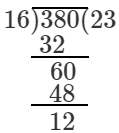
We know the $H.C.F.$ of two numbers is a factor of their $L.C.M.$ but 16 is not a factor of $380$ or $380$ is not divisible by $16.$
It can not be possible. View full question & answer→Question 333 Marks
Prove that following numbers are irrationals:
$\frac{3}{2\sqrt{5}}$
AnswerLet us assume that $\frac{3}{2\sqrt{5}}$ is rational.
Then, there exist positive co-primes a and b such that,
$\frac{3}{2\sqrt{5}}=\frac{\text{a}}{\text{b}}$
$\sqrt{5}=\frac{3}{2}\frac{\text{b}}{\text{a}}$
$\sqrt{5}$ is rational. This is a contradication.
Thus $\frac{3}{2\sqrt{5}}$ is irrational.
View full question & answer→Question 343 Marks
Find the greatest number that will divide $445, 572$ and $699$ leaving remainders $4, 5$ and $6$ respectively.
AnswerThe required number when divides $445, 572$ and $699$ leaves remainders $4, 5$ and $6$
This means $445 - 4 = 441, 572 - 5 = 567$ and $699 - 6 = 693$ are completely divisible by the number
$\therefore$ The required number $= HCF$ of $441, 567$ and $693$
First consider $441$ and $567$
By applying Euclid’s division lemma
$567 = 441 × 1 + 126$
$441 = 126 × 3 + 63$
$126 = 63 × 2 + 0$
$\therefore HCF $ of $441$ and $567 = 63$
Now consider $63$ and $693$
By applying Euclid’s division lemma
$693 = 63 × 11 + 0$
$\therefore HCF$ of $441, 567$ and $693 = 63$
Hence required number is $63.$
View full question & answer→Question 353 Marks
Find the $LCM$ and $HCF$ of the following integer by applying the prime factorisation method.
$24, 15$ and $36$
AnswerLet us first find the factors of $24, 15$ and $36.$
$24=2^3 \times 3 $
$15=3 \times 5$
$36=2^2 \times 3^2$
$\text { L.C.M of } 24,15 \text { and } 36=2^3 \times 3^2 \times 5$
$L.C.M$ of $24, 15$ and $36 = 360$
$H.C.F$ of $24, 15$ and $36 = 3$
View full question & answer→Question 363 Marks
Express the $HCF$ of $468$ and $222$ as $468x + 222y$ where $x, y$ are integers in two different ways.
AnswerWe need to express the $H.C.F.$ of $468$ and $222$ as $468x + 222y$
Where $x, y$ are integers in two different ways.
Given integers are $468$ and $222,$ where $468 > 222$
By applying Euclid’s division lemma, we get $468 = 222 × 2 + 24.$
Since the remainder $≠ 0,$ so apply division lemma on divisor $222$ and remainder $24.$
$222 = 24 × 9 + 6.$
Since the remainder $≠ 0,$ so apply division lemma on divisor $24$ and remainder $6.$
$24 = 6 × 4 + 0.$
We observe that remainder is $0$. So the last divisor 6 is the $H.C.F.$ of $468$ and $222$ from we have
$6 = 222 - 24 × 9$
$⇒ 6 = 222 - (468 - 222 × 2) × 9 [$Substiuting $24 = 468 - 222 × 2]$
$⇒ 6 = 222 - 468 × 9 + 222 × 18$
$⇒ 6 = 222 × 19 - 468 × 9$
$⇒ 6 = 222y + 468x,$ where $x = -9 $ and $y = 19$
View full question & answer→Question 373 Marks
A mason has to fit a bathroom with square marble tiles of the largest possible size. The size of the bathroom is $10\ ft.$ by $8\ ft.$ What would be the size in inches of the tile required that has to be cut and how many such tiles are required$?$
AnswerA mason has to fit a bathroom with square marble tiles of the largest possible size. The size of the bathroom is $10\ ft.$ by $8\ ft.$ We need to find the size in inches of the tile required that has to be cut and number of such tiles are required.
Size of bathroom $= 10\ ft$ by $8\ ft$
$= (10 × 12)$ inch by $(8 × 12)$ inch
$= 120$ inch by $96$ inch
The largest size of tile required $= H.C.F.$ of $120$ and $96.$
By applying Euclid’s division lemma
$120 = 96 × 1 + 24$
$96 = 24 × 4 + 0$
Therefore, $H.C.F. = 24.$
Thus, largest size of tile required $= 24$ inches.
Therefore,
No, of tiles required $= \frac{\text{Area of bathroom}}{\text{Area of 1 tile}}$
$=\frac{120 \times 96}{24 \times 24}$
$= 5 \times 4$
$= 20 \text{ tiles}.$
View full question & answer→Question 383 Marks
Write the exponent of $2$ in the price factorization of $144.$
AnswerUsing the factor tree for prime factorization, we have:
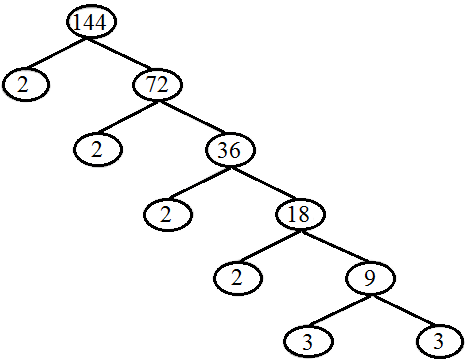
$144 = 2 × 2 × 2 × 2 × 3 × 3$
$144 = 2^4× 3^2$
Hence the exponent of $2$ in $144$ is $4.$ View full question & answer→Question 393 Marks
Show that the square of any positive integer cannot be of the form $3m + 2,$ where m is a natural number.
AnswerBy Euclid's lemma, $b = aq + r, 0 ≤ r < a.$
Here, $b$ is a positive integer and $a = 3.$
$\therefore b = 3q + r,$ for $0 ≤ r < 3$
This must be in the form $3q, 3q + 1$ or $3q + 2.$
Now,
$ (3 q)^2=9 q^2=3 m, \text { where } m=3 q^2$
$ (3 q+1)^2=9 q^2+6 q+1=3\left(3 q^2+2 q\right)+1=3 m+1, \text { where } m=3 q^2+2 q $
$ (3 q+2)^2=9 q^2+12 q+4=3\left(3 q^2+4 q+1\right)+1=3 m+1, \text { where } m=3 q^2+4 q+1$
Therefore, the square of a positive integer cannot be of the form $3m + 2,$ where $m$ is a natural number.
View full question & answer→Question 403 Marks
Find the $HCF$ of the following pairs of integers and express it as a linear combination of them.
$506$ and $1155$
AnswerGiven that two positive integers are $506$ and $1155$ and $1155 > 506.$
So. applying Euclid's division algorithem
$1155 = 506 × 2 + 143 …..(i)$
Here, remainder $143 ≠ 0,$ so again apply euclid's division algorithem on divisor $506$ and remainder $143.$
$506 = 143 × 3 + 77 …..(ii)$
Here, remainder $77 ≠ 0,$ so again apply euclid's division algorithem on divisor $143$ and remainder $77.$
$143 = 77 × 1 + 66 …..(iii)$
Here, remainder $66 ≠ 0,$ so again apply euclid's division algorithem on divisor $77$ and remainder $66.$
$77 = 66 × 1 +11 …..(iv)$
Here, remainder $11 ≠ 0,$ so again apply euclid's division algorithem on divisor $66$ and remainder $11.$
$66 = 11 × 6 + 0 …..(v)$
Now, remainder $= 0.$
So, tha division of this stage and remainder of previous stage i.e., $11$ is $HCF$ of $506$ and $1155.$
$HCF (506, 1155) = 11$
Linear Combination:
$11 = 16 × 506 + (-7) × 1155$
View full question & answer→Question 413 Marks
Show that $2-\sqrt{3}$ is an irrational number.
AnswerLet us assume that $2-\sqrt{3}$ is rational.
Then, there exist positive co primes a and b such that,
$2-\sqrt{3}=\frac{\text{a}}{\text{b}}$
$\sqrt{3}=2-\frac{\text{a}}{\text{b}}$
This implies, $\sqrt{33}$ is a rational number, which is a contradiction.
Hence, $2-\sqrt{3}$ is irrational number
View full question & answer→Question 423 Marks
Two brands of chocolates are available in packs of $24$ and $15$ respectively. If I need to buy an equal number of chocolates of both kinds, what is the least number of boxes of each kind I would need to buy$?$
AnswerNumber of chocolates of $1^{st}$ brand in one pack $= 24$
Number of chocolates of $2^{nd}$ b and in one pack $= 15$
$\therefore$ The least number of chocolates $1$ need to purchase
$24 = 2 × 2 × 2 × 3$
$15 = 3 × 5$
So, that $LCM$ of $24$ and $15$
$= 2 × 2 × 2 × 3 × 5$
$= 120$
$\therefore$ The number of packet of $1st$ brand $=\frac{120}{24}=5$
And the number of packet of $2nd$ brand $=\frac{120}{15}=8$
View full question & answer→Question 433 Marks
Prove that $4-5\sqrt{2}$ is an irrational number.
AnswerLet $4-5\sqrt{2}$ is not are irrational number.
and let $4-5\sqrt{2}$ is a rational number.
and $4-5\sqrt{2}=\frac{\text{a}}{\text{b}}$ where a and b are positive prime integers,
$\Rightarrow\ 4-\frac{\text{a}}{\text{b}}=5\sqrt{2}$
$\Rightarrow\ \frac{4\text{b}-\text{a}}{\text{b}}=5\sqrt{2}$
$\Rightarrow\ \frac{4\text{b}-\text{a}}{5\text{b}}=\sqrt{2}$
$\sqrt{2}$ is a rational number.
But $\sqrt{2}$ is an irrational number.
Our supposition is wrong.
$4-5\sqrt{2}$ is an irrational number.
View full question & answer→Question 443 Marks
$15$ pastries and $12$ biscuit packets have been donated for a school fete. These are to be packed in several smaller identical boxes with the same number of pastries and biscuit packets in each. How many biscuit packets and how many pastries will each box contain$?$
AnswerNumber of pastries $= 15$
Number of biscuit packets $= 12$
$\therefore $ The required no of boxes to contain equal number $= HCF$ of $15$ and $12$
By applying Euclid’s division lemma
$15 = 12 × 1 + 3$
$12 = 3 × 4 + 0$
$\therefore $ No. of boxes required $= 3$
Hence each box will contain $\frac{15}{3}=5$ pastries and $\frac{2}{3}$ biscuit packets.
View full question & answer→Question 453 Marks
Prove that $\sqrt{2}+\sqrt{3}$ is an irrational number.
AnswerLet us suppose that $\sqrt{2}+\sqrt{3}$ is rational.
Let $\sqrt{2}+\sqrt{3}=\text{a},$ where a is rational.
Therefore, $\sqrt{2}=\text{a}-\sqrt{3}$
Squaring on both sides, we get
$2=\text{a}^2+3-2\text{a}\sqrt{3}$
Therefore,
$\sqrt{3}=\frac{\text{a}^2+1}{2\text{a}}$
which is a contradiction as the right hand side is a rational number while $\sqrt{3}$ is irrational.
Hence, $\sqrt{2}+\sqrt{3}$ is irrational.
View full question & answer→Question 463 Marks
Find the $HCF$ of the following pairs of integers and express it as a linear combination of them.
$592$ and $252$
AnswerWe need to find the $H.C.F.$ of $592$ and $252$ and express it as a linear combination of $592$ and $252.$
By applying Euclid’s division lemma
$592 = 252 × 2 + 88$
Since remainder $≠ 0,$ apply division lemma on divisor $252$ and remainder $88.$
$252 = 88 × 2 + 76$
Since remainder $≠ 0,$ apply division lemma on divisor $88$ and remainder $76.$
$88 = 76 × 1 + 12$
Since remainder $≠ 0,$ apply division lemma on divisor $76$ and remainder $12.$
$76 = 12 × 6 + 4$
Since remainder $≠ 0$, apply division lemma on divisor $12$ and remainder $4.$
$12 = 4 × 3 + 0$
Therefore, $H.C.F. = 4.$
Now,
$4 = 76 - 12 × 6$
$= 76 - [88 - 76 × 1] × 6$
$= 76 - 88 × 6 + 76 × 6$
$= 76 × 7 - 88 × 6$
$= (252 - 88 × 2) × 7 - 88 × 6$
$= 252 × 7 - 88 × 14 - 88 × 6$
$= 252 × 7 - 88 × 20$
$= 252 × 7 - [592 - 252 × 2] × 20$
$= 252 × 7 - 592 × 20 + 252 × 40$
$= 252 × 47 - 592 × 20$
$= 252 × 47 + 592 × (-20)$
View full question & answer→Question 473 Marks
What is the largest number that divides $626, 3127$ and $15628$ and leaves remainders of $1, 2$ and $3$ respectively.
AnswerThe reqwired number when divises $626, 3127$ and $157628,$ leaves remainder $1, 2$ and $3.$
This meams $626 - 1 = 625, 3127 - 2 = 3125$ and $15628 - 3 = 15625$ are completely divisible by the number
$\therefore$ The required number $= H.C.F$ of $625, 3125$ and $15625$
First consider $625$ and $3125$
By applying Euclid’s division lemma
$3125 = 625 × 5 + 0$
$H.C.F$ of $625$ and $3125 = 625$
Now consider $625$ and $15625$
By applying Euclid’s division lemma
$15625 = 625 × 25 + 0$
$\therefore H.C.F$ of $625, 3125$ and $15625 = 625$
Hence required number is $625.$
View full question & answer→Question 483 Marks
Find the greatest number of $6$ digits exactly divisible by $24, 15$ and $36.$
Answergreatest number of $6$ digit $= 999999$
Prime factor of $24, 15$ and $36$ are
$ 24=2^3 \times 3 $
$ 15=3 \times 5 $
$ 36 \times 2^2 \times 3^2$
$ \text { L.C.M }(24,15,36)=2^3 \times 3^2 \times 5 $
$ =8 \times 9 \times 5 $
$ =360$
Required number must be divisible by LCM of $24, 15$ and $36$ i.e., $360.$
Required number $= 999999 -$ Remainder when $999999$ is divided by $360.$
$= 999999 - (999999$ mod $360)$
$= 999999 - 279$
$= 999720$
View full question & answer→Question 493 Marks
Prove that following numbers are irrationals:
$5\sqrt{2}$
AnswerLet us assume that $5\sqrt{2}$ is rational.
Then, there exist positive co-primes a and b such that,
$5\sqrt{2}=\frac{\text{a}}{\text{b}}$
$\sqrt{2}=\frac{\text{a}}{5\text{b}}$
$\sqrt{2}$ is a rational number which is a contradication.
Hence $5\sqrt{2}$ is irrational.
View full question & answer→Question 503 Marks
Find the largest number which divides $615$ and $963$ leaving remainder $6$ in each case.
AnswerWe need to find the largest number which divides $615$ and $963$ leaving remainder $6$ in each case.
The required number when divides $615$ and $963,$ leaves remainder $6,$ this means $615 - 6 = 609$ and $963 - 6 = 957$ are completely divisible by the number.
Therefore,
The required number $= H.C.F.$ of $609$ and $957.$
By applying Euclid’s division lemma
$957 = 609 × 1 + 348$
$609 = 348 × 1 + 261$
$348 = 216 × 1 + 87$
$261 = 87 × 3 + 0.$
Therefore, $H.C.F. = 87.$
Hence, the required number is $87.$
View full question & answer→