Question 13 Marks
The angle of elevation of the top of a building from the foot of the tower is $30^\circ $ and the angle of elevation of the top of the tower from the foot of the building is $60^\circ $. If the tower is $50\ m$ high, find the height of the building.
AnswerGiven,
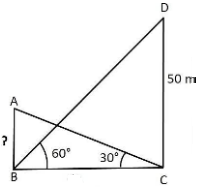
Let the height of building be $AB$ and height of tower $CD$
Height of the tower $(CD)= 50\ m$
Angle of elevation of top of building from foot of tower $= 30^\circ$
Hence, $\angle ACB = 30^o $
Angle of elevation of top of tower from from foot of building $= 60^\circ$
Hence,$\angle$ DBC $= 60^\circ$
$\angle ABC = 90^\circ$ & $\angle DCB = 90^\circ$
In a right angle triangle $DBC,$
$\tan B = \frac{side \ opposite \ to \ angle \ to \ D} {side \ opposite \ to \ angle \ H}$
$\tan B = \frac{D C}{B C}$
$\tan 60^0$ = $\frac{50}{B C}$
$B C=\frac{50}{\sqrt{3}}$
Similarly,
In a right angle triangle $ABC,$
$\tan C = \frac{side \ opposite \ to \ angle \ to \ C} {side \ adjacent \ to \ angle \ C}$
$\tan 30^0$ = $\frac{AB} {BC}$
$\frac{1}{\sqrt{3}}=\frac{A B}{\frac{50}{\sqrt{3}}}$
$\frac{1}{\sqrt{3}} \times \frac{50}{\sqrt{3}}=\mathrm{AB}$
$A B=\frac{1}{\sqrt{3}} \times \frac{50}{\sqrt{3}}$
$A B=\frac{50}{3} m$ View full question & answer→Question 23 Marks
A statue, $1.6\ m$ tall, stands on the top of a pedestal. From a point on the ground, the angle of elevation of the top of the statue is $60^\circ$ and from the same point the angle of elevation of the top of the pedestal is $45^\circ$. Find the height of the pedestal.
Answer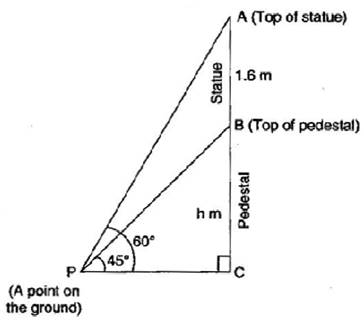
Let the height of the pedestal be $h\ m.$
$\therefore BC = h\ m$
In right triangle $ACP,$
$\tan 60 ^ { \circ } = \frac { A C } { P C }$
$\Rightarrow \sqrt { 3 } = \frac { A B + B C } { P C }$
$\Rightarrow \sqrt { 3 } = \frac { 1.6 + h } { \mathrm { PC } }..........(i)$
In right triangle $BCP,$
$\tan 45 ^ { \circ } = \frac { B C } { P C }$
$\Rightarrow 1 = \frac { h } { \mathrm { PC } } \Rightarrow _ { \mathrm { PC } } = h$
$\therefore \sqrt { 3 } = \frac { 1.6 + h } { h }[$From eq. $(i)]$
$\Rightarrow \sqrt { 3 } h = 1.6 + h \Rightarrow h ( \sqrt { 3 } - 1 ) = 1.6 \Rightarrow \frac { 1.6 } { \sqrt { 3 } - 1 }$
$\Rightarrow \quad \frac { 1.6 ( \sqrt { 3 } + 1 ) } { ( \sqrt { 3 } - 1 ) ( \sqrt { 3 } + 1 ) } \Rightarrow { h = \frac { 1.6 ( \sqrt { 3 } + 1 ) } { 3 - 1 } } \Rightarrow h = \frac { 1.6 ( \sqrt { 3 } + 1 ) } { 2 }$
$\Rightarrow h = 0.8 ( \sqrt { 3 } + 1 ) _ { \mathrm { m } }$ View full question & answer→Question 33 Marks
From a point on the ground, the angles of elevation of the bottom and the top of a transmission tower fixed at the top of a $20\ m$ high building are $45^\circ $ and $60^\circ $ respectively. Find the height of the tower
Answer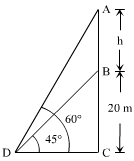
Let $BC$ be the building, $AB$ be the transmission tower, and $D$ be the point on the ground.
In $ΔBCD,$
${BC \over CD }= \tan 45^\circ $
$\Rightarrow {20\over CD} = 1$
$\Rightarrow CD =20$
In $\triangle ACD,$
${AC\over CD} = \tan 60^\circ $
$\Rightarrow \frac{AB+BC}{CD} = \sqrt 3$
$\Rightarrow \frac{AB+20}{20} = \sqrt 3$
$\Rightarrow {AB+20}= 20\sqrt 3$
$\Rightarrow AB = 20({\sqrt 3 - 1}) \ m.$ View full question & answer→Question 43 Marks
A $1.5\ m$ tall boy is standing at some distance from a $30\ m$ tall building. The angle of elevation from his eyes to the top of the building increases from $30^\circ $ to $60^\circ $ as he walks towards the building. Find the distance he walked towards the building.
Answer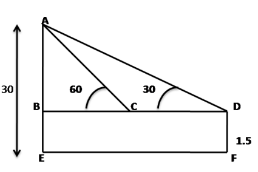
Let $AE$ is the Length of the building. So $AE = 30$ Again $BE = DF = 1.5 AB = AE - BE = 30 - 1.5 = 28.5$
Now in triangle $ABC, \tan 60 = \frac{AB}{BC}$
$\Rightarrow \sqrt3 = \frac{28.5}{BC}$
$\Rightarrow BC = \frac{28.5}{\sqrt 3}$ Again in triangle $ABD \tan 30 = \frac{AB}{BD}$
$\sqrt{1}{\sqrt3}=\frac{28.5}{BD}$
$\Rightarrow BD = 28.5\times\sqrt3 \Rightarrow BC + CD = 28.5\sqrt3 \Rightarrow 28.5/\sqrt3 + CD = 28.5\sqrt3 \Rightarrow CD = \frac{28.5}{\sqrt 3}- \frac{28.5}{\sqrt 3}$
$\Rightarrow CD = \frac{28.5\times3-28.5}{\sqrt3}$
$\Rightarrow CD = \frac{28.5(3-1)}{\sqrt3}$
$\Rightarrow CD = \frac{(28.5\times 2)}{\sqrt3}$
$\Rightarrow CD = \frac{(57)}{\sqrt3}$
$\Rightarrow CD = \frac{(57\sqrt3)}{\sqrt3\times\sqrt3}$ (Multiply $\sqrt 3$ in numerator and denominator) $\Rightarrow CD = \frac{57\sqrt3}{3}$
$\Rightarrow CD = 19\sqrt3$ The distance he walked towards the building is $19 \sqrt 3\ m$
View full question & answer→Question 53 Marks
A kite is flying at a height of $60\ m$ above the ground. The string attached to the kite is temporarily tied to a point on the ground. The inclination of the string with the ground is $60^\circ$. Find the length of the string, assuming that there is no slack in the string.
Answer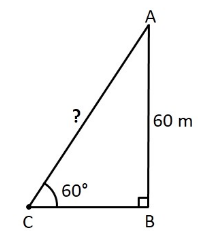
In right triangle $ABC,$
$\sin 60 ^ { \circ } = \frac { A B } { A C }$
$\Rightarrow \frac { \sqrt { 3 } } { 2 } = \frac { 60 } { \mathrm { AC } }$
$A C = \frac { 120 } { \sqrt { 3 } }$
Multiplying $\sqrt3$ in both numerator and denominator,
$\mathrm { AC } = \frac { 120 } { \sqrt { 3 } } \times \frac { \sqrt { 3 } } { \sqrt { 3 } }$
AC = $40\sqrt3 m$
Hence the length of the string is $40\sqrt 3\ m.$ View full question & answer→Question 63 Marks
A contractor plans to install two slides for the children to play in a park. For the children below the age of $5$ years, she prefers to have a slide whose top is at a height of $1.5\ m$, and is inclined at an angle of $30^\circ $ to the ground, whereas for elder children, she wants to have a steep slide at a height of $3\ m,$ and inclined at an angle of $60^\circ $ to the ground. What should be the length of the slides in each case$?$
AnswerIn the first case:
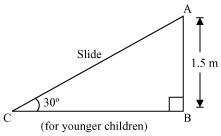
Height of slide$= 1.5\ m$ and angle of elevation $= 30^\circ $
Now,
$\sin \theta=\frac{p}{h}$
where p = perpendicular, i.e. height of the slide and $h = $hypotenuse, i.e. length of the slide and $\theta$ is the angle of elevation
$\sin 30^{\circ}=\frac{1.5}{h}$
$\frac{1}{2}=\frac{1.5}{h}$
Hence, $h = 3\ m$
In the second case:
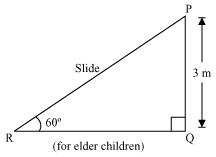
Height of slide, $= 3\ m, $ angle of elevation $= 60^\circ $
$\sin \theta=\frac{p}{h}$
$\sin 60^{\circ}=\frac{3}{h}$
$\frac{\sqrt{3}}{2}=\frac{3}{h}$
Hence, $h = 2{\sqrt{3}} m$
Therefore, the length of the slide in the first and the second case are $3\ m$ and $2{\sqrt{3}}$ m respectively. View full question & answer→Question 73 Marks
A tree breaks due to storm and the broken part bends so that the top of the tree touches the ground making an angle $30^\circ$ with it. The distance between the foot of the tree to the point where the top touches the ground is $8\ m.$ Find the height of the tree.
Answer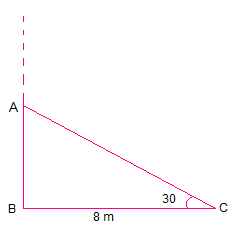
Let $AC$ be the broken part of the tree.
$\therefore$ Total height of the tree $= AB + AC$
In right $\triangle ABC,$
$\cos\ 30^\circ = \frac{BC}{AC}$
$\Rightarrow \frac{\sqrt3}{2} = 8/AC \frac{\sqrt3}{2}=\frac{8}{AC}$
$\Rightarrow AC = \frac{16}{\sqrt3}$
Also,
$\tan 30^\circ =\frac{AB}{BC}$
$\Rightarrow \frac{1}{\sqrt3}=\frac{AB}{8}$
$\Rightarrow AB = \frac{8}{\sqrt3}$
Total height of the tree $= AB + AC = 16/\sqrt3 + 8/\sqrt3 = 24/\sqrt3\frac{16}{\sqrt3} + \frac{8}{\sqrt3} = \frac{24}{\sqrt3}$ View full question & answer→Question 83 Marks
A straight highway leads to the foot of a tower. A man standing at the top of the tower observes a car at an angle of depression of $30^\circ ,$ which is approaching the foot of the tower with a uniform speed. Six seconds later, the angle of depression of the car is found to be $60^\circ .$ Find the further time taken by the car to reach the foot of the tower from this point.
Answer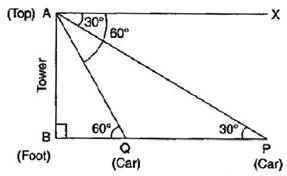
In right triangle $ABP, $
$ \tan 30 ^ { \circ } = \frac { \mathrm { AB } } { \mathrm { BP } } $
$ \Rightarrow \frac { 1 } { \sqrt { 3 } } = \frac { \mathrm { AB } } { \mathrm { BP } } $
$BP = AB \sqrt3 ........ (i)$
In right triangle $ABQ,$
$ \tan\;60^0\;={AB\over BQ} $
$ \Rightarrow \sqrt { 3 } = \frac { A B } { B Q } $
$ \Rightarrow _ { B Q } = \frac { A B } { \sqrt { 3 } } ....... (ii)$
$ \because PQ = BP - BQ$
$ \therefore PQ = AB \sqrt { 3 } - \frac { A B } { \sqrt { 3 } } = \frac { 3 A B - A B } { \sqrt { 3 } } = \frac { 2 A B } { \sqrt { 3 } } = 2BQ [$From eq.$ (ii)]$
$\Rightarrow BQ = \frac12 PQ$
$ \because$ Time taken by the car to travel a distance $PQ = 6$ seconds.
$\therefore$ Time taken by the car to travel a distance $BQ$, i.e. $\frac12 PQ = \frac12 \times 6 = 3$ seconds.
Hence, the further time taken by the car to reach the foot of the tower is 3 seconds. View full question & answer→Question 93 Marks
A $1.2\ m$ tall girl spots a balloon moving with the wind in a horizontal line at a height of $88.2\ m$ from the ground. The angle of elevation of the balloon from the eyes of the girl at any instant is $60^\circ $. After some time, the angle of elevation reduces to $30^\circ .$ Find the distance traveled by the balloon during the interval.
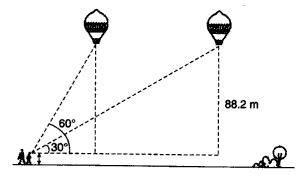
AnswerIn right triangle $ABC,$
$\tan 60 ^ { \circ } = \frac { A B } { B C }$
$\Rightarrow \sqrt { 3 } = \frac { 88.2 } { B C }$
$\Rightarrow B C = \frac { 88.2 } { \sqrt { 3 } }$
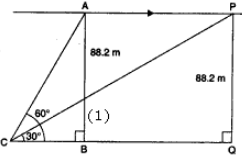
In right triangle $PQC,$
$\tan 30 ^ { \circ } = \frac { \mathrm { PQ } } { \mathrm { CO } }$
$\Rightarrow \tan 30 ^ { \circ } = \frac { \mathrm { PQ } } { \mathrm { CB } + \mathrm { BQ } } \Rightarrow \frac { 1 } { \sqrt { 3 } } = \frac { 88.2 } { \frac { 88.2 } { \sqrt { 3 } } + \mathrm { BQ } }.......$ From $(1)$
$\Rightarrow \frac { 1 } { \sqrt { 3 } } = \frac { 88.2 \sqrt { 3 } } { 88.2 + \mathrm { BQ } \sqrt { 3 } } \Rightarrow 88.2 + \mathrm { BQ } \sqrt { 3 } = 264.6$
$\Rightarrow \mathrm { BQ } \sqrt { 3 } = 264.6 - 88.2 = 176.4$
$\Rightarrow B Q = \frac { 176.4 } { \sqrt { 3 } } = \frac { ( 176.4 ) \sqrt { 3 } } { \sqrt { 3 } \sqrt { 3 } }$
$= \frac { ( 176.4 ) \sqrt { 3 } } { 3 } = ( 58.8 ) \sqrt { 3 } = \frac { 58.8 } { 10 } \sqrt { 3 } = \frac { 294 } { 5 } \sqrt { 3 }$
Hence, the distance travelled by the balloon during the interval is $\frac { 294 } { 5 } \sqrt { 3 } \mathrm { m }$. View full question & answer→Question 103 Marks
As observed from the top of a $75\ m$ high lighthouse from the sea-level, the angles of depression of two ships are $30^\circ$ and $45^\circ$. If one ship is exactly behind the other on the same side of the lighthouse, find the distance between two ships.
AnswerIn right triangle $ABQ,$
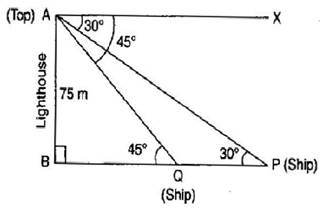
$\tan 45 ^ { \circ } = \frac { A B } { B Q }$
$\Rightarrow 1 = \frac { 75 } { \mathrm { BQ } }$
$\Rightarrow BQ = 75\ m ........ (i)$
In right triangle $ABP,$
$\tan 30 ^ { \circ } = \frac { A B } { B P }$
$\Rightarrow \frac { 1 } { \sqrt { 3 } } = \frac { A B } { B Q + Q P } $
$\Rightarrow \frac { 1 } { \sqrt { 3 } } = \frac { A B } { 75 + Q P }[$From eq. $(i)]$
$\Rightarrow 75 + QP = 75\sqrt3$
$QP = 75(\sqrt3-1) m$
Hence the distance between the two ships is $75(\sqrt3-1) m.$ View full question & answer→Question 113 Marks
From the top of a $7\ m$ high building, the angle of elevation of the top of a cable tower is $60^\circ$ and the angle of depression of its foot is $45^\circ$. Determine the height of the tower.
AnswerIn right triangle $ABD,$
$\tan {45^0} = \frac{{AB}}{{BD}}$
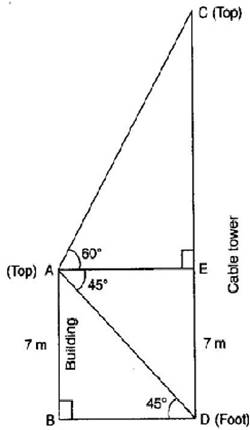
$ \Rightarrow 1 = \frac { 7 } { B D }$
$ \Rightarrow BD = 7 m$
$ \Rightarrow AE = 7 m$
In right triangle $AEC,$
$\tan 60 ^ { \circ } = \frac { C E } { A E }$
$\Rightarrow \sqrt { 3 } = \frac { \mathrm { CE } } { 7 } \Rightarrow \mathrm { CE } = 7 \sqrt { 3 } \mathrm { m }$
$\therefore CD = CE + ED$
$= CE + AB$
$= 7 \sqrt { 3 } + 7 = 7 ( \sqrt { 3 } + 1 ) { \mathrm { m } }$
Hence height of the tower is $7 ( \sqrt { 3 } + 1 ) m$. View full question & answer→Question 123 Marks
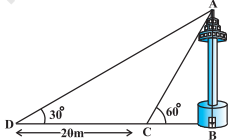
A TV tower stands vertically on a bank of a canal. From a point on the other bank directly opposite the tower, the angle of elevation of the top of the tower is $60^\circ .$ From another point $20\ m$ away from this point on the line joing this point to the foot of the tower, the angle of elevation of the top of the tower is $30^\circ .$ Find the height of the tower and the width of the canal.
View full question & answer→Question 133 Marks
Two poles of equal heights are standing opposite each other on either side of the road, which is $80\ m$ wide. From a point between them on the road, the angles of elevation of the top of the poles are $60^\circ$ and $30^\circ$ respectively. Find the height of the poles and the distances of the point from the poles.
Answer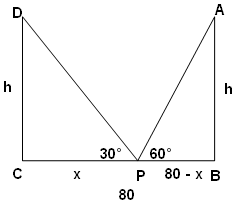
Suppose $AB$ and $CD$ are the two poles of equal height $h\ m.$
$BC$ be the $80\ m$ wide road. $P$ is any point on the road.
Let $CP$ be $x\ m,$ therefore $BP = (80 – x)$ .
Also, $\angle APB = 60^\circ$ and $\angle DPC =30^\circ$
In right angled triangle $DCP,$
$\tan 30^\circ = \frac{CD}{CP}$
$\Rightarrow \frac{h}{x} = \frac{1}{{\sqrt 3 }}$
$\Rightarrow h=\frac{x}{\sqrt3} .......(1)$
In right angled triangle $ABP,$
$\tan\ 60^\circ= AB/AP \frac{AB}{AP}$
$\Rightarrow \frac{h}{80-x}=\sqrt3$
$\Rightarrow h=\sqrt3(80-x)$
$\Rightarrow \frac{x}{\sqrt3}=\sqrt3(80-x)$
$\Rightarrow x = 3(80 – x)$
$\Rightarrow x = 240 – 3x$
$\Rightarrow x + 3x = 240$
$\Rightarrow 4x = 240$
$\Rightarrow x = 60$
Height of the pole, $h = x/\sqrt3 = 60/\sqrt3 = 20\sqrt3.$
Thus, the position of the point P is 60 m from C and the height of each pole is $20\sqrt3\ m.$
View full question & answer→Question 143 Marks
From a point on a bridge across a river, the angles of depression of the banks on opposite sides of the river are $30^\circ $ and $45^\circ ,$ respectively. If the bridge is at a height of $3\ m$ from the banks, find the width of the river.
Answer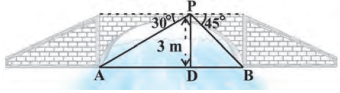
In the above-given fig, $A$ and $B$ represent points on the bank on opposite sides of the river, so that $AB$ is the width of the river.
$P$ is a point on the bridge at a height of $3\ m$, i.e.,
$DP = 3\ m$. Here, we are interested to determine the width of the river, which is the length of the side $AB$ of the
$\triangle APB.$
Now, $AB = AD + DB$
In right $\triangle APD, \angle A = 30^\circ $
So,$\tan 30^\circ = \frac{\mathrm{PD}}{\mathrm{AD}}$
i.e., $\frac{1}{\sqrt{3}}=\frac{3}{\mathrm{AD}}$ or $AD = 3 \sqrt{3} m$
Also, in right $\triangle PBD, \angle B = 45^\circ .$ So, $BD = PD = 3\ m$
Now, $AB = BD + AD = 3 + 3 \sqrt{3}$ = 3$(1+\sqrt{3})m$
Therefore, the width of the river is $3(\sqrt{3}+1)m$ View full question & answer→Question 153 Marks
The angles of depression of the top and bottom of an $8\ m$ tall building from top of a multistoreyed building are $30^\circ$ and $45^\circ$, respectively. Find the height of multi-storeyed building and distance between two buildings.
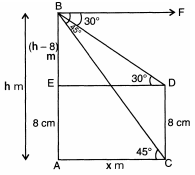
AnswerLet h is height of big building,here as per the diagram.
$AE = CD = 8 m ($Given$)$
$BE = AB-AE = (h - 8) m$
Let $AC = DE = x$
Also, $\angle F B D = \angle B D E = 30 ^ { \circ }$
$\angle F B C = \angle B C A = 45 ^ { \circ }$
In $\triangle ACB, \angle A = 90 ^ { \circ }$
$\tan 45 ^ { \circ } = \frac { A B } { A C }$
$\Rightarrow x = h, ...(i)$
In $\vartriangle BDE, \angle E = 90 ^ { \circ }$
$\tan 30 ^ { \circ } = \frac { B E } { E D }$
$\Rightarrow \quad x = \sqrt { 3 } ( h - 8 ) .(ii)$
From $(i)$ and $(ii),$ we get
$h = \sqrt { 3 } h - 8 \sqrt { 3 }$
$h(√3 - 1) = 8√3$
$h = \frac{8\sqrt3}{\sqrt3-1}=\frac{8\sqrt3}{\sqrt3-1}×\frac{\sqrt3+1}{\sqrt3+1}$
$= \frac{1}{2}×(24+8√3)=\frac{1}{2}×(24+13.84)=18.92\ m$
Hence height of the multistory building is $18.92\ m$ and the distance between two buildings is $18.92\ m.$ View full question & answer→Question 163 Marks
From a point $P$ on the ground the angle of elevation of the top of a $10\ m$ tall building is $30^\circ$. A flag is hoisted at the top of the building and the angle of elevation of the top of the flagstaff from $P$ is $45^\circ$. Find the length of the flagstaff and distance of building from point $P.\ \sqrt { 3 } = 1.732 ]$
AnswerLet height of flagstaff be $BD = x\ m$
$\therefore \quad \tan 30 ^ { \circ } = \frac { A B } { A P }$
$\Rightarrow \quad \frac { 1 } { \sqrt { 3 } } = \frac { 10 } { A P }$
$A P = 10 \sqrt { 3 }$
distance of the building from $P.$
$= 10 \times 1.732 = 17.32 \mathrm { m }$
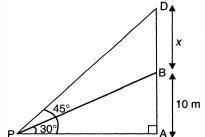
$\tan 45 ^ { \circ } = \frac { A D } { A P } \text { or } 1 = \frac { 10 + x } { 17 \cdot 32 }$
or,$ x + 10 = 17.32$
$x = 17.32 - 10$
$x = 7.32$
Hence, length of flagstaff $x = 1 7.32\ m.$ View full question & answer→Question 173 Marks
An observer $1.5\ m$ tall is $28.5\ m$ away from a chimney. The angle of elevation of the top of the chimney from her eyes is $45^\circ $. Find the height of the chimney$?$
View full question & answer→Question 183 Marks
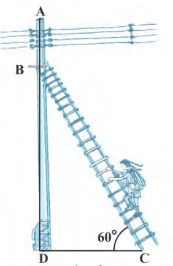
An electrician has to repair an electric fault on a pole of height $5\ m.$ She needs to reach a point $1.3\ m$ below the top of the pole to undertake the repair work. What should be the length of the ladder that she should use which, when inclined at an angle of $60^\circ $ to the horizontal, would enable her to reach the required position$?$ Also, how far from the foot of the pole should she place the foot of the ladder$? ($You may take $\sqrt 3 = 1.73)$
View full question & answer→Question 193 Marks
A tower stands vertically on the ground. From a point on the ground, which is $15\ m$ away from the foot of the tower, the angle of elevation of the top of the tower is found to be $60°.$ Find the height of the tower.
Answer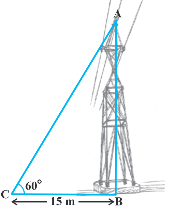
First, let us draw a simple diagram to represent the problem. Here $AB$ represents the tower, $CB$ is the distance of the point from foot of the tower and $\angle ACB$ is the angle of elevation. We need to determine the height of the tower, i.e., $AB.$ Also, $ACB$ is a triangle, right-angled at $B.$ To solve the problem, we choose the trigonometric ratio $\tan 60^\circ ($or $\cot 60^\circ ),$ as the ratio involves $AB$ and $BC.$
Now, $ \tan 60^\circ =\frac{\mathrm{AB}}{\mathrm{BC}}$
i.e., $\sqrt{3}=\frac{\mathrm{AB}}{15}$
i.e., $AB = 15 \sqrt{3}$
Hence, the height of the tower is $15 \sqrt{3}\ m$ View full question & answer→