Questions

4 Marks Questions

🎯

Test yourself on this topic

5 questions · timed · auto-graded

Question 14 Marks
A solid is consisting of a right circular cone of height 120 cm and radius 60 cm standing on a hemisphere of radius 60 cm. It is placed upright in a right circular cylinder full of water such that it touches the bottom. Find the volume of water left in the cylinder, if the radius of the cylinder is 60 cm and its height is 180 cm.
Answer
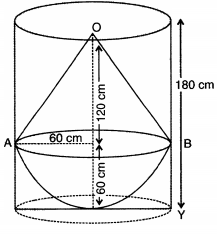
According to the question,A solid is consisting of a right circular cone of height 120 cm and radius 60 cm standing on a hemisphere of radius 60 cm. It is placed upright in a right circular cylinder full of water such that it touches the bottom.
Given, height of cone, h = 120 cm, radius of cone r = 60 cm
Radius of hemisphere = 60 cm.
Volume of cone $= \frac { 1 } { 3 } \pi r ^ { 2 } h$ 
$= \frac { 1 } { 3 } \times 3.14 \times 60 \times 60 \times 120$ 
$= 3.14 \times 60 \times 60 \times 40$ 
$= 452160 \mathrm { cm } ^ { 3 }$ 
Volume of hemisphere=$\frac{2}{3}πr^3=\frac{2}{3} ×\frac{22}{7}×(60)^3$=452160
Total volume = Volume of cone + Volume of hemisphere
= 452160 + 452160
$= 904320 \mathrm { cm } ^ { 3 }$ 
Height of cylinder = 180 cm,
radius = 60 cm
Volume of water in the cylinder = Volume of cylinder
$= \pi r ^ { 2 } h$ 
$= 3.14 \times 60 \times 60 \times 180$ 
$= 2034720 \mathrm { cm } ^ { 3 }$ 
Water left in the cylinder = Volume of water - Volume of (cone + hemisphere)
= 2034720 - 904320
$= 1130400 \mathrm { cm } ^ { 3 }$
View full question & answer
Question 24 Marks
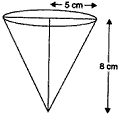
A vessel is in the form of an inverted cone. Its height is 8 cm and the radius of its top, which is open, is 5 cm. It is filled with water up to the brim. When lead shots, each of which is a sphere of radius 0.5 cm are dropped into the vessel, one-fourth of the water flows out. Find the number of lead shots dropped in the vessel.
View full question & answer
Question 34 Marks
A solid toy is in the form of a hemisphere surmounted by a right circular cone. The height of the cone is $2 \ cm$ and the diameter of the base is $4 \ cm.$ Determine the volume of the toy. If a right circular cylinder circumscribes the toy, find the difference of the volume of the cylinder and toy. $($Take $\pi = 3.14)$
Answer
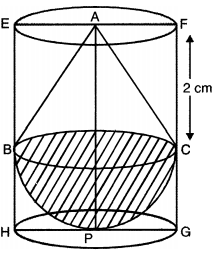
According to the question, A solid toy is in the form of a hemisphere surmounted by a right circular cone. The height of the cone is $2 \ cm$ and the diameter of the base is $4 \ cm.$
Let $BPC$ is a hemisphere and $ABC$ is a cone.
Radius of hemisphere $=$ Radius of cone
$= \frac { 4 } { 2 } = 2 \mathrm { \ cm }$
$h =$ Height of cone $= 2 \ cm$
Volume of toy $= \frac { 2 } { 3 } \pi r ^ { 3 } + \frac { 1 } { 3 } \pi r ^ { 2 } h$
$= \frac { 1 } { 3 } \pi r ^ { 2 } ( 2 r + h ) = \frac { 1 } { 3 } \times 3.14 \times 2 \times 2 ( 2 \times 2 + 2 )$
$= \frac { 1 } { 3 } \times 3.14 \times 4 \times 6$
$= 25.12 \mathrm { \ cm } ^ { 3 } ...(i)$
Let right circular cylinder $EFGH$ circumscribe the given solid toy.
Radius of cylinder $= 2 \ cm,$
Height of cylinder $= 4 \ cm$
Volume of right circular cylinder $= \pi r ^ { 2 } h$
$= 3.14 \times ( 2 ) ^ { 2 } \times 4 \mathrm { \ cm } ^ { 3 } ...(iii)$
$= 50.24 \mathrm { \ cm } ^ { 3 }$
$\therefore$ Difference of two volume $=$ Volume of cylinder $-$ Volume of toy
$= 50.24 - 25.12$
$=25.12 \ cm^3$
View full question & answer
Question 44 Marks
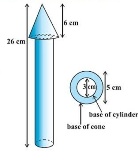
A wooden toy rocket is in the shape of a cone mounted on a cylinder as shown in given below figure. The height of the entire rocket is $26 \ cm,$ while the height of the conical part is $6 \ cm.$ The base of the conical portion has a diameter of $5 \ cm,$ while the base diameter of the cylindrical portion is $3 \ cm.$ If the conical portion is to be painted orange and the cylindrical portion yellow, find the area of the rocket painted with each of these colours. $($Take $\pi =3.14)$​​​​​​​
Answer
Let radius, slant height and height of cone be $r, l$ and $h$ respectively and radius and height of cylinder be $r_{1 }$ and $h_1$ respectively.
$r = 2.5 \ cm, h = 6 \ cm, r_1 = 1.5 \ cm$ and $h_1 = 26 - 6 = 20 \ cm$
$\therefore l = \sqrt { r ^ { 2 } + h ^ { 2 } } = \sqrt { ( 2.5 ) ^ { 2 } + 6 ^ { 2 } } $
$ = \sqrt { 6.25 + 36 } = \sqrt { 42.25 }$
$= 6.5 \mathrm { \ cm }$ Here, the conical portion has its circular base resting on the base of the cylinder, but the base of the cone is larger than the base of the cylinder. So, a part of the base of the cone $($a ring$)$ is to be painted.
So, the area to be painted orange $=$ Curved surface area of the cone $+$ Base area of the cone $-$ Base area of the cylinder
$ = \pi r l + \pi r ^ { 2 } - \pi r _ { 1 } ^ { 2 }$
$ = \pi \left\{ r l + r ^ { 2 } - r _ { 1 } ^ { 2 } \right\}$
$ = \pi \left\{ 2.5 \times 6.5 + ( 2.5 ) ^ { 2 } - ( 1.5 ) ^ { 2 } \right\}$
$ = 3.14 ( 16.25 + 6.25 - 2.25 ) = 3.14 \times 20.25 = 63.585 \mathrm { \ cm } ^ { 2 }$
Now, the area to be painted yellow $=$ Curved surface area of the cylinder $+$ Area of the base of the cylinder
$ = 2 \pi r _ { 1 } h _ { 1 } + \pi r _ { 1 } ^ { 2 }$
$= \pi r _ { 1 } \left( 2 h _ { 1 } + r _ { 1 } \right)$
$= 3.14 \times 1.5 ( 2 \times 20 + 1.5 ) $
$ = 3.14 \times 1.5 \times 41.5 = 4.71 \times 41.5 = 195.465 \mathrm { \ cm } ^ { 2 }$
View full question & answer
Question 54 Marks
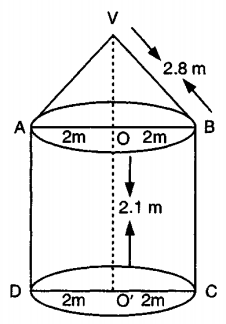
A tent is in the shape of a cylinder surmounted by a conical top. If the height and diameter of the cylindrical part are 2.1 m and 4 m respectively, and the slant height of the top is 2.8 m, find the area of the canvas used for making the tent. Also, find the cost of the canvas of the tent at the rate of ₹ 500 per m2. (Note that the base of the tent will not be covered with canvas.)
Answer
For conical portion, r = 2m and $l$ = 2.8 m. Let S1 the curved surface area of conical portion. Then,

$S _ { 1 } = \pi r l = \pi \times 2 \times 2.8 \mathrm { m } ^ { 2 } = 5.6 \pi \mathrm { m } ^ { 2 }$
For cylindrical portion, we have r = 2m ,h = 2.1m
Let S2 be the curved surface area of cylindrical portion. Then
$S _ { 2 } = 2 \pi r h = 2 \pi \times 2 \times 2.1 \mathrm { m } = 8.4 \pi \mathrm { m } ^ { 2 }$
Let S be the area of the canvas used. Then,
S = S1 + S= $( 5.6 \pi + 8.4 \pi ) \mathrm { m } ^ { 2 } = 14 \times \frac { 22 } { 7 } \mathrm { m } ^ { 2 } = 44 \mathrm { m } ^ { 2 }$
Total cost of the canvas at the rate of Rs 500 per m2 = Rs $( 500 \times 44 )$= Rs 22000
View full question & answer
4 Marks Questions - Maths STD 10 Questions - Vidyadip