Questions

3 Marks Question

🎯

Test yourself on this topic

19 questions · timed · auto-graded

Question 13 Marks
A solid is consisting of a right circular cone of height $120\ cm$ and radius $60\ cm$ standing on a hemisphere of radius $60 \ cm.$ It is placed upright in a right circular cylinder full of water such that it touches the bottom. Find the volume of water left in the cylinder, if the radius of the cylinder is $60 \ cm$ and its height is $180\ cm.$
Answer
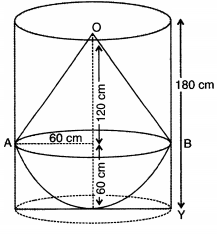
According to the question,A solid is consisting of a right circular cone of height $120 \ cm$ and radius $60 \ cm$ standing on a hemisphere of radius $60 \ cm.$ It is placed upright in a right circular cylinder full of water such that it touches the bottom.
Given, height of cone, $h = 120 \ cm,$ radius of cone $r = 60 \ cm$
Radius of hemisphere $= 60 \ cm.$
Volume of cone $= \frac { 1 } { 3 } \pi r ^ { 2 } h$
$= \frac { 1 } { 3 } \times 3.14 \times 60 \times 60 \times 120$
$= 3.14 \times 60 \times 60 \times 40$
$= 452160 \mathrm { cm } ^ { 3 }$
Volume of hemisphere=$\frac{2}{3}πr^3=\frac{2}{3} ×\frac{22}{7}×(60)^3=452160$
Total volume $=$ Volume of cone $+$ Volume of hemisphere
$= 452160 + 452160$
$= 904320 \mathrm { cm } ^ { 3 }$
Height of cylinder $= 180 \ cm,$
radius $= 60\ cm$
Volume of water in the cylinder $=$ Volume of cylinder
$= \pi r ^ { 2 } h$
$= 3.14 \times 60 \times 60 \times 180$
$= 2034720 \mathrm { cm } ^ { 3 }$
Water left in the cylinder = Volume of water $-$ Volume of $($cone $+$ hemisphere$)$
$= 2034720 - 904320$
$= 1130400 \mathrm { cm } ^ { 3 }$
View full question & answer
Question 23 Marks
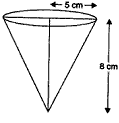
A vessel is in the form of an inverted cone. Its height is $8\ cm$ and the radius of its top, which is open, is $5 \ cm.$ It is filled with water up to the brim. When lead shots, each of which is a sphere of radius $0.5\ cm$ are dropped into the vessel, one-fourth of the water flows out. Find the number of lead shots dropped in the vessel.
Answer

For cone Radius of the top $(r) = 5\ cm$
Height$(h) = 8 \ cm$
$\therefore $ Volume =$\frac{1}{3}\pi {r^2}h$
=$\frac{1}{3}\pi {\left( r \right)^2}8$
=$\frac{{200}}{3}\pi c{m^3}$
For spherical lead shot
Radius $(R) = 0.5\ cm$
$\therefore $ The volume of a spherical lead shot $=\frac{4}{3}\pi {R^3} = \frac{4}{3}\pi {\left( {0.5} \right)^3} = \frac{\pi }{6}c{m^3}$
The volume of water that flows out $=\frac{1}{4}$volume of the cone
$=\frac{1}{4}\left( {\frac{{200\pi }}{3}} \right)\,c{m^3} = \frac{{50\pi }}{3}\,c{m^3}$
Let the number of lead shot dropped in the vessel be $'n'.$
Then, Volume of a lead shot = $\frac{{n\pi }}{6} = \frac{{50\pi }}{3}$
According to the questions, $\frac{{n\pi }}{6} = \frac{{50\pi }}{3}$
$\Rightarrow $ $n = \frac{{50\pi }}{3}\frac{6}{\pi } \Rightarrow n = 100$
Hence, the number of lead shot dropped in the vessel is $100.$
View full question & answer
Question 33 Marks
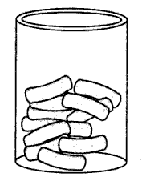
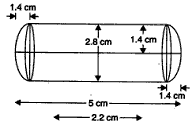
A gulab jamun, contains sugar syrup up to about $30\%$ of its volume. Find approximately how much syrup would be found in $45$ gulab jamun, each shaped like a cylinder with two hemispherical ends with length $5 \ cm$ and diameter $2.8 \ cm.$
Answer
Volume of a gulab jamun

$ = \frac{2}{3}\pi {(1.4)^3} + \pi {(1.4)^2}(2.2) + \frac{2}{3}\pi {(1.4)^3}$
$ = \frac{4}{3}\pi {(1.4)^3} + \pi {(1.4)^2}(2.2)$
$ = \pi {(1.4)^2}\left[ {\frac{{4 \times 1.4}}{3} + 2.2} \right]$
$ = \pi (1.96)\left[ {\frac{{5.6 + 6.6}}{3}} \right]$
$ = \frac{{\pi (1.96)(12.2)}}{3}c{m^3}$
$\therefore $ Volume of $45$ gulab jamuns
$ = 45 \times \frac{{\pi (1.96)(12.2)}}{3}$
$ = 15\pi (1.96 \times 12.2)$
$ = 15 \times \frac{{22}}{7} \times 1.96 \times 12.2$
$ = 15 \times 22 \times 2.8 \times 12.2$
$ =1127.28 \mathrm{~cm}^3$
$ \therefore \text { Volume of syrup } $
$ =1127.28 \times \frac{30}{100} $
$ =338.184 \mathrm{~cm}^3 $
$ =338 \mathrm{~cm}^3 \text { (approx.) }$
View full question & answer
Question 43 Marks
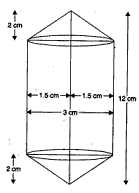
Rachel, an engineering student, was asked to make a model shaped like a cylinder with two cones attached at its two ends by using a thin aluminium sheet. The diameter of the model is $3\ cm$ and its length is $12 \ cm$. If each cone has a height of $2 \ cm,$ find the volume of air contained in the model that Rachel made. (Assume the outer and inner dimensions of the model to be nearly the same).
Answer
For upper conical portion
Radius of the base$(r) = 1.5 \ cm$
Height $(h_1) = 2 \ cm$
$\therefore$ Volume $= \frac13 \pi r^2h_1= \frac13 \pi (1.5)^2(2) = 1.5 \pi  \ cm^3$

For lower conical portion
Volume $= 1.5 \pi \ cm^3$
For central cylindrical portion
Radius of the base$(r) = 1.5 \ cm$
Height $(h_2) = 12 - (2 + 2) = 12 - 4 = 8 \ cm$
$\therefore$ Volume $= \pi r^2h_2= \frac13 \pi (1.5)^2(8)= 18 \pi \ cm^3$
Therefore, volume of the model $ = 1.5\pi + 1.5 \pi + 18 \pi = 21\pi = 21 \times \frac{22}7 = 66\  cm^3$
Hence, the volume of the air contained in the model that Rechel made is $66\ cm^3$.
View full question & answer
Question 53 Marks
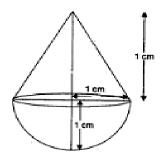
A solid is in the shape of a cone standing on a hemisphere with both their radii being equal to $1 \ cm$ and the height of the cone is equal to its radius. Find the volume of the solid in terms of $\pi$.
Answer

For Hemisphere,
Radius$(r) = 1\ cm$
$\therefore $ Volume $= \frac { 2 } { 3 } \pi r ^ { 3 }$
$= \frac { 2 } { 3 } \pi ( 1 ) ^ { 3 }$
$= \frac { 2 } { 3 } \pi \mathrm { cm } ^ { 3 }$
For cone,
Radius of the base$(r) = 1 \ cm$
Height $(h) = 1 \ cm$
$\therefore $ Volume$= \frac { 1 } { 3 } \pi r ^ { 2 } h$
$= \frac { 1 } { 3 } \pi ( 1 ) ^ { 2 } ( 1 ) = \frac { 1 } { 3 } \pi \operatorname { cm } ^ { 3 }$
Therefore, volume of the solid
$=$volume of the hemisphere $+$ volume of cone
$= \frac { 2 } { 3 } \pi + \frac { 1 } { 3 } \pi = \pi \mathrm { cm } ^ { 3 }$
View full question & answer
Question 63 Marks
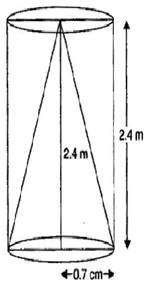
From a solid cylinder whose height is $2.4 \ cm$ and diameter $1.4 \ cm,$ a conical cavity of the same height and same diameter is hollowed out. Find the total surface area of the remaining solid to the nearest $cm^2$.
Answer

Diameter of the solid cylinder $= 1.4\ cm$
$\therefore$ Radius of the solid cylinder $= 0.7 \ cm$
$\therefore$ Radius of the base of the conical cavity $= 0.7 \ cm$
Height of the solid cylinder $= 2.4 \ cm$
$\therefore$ Height of the conical cavity $= 2.4 \ cm$
$\therefore$ Slant height of the conical cavity = $\sqrt{(0.7)^2\;+\;(2.4)^2\;}\;=\sqrt{0.49\;+5.76}=\;\sqrt{6.25}\;=\;2.5 \ cm$
$\therefore TSA$ of remaining solid
$ =2 \pi(0.7)(2.4)+\pi(0.7)^2+\pi(0.7)(2.5) $
$ =3.36 \pi+0.49 \pi+1.75 \pi$
$ =5.6 \pi$
$ =5.6 \times \frac{22}{7} $
$ =17.6 \mathrm{~cm}^2=18 \mathrm{~cm}^2 \text { (to the nearest } \mathrm{cm}^2 \text { ) }$
View full question & answer
Question 73 Marks
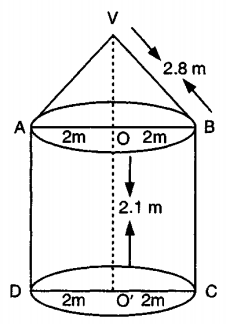
A tent is in the shape of a cylinder surmounted by a conical top. If the height and diameter of the cylindrical part are $2.1\ m$ and $4\ m$ respectively, and the slant height of the top is $2.8\ m,$ find the area of the canvas used for making the tent. Also, find the cost of the canvas of the tent at the rate of $₹\ 500\ per\ m^2$. (Note that the base of the tent will not be covered with canvas.)
Answer
For conical portion, $r = 2\ m$ and $l = 2.8\ m.$ Let $S_1$ the curved surface area of conical portion. Then,

$S _ { 1 } = \pi r l = \pi \times 2 \times 2.8 \mathrm { m } ^ { 2 } = 5.6 \pi \mathrm { m } ^ { 2 }$
For cylindrical portion, we have $r = 2\ m ,h = 2.1\ m$
Let $S_2$ be the curved surface area of cylindrical portion. Then
$S _ { 2 } = 2 \pi r h = 2 \pi \times 2 \times 2.1 \mathrm { m } = 8.4 \pi \mathrm { m } ^ { 2 }$
Let S be the area of the canvas used. Then,
$\mathrm{S}=\mathrm{S}_1+\mathrm{S}_2=(5.6 \pi+8.4 \pi) \mathrm{m}^2=14 \times \frac{22}{7} \mathrm{~m}^2=44 \mathrm{~m}^2$
Total cost of the canvas at the rate of $Rs\ 500$ per $m^2= Rs ( 500 \times 44 )= Rs\ 22000$
View full question & answer
Question 83 Marks
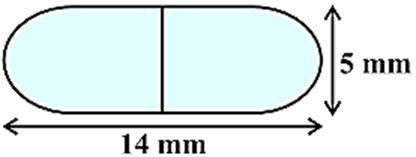
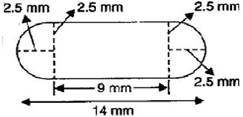
A medicine capsule is in the shape of a cylinder with two hemispheres stuck to each of its ends (see figure). The length of the entire capsule is $14\ mm$ and the diameter of the capsule is $5\ mm.$ Find its surface area.
Answer

Radius of the hemisphere = $\frac{5}{2}\ mm$
Let radius $= r = 2.5\ mm$
Cylindrical height $=$ Total height $-$ Diameter of sphere $= h = 14 - (2.5 + 2.5) = 9\ mm$
Surface area of the capsule $=$ Curved surface area of cylinder $+$ Surface area of the hemisphere
$ =2 \pi r h+2\left(2 \pi r^2\right) $
$ =2 \times \pi \times \frac{5}{2} \times 9+2 \times 2 \pi \times\left(\frac{5}{2}\right)^2 $
$ =45 \pi+25 \pi $
$ =70 \pi=70 \times \frac{22}{7}=220 \mathrm{~mm}^2$
View full question & answer
Question 93 Marks
A hemispherical depression is cut out from one face of a cubical wooden block such that the diameter l of the hemisphere is equal to the edge of the cube. Determine the surface area of the remaining solid.
Answer
According to the question,a hemispherical depression is cut from one face of the cubical block such that the diameter $l$ of the hemisphere is equal to the edge of the cube.
Let the radius of hemisphere $= r$
$\therefore$ $r = \frac { l } { 2 }$
Now, the required surface area $=$ Surface area of cubical block $-$ Area of base of hemisphere $+$ Curved surface area of hemisphere.
$= 6 ( \text { side } ) ^ { 2 } - \pi r ^ { 2 } + 2 \pi r ^ { 2 }$
$= 6 l ^ { 2 } - \pi \left( \frac { l } { 2 } \right) ^ { 2 } + 2 \pi \left( \frac { l } { 2 } \right) ^ { 2 }$
$= 6 l ^ { 2 } - \frac { \pi l ^ { 2 } } { 4 } + \frac { \pi } { 2 } l ^ { 2 }$
$= 6 l ^ { 2 } + \frac { \pi l ^ { 2 } } { 4 }$
Surface area $= \frac { 1 } { 4 } ( 24 + \pi ) l ^ { 2 }$ units.
$= \frac { 1 } { 4 } \left( 24 + \frac { 22 } { 7 } \right) l^2$
$= \frac { 1 } { 4 } \times \frac { 190 } { 7 } ×l^2$
$= 184.18 l ^ { 2 } \text { unit } ^ { 2 }$
View full question & answer
Question 103 Marks
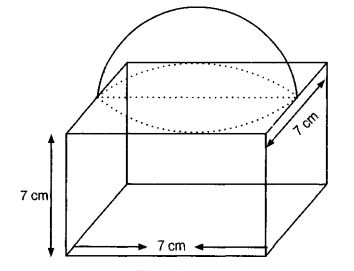
A cubical block of side $7\ cm$ is surrounded by a hemisphere. What is the greatest diameter the hemisphere can have$?$ Find the total surface area of the solid.
Answer
The hemisphere can occupy whole of the side of cube.
Hence, greatest diameter of hemisphere $=$ side of cube $= 7\ cm$

$\therefore$ Radius of the hemisphere $= \frac { 7 } { 2 } \mathrm { cm }$
Let $S$ be the total surface area of the solid.
​​​​​​​Then, $S =$ Surface area of the cube $+$ Curved surface area of hemisphere $-$ Area of the base of the hemisphere
$\Rightarrow \quad S = \left\{ 6 \times 7 ^ { 2 } + 2 \times \frac { 22 } { 7 } \times \left( \frac { 7 } { 2 } \right) ^ { 2 } - \frac { 22 } { 7 } \times \left( \frac { 7 } { 2 } \right) ^ { 2 } \right\} \mathrm { cm } ^ { 2 }$
$\Rightarrow \quad S = \left\{ 294 + 77 - \frac { 77 } { 2 } \right\} \mathrm { cm } ^ { 2 } = \left( 294 + \frac { 77 } { 2 } \right) \mathrm { cm } ^ { 2 } = 332.5 \mathrm { cm } ^ { 2 }$
View full question & answer
Question 113 Marks
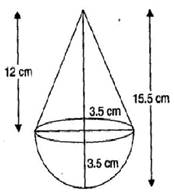
A toy is in the form of a cone of radius $3.5\ cm$ mounted on a hemisphere of the same radius. The total height of the toy is $15.5\ cm.$ Find the total surface area of the toy.
Answer

Radius of the cone $= 3.5\ cm$
$\therefore $ Radius of the hemisphere $= 3.5\ cm$
Total height of the toy $= 15.5\ cm$
$\therefore $ Height of the cone $= 15.5 - 3.5 = 12\ cm$
Slant height of the cone = $\sqrt {{{(3.5)}^2} + {{(12)}^2}} = \sqrt {12.25 + 144} $
$ = \sqrt {156.25} = 12.5\ cm$
$\therefore $ Total surface area of the toy $=$ Curved surface area of hemisphere $+$ Curved surface area of cone
$ = 2\pi {r^2} + \pi rl = 2\pi {(3.5)^2} + \pi (3.5)(12.5)$
$ = 24.5\pi + 43.75\pi = 68.25\pi = 68.25 \times \frac{{22}}{7} = 214.5\ cm^2$
View full question & answer
Question 123 Marks
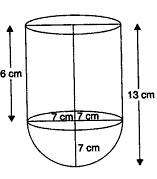
A vessel is in the form of a hollow hemisphere mounted by a hollow cylinder. The diameter of the hemisphere is $14\ cm$ and the total height of the vessel is $13\ cm.$ Find the inner surface area of the vessel.
Answer
$\because$ Diameter of the hallow hemisphere $= 14\ cm$
$\therefore$ Radius of the hollow hemisphere $= \frac{14}2= 7\ cm$

$\therefore$ Radius of the base of the hollow cylinder $= 7\ cm$
Total height of the vessel $= 13 \ cm$
$\therefore$ Height of the hollow cylinder $= 13 - 7 = 6 \ cm$
$\therefore$ Inner surface area of the vessel $=$ Inner surface area of the hollow hemisphere $+$ Inner surface area of the hollow cylinder
$=2 \pi(7)^2+2 \pi(7)(6) $
$=98 \pi+84 \pi=182 \pi $
$ =182 \times \frac{22}{7}=26 \times 22=572 \mathrm{~m}^2$
View full question & answer
Question 133 Marks
Two cubes each of volume $64\ cm^3$ are joined end to end. Find the surface area and volume of the resulting cuboid.
View full question & answer
Question 143 Marks
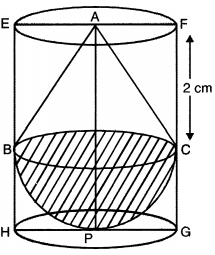
A solid toy is in the form of a hemisphere surmounted by a right circular cone. The height of the cone is $2 \ cm$ and the diameter of the base is $4 \ cm.$ Determine the volume of the toy. If a right circular cylinder circumscribes the toy, find the difference of the volume of the cylinder and toy. $($Take $\pi = 3.14)$
Answer
According to the question, A solid toy is in the form of a hemisphere surmounted by a right circular cone. The height of the cone is $2 \ cm$ and the diameter of the base is $4 \ cm.$
Let $BPC$ is a hemisphere and $ABC $ is a cone.
Radius of hemisphere $=$ Radius of cone
$= \frac { 4 } { 2 } = 2 \mathrm { cm }$
$h =$ Height of cone $= 2\ cm$
Volume of toy $= \frac { 2 } { 3 } \pi r ^ { 3 } + \frac { 1 } { 3 } \pi r ^ { 2 } h$
$= \frac { 1 } { 3 } \pi r ^ { 2 } ( 2 r + h ) = \frac { 1 } { 3 } \times 3.14 \times 2 \times 2 ( 2 \times 2 + 2 )$
$= \frac { 1 } { 3 } \times 3.14 \times 4 \times 6$
$= 25.12 \mathrm { cm } ^ { 3 } ...(i)$
Let right circular cylinder $EFGH$ circumscribe the given solid toy.
Radius of cylinder $= 2 \ cm,$
Height of cylinder $= 4 \ cm$
Volume of right circular cylinder $= \pi r ^ { 2 } h$
$= 3.14 \times ( 2 ) ^ { 2 } \times 4 \mathrm { cm } ^ { 3 } ...(iii)$
$= 50.24 \mathrm { cm } ^ { 3 }$
$\therefore$ Difference of two volume $=$ Volume of cylinder $- $ Volume of toy
$= 50.24 - 25.12$
$=25.12\ cm^3$
View full question & answer
Question 153 Marks
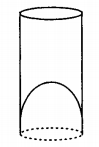
A juice seller was serving his customers using glasses as shown in Figure. The inner diameter of the cylindrical glass was $5 \ cm,$ but the bottom of the glass had a hemispherical raised portion which reduced the capacity of the glass. If the height of a glass was $10 \ cm,$ find the apparent capacity of the glass and its actual capacity. $($Use $\pi = 3.14)$
Answer
self-learning
View full question & answer
Question 163 Marks
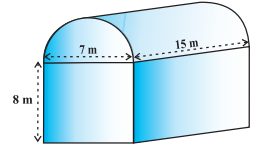
Shanta runs an industry in a shed which is in the shape of a cuboid surmounted by a half cylinder. If the base of the shed is of dimension $7\ m \times 15\ m$ and the height of the cuboidal portion is $8\ m,$ find the volume of air that the shed can hold. Further, suppose the machinery in the shed occupies a total space of $300\ m^3,$ and there are $20$ workers, each of whom occupy about $0.08\ m^3$ space on an average. Then, how much air is in the shed$? ($Take $\pi = \frac {22}7)$
Answer
self-learning
View full question & answer
Question 173 Marks
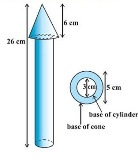
A wooden toy rocket is in the shape of a cone mounted on a cylinder as shown in given below figure. The height of the entire rocket is $26\ cm$, while the height of the conical part is $6 \ cm$. The base of the conical portion has a diameter of $5 \ cm,$ while the base diameter of the cylindrical portion is $3 \ cm.$ If the conical portion is to be painted orange and the cylindrical portion yellow, find the area of the rocket painted with each of these colours. $($Take $\pi  =3.14)$
Answer
Let radius, slant height and height of cone be $r,$ l and h respectively and radius and height of cylinder be $r_1$ and $h_1$ respectively.
$\mathrm{r}=2.5 \mathrm{~cm}, \mathrm{~h}=6 \mathrm{~cm}, \mathrm{r}_1=1.5 \mathrm{~cm}$ and $\mathrm{h}_1=26-6=20 \mathrm{~cm}$
$\therefore \quad l = \sqrt { r ^ { 2 } + h ^ { 2 } } = \sqrt { ( 2.5 ) ^ { 2 } + 6 ^ { 2 } } $
$ = \sqrt { 6.25 + 36 } = \sqrt { 42.25 }$
$= 6.5 \mathrm { cm }$ Here, the conical portion has its circular base resting on the base of the cylinder, but the base of the cone is larger than the base of the cylinder. So, a part of the base of the cone $($a ring$)$ is to be painted.
So, the area to be painted orange $=$ Curved surface area of the cone $+$ Base area of the cone $-$ Base area of the cylinder
$ = \pi r l + \pi r ^ { 2 } - \pi r _ { 1 } ^ { 2 }$
$ = \pi \left\{ r l + r ^ { 2 } - r _ { 1 } ^ { 2 } \right\}$
$ = \pi \left\{ 2.5 \times 6.5 + ( 2.5 ) ^ { 2 } - ( 1.5 ) ^ { 2 } \right\}$
$ = 3.14 ( 16.25 + 6.25 - 2.25 ) = 3.14 \times 20.25 = 63.585 \mathrm { cm } ^ { 2 }$
Now, the area to be painted yellow $=$ Curved surface area of the cylinder $+$ Area of the base of the cylinder
$ = 2 \pi r _ { 1 } h _ { 1 } + \pi r _ { 1 } ^ { 2 }$
$= \pi r _ { 1 } \left( 2 h _ { 1 } + r _ { 1 } \right)$
$= 3.14 \times 1.5 ( 2 \times 20 + 1.5 ) $
$ = 3.14 \times 1.5 \times 41.5 = 4.71 \times 41.5 = 195.465 \mathrm { cm } ^ { 2 }$
View full question & answer
Question 183 Marks
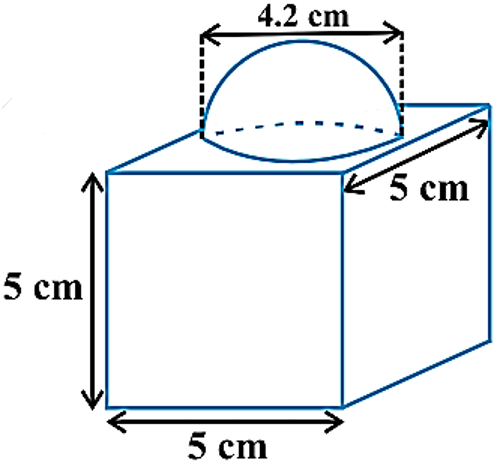
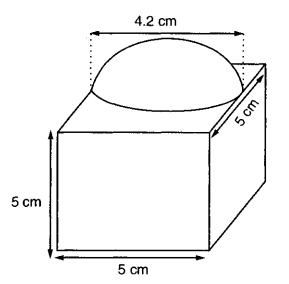
A decorative block shown in Figure is made of two solids $-$ a cube and a hemisphere. The base of the block is a cube with edge $5\ cm,$ and the hemisphere fixed on the top has a diameter $4.2 \ cm.$ Find the total surface area of the block. $($Take$\pi $ = $\frac{22}{7}).$
Answer
Let $S$ be the total surface area of the decorative block. Then,
$S =$ Total surface area of the cube $-$ Base area of hemisphere $+$ Curved surface area of hemisphere

$\Rightarrow S = \left( 6 \times 5 \times 5 - \pi r ^ { 2 } + 2 \pi r ^ { 2 } \right) \mathrm { cm } ^ { 2 }$
$\Rightarrow S = \left( 150 + \pi r ^ { 2 } \right) \mathrm { cm } ^ { 2 }$
$\Rightarrow S = \left\{ 150 + \frac { 22 } { 7 } \times ( 2.1 ) ^ { 2 } \right\} \mathrm { cm } ^ { 2 }$
$\Rightarrow S = \{ 150 + 22 \times 0.3 \times 2.1 \} \mathrm { cm } ^ { 2 }$
$\Rightarrow S=(150+13.86) \mathrm{cm}^2=163.86 \mathrm{~cm}^2$
View full question & answer
Question 193 Marks
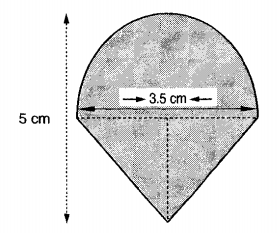
Rasheed got a playing top (lattu) as his birthday present, which surprisingly had no colour on it. He wanted to colour it with his crayons. The top is shaped like a cone surmounted by a hemisphere. The entire top is $5 \ cm$ in height and the diameter of the top is $3.5\ cm.$ Find the area he has to colour. $($Take $\pi = \frac {22}7).$
Answer
Surface area to colour $=$ surface area of hemisphere $+$ curved surface area of cone
Diameter of hemisphere $= 3.5 \ cm$
So radius of hemispherical portion of the lattu $= r =  \frac { 3.5 } { 2 } \mathrm { cm } = 1.75$
$r =$ Radius of the concial portion $ = \frac{3.5}2 = 1.75$
Height of the conical portion = height of top - radius of hemisphere $ = 5 - 1.75 = 3.25\ cm$
Let $I$ be the slant height of the conical part. Then,
$l^2=h^2+r^2$
$l^2=(3.25)^2+(1.75)^2$
$\Rightarrow l^2\;=10.5625+3.0625$
$\Rightarrow l^2=13.625$
$\Rightarrow l=\sqrt{13.625}$
$\Rightarrow l=3.69$
Let $S$ be the total surface area of the top. Then,
$S = 2 \pi r ^ { 2 } + \pi r l$
$\Rightarrow \quad S = \pi r ( 2 r + l )$
$\Rightarrow S=\frac{22}7\times1.75(2\times1.75+3.7)$
$\;\;\;\;=\;5.5(3.5+3.7)$
$=5.5(7.2)$
$=39.6\;cm^2$
View full question & answer
3 Marks Question - Maths STD 10 Questions - Vidyadip