MCQ 11 Mark
In mean equation $\overline{ X }=a+\frac{\Sigma f i d i}{\Sigma f_i} d i$ _______ .
- ✓
$x_i-a$
- B
$a-x_i$
- C
$f_i-a$
- D
$a-f_i$
AnswerCorrect option: A. $x_i-a$
$x_i-a$
View full question & answer→MCQ 21 Mark
The volume of a cube is $2744 \ cm ^3$. Its surface area is
- A
$196 \ cm ^2$
- ✓
$1176 \ cm ^2$
- C
$784 \ cm ^2$
- D
$588 \ cm ^2$
AnswerCorrect option: B. $1176 \ cm ^2$
We have, $V=a^3=2744=2^3 \times 7^3$
$\Rightarrow a=(2 \times 7)=14 \ cm .$
$\therefore \text { S.A. }=6 \times a^2=6 \times 14^2=1176 \ cm ^2$
View full question & answer→MCQ 31 Mark
The ratio of the total surface area to the lateral surface area of a cylinder with base radius $80 cm$ and height $20 cm$ is
- A
$1: 2$
- B
$2: 1$
- C
$3: 1$
- ✓
$5: 1$
AnswerCorrect option: D. $5: 1$
(d) : $\frac{\text { Total surface area }}{\text { Lateral surface area }}=\frac{2 \pi r(h+r)}{2 \pi r h}$
$
=\frac{h+r}{h}=\frac{(20+80)}{20}=\frac{100}{20}=\frac{5}{1}
$
$\therefore \quad$ Required ratio is $5: 1$.
View full question & answer→MCQ 41 Mark
The height of a cylinder is $14 \ cm$ and its curved surface area is $264 \ cm ^2$. The volume of the cylinder is
- A
$296 \ cm ^3$
- ✓
$396 \ cm ^3$
- C
$369 \ cm ^3$
- D
$503 \ cm ^3$
AnswerCorrect option: B. $396 \ cm ^3$
$\text{C.S.A.} =2 \pi r h=2 \times \frac{22}{7} \times r \times 14=264\ ($given$)$
$\Rightarrow r=\frac{264}{88}=3 \ cm$
$\therefore$ Volume $=\pi r^2 h=\frac{22}{7} \times 3 \times 3 \times 14=396 \ cm ^3$
View full question & answer→MCQ 51 Mark
The ratio of the volumes of two spheres is $8: 27$. The ratio between their surface areas is
- A
$2: 3$
- B
$4: 27$
- C
$8: 9$
- ✓
$4: 9$
AnswerCorrect option: D. $4: 9$
(d) : $\frac{\text { Volume of sphere with radius } r}{\text { Volume of sphere with radius } R}$
$
=\frac{\frac{4}{3} \pi r^3}{\frac{4}{3} \pi R^3}=\frac{8}{27} \Rightarrow \frac{r^3}{R^3}=\frac{8}{27} \Rightarrow\left(\frac{r}{R}\right)^3=\left(\frac{2}{3}\right)^3 \Rightarrow \frac{r}{R}=\frac{2}{3}
$
Ratio between their surface areas
$
=\frac{4 \pi r^2}{4 \pi R^2}=\frac{r^2}{R^2}=\left(\frac{r}{R}\right)^2=\left(\frac{2}{3}\right)^2=\frac{4}{9}
$
View full question & answer→MCQ 61 Mark
The radii of the base of a cylinder and a cone are in the ratio $3: 4$ and their heights are in the ratio $2: 3$, then ratio of their volumes is
- ✓
$9: 8$
- B
$9: 4$
- C
$3: 1$
- D
$27: 64$
AnswerCorrect option: A. $9: 8$
(a) : Let the radii of the cylinder and cone be $3 r$ and $4 r$ respectively and their heights be $2 h$ and $3 h$ respectively. Then,
$
\frac{\text { Volume of cylinder }}{\text { Volume of cone }}=\frac{\pi(3 r)^2 \times 2 h}{\frac{1}{3} \pi(4 r)^2 3 h}=\frac{54}{48}=\frac{9}{8}
$
View full question & answer→MCQ 71 Mark
The base radius of the cylinder is $1 \frac{2}{3}$ times its height. The cost of painting its $\text{C.S.A.}$ at $2$ paise $cm ^2$ is $₹\ 92.40$ . The volume of the cylinder is
- ✓
$80850 \ cm ^3$
- B
$88850 \ cm ^3$
- C
$80508 \ cm ^3$
- D
AnswerCorrect option: A. $80850 \ cm ^3$
$r=\frac{5}{3} h, \text{C.S.A.} =2 \pi r h=2 \times \frac{22}{7} \times \frac{5}{3} h^2$
$\Rightarrow \frac{220}{21} h^2=\frac{9240}{2} $
$\Rightarrow h=21 \ cm , r=35 \ cm$
$\therefore V=\pi r^2 h=\frac{22}{7} \times 35 \times 35 \times 21=80850 \ cm ^3$
View full question & answer→MCQ 81 Mark
A circus tent is cylindrical up to a height of $4 m$ and conical above it. If its diameter is $105 m$ and its slant height is $40 m$, the total area of canvas required to built the tent is
- ✓
$7920 m ^2$
- B
$7820 m ^2$
- C
$9720 m ^2$
- D
$2645 m ^2$
AnswerCorrect option: A. $7920 m ^2$
(a) : Area of canvas $=(2 \pi r h+\pi r l)$
$
=\left(2 \times \frac{22}{7} \times \frac{105}{2} \times 4+\frac{22}{7} \times \frac{105}{2} \times 40\right) m ^2=7920 m ^2
$
View full question & answer→MCQ 91 Mark
A glass cylinder with diameter $20 \ cm$ has water to a height of $9 \ cm$. A metal cube of $8 \ cm$ edge is immersed in it completely. The height by which water will rise in the cylinder is $($Take $\pi=3.14 )$
- ✓
$1.6 \ cm$
- B
$2.5 \ cm$
- C
$1 \ cm$
- D
$2.6 \ cm$
AnswerCorrect option: A. $1.6 \ cm$
Volume of the water displaced $=$ Volume of the cube of edge $8 \ cm$
$\Rightarrow \pi r^2 h=8^3 $
$\Rightarrow 3.14 \times 10^2 \times h=8 \times 8 \times 8$
$\Rightarrow h=\frac{8 \times 8 \times 8}{3.14 \times 100} \ cm =1.6 \ cm$
View full question & answer→MCQ 101 Mark
The volume of the greatest sphere that can be cut off from a cylindrical log of wood of base radius $1 cm$ and height $5 cm$ is
- ✓
$\frac{4}{3} \pi cm ^3$
- B
$\frac{10}{3} \pi cm ^3$
- C
$5 \pi cm ^3$
- D
$\frac{20}{3} \pi cm ^3$
AnswerCorrect option: A. $\frac{4}{3} \pi cm ^3$
(a) : The radius of the greatest sphere that can be cut off from the cylinder $=1 cm$$\therefore \quad$
Volume of the sphere $=\frac{4}{3} \pi r^3=\frac{4}{3} \pi(1)^3=\frac{4}{3} \pi cm ^3$
View full question & answer→MCQ 111 Mark
The length of the diagonal of a cube is $6 \sqrt{3}$ $cm$. Its total surface area is
- A
$144 cm ^2$
- ✓
$216 cm ^2$
- C
$180 cm ^2$
- D
$108 cm ^2$
AnswerCorrect option: B. $216 cm ^2$
(b) : Let $a$ be the side of the cube.Given, diagonal of cube $=6 \sqrt{3} cm$
$
\therefore \sqrt{3} a=6 \sqrt{3} \Rightarrow a=6 cm
$
$\therefore$ Total surface area $=6 a^2=(6 \times 6 \times 6) cm ^2=216 cm ^2$
View full question & answer→MCQ 121 Mark
A cube whose edge is $20 cm$ long, has circles on each of its faces painted black. What is the total area of the unpainted surface of the cube, if the circles are of the largest possible areas?
- A
$90.72 cm ^2$
- B
$256.72 cm ^2$
- C
$330.3 cm ^2$
- ✓
$514.28 cm ^2$
AnswerCorrect option: D. $514.28 cm ^2$
(d) : Diameter of circle $=20 cm$
$\therefore \quad$ Area of a circle $=100 \pi cm ^2$
$\therefore \quad$ Area of 6 circles $=6 \times 100 \pi=600 \pi cm ^2$
Surface area of cube $=6 \times(20)^2=2400 cm ^2$
Area of unpainted surface $=(2400-600 \pi) cm ^2$
$
=2400-600 \times \frac{22}{7}=514.28 cm ^2
$
View full question & answer→MCQ 131 Mark
The total surface area of a cube is $864 cm ^2$. Its volume is
- A
$3456 cm ^3$
- B
$432 cm ^3$
- ✓
$1728 cm ^3$
- D
$3460 cm ^3$
AnswerCorrect option: C. $1728 cm ^3$
(c) : Let $a$ be the side of the cube.Given, total surface area of cube $=864 cm ^2$
$
\therefore \quad 6 a^2=864 \Rightarrow a^2=144 \Rightarrow a=12 cm
$
$\therefore$ Volume of the cube $=(12 \times 12 \times 12) cm ^3=1728 cm ^3$
View full question & answer→MCQ 141 Mark
Two cubes each of volume $27 \ cm ^3$ are joined end to end to form a solid. Find the surface area of the resulting cuboid.
- ✓
$90 \ cm ^2$
- B
$80 \ cm ^2$
- C
$70 \ cm ^2$
- D
$60 \ cm ^2$
AnswerCorrect option: A. $90 \ cm ^2$
Let the edge of each cube be $a \ cm$.
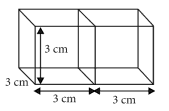
$\therefore \quad$ Volume of each cube $=a^3 \ cm ^3$
i.e., $a^3=27=(3)^3$
$\Rightarrow a=3$
$\therefore \quad$ Surface area of the cuboid
$=2(l b+b h+h l)$
$=2(6 \times 3+3 \times 3+3 \times 6)$
$=2 \times 45=90 \ cm ^2$ View full question & answer→MCQ 151 Mark
If the total surface area of a solid hemisphere is $462 cm ^2$, then find its volume. $\left[\right.$ Take $\left.\pi=\frac{22}{7}\right]$
- A
$518 cm ^3$
- B
$726 cm ^3$
- C
$816 cm ^3$
- ✓
$718.67 cm ^3$
AnswerCorrect option: D. $718.67 cm ^3$
(d) : Let radius of hemisphere $=r cm$Total surface area of hemisphere $=462 cm ^2$
$
\Rightarrow 3 \pi r^2=462 \Rightarrow r^2=\frac{462 \times 7}{3 \times 22}=49 \Rightarrow r=7
$
$\therefore \quad$ Volume of hemisphere
$
=\frac{2}{3} \pi r^3=\frac{2}{3} \times \frac{22}{7} \times 7 \times 7 \times 7=718.67 cm ^3
$
View full question & answer→MCQ 161 Mark
The radius of spherical balloon increases from $8 \ cm$ to $12 \ cm$. The ratio of the surface areas of the balloon in two cases is
- A
$2: 3$
- B
$3: 2$
- C
$8: 27$
- ✓
$4: 9$
AnswerCorrect option: D. $4: 9$
Let $r_1$ and $r_2$ be the radius of smaller spherical balloon and bigger spherical balloon respectively.
$\therefore r_1=8 \ cm \text { and } r_2=12 \ cm$
Hence, required ratio
$=\frac{\text { Surface area of smaller spehrical sphere }}{\text { Surface area of bigger spherical sphere }}=\frac{4 \pi r_1^2}{4 \pi r_2^2}=\left(\frac{r_1}{r_2}\right)^2$
$=\left(\frac{8}{12}\right)^2=\left(\frac{2}{3}\right)^2=\frac{4}{9}=4: 9$
View full question & answer→MCQ 171 Mark
If two cubes, each of edge $4 cm$ are joined end to end, then the surface area of the resulting cuboid is
- A
$100 cm ^2$
- ✓
$160 cm ^2$
- C
$200 cm ^2$
- D
$80 cm ^2$
AnswerCorrect option: B. $160 cm ^2$
(b) : Two cubes of edge $4 cm$ each are joined end to end to form a cuboid.
$\therefore$ For resulting cuboid, length $(l)=4+4=8 cm$, breadth $(b)=4 cm$ and height $(h)=4 cm$
$\therefore \quad$ Surface area of cuboid
$
=2(l b+b h+h l)=2(8 \times 4+4 \times 4+4 \times 8)=160 cm ^2
$
View full question & answer→MCQ 181 Mark
The length of the longest pole that can be kept in a room of dimensions $12 m \times 9 m \times 8 m$ is
- A
$29 m$
- B
$21 m$
- C
$19 m$
- ✓
$17 m$
AnswerCorrect option: D. $17 m$
(d) : Given, length $(l)=12 m$, breadth $(b)=9 m$ and height $(h)=8 m$
Length of the longest pole
$=$ Length of diagonal of the room
$
=\sqrt{l^2+b^2+h^2}=\sqrt{(12)^2+(9)^2+(8)^2}=\sqrt{289}=17 m
$
View full question & answer→MCQ 191 Mark
The ratio of the radii of two spheres is $4: 5$. Then the ratio of their total surface area is
- ✓
$16: 25$
- B
$2: \sqrt{3}$
- C
$5: 4$
- D
$2: 3$
AnswerCorrect option: A. $16: 25$
(a) : Let $r_1$ and $r_2$ be radii of two spheres.
$
\therefore \quad \frac{r_1}{r_2}=\frac{4}{5}
$
(Given)
Ratio of total surface area of two spheres
$
\frac{4 \pi r_1^2}{4 \pi r_2^2}=\left(\frac{r_1}{r_2}\right)^2=\left(\frac{4}{5}\right)^2=\frac{16}{25}
$
View full question & answer→MCQ 201 Mark
The curved surface area of a right circular cone of height $15 cm$ and base diameter $16 cm$ is
- A
$60 \pi cm ^2$
- B
$68 \pi cm ^2$
- C
$120 \pi cm ^2$
- ✓
$136 \pi cm ^2$
AnswerCorrect option: D. $136 \pi cm ^2$
(d) : Let $r$ be the radius, $h$ be the height and $l$ be the slant height of right circular cone.
Now, $h=15 cm$, Diameter $=16 cm$
[Given]
$
\therefore r=\frac{16}{2}=8 cm
$Also, $l=\sqrt{r^2+h^2}=\sqrt{8^2+15^2}=\sqrt{289}=17 cm$
$\therefore \quad$ Curved surface area of the cone $=\pi r l$
$
=\pi \times 8 \times 17=136 \pi cm ^2
$
View full question & answer→MCQ 211 Mark
A right triangle with sides $3 cm , 4 cm$ and $5 cm$ is rotated about the side of $3 cm$ to form a cone. The volume of the cone so formed is
- A
$12 \pi cm ^3$
- B
$15 \pi cm ^3$
- ✓
$16 \pi cm ^3$
- D
$20 \pi cm ^3$
AnswerCorrect option: C. $16 \pi cm ^3$
(c) : Here, radius $(r)=4 cm$ and height $(h)=3 cm$
$\therefore \quad$ Volume of the cone $=\frac{1}{3} \pi r^2 h$
$
=\frac{\pi}{3} \times 4 \times 4 \times 3=16 \pi cm ^3
$
View full question & answer→MCQ 221 Mark
The volume of the largest right circular cone that can be cut out from a cube of edge $4.2 cm$ is
- A
$9.7 cm ^3$
- B
$72.6 cm ^3$
- C
$58.2 cm ^3$
- ✓
$19.4 cm ^3$
AnswerCorrect option: D. $19.4 cm ^3$
(d) : Diameter of cone $=$ length of cube $=4.2 cm$
$\therefore$ Radius of cone, $r=\frac{4.2}{2}=2.1 cm$
Height of cone $=$ Height of cube $=4.2 cm$
$\therefore \quad$ Volume of the cone $=\frac{1}{3} \pi r^2 h$
$
=\frac{1}{3} \times \frac{22}{7} \times \frac{21}{10} \times \frac{21}{10} \times \frac{42}{10}=19.4 cm ^3 \text { (approx). }
$
View full question & answer→MCQ 231 Mark
The volume of the largest right circular cone that can be carved out of a solid hemisphere of radius $r$ can be calculated as:
Radius of largest cone $=$ Radius of hemisphere $=$ $r$ (Step 1)
Height of largest cone $=$ Radius of hemisphere $=r$ (Step 2)
$\therefore \quad$ Volume of cone $=\frac{1}{3} \pi r^2 h=\frac{1}{3} \pi r^2 r=\frac{1}{3} \pi r^3$
(Step 3)In which step is there an error involving?
Answer(d) : Radius of largest cone $=$ Radius of hemisphere $=r$ (Step 1)
Height of largest cone $=$ Radius of hemisphere $=r$ (Step 2)
$\therefore \quad$ Volume of cone $=\frac{1}{3} \pi r^2 h=\frac{1}{3} \pi r^2 r=\frac{1}{3} \pi r^{\prime}$ (Step 3)
View full question & answer→MCQ 241 Mark
If the length, breadth and height of a cuboid are made 2,4 and 6 times respectively, then by what percent the volume increases?
- A
$47 \%$
- B
$470 \%$
- ✓
$4700 \%$
- D
AnswerCorrect option: C. $4700 \%$
(c) : We know that if length, breadth and height of a cuboid are made by $x, y$ and $z$ times respectively then volume be increased by
$
(x y z-1) \times 100 \% \text {. }
$
In our problem, $x=2, y=4, z=6$
$\therefore \%$ increase in volume $=(2 \times 4 \times 6-1) \times 100 \%=4700 \%$
View full question & answer→MCQ 251 Mark
The radius of a sphere $($in $cm)$ whose volume is $12 \pi \ cm ^3$ is
- ✓
$3^{2 / 3}$
- B
$3^{3 / 2}$
- C
$3^{1 / 3}$
- D
$3^{1 / 2}$
AnswerCorrect option: A. $3^{2 / 3}$
Let radius of the sphere be $r \ cm$.
According to question,
$\frac{4}{3} \pi r^3=12 \pi$
$\Rightarrow r^3=\frac{3 \times 12}{4}=9=3^2 $
$\Rightarrow r=\left(3^2\right)^{1 / 3}=(3)^{2 / 3} \ cm$
View full question & answer→MCQ 261 Mark
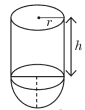
The total surface area of solid opened at the top in the given figure is
- ✓
$2 \pi r(h+r)$
- B
$\pi r(2 h+r)$
- C
$2 \pi h(h+r)$
- D
AnswerCorrect option: A. $2 \pi r(h+r)$
(a) : Total surface area of solid = Curved surface area of cylinder + Curved surface area of hemisphere $=2 \pi r h+2 \pi r^2=2 \pi r(h+r)$
View full question & answer→MCQ 271 Mark
If curved surface area of cylinder is equal to its volume. The radius of cylinder will be
Answer(a) : Let $h$ and $r$ be the height and radius of the base of the right circular cylinder respectively, then
$2 \pi r h=\pi r^2 h$ i.e., $r=2$
View full question & answer→MCQ 281 Mark
A solid is hemispherical at the bottom and conical (of same radius) above it. If the surface areas of the two parts are equal, then what will be the ratio of its radius and the slant height of the conical part?
- A
$2: 1$
- ✓
$1: 2$
- C
$3: 2$
- D
$2: 3$
AnswerCorrect option: B. $1: 2$
(b) : Let $r$ be the radius of hemisphere and conical part. Also, let $l$ be the slant height of conical part.
Given that, surface area of hemisphere
$=$ surface area of conical part
$\Rightarrow 2 \pi r^2=\pi r l \Rightarrow 2 r=l$
$\Rightarrow \frac{r}{l}=\frac{1}{2}$ i.e., $r: l=1: 2$
View full question & answer→MCQ 291 Mark
The total surface area of a cube is $32 \frac{2}{3} m ^2$. The volume of the cube (in $m ^3$ ) is
- ✓
$12 \frac{19}{27}$
- B
$19 \frac{12}{27}$
- C
$12 \frac{7}{27}$
- D
AnswerCorrect option: A. $12 \frac{19}{27}$
(a) : Let the side of the cube be $x m$.
$\therefore$ Total surface area $=6 x^2 m ^2$
$\Rightarrow \quad 6 x^2=32 \frac{2}{3} \Rightarrow 6 x^2=\frac{98}{3}$
$\Rightarrow x^2=\frac{98}{3} \times \frac{1}{6}=\frac{49}{9} \Rightarrow x=\frac{7}{3} m$.
$\therefore \quad$ Volume of the cube $=x^3 m ^3$
$
=\left(\frac{7}{3}\right)^3 m ^3=\frac{343}{27} m ^3=12 \frac{19}{27} m ^3 \text {. }
$
View full question & answer→MCQ 301 Mark
A cone and a cylinder have the same radii but the height of the cone is 3 times that of the cylinder. The ratio of their volumes is/are
- A
$1: 2$
- B
$2: 1$
- ✓
$1: 1$
- D
$2: 3$
AnswerCorrect option: C. $1: 1$
(c) : Let the radius and the height of the cylinder are $r$ and $h$ respectively.
So, radius of the cone is $r$ and height of the cone is $3 h$.
$\therefore \quad$ Volume of the cylinder $=\pi r^2 h$
Volume of the cone $=\frac{1}{3} \pi r^2 3 h=\pi r^2 h$
So, required ratio $=\frac{\pi r^2 h}{\pi r^2 h}=1: 1$
View full question & answer→MCQ 311 Mark
The volume of a hemisphere is $2425 \frac{1}{2} cm ^3$. Its curved surface area is $\left[\right.$ Use $\left.\pi=\frac{22}{7}\right]$
- A
$793 cm ^2$
- B
$963 cm ^2$
- ✓
$693 cm ^2$
- D
AnswerCorrect option: C. $693 cm ^2$
(c) : Given, volume of hemisphere $=\frac{4851}{2} cm ^3$
Let the radius of the hemisphere be ' $r$ ' $cm$.
$\therefore \quad$ Volume of hemisphere $=\frac{2}{3} \pi r^3$
$\Rightarrow \frac{2}{3} \pi r^3=\frac{4851}{2}$
$\Rightarrow r^3=\frac{4851 \times 3 \times 7}{2 \times 2 \times 22} \Rightarrow r=\frac{21}{2} cm$
Now, curved surface area of hemisphere $=2 \pi r^2$
$
=2 \times \frac{22}{7} \times \frac{21 \times 21}{2 \times 2}=693 cm ^2
$
View full question & answer→MCQ 321 Mark
Find the volume of the largest right circular cone that can be cut out from a cube of edge 6.4 $cm$.
- A
$49.65 cm ^3$
- B
$62.6 cm ^3$
- C
$48.2 cm ^3$
- ✓
$68.65 cm ^3$
AnswerCorrect option: D. $68.65 cm ^3$
(d) : Diameter of cone $=$ length of cube $=6.4 cm$
$\therefore$ Radius of cone, $r=\frac{6.4}{2}=3.2 cm$
Height of cone $=$ Height of cube $=6.4 cm$
$\therefore \quad$ Volume of the cone $=\frac{1}{3} \pi r^2 h$
$=\frac{1}{3} \times \frac{22}{7} \times \frac{32}{10} \times \frac{32}{10} \times \frac{64}{10}=68.65 cm ^3$ (approx.)
View full question & answer→MCQ 331 Mark
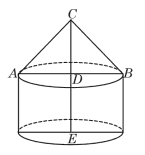
A toy is in the form of a right circular cylinder surmounted by a right circular cone as shown in the figure. If $A D=D E=D C=1 cm$, then the volume of the toy $\left(\right.$ in $cm ^3$ ) is
- ✓
$\frac{4}{3} \pi$
- B
$\frac{3}{4} \pi$
- C
$3 \pi$
- D
$4 \pi$
AnswerCorrect option: A. $\frac{4}{3} \pi$
(a) : Let $r$ be the radius and $h$ be the height of cylindrical part and conical part.
$
\therefore r=h=1 cm
$.
Volume of the toy
$=$ Volume of cylindrical part + Volume of conical part
$
=\pi r^2 h+\frac{1}{3} \pi r^2 h=\pi(1)^2(1)+\frac{1}{3} \pi(1)^2(1)=\frac{4 \pi}{3} cm ^3
$
View full question & answer→MCQ 341 Mark
The internal and external radii of a hemispherical bowl are $r_1$ and $r_2$ respectively. Then, the curved surface area of the bowl is
- ✓
$2 \pi\left(r_1^2+r_2^2\right)$
- B
$\left(r_1^2+r_2{ }^2\right)$
- C
$\pi\left(r_1^2+r_2^2\right)$
- D
AnswerCorrect option: A. $2 \pi\left(r_1^2+r_2^2\right)$
(a) : The curved surface area of the hemispherical bowl
$
=2 \pi r_1^2+2 \pi r_2^2=2 \pi\left(r_1^2+r_2^2\right) \text {. }
$
View full question & answer→MCQ 351 Mark
A hemisphere and a cone have equal bases. If their heights are also equal, then the ratio of their curved surface areas is
- A
$\sqrt{2}: 3$
- B
$1: \sqrt{2}$
- ✓
$\sqrt{2}: 1$
- D
$1: 1$
AnswerCorrect option: C. $\sqrt{2}: 1$
(c) : Let $r$ be the radii of bases of both hemisphere and cone.
$\because \quad$ Height of hemisphere, $h=r$
$\Rightarrow$ Height of cone, $h=r$
$\therefore$ Curved surface area of hemisphere $=2 \pi r^2$
Also, curved surface area of cone $=\pi r l=\pi r \sqrt{r^2+h^2}$
$
=\pi r \sqrt{r^2+r^2}[\because h=r]=\sqrt{2} \pi r^2
$
$\therefore \quad$ Required ratio $=2 \pi r^2: \sqrt{2} \pi r^2=\sqrt{2}: 1$
View full question & answer→MCQ 361 Mark
If the radius and slant height of a cone are in ratio $4: 7$ and its curved surface area is $792 cm ^2$, then its radius will be
- A
$10 cm$
- B
$11 cm$
- ✓
$12 cm$
- D
$13 cm$
AnswerCorrect option: C. $12 cm$
(c) : Let the radius $(r)$ and the slant height $(l)$ of cone be $4 x$ and $7 x$ respectively.
$\therefore \quad$ Curved surface area of cone $=\pi r l=\pi(4 x)(7 x)$
$\Rightarrow 792=28 \times \frac{22}{7} \times x^2$
[Given]
$\Rightarrow x^2=\frac{792 \times 7}{28 \times 22}=9 \Rightarrow x=3$
$\therefore$ Radius of cone $=4 x=4 \times 3=12 cm$
View full question & answer→MCQ 371 Mark
Two cones have their heights in the ratio $1: 3$ and radii in the ratio $3: 1$. The ratio of their volumes will be
- ✓
$3: 1$
- B
$1: 3$
- C
$2: 3$
- D
$1: 4$
AnswerCorrect option: A. $3: 1$
(a) : Let height of one cone be $h$ and height of another cone be $3 h$. Radius of one cone is $3 r$ and radius of another cone is $r$.
$\therefore \quad$ Ratio of their volumes $=\frac{\frac{1}{3} \pi(3 r)^2 \times h}{\frac{1}{3} \pi r^2 \times(3 h)}$ $=\frac{9 r^2 h}{3 r^2 h}=\frac{9}{3}=3: 1$
View full question & answer→MCQ 381 Mark
A sphere of maximum volume is cut-out from a solid hemisphere of radius $r$. What is the ratio of the volume of the hemisphere to that of the cut-out sphere?
- ✓
$4: 1$
- B
$2: 3$
- C
$1: 1$
- D
$1: 4$
AnswerCorrect option: A. $4: 1$
(a) : Here, radius of hemisphere $=r$
$\therefore \quad$ Volume of hemisphere $=\frac{2}{3} \pi r^3$
$\because \quad$ Diameter of sphere of maximum volume that is cutout from it is $r$.
$\Rightarrow$ Radius of sphere $=\frac{r}{2}$
Volume of sphere $=\frac{4}{3} \pi\left(\frac{r}{2}\right)^3=\frac{\pi}{6} r^3$
$\therefore \quad$ Required ratio $=\frac{\frac{2}{3} \pi r^3}{\frac{\pi}{6} r^3}=4: 1$
View full question & answer→MCQ 391 Mark
The volume of the sphere with radius $1.5 cm$ is............
- A
$4.5 cm ^3$
- B
$9.5 cm ^3$
- ✓
$14.14 cm ^3$
- D
$2.8 cm ^3$
AnswerCorrect option: C. $14.14 cm ^3$
$14.14 cm ^3$
View full question & answer→MCQ 401 Mark
The volume of the cone having height $3.5 cm$ and radius $6 cm$ is............
- A
$288 cm ^3$
- B
$269.5 cm ^3$
- C
$2874 cm ^3$
- ✓
$132 cm ^3$
AnswerCorrect option: D. $132 cm ^3$
$132 cm ^3$
View full question & answer→MCQ 411 Mark
$r=2.5, h=10 cm$ then the volume of the cylinder is............
- ✓
$196.25 cm ^3$
- B
$269.5 cm ^3$
- C
$124 cm ^3$
- D
$198 cm ^3$
AnswerCorrect option: A. $196.25 cm ^3$
$196.25 cm ^3$
View full question & answer→MCQ 421 Mark
The curved surface area of the sphere is............
- A
$2 \pi r h$
- B
$2 \pi r^2$
- ✓
$4 \pi r^2$
- D
$\frac{1}{3} \pi r^2 h$
AnswerCorrect option: C. $4 \pi r^2$
$4 \pi r^2$
View full question & answer→MCQ 431 Mark
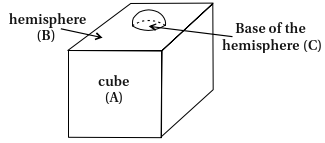
- ✓
$A + B - C$
- B
$A + B + C$
- C
$B + C - A$
- D
$A + C - B$
AnswerCorrect option: A. $A + B - C$
$A + B - C$
View full question & answer→