Questions · Page 1 of 2

3 Marks Question

🎯

Test yourself on this topic

50 questions · timed · auto-graded

Question 13 Marks
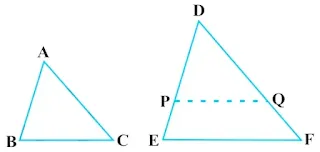
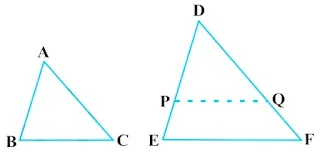
If in two triangles, corresponding angles are equal, then their corresponding sides are in the same ratio $($or proportion$)$ and hence the two triangles are similar:
Answer
Image
This criterion is referred to as the $AAA$
$($Angle-Angle-Angle$)$ criterion of similarity of two triangles.
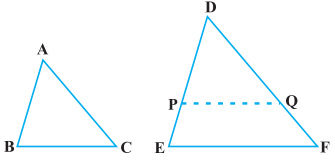
This theorem can be proved by taking two triangles $ABC$ and $DEF$ such that $\angle A =\angle D , \angle B =\angle E$ and $\angle C =\angle F ($see Fig. $6.24)$
Cut $DP = AB$ and $DQ = AC$ and join $PQ$.
So,
$\Delta ABC \cong \Delta DPQ$
$($Why $?)$
This gives
$\angle B =\angle P =\angle E \text { and } PQ \| EF .....($How$?)$
Therefore,
$\frac{ DP }{ PE }=\frac{ DQ }{ QF } .....($Why$?)$
i.e.,
$\frac{ AB }{ DE }=\frac{ AC }{ DF } .....($Why$?)$
Similarly,
$\frac{ AB }{ DE }=\frac{ BC }{ EF } \text { and so } \frac{ AB }{ DE }=\frac{ BC }{ EF }=\frac{ AC }{ DF } \text {. }$
View full question & answer
Question 23 Marks
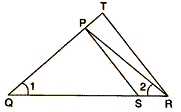
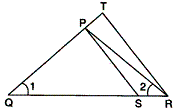
In Figure, $\frac{{QR}}{{QS}} = \frac{{QT}}{{PR}}$ and $\angle 1 =  \angle 2. $ Show that $\triangle PQS \sim \triangle TQR$.
Answer
Given: In figure, $\frac{{QR}}{{QS}} = \frac{{QT}}{{PR}}$ and $\angle 1 = \angle 2$
To prove: $\triangle PQS \sim \triangle TQR$
Proof: In $\triangle PQR \because \angle 1= \angle 2$
$\therefore PR = QP (1).......[ \because$ sides opposite to equal angle of a triangle are equal$]$
Now, $\frac{{QR}}{{QS}} = \frac{{QT}}{{PR}} ......$given
$\Rightarrow \frac{{QR}}{{QS}} = \frac{{QT}}{{QP}} (2).......$Using$(1)$
Again in $\triangle PQS$ and $\triangle TQR$
$\because \frac{{QR}}{{QS}} = \frac{{QT}}{{QP}}...........$From$(2) $
$ \therefore \frac{{QS}}{{QR}} = \frac{{QP}}{{QT}}$ and $\angle SQP = \angle RQT$
$\therefore \triangle PQS \sim \triangle TQR ...........SAS$ similarity criterion
View full question & answer
Question 33 Marks
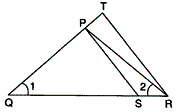
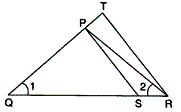
In Figure, $\frac{{QR}}{{QS}} = \frac{{QT}}{{PR}}$ and $\angle1 = \angle2.$ Show that $\triangle PQS \sim \triangle TQR.$
Answer
Given: In figure, $\frac{{QR}}{{QS}} = \frac{{QT}}{{PR}}$ and $\angle 1 = \angle 2$
To prove: $\triangle PQS \sim \triangle TQR$
Proof: In $\triangle PQR \because \angle 1= \angle 2$
$\therefore PR = QP (1).......[ \because$ sides opposite to equal angle of a triangle are equal$]$
Now, $\frac{{QR}}{{QS}} = \frac{{QT}}{{PR}} ......$given
$\Rightarrow \frac{{QR}}{{QS}} = \frac{{QT}}{{QP}} (2).......$Using$(1)$
Again in $\triangle PQS$ and $\triangle TQR$
$\because \frac{{QR}}{{QS}} = \frac{{QT}}{{QP}}...........$From$(2)$
$\therefore \frac{{QS}}{{QR}} = \frac{{QP}}{{QT}}$ and $\angle SQP = \angle RQT$
$\therefore \triangle PQS \sim \triangle TQR...........SAS$ similarity criterion
View full question & answer
Question 43 Marks
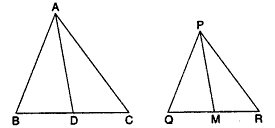
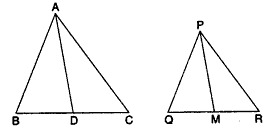
If $AD$ and $PM$ are medians of triangles $ABC$ and $PQR,$ respectively where $\triangle   ABC \sim \triangle PQR$, Prove that $\frac{{AB}}{{PQ}} = \frac{{AD}}{{PM}}$
Answer
Given: $AD$ and $PM$ are median of triangles $ABC$ and $PQR$ respectively where $\triangle ABC \sim \triangle PQR$

To prove: $\frac{{AB}}{{PQ}} = \frac{{AD}}{{PM}}$
Proof: $\triangle ABC \sim \triangle PQR ........$Given
$\therefore \frac{{AB}}{{PQ}} = \frac{{BC}}{{QR}} = \frac{{CA}}{{RP}} .......(1).....[ \because$ Corresponding sides of two similar triangles are proportional$]$
and $\angle A = \angle P, \angle B = \angle Q, \angle C = \angle R, ..........(2) [ \because$ corresponding sides of two similar triangles are proportional$]$
But $BC = 2BD$ and $QR = 2QM.............. \because AD$ and $PM$ are medians
So, from$(1), \frac{{AB}}{{PQ}} = \frac{{2BD}}{{2QM}}$
$\Rightarrow \frac{{AB}}{{PQ}} = \frac{{BD}}{{QM}} ........(3)$
Also, $\angle ABD = \angle PQM .........(4)..........$ From $(2)$
$\therefore \triangle ABD \sim \triangle PQM .......SAS$ similarity criterion
$\therefore \frac{{AB}}{{PQ}} = \frac{{AD}}{{PM}} ........ [\because$ Corresponding sides of two similar triangles are proportional$]$
View full question & answer
Question 53 Marks
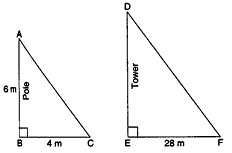
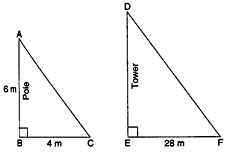
A vertical pole of length $6\ m$ casts a shadow $4 \ m$ long on the ground and at the same time a tower casts a shadow $28\ m$ long. Find the height of the tower.
Answer
Let $AB$ denoted the vertical pole of length $6m.\ BC$ is the shadow of the pole on the ground $BC = 4m.$
Let $DE$ denote the tower.
$EF$ is shadow of the tower on the ground.
$EF = 28\ m.$
Let the height of the tower be $h\ m.$

In $\triangle ABC$ and $\triangle DEF,$
$\angle B = \angle E ......[$Each equal to $90^\circ$  because pole and tower are standing vertical to the ground$]$
$ \angle C = \angle F .....[$Same elevation$]$
$ \angle A = \angle D \because$ shadows are cast at the same time
$\therefore \triangle ABC$ and $\triangle DEF,$
$\angle B= \angle E ............[$Each equal to $90^\circ$ because pole and tower are standing vertical to the ground.$]$
$\angle A= \angle D ( \because$ shadows are cast at the same time$)$
$\therefore \vartriangle ABC ~ \vartriangle DEF ......(AA$ similarity criterion$)$
$\therefore \frac{{AB}}{{DE}} = \frac{{BC}}{{EF}} ...........[ \because$ corresponding sides of two similar triangles are proportional$]$
$\Rightarrow \frac{6}{h} = \frac{4}{{28}} $
$ \Rightarrow h = \frac{{6 \times 28}}{4} \Rightarrow h = 42$
Hence, the height of the tower is $42\ m$
View full question & answer
Question 63 Marks
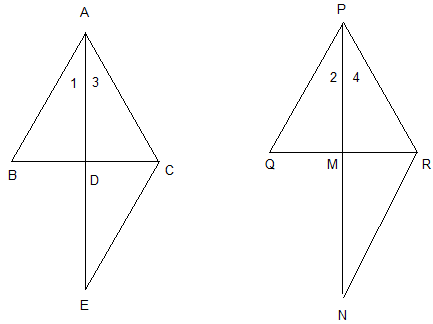
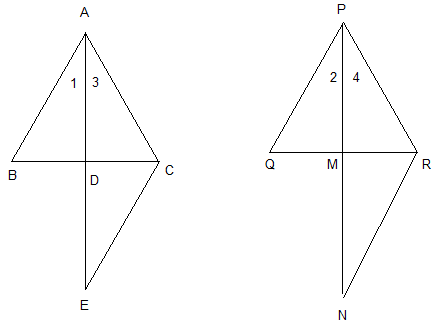
Sides $AB$ and $AC$ and median $AD$ of a triangle $ABC$ are respectively proportional to sides $PQ$ and $PR$ and median $PM$ of another triangle $PQR$. Show that $ \Delta A B C \sim \Delta P Q R$.
Answer

Given : In $\Delta A B C \text { and } \Delta P Q R$ The $AD$ and $PM$ are their medians,
such that $\frac { A B } { P Q } = \frac { A D } { P M } = \frac { A C } { P R }$
To prove $: \Delta A B C \sim \Delta P Q R$
Construction : Produce $AD$ to $E$ such that $AD = DE$ and produce $PM$ to $N$ such that $PM = MN.$ Join $CE$ and $RN.$
Proof : In $\Delta A B D \text { and } \Delta E D C$
$AD=DE$
$\angle A D B = \angle E D C ($vertically opposite angles$)$
$BD=DC\text{(as AD is a median)}$
$\therefore \quad \Delta A B D \equiv \Delta E D C ($By $SAS$ congruency$)$
or, $AB=CE ($By $CPCT)$
Similarly, $PQ = RN $
$\frac { A B } { P Q } = \frac { A D } { P M } = \frac { A C } { P R } ($Given$)$
or, $\frac { C E } { R N } = \frac { 2 A D } { 2 P M } = \frac { A C } { P R }$
or $\frac{CE}{RN}=\frac{AE}{PN}=\frac{AC}{PR}$
So ∆$ACE \sim ∆PRN$
$\angle 3=\angle 4$
$Similarly \angle 1=\angle 2$
$\angle 1+\angle3=\angle2+\angle4$
$So \angle A=\angle P\text{ and}$
$\frac{AB}{PQ}=\frac{AC}{PR}\text{(given)}$
Hence $∆ABC\sim ∆PQR$
View full question & answer
Question 73 Marks
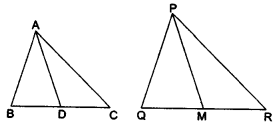
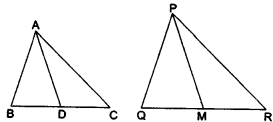
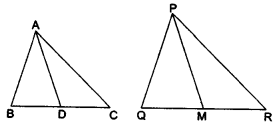
Sides $AB$ and $BC$ and median $AD$ of a triangle $ABC$ are respectively proportional to sides $PQ$ and $QR$ and median $PM$ of $\triangle PQR ($see figure$)$. Show that $\triangle A B C \sim \triangle P Q R .$
Answer

It is given that:
$\frac { A B } { P Q } = \frac { B C } { Q R } = \frac { A D } { P M }$
$\Rightarrow \quad \frac { A B } { P Q } = \frac { A D } { P M }$$= \frac { B C } { Q R } = \frac { \frac { 1 } { 2 } B C } { \frac { 1 } { 2 } Q R } = \frac { B D } { Q M }.........(i)$
In $\triangle ABD$ and $\triangle PQM$, we have
$\frac { A B } { P Q } = \frac { A D } { P M } = \frac { B D } { Q M } [$from$(i)]$
$\therefore \quad \triangle A B D \sim \triangle P Q M [$by $SSS-$similarity criteria$].$
And also, $\angle B = \angle Q [$corresponding angles of similar triangles are equal$].$
Now, in $\triangle ABC$ and $\triangle PQR$, we have
$\angle B = \angle Q$ [proved above]
and $\frac { A B } { P Q } = \frac { B D } { Q M } [$from$(i)].$
$\therefore \quad \triangle A B C \sim \triangle P Q R [$by $SAS-$similarity criteria$].$
View full question & answer
Question 83 Marks
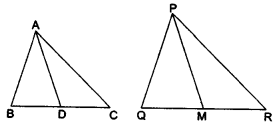
Sides $AB$ and $BC$ and median $AD$ of a triangle $ABC$ are respectively proportional to sides $PQ$ and $QR$ and median $PM$ of $\triangle PQR ($see figure$).$ Show that $\triangle A B C \sim \triangle P Q R$
Answer

It is given that:
$\frac { A B } { P Q } = \frac { B C } { Q R } = \frac { A D } { P M }$
$\Rightarrow \quad \frac { A B } { P Q } = \frac { A D } { P M }= \frac { B C } { Q R } = \frac { \frac { 1 } { 2 } B C } { \frac { 1 } { 2 } Q R } = \frac { B D } { Q M }.......(i)$
In $\triangle ABD$ and $\triangle PQM,$ we have
$\frac { A B } { P Q } = \frac { A D } { P M } = \frac { B D } { Q M } [from(i)]$
$\therefore \quad \triangle A B D \sim \triangle P Q M [$by $SSS-$similarity criteria$].$
And also, $\angle B = \angle Q [$corresponding angles of similar triangles are equal$].$
Now, in $\triangle ABC$ and $\triangle PQR,$ we have
$\angle B = \angle Q [$proved above$]$
and $\frac { A B } { P Q } = \frac { B D } { Q M } [$from$(i)].$
$\therefore \quad \triangle A B C \sim \triangle P Q R [$by $SAS-$similarity criteria$].$
View full question & answer
Question 93 Marks
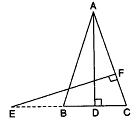
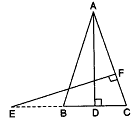
In the figure, $E$ is the point on side $CB$ produced on an isosceles triangle $ABC$ with $AB = AC.$ If $AD \bot BC$ and $EF \bot AC,$ prove that $\triangle ABD \sim \triangle ECF.$
Answer
$E$ is the point on side $CB$ produced on an isosceles triangle $ABC$ with $AB=AC.AD-BC \bot$ and$ EF \bot AC.$ with $AB=AC.$ Also, $AD \bot BC$ and $EF \bot AC.$
To prove:$ \triangle ABD \sim \triangle ECF$
Proof: In $\triangle ABD$ and $\triangle ECF,$
$\therefore AB = AC ........$Given
$\therefore \angle ACB = \angle ABC ......$Angle opposite to equal sides of a triangle are equal
$\Rightarrow \angle ABC = \angle ACB $
$ \Rightarrow \angle ABD = \angle ECF ..........(1)$
$ \angle ADB = \angle EFC .........(2) [$Each equal to $90^\circ$ In view of $(1)$ and $(2)]$
$\triangle ABD \sim \triangle ECF.............AA$ similarity criterion
View full question & answer
Question 103 Marks
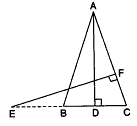
In the figure, $E$ is the point on side $CB$ produced on an isosceles triangle $ABC$ with $AB = AC.$ If $AD \bot BC$ and $EF \bot AC,$ prove that $\triangle ABD \sim \triangle ECF.$
Answer
$E$ is the point on side $CB$ produced on an isosceles triangle $ABC$ with $AB=AC.AD-BC \bot$ and $EF \bot AC.$ with $AB=AC$. Also, $AD \bot BC$ and $EF \bot AC.$
To prove: $\triangle ABD \sim \triangle ECF$
Proof: In $\triangle ABD$ and $\triangle ECF,$
$\therefore AB = AC ........$Given
$\therefore \angle ACB = \angle ABC ......$Angle opposite to equal sides of a triangle are equal
$\Rightarrow \angle ABC = \angle ACB $
$ \Rightarrow \angle ABD = \angle ECF ..........(1)$
$ \angle ADB = \angle EFC .........(2) [$Each equal to $90^\circ$ In view of $(1)$ and $(2)]$
$\triangle ABD \sim \triangle ECF.............AA$ similarity criterion
View full question & answer
Question 113 Marks
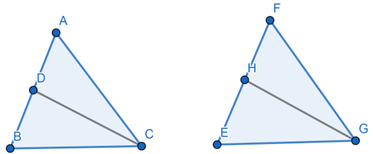
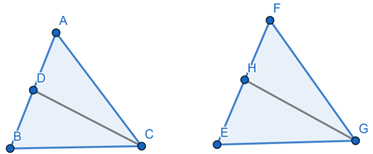
$CD$ and $GH$ are respectively the bisectors of $\angle ACB$ and $\angle EGF $ such that $D$ and $H$ lie on sides $AB$ and $FE$ of $\triangle ABC$ and $\triangle EFG$ respectively. If $\triangle ABC \sim\triangle FEG,$ show that:
  1. $\frac{C D}{G H}=\frac{A C}{F G}$
  2. $\triangle DCB \sim\triangle HGE$
  3. $\triangle DCA \sim\triangle HGF$
Answer

Given, $\triangle ABC \sim\triangle FEG ….(1)$
$(i)$ Corresponding angles of similar triangles
$\Rightarrow \angle BAC = \angle EFG ….(2)$
And $\angle ABC = \angle FEG …(3)$
$ \Rightarrow \angle ACB = \angle FGE$
$ \Rightarrow \frac{1}{2}\angle ACB = \frac{1}{2}\angle FGE $
$ \Rightarrow \angle ACD = \angle FGH$ and $\angle BCD = \angle EGH ……(4)$
Consider $\triangle ACD$ and $\triangle FGH$
$ \Rightarrow$ From $(2)$ we have
$\Rightarrow \angle DAC = \angle HFG$
From $(4)$ we have
$\Rightarrow \angle ACD = \angle EGH$
Also, $\angle ADC = \angle FGH$
If the $\angle A=\angle F ,$ then by angle sum property of triangle $3^{rd}$  angle will also be equal.
By $AAA$ similarity, in two triangles, if the angles are equal, then sides opposite to the equal angles are in the same ratio (or proportional) and hence the triangles are similar.
$\therefore\triangle ADC \sim\triangle FHG$
$(ii)$ By Converse proportionality theorem
$\Rightarrow \frac{C D}{G H}=\frac{A C}{F G} $
$(iii)$ Consider $\triangle DCB$ and $\triangle HGE$
From eq$(3)$ we have
$\Rightarrow \angle DBC = \angle HEG$
From $(4)$ we have
$\Rightarrow \angle BCD = \angle FGH$
Also, $\angle BDC = \angle EHG$
$ \therefore\triangle DCB \sim\triangle HGE$
Hence proved.
View full question & answer
Question 123 Marks
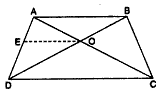
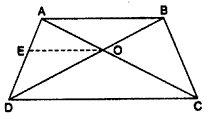
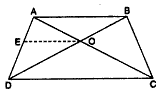
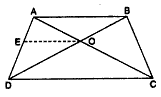
$ABCD$ is a trapezium in which $AB || DC$ and its diagonals intersect each other at the point $O$. Show that $\frac{{AO}}{{BO}} = \frac{{CO}}{{DO}}$.
Answer
Given: $ABCD$ is a trapezium in which $AB||DC.$
ITs diagonals intersect each other at the point $O.$
To prove: $\frac{{AO}}{{BO}} = \frac{{CO}}{{DO}}$
Construction:
Through $O$, draw a line $OE$ parallel to $AB$ or $DC$ intersecting $AD$ at $E.$
Proof: In $\triangle ADC$
$\because OE||DC$
$\therefore \frac{{AO}}{{CO}} = \frac{{AE}}{{DE}}$(1)......[By basic proportionality theorem]
In $\triangle DBA,\,\because OE||AB$
$\therefore \frac{{DE}}{{AE}} = \frac{{DO}}{{BO}}$.....[By basic proportionality theorem]
$ \Rightarrow \frac{{DE}}{{AE}} = \frac{{DO}}{{BO}}......$[By basic proportionality theorem]
From $(1)$ and $(2)$, $\frac{{AO}}{{CO}} = \frac{{BO}}{{DO}} \Rightarrow \frac{{AO}}{{BO}} = \frac{{CO}}{{DO}}$
View full question & answer
Question 133 Marks
$ABCD$ is a trapezium in which $AB || DC$ and its diagonals intersect each other at the point $O$. Show that $\frac{{AO}}{{BO}} = \frac{{CO}}{{DO}}$
Answer
Given: $ABCD$ is a trapezium in which $AB||DC.$
ITs diagonals intersect each other at the point $O.$
To prove: $\frac{{AO}}{{BO}} = \frac{{CO}}{{DO}}$

Construction:
Through $O$, draw a line $OE$ parallel to $AB$ or $DC$ intersecting $AD$ at $E.$
Proof: In $\triangle ADC $
$ \because OE||DC $
$ \therefore \frac{{AO}}{{CO}} = \frac{{AE}}{{DE}} (1)......$[By basic proportionality theorem]
In $\triangle DBA,\,\because OE||AB $
$ \therefore \frac{{DE}}{{AE}} = \frac{{DO}}{{BO}} .....$[By basic proportionality theorem]
$\Rightarrow \frac{{DE}}{{AE}} = \frac{{DO}}{{BO}}......$ [By basic proportionality theorem]
From $(1)$ and $(2)$, $\frac{{AO}}{{CO}} = \frac{{BO}}{{DO}} \Rightarrow \frac{{AO}}{{BO}} = \frac{{CO}}{{DO}}$
View full question & answer
Question 143 Marks
Prove that the line joining the mid points of any two sides of a triangle is parallel to the third side.
Answer
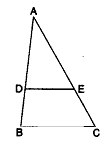
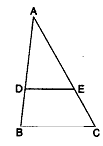
Given: $A \triangle ABC$ in which $D$ and $E$ are the mid-points of sides $AB$ and $AC$ respectively. $DE$ is the line joining $D$ and $E.$
To prove:$DE \parallel BC$
Proof:
$\because D$ is the mid-point of $AB$
$\therefore AD=DB$
$ \therefore \frac{{AD}}{{DB}} = 1 .....(1)$
$ \because E$ is the mid-point of $AC$

$\therefore AE=EC$
$ \therefore \frac{{AE}}{{EC}} = 1 .....(2)$
From $(1)$ and $(2)$,$ \frac{{AD}}{{DB}} = \frac{{AE}}{{EC}} $
$ \therefore \frac{{AE}}{{EC}} = 1......(2) ....$By converse of basic proportionality theorem
View full question & answer
Question 153 Marks
Prove that a line draw through the mid point of one side of a triangle parallel to another side bisects the third side.
Answer
Guven: $A DABC$ in which $D$ is the mid-point of $AB$ and $DE \parallel BC.$
To prove: $E$ is the mid-point of $AC$
Proof:
$\therefore DE||BC $
$ \therefore \frac{{AD}}{{DB}} = \frac{{AE}}{{EC}} (1).........$ [By basic proportionality theorem]
$\because D$ is the midpoint of $AB$
$\therefore AD = DB\,\,\therefore \frac{{AD}}{{DB}} = 1 $
$ \therefore \frac{{AE}}{{EC}} = 1.....$.From$(1) $
$ \therefore AE = EC\,\therefore E$ is the mid-point of $AC.$
View full question & answer
Question 163 Marks
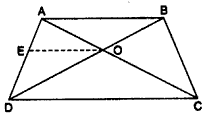
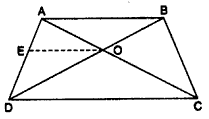
The diagonals of a quadrilateral $ABCD$ intersect each other at the point $O$ such that $\frac{{AO}}{{BO}} = \frac{{CO}}{{DO}}$. Show that $ABCD$ is a trapezium.
Answer
Given: The diagonals of a quadrilateral $ABCD$ intersect each other at the point $O$ such that $\frac{{AO}}{{BO}} = \frac{{CO}}{{DO}}$
To prove: $ABCD$ is trapezium.
Construction: Through $O$ draw a line $OE||BA$ intersecting $AD$ at $E.$
Proof: In $\triangle DBA$$\because OE||BA$

$\therefore \frac{{DO}}{{BO}} = \frac{{DE}}{{AE}} \Rightarrow \frac{{CO}}{{AO}} = \frac{{DE}}{{AE}}$
$\because \frac{{AO}}{{BO}} = \frac{{CO}}{{DO}}\,[Given]$
$\Rightarrow \frac{{DO}}{{BO}} = \frac{{CO}}{{AO}} \Rightarrow \frac{{AO}}{{CO}} = \frac{{AE}}{{DE}}$.........[Taking reciprocals]
$\therefore $In $\triangle ADC$
$OE \parallel CD ...........$[By converse basic proportionality theorem]
But $OE \parallel BA$
$BA \parallel CD........$ [By construction]
The quadrilateral $ABCD$ is a Trapezium.
View full question & answer
Question 173 Marks
The diagonals of a quadrilateral $ABCD$ intersect each other at the point $O$ such that $\frac{{AO}}{{BO}} = \frac{{CO}}{{DO}} .$ Show that $ABCD$ is a trapezium.
Answer
Given: The diagonals of a quadrilateral $ABCD$ intersect each other at the point $O$ such that $ \frac{{AO}}{{BO}} = \frac{{CO}}{{DO}} $
To prove: $ABCD$ is trapezium.
Construction: Through $O$ draw a line $OE||BA$ intersecting $AD$ at $E.$
Proof: In $ \triangle DBA \because OE||BA $

$ \therefore \frac{{DO}}{{BO}} = \frac{{DE}}{{AE}} \Rightarrow \frac{{CO}}{{AO}} = \frac{{DE}}{{AE}} $
$ \because \frac{{AO}}{{BO}} = \frac{{CO}}{{DO}}\,[Given] $
$ \Rightarrow \frac{{DO}}{{BO}} = \frac{{CO}}{{AO}} \Rightarrow \frac{{AO}}{{CO}} = \frac{{AE}}{{DE}} .........$[Taking reciprocals]
$ \therefore In \triangle ADC $
$OE \parallel CD ...........$[By converse basic proportionality theorem]
But $OE \parallel BA$
BA $ \parallel CD........$[By construction]
The quadrilateral $ABCD$ is a Trapezium.
View full question & answer
Question 183 Marks
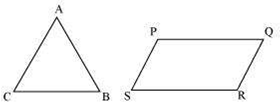
Give two different examples of each of the following:
  1. similar figures.
  2. non-similar figures.
Answer
  1. Two examples of similar figures are:
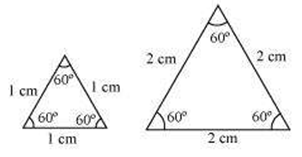
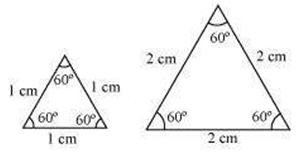
    1. Two equilateral triangles with sides $1 \ cm$ and $2 \ cm$ respectively
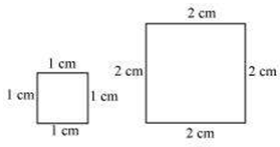
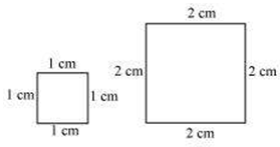
    2. Two squares with sides $1 \ cm$ and $2 \ cm$ respectively
  2. Now two examples of non-similar figures are:
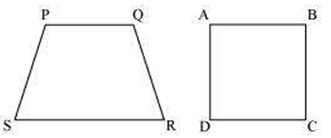
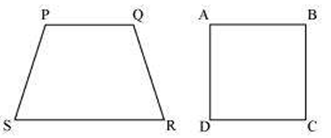
    1. Trapezium and square
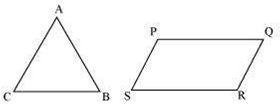
    2. Triangle and parallelogram
View full question & answer
Question 193 Marks
Give two different examples of each of the following:
  1. similar figures.
  2. non-similar figures.
Answer
  1. Two examples of similar figures are:
    1. Two equilateral triangles with sides $1 \ cm$ and $2 \ cm$ respectively
    2. Two squares with sides $1 \ cm$ and $2 \ cm$ respectively
  2. Now two examples of non-similar figures are:
    1. Trapezium and square
    2. Triangle and parallelogram
View full question & answer
Question 203 Marks
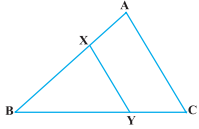
In the given figure, the line segment $XY$ is parallel to side $AC$ of $\triangle ABC$ and it divides the triangle into two parts of equal areas. Find the ratio $\frac{\mathrm{A} \mathrm{X}}{\mathrm{AB}} .$
Answer
Since $XY \parallel AC$
$​ \therefore ​ ​ \angle ​BXY = ​ \angle ​BAC$
$​ \angle ​BYX = ​ \angle BCA$​ [Corresponding angles]
$​ \therefore ​ ​ \triangle ​BXY ​ \cong ​ \triangle BAC [AA$ similarity]
$​ \therefore ​ ​​ \frac{{ar\left( {\triangle BXY} \right)}}{{ar\left( {\triangle BAC} \right)}} = \frac{{B{X^2}}}{{B{A^2}}}$
But ar$(​ \triangle ​BXY)=ar(XYCA)$
$​ \therefore ​ 2(​ \triangle ​BXY)=ar( \triangle BXY)+ar(XYCA)$
$= ar( \triangle BAC)$
$\therefore \frac{{ar\left( {\triangle BXY} \right)}}{{ar\left( {\triangle BAC} \right)}} = \frac{1}{2} $
$ \therefore \frac{{B{X^2}}}{{B{A^2}}} = \frac{1}{2} $
$​ \Rightarrow ​ \therefore \frac{{BX}}{{BA}} = \frac{1}{{\sqrt 2 }} $
$​ \therefore ​ \frac{{BA - BX}}{{BA}} = \frac{{\sqrt 2 - 1}}{{\sqrt 2 }} $
$​ \Rightarrow ​ \frac{{AX}}{{AB}} = \frac{{\sqrt 2 - 1}}{{\sqrt 2 }} = \frac{{2 - \sqrt 2 }}{2}$
View full question & answer
Question 213 Marks
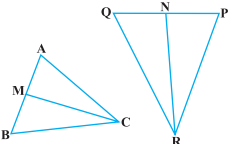
In Fig. $CM$ and $RN$ are respectively the medians of \triangle $ABC$ and $\triangle PQR$. If $\triangle ABC \sim\triangle PQR$, prove that:
  1. $\triangle AMC \sim\triangle PNR$
  2. $\frac{C M}{R N}=\frac{A B}{P Q}$
  3. $\triangle CMB \sim\triangle RNQ$
Answer
  1. $\triangle ABC \sim\triangle PQR$ (Given)
    So, $\frac{A B}{P Q}=\frac{B C}{Q R}=\frac{C A}{R P} ...(1)$ (corresponding sides of similar triangles are proportional)
    and $\angle A = \angle P, \angle B = \angle Q and \angle C = \angle R ...(2)$
    But $AB = 2 AM$ and $PQ = 2 PN$ (As $CM$ and $RN$ are medians)
    So, from $(1),$
    i.e., $\frac{A M}{P N}=\frac{C A}{R P} ...(3)$
    Also, $\angle MAC = \angle NPR $[From $(2)] ...(4)$
    So, from $(3)$ and $(4),$
    $ \triangle AMC \sim\triangle PNR (SAS$ similarity criterion)$ ...(5)$
  2. From $(5), \frac{\mathrm{CM}}{\mathrm{RN}}=\frac{\mathrm{CA}}{\mathrm{RP}} ...(6)$ (corresponding sides of similar triangles are proportional)
    But $\frac{C A}{R P}=\frac{A B}{P Q}$ [From $(1)] ...(7)$
    Therefore, $\frac{C M}{R N}=\frac{A B}{P Q}$ [From $(6)$ and $(7)] ...(8)$
  3. Again, $\frac{A B}{P Q}=\frac{B C}{Q R}$ [From $(1)]$
    Therefore $\frac{\mathrm{CM}}{\mathrm{RN}}=\frac{\mathrm{BC}}{\mathrm{QR}}$ [From $(8)] ...(9)$
    Also, $\frac{C M}{R N}=\frac{A B}{P Q}=\frac{2 B M}{2 Q N}$
    i.e., $\frac{\mathrm{CM}}{\mathrm{RN}}=\frac{\mathrm{BM}}{\mathrm{QN}} ...(10)$
    i.e.,$ \frac{\mathrm{CM}}{\mathrm{RN}}=\frac{\mathrm{BC}}{\mathrm{QR}}=\frac{\mathrm{BM}}{\mathrm{QN}}$ [From $(9)$ and $(10)]$
    Therefore, $\triangle CMB \sim\triangle RNQ (SSS$ similarity criterion)
View full question & answer
Question 223 Marks
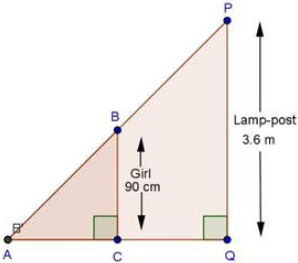
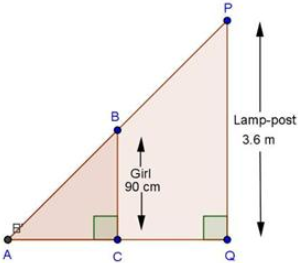
A girl of height $90 \ cm$ is walking away from the base of a lamp-post at a speed of $1.2 m/sec$. If the lamp is $3.6 \ m$ above the ground, find the length of her shadow after $4$ seconds.
Answer
We have,

Height of girl $= 90 cm = 0.9 m$
Height of lamp-post $= 3.6 m$
Speed of girl $= 1.2 m/sec$
Time taken $= 4 sec.$
$\therefore$ Distance moved by girl $(CQ) =$ Speed $\times$ Time
$= 1.2 \times 4$
$= 4.8 m$
Let length of shadow $(AC) = x cm$
In $\Delta ABC$  and $\Delta APQ$
$\angle ACB = \angle AQP$ [Each $90^\circ ]$
$\angle BAC = \angle PAQ$ [Common]
Then, $\Delta ABC ~ \Delta APQ$ [By $AA$ similarity]
$\therefore \frac{{AC}}{{AQ}} = \frac{{BC}}{{PQ}}$ [Corresponding parts of similar $\Delta$ are proportional]
$ \Rightarrow \frac{x}{{x + 4.8}} = \frac{{0.9}}{{3.6}}$
$\Rightarrow \frac{x}{{x + 4.8}} = \frac{1}{4}$
$\Rightarrow 4x = x + 4.8$
$\Rightarrow 4x - x = 4.8$
$\Rightarrow 3x = 4.8$
$\Rightarrow x = \frac{{4.8}}{3} = 1.6m$
$\therefore$ Length of shadow $= 1.6 \ m$
View full question & answer
Question 233 Marks
A girl of height $90 \ cm$ is walking away from the base of a lamp-post at a speed of $1.2 m/sec$. If the lamp is $3.6\  m$ above the ground, find the length of her shadow after $4$ seconds.
Answer
We have,

Height of girl $= 90 cm = 0.9 m$
Height of lamp-post $= 3.6 m$
Speed of girl $= 1.2 m/sec$
Time taken $= 4 sec.$
\therefore Distance moved by girl $(CQ) =$ Speed \times Time
$= 1.2 \times 4$
$= 4.8 m$
Let length of shadow $(AC) = x cm$
In $\Delta ABC$ and $\Delta APQ$
$\angle ACB = \angle AQP$ [Each $90^\circ ]$
$\angle BAC = \angle PAQ$ [Common]
Then, $\Delta ABC ~ \Delta APQ$ [By $AA$ similarity]
$\therefore \frac{{AC}}{{AQ}} = \frac{{BC}}{{PQ}}$ [Corresponding parts of similar \Delta are proportional]
$\Rightarrow \frac{x}{{x + 4.8}} = \frac{{0.9}}{{3.6}}$
$\Rightarrow \frac{x}{{x + 4.8}} = \frac{1}{4}$
$\Rightarrow 4x = x + 4.8$
$\Rightarrow 4x - x = 4.8$
$\Rightarrow 3x = 4.8$
$\Rightarrow x = \frac{{4.8}}{3} = 1.6m$
$\therefore$ Length of shadow $= 1.6 m$
View full question & answer
Question 243 Marks
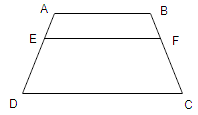
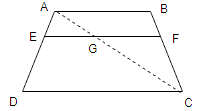
$ABCD$ is a trapezium with $AB || DC. E$ and $F$ are two points on non-parallel sides $AD$ and $BC$ respectively, such that $EF$ is parallel to $AB$. Show that $\frac{AE}{ED}=\frac{BF}{FC}$ 
Answer
Given, In trapezium $ABCD,$
$AB || DC$ and $EF || DC$ 
To prove $\frac{AE}{ED}=\frac{BF}{FC}$ 
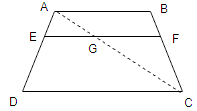
Construction: Join $AC$ to intersect $EF$ at $G.$

Proof Since, $AB || DC$ and $EF || DC$ 
$EF || AB$ [since, lines parallel to the same line are also parallel to each other ]$...... (i)$
In $\triangle ADC$, $EG || DC$ [$\because $ $EF || DC$]
By using basic proportionality theorem,
$\frac{AE}{ED}=\frac{AG}{GC} ....(ii)$
In $\triangle ABC$, $ GF || AB$ [$\because $ $EF || AB$  from $(i)]$
By using basic proportionality theorem ,
$\frac{CG}{AG}=\frac{CF}{BF}$ or $\frac{AG}{GC}=\frac{BF}{CF}$ [ On taking reciprocal of the terms]$............. (iii)$
From Equations $(ii)$ and $(iii)$, we get
$\frac{AE}{ED}=\frac{BF}{FC}$ 
Hence Proved.
View full question & answer
Question 253 Marks
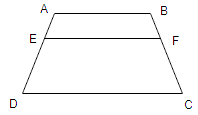
$ABCD$ is a trapezium with $AB || DC. E$ and $F$ are two points on non-parallel sides $AD$ and $BC$ respectively, such that $EF$ is parallel to $AB.$ Show that $\frac{AE}{ED}=\frac{BF}{FC}$
Answer
Given, In trapezium $ABCD,$
$AB || DC$ and $EF || DC$
To prove $\frac{AE}{ED}=\frac{BF}{FC}$
Construction: Join $AC$ to intersect $EF$ at $G.$

Proof Since, $AB || DC$ and $EF || DC$
$EF || AB[$since, lines parallel to the same line are also parallel to each other $]...... (i)$
In $\triangle ADC, EG || DC[\because EF || DC]$
By using basic proportionality theorem,
$\frac{AE}{ED}=\frac{AG}{GC}....(ii)$
In $\triangle ABC, GF || AB[\because EF || AB$ from $(i)]$
By using basic proportionality theorem ,
$\frac{CG}{AG}=\frac{CF}{BF}$ or $\frac{AG}{GC}=\frac{BF}{CF}[$ On taking reciprocal of the terms$]............. (iii)$
From Equations $(ii)$ and $(iii),$ we get
$\frac{AE}{ED}=\frac{BF}{FC}$
Hence Proved.
View full question & answer
Question 263 Marks
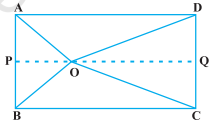
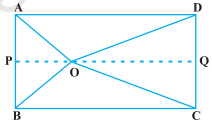
$O$ is any point inside a rectangle $ABCD$ see Fig. Prove that $OB^2+ OD^2= OA^2+ OC^2$ .
Answer
Through $O$ , draw $P Q|\mid B C$ so that $P$ lies on $A B$ and $Q$ lies on $D C$.
Now, $PQ || BC$
Therefore, $PQ \perp AB$ and $PQ \perp DC \left(\angle B =90^{\circ}\right.$ and $\left.\angle C =90^{\circ}\right)$
So, $\angle BPQ =90^{\circ}$ and $\angle CQP =90^{\circ}$
Therefore, $BPQC$ and $APQD$ are both rectangles.
Now, from $\triangle O P B$
$O B^2=B P^2+O P^2 \ldots(1)$
Similarly, from $\triangle O Q D$,
$O D^2=O Q^2+D Q^2 \ldots(2)$
From $\triangle O Q C$, we have
$O C^2=O Q^2+C Q^2 \ldots(3)$and from
$\triangle O A P$, we have
$O A^2=A P^2+O P^2 \ldots(4)$
Adding (1) and (2),
$ O B^2+O D^2=B P^2+O P^2+O Q^2+D Q^2$
$ =C Q^2+O P^2+O Q^2+A P^2(A s B P=C Q \text { and } D Q=A P) $
$ =C Q^2+O Q^2+O P^2+A P^2 $
$ O B^2+O D^2=O C^2+O A^2[\text { From (3) and (4) }]$
Hence proved.
View full question & answer
Question 273 Marks
$O$ is any point inside a rectangle $ABCD$ see Fig. Prove that $OB^2+ OD^2= OA^2+ OC^2.$
Answer
 Through $O$ , draw $PQ \| BC$ so that $P$ lies on $AB$ and $Q$ lies on $DC $.
Now, $PQ || BC$
Therefore, $PQ \perp AB$ and $PQ \perp DC \left(\angle B =90^{\circ}\right.$ and $\left.\angle C =90^{\circ}\right)$
So, $\angle BPQ =90^{\circ}$ and $\angle CQP =90^{\circ}$
Therefore, $B P Q C$ and $A P Q D$ are both rectangles.
Now, from $\triangle OPB$
$O B^2=B P^2+O P^2 \ldots(1)$
Similarly, from $\triangle O Q D$,
$O D^2=O Q^2+D Q^2 \ldots(2)$
From $\triangle O Q C$, we have
$O C^2=O Q^2+C Q^2 \ldots(3)$
and from $\triangle O A P$, we have
$O A^2=A P^2+O P^2 \ldots(4)$
Adding (1) and (2),
$ O B^2+O D^2=B P^2+O P^2+O Q^2+D Q^2 $
$=C Q^2+O P^2+O Q^2+A P^2(A s B P=C Q \text { and } D Q=A P) $
$ =C Q^2+O Q^2+O P^2+A P^2$
$O B^2+O D^2=O C^2+O A^2[\text { From (3) and (4)] }$
Hence proved.
View full question & answer
Question 283 Marks
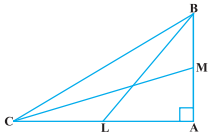
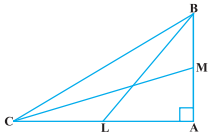
$BL$ and $CM$ are medians of ​$\triangle ​ABC$ right angled at A. Prove that $4\left(B^2+C M^2\right)=5 B C^2$
Answer

$BL$ and $CM$ are medians of a $\triangle ABC$ in which $\angle A=90^\circ$
From $\triangle A B C, B C^2=A B^2+A C^2 \ldots (i)$
From right angled $\vartriangle $ ABL,
$B L^2=A L^2+A B^2$
i.e $B{L^2} = {\left( {\frac{{AC}}{2}} \right)^2} + A{B^2}$
$\Rightarrow 4 \mathrm{BL}^2=A C^2+4 A B^2$
From right-angled $\triangle $CMA,
$\mathrm{CM}^2=\mathrm{AC}^2+\mathrm{AM}^2$
i.e $C{M^2} = A{C^2} + {\left( {\frac{{AB}}{2}} \right)^2}$[mid-point]
$\Rightarrow $$C{M^2} = A{C^2} + \frac{{A{B^2}}}{4}$
$\Rightarrow $$4C{M^2} = 4A{C^2} + A{B^2} .....(iii)$
Adding $(ii)$ and $(iii)$,, we get
$\text { i.e. } 4\left(B L^2+C M^2\right)=5\left(A C^2+A B^2\right)=5 B C^2[\text { From (i) }]$
View full question & answer
Question 293 Marks
$BL$ and $CM$ are medians of ​$\triangle ​ABC$ right angled at A. Prove that $4(BL^2+ CM^2) = 5BC^2$
Answer

BL and CM are medians of a $\triangle $ ABC in which $\angle A=90^\circ$
From $\triangle ABC, BC^2= AB^2+ AC^2....(i)$
From right angled $\vartriangle ABL,$
$BL^2= AL^2+ AB^2$
i.e $B{L^2} = {\left( {\frac{{AC}}{2}} \right)^2} + A{B^2}$
$\Rightarrow 4BL^2= AC^2+ 4AB^2.....(ii)$
From right-angled $\triangle CMA,$
$CM^2= AC^2+ AM^2$
i.e $C{M^2} = A{C^2} + {\left( {\frac{{AB}}{2}} \right)^2}$[mid-point]
$\Rightarrow $ $C{M^2} = A{C^2} + \frac{{A{B^2}}}{4}$
$\Rightarrow $ $4C{M^2} = 4A{C^2} + A{B^2} .....(iii)$
Adding $(ii)$ and $(iii)$,, we get
i.e. $4\left(B L^2+C M^2\right)=5\left(A C^2+A B^2\right)=5 B C^2[$ From (i) $]$
View full question & answer
Question 303 Marks
In the given figure, if $AD \bot BC$, prove that $AB^2+ CD^2= BD^2+ AC^2$.
Answer

In right angled $\triangle BDA$,
By pythagoras theorem
$AB^2= AD^2+ BD^2...(i)$
And in right angled $\triangle CDA$ ,
By pythagoras theorem
$AC^2= CD^2+ AD^2...(ii)$
On subtracting Eq$(ii)$ from Eq$(i)$ , we get
$AB^2- AC^2 = [AD^2+ BD^2] - [CD^2+ AD^2]$
$AB^2- AC^2=  AD^2+ BD^2- CD^2- AD^2$
$AB^2- AC^2= BD^2- CD^2$
$\therefore AB^2+ CD^2= BD^2+ AC^2$
View full question & answer
Question 313 Marks
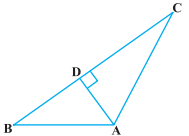
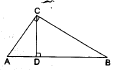
In the given figure, $\angle ACB = 90^\circ $ and $CD \perp AB.$ prove that $\frac { B C ^ { 2 } } { A C ^ { 2 } } = \frac { B D } { A D }$.

 
Answer
In $\triangle ACD$ and $\triangle ABC$
$\angle A = \angle A $ (Common)
$\angle ADC = \angle ACB$ ( each $90^\circ )$
Thus, By $AA$ similarity criteria
$\triangle ADC \sim \triangle ACB$
Thus, $\frac {AD} {AC} = \frac {AC} {AB} $
$\Rightarrow AC^2 = AD ×AB$... $(i)$
Similarly, $\triangle CDB \sim \triangle ACB $
And, $\frac {DC} {BC} = \frac {BC} {AB} $
$\Rightarrow BC^2 = DB ×AB... (ii)$
Dividing$ (ii)$ by$ (i)$
$\frac {BC^2 } {AC^2 } = \frac {DB} {AD} $
Hence Proved
View full question & answer
Question 323 Marks
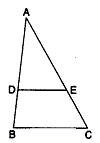
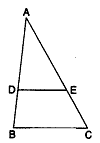
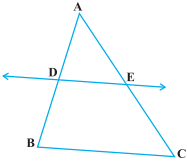
If a line intersects the sides $AB $and $AC$ of a $\triangle ABC$ at $D$ and $E$ respectively and is parallel to $BC$, prove that $\frac{A D}{A B}=\frac{A E}{A C}$ (see figure).
Answer
$DE || BC$ (Given)
therefore $\frac{\mathrm{AD}}{\mathrm{DB}}=\frac{\mathrm{AE}}{\mathrm{EC}}$ (by BPT)
or $\frac{D B}{A D}=\frac{E C}{A E}$ (by taking reciprocal on both sides)
or $\frac{D B}{A D}+1=\frac{E C}{A E}+1$ (add 1 on both sides)
we get $\frac{A B}{A D}=\frac{A C}{A E}$
So $\frac{A D}{A B}=\frac{A E}{A C}$
Hence proved
View full question & answer
Question 333 Marks
If one angle of a triangle is equal to one angle of the other triangle and the sides including these angles are proportional, then the two triangles are similar
Answer
Image
This criterion is referred to as the $SAS$ (Side-Angle-Side) similarity criterion for two triangles.
As before, this theorem can be proved by taking two triangles $ABC$ and$ DEF$ such that $\frac{ AB }{ DE }=\frac{ AC }{ DF }(<1)$ and $\angle A =\angle D$ (see Fig. $6.28).$ Cut $DP = AB, DQ$ $= AC$ and join $PQ$.
$\text { Now, } PQ \| EF \text { and } \triangle ABC \cong \triangle DPQ $
$\text { So, } \angle A =\angle D , \angle B =\angle P \text { and } \angle C =\angle Q $
$\text { Therefore, } \Delta ABC \sim \Delta DEF $
$\text { We now take some examples to illustrate the use of these criteria. }$
View full question & answer
Question 343 Marks
If in two triangles, sides of one triangle are proportional to (i.e., in the same ratio of ) the sides of the other triangle, then their corresponding angles are equal and hence the two triangles are similiar.
Answer
Image
This theorem can be proved by taking two triangles $ABC$ and $DEF$ such that $\frac{ AB }{ DE }=\frac{ BC }{ EF }=\frac{ CA }{ FD }(<1)($ see Fig. $6.26):$
Cut $DP = AB$ and $DQ = AC$ and join $PQ$.
It can be seen that $\frac{ DP }{ PE }=\frac{ DQ }{ QF }$ and $PQ \| EF$ (How?)
So, $\angle P =\angle E$ and $\angle Q =\angle F$.
Therefore,
$\frac{ DP }{ DE }=\frac{ DQ }{ DF }=\frac{ PQ }{ EF }$
So,
$\frac{ DP }{ DE }=\frac{ DQ }{ DF }=\frac{ BC }{ EF } \quad \text { (Why?) }$
So,
$BC = PQ \quad \text { (Why?) }$
Thus,
$\Delta ABC \cong \Delta DPQ$
(Why ?)
So,
$\angle A =\angle D , \angle B =\angle E \text { and } \angle C =\angle F \text { (How ?) }$
View full question & answer
Question 353 Marks
If in two triangles, corresponding angles are equal, then their corresponding sides are in the same ratio (or proportion) and hence the two triangles are similar:
Answer
Image
This criterion is referred to as the AAA
(Angle-Angle-Angle) criterion of similarity of two triangles.
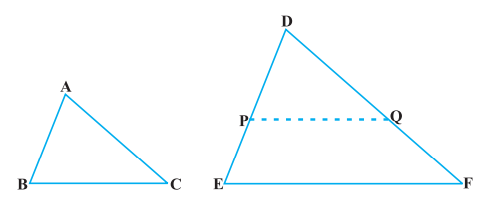
This theorem can be proved by taking two triangles $ABC$ and $DEF$ such that $\angle A =\angle D , \angle B =\angle E$ and $\angle C =\angle F$ (see Fig. 6.24)
Cut $DP = AB$ and $DQ = AC$ and join $PQ$.
So,
$\Delta ABC \cong \Delta DPQ$
(Why ?)
This gives
$\angle B =\angle P =\angle E \text { and } PQ \| EF$ .....(How?)
Therefore,
$\frac{ DP }{ PE }=\frac{ DQ }{ QF }$ .....(Why?)
i.e.,
$\frac{ AB }{ DE }=\frac{ AC }{ DF }$ .....(Why?)
Similarly,
$\frac{ AB }{ DE }=\frac{ BC }{ EF } \text { and so } \frac{ AB }{ DE }=\frac{ BC }{ EF }=\frac{ AC }{ DF } \text {. }$
View full question & answer
Question 363 Marks
Answer
Given: In figure, $\frac{{QR}}{{QS}} = \frac{{QT}}{{PR}}$and   $\angle$  1 =  $\angle$  2
To prove: $\triangle PQS \sim \triangle TQR$
Proof: In  $\triangle $  PQR   $\because $   $\angle$  1=  $\angle$  2
$\therefore $  PR = QP (1).......[  $\because $  sides opposite to equal angle of a triangle are equal]
Now, $\frac{{QR}}{{QS}} = \frac{{QT}}{{PR}}$ ......given
$ \Rightarrow \frac{{QR}}{{QS}} = \frac{{QT}}{{QP}}$ (2).......Using(1)
Again in $\triangle PQS$ and $\triangle TQR$
$\because \frac{{QR}}{{QS}} = \frac{{QT}}{{QP}}...........From(2)$
$\therefore \frac{{QS}}{{QR}} = \frac{{QP}}{{QT}}$ and $\angle SQP = \angle RQT$
$\therefore \triangle PQS \sim \triangle TQR$...........SAS similarity criterion
View full question & answer
Question 373 Marks
Answer
Given: In figure, $\frac{{QR}}{{QS}} = \frac{{QT}}{{PR}}$and   $\angle$  1 =  $\angle$  2
To prove: $\triangle PQS \sim \triangle TQR$
Proof: In  $\triangle $  PQR   $\because $   $\angle$  1=  $\angle$  2
$\therefore $  PR = QP (1).......[  $\because $  sides opposite to equal angle of a triangle are equal]
Now, $\frac{{QR}}{{QS}} = \frac{{QT}}{{PR}}$ ......given
$ \Rightarrow \frac{{QR}}{{QS}} = \frac{{QT}}{{QP}}$ (2).......Using(1)
Again in $\triangle PQS$ and $\triangle TQR$
$\because \frac{{QR}}{{QS}} = \frac{{QT}}{{QP}}...........From(2)$
$\therefore \frac{{QS}}{{QR}} = \frac{{QP}}{{QT}}$ and $\angle SQP = \angle RQT$
$\therefore \triangle PQS \sim \triangle TQR$...........SAS similarity criterion
View full question & answer
Question 383 Marks
If AD and PM are medians of triangles ABC and PQR, respectively where  $\triangle $  ABC  $ \sim $  $\triangle $PQR, Prove that $\frac{{AB}}{{PQ}} = \frac{{AD}}{{PM}}$
View full question & answer
Question 393 Marks
A vertical pole of length $6 \ m$ casts a shadow $4 \ m$ long on the ground and at the same time a tower casts a shadow $28 \ m$ long. Find the height of the tower.
Answer
Let $AB$ denoted the vertical pole of length $6 \ m.BC$ is the shadow of the pole on the ground $BC = 4 \ m.$
Let $DE$ denote the tower.
$EF$ is shadow of the tower on the ground.
$EF = 28 \ m.$
Let the height of the tower be h m.
 
In $\triangle $ABC and $\triangle $DEF,
$\angle  B =  \angle E ......[$Each equal to $90^{\circ}$ because pole and tower are standing vertical to the ground$]$
$\angle  C =  \angle F .....[$Same elevation$]$
$\angle  A =  \angle  D  \because $ shadows are cast at the same time
$\therefore  \triangle ABC$ and $\triangle DEF,$
$\angle  B=  \angle  E ............[$Each equal to $90^{\circ}$ because pole and tower are standing vertical to the ground.$]$
$ \angle A= \angle D (  \because $ shadows are cast at the same time$)$
$\therefore  \vartriangle   ABC ~  \vartriangle  DEF ......(AA$ similarity criterion$)$
$\therefore  \frac{{AB}}{{DE}} = \frac{{BC}}{{EF}}  ...........[  \because $ corresponding sides of two similar triangles are proportional$]$
$\Rightarrow  \frac{6}{h} = \frac{4}{{28}}$
$\Rightarrow  h = \frac{{6 \times 28}}{4} \Rightarrow h = 42$
Hence, the height of the tower is $42 \ m$
View full question & answer
Question 403 Marks
Sides AB and AC and median AD of a triangle ABC are respectively proportional to sides PQ and PR and median PM of another triangle PQR. Show that $\Delta A B C \sim \Delta P Q R$.
View full question & answer
Question 413 Marks
View full question & answer
Question 423 Marks
Sides AB and BC and median AD of a triangle ABC are respectively proportional to sides PQ and QR and median PM of $\triangle$PQR (see figure). Show that $\triangle A B C \sim \triangle P Q R$.
Answer
It is given that:
 $\frac { A B } { P Q } = \frac { B C } { Q R } = \frac { A D } { P M }$
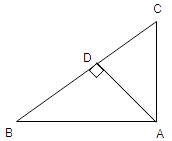
$\Rightarrow \quad \frac { A B } { P Q } = \frac { A D } { P M }$$= \frac { B C } { Q R } = \frac { \frac { 1 } { 2 } B C } { \frac { 1 } { 2 } Q R } = \frac { B D } { Q M }$ ....................................(i)
In $\triangle ABD$ and $\triangle PQM$, we have
$\frac { A B } { P Q } = \frac { A D } { P M } = \frac { B D } { Q M }$           [from(i)]
$\therefore \quad \triangle A B D \sim \triangle P Q M$ [by SSS-similarity criteria].
And also, $\angle B = \angle Q$          [corresponding angles of similar triangles are equal].
Now, in $\triangle ABC$ and $\triangle PQR$, we have
$\angle B = \angle Q$   [proved above]
and $\frac { A B } { P Q } = \frac { B D } { Q M }$ [from(i)].
$\therefore \quad \triangle A B C \sim \triangle P Q R$    [by SAS-similarity criteria].
View full question & answer
Question 433 Marks
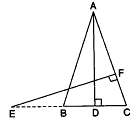
In the figure, $E$ is the point on side $CB$ produced on an isosceles triangle $ABC$ with $AB = AC.$ If $AD   \bot   BC$ and $EF  \bot AC,$ prove that $\triangle  ABD  \sim  \triangle ECF.$​​​​​​​
Answer
$E$ is the point on side $CB$ produced on an isosceles triangle $ABC$ with $AB=AC.AD-BC  \bot $ and $EF \bot AC.$ with $AB=AC.$  Also, $AD \bot  BC$ and $EF \bot AC.$
To prove: $\triangle  ABD  \sim $
$\triangle  ECF$
Proof: In $\triangle  ABD$ and $\triangle ECF,$
$\therefore AB = AC .....$Given
$\therefore  \angle ACB =  \angle ABC .....$Angle opposite to equal sides of a triangle are equal
$ \Rightarrow \angle ABC = \angle ACB$
$ \Rightarrow \angle ABD = \angle ECF......(1)$
$\angle ADB = \angle EFC.....(2) [$Each equal to $90^{\circ}$ In view of $(1)$ and $(2)]$
$\triangle  ABD   \sim $
$\triangle  ECF.....AA$ similarity criterion
View full question & answer
Question 443 Marks
In the figure, $E$ is the point on side $CB$ produced on an isosceles triangle $ABC$ with $AB = AC$. If $AD \bot BC$ and $EF \bot AC, $ prove that $\triangle ABD \sim \triangle ECF.$
Answer
$E$ is the point on side $CB$ produced on an isosceles triangle $ABC$ with $AB=AC.AD-BC \bot$ and $EF \bot AC. $ with $AB=AC.$ Also, $AD \bot BC$ and $EF \bot AC.$
To prove: $\triangle ABD \sim  \triangle ECF$
Proof: In $\triangle ABD$ and $\triangle ECF,$
$\therefore AB = AC ......$ Given
$\therefore \angle ACB = \angle ABC ......$Angle opposite to equal sides of a triangle are equal
$\Rightarrow \angle ABC = \angle ACB$
$\Rightarrow \angle ABD = \angle ECF ... ...(1)$
$\angle ADB = \angle EFC... ..(2) [$Each equal to $90^{\circ}$ In view of $(1)$ and $(2)]$
$\triangle ABD \sim \triangle ECF.....AA $ similarity criterion
View full question & answer
Question 453 Marks
$CD$ and $GH$ are respectively the bisectors of $\angle ACB$ and $\angle EGF$ such that $D$ and $H$ lie on sides $AB$ and $FE$ of $\triangle ABC$ and $\triangle EFG$ respectively. If $\triangle ABC  \sim\triangle FEG,$ show that:
$(1) \frac{C D}{G H}=\frac{A C}{F G}$
$(2) \triangle DCB  \sim\triangle HGE$
$(3) \triangle DCA  \sim\triangle HGF$
Answer

Given, $\triangle ABC  \sim\triangle FEG ….(1)$
$(i)$ Corresponding angles of similar triangles
$\Rightarrow \angle BAC =  \angle EFG ….(2)$
And $\angle ABC =  \angle FEG …(3)$
$\Rightarrow \angle ACB =  \angle FGE$
$\Rightarrow \frac{1}{2}\angle ACB = \frac{1}{2}\angle FGE$
$\Rightarrow \angle ACD =  \angle FGH$ and $\angle BCD =  \angle EGH ……(4)$
Consider $\triangle ACD$ and $\triangle FGH$
$\Rightarrow$ From $(2)$ we have
$\Rightarrow \angle DAC =  \angle HFG$
From $(4)$ we have
$\Rightarrow \angle ACD =  \angle EGH$
Also, $\angle ADC =  \angle FGH$
If the $\angle A=\angle F$, then by angle sum property of triangle $3^{rd}$ angle will also be equal.
By $AAA$ similarity, in two triangles, if the angles are equal, then sides opposite to the equal angles are in the same ratio $($or proportional$)$ and hence the triangles are similar.
$\therefore \triangle ADC  \sim \triangle FHG$
$(ii)$ By Converse proportionality theorem
$\Rightarrow \frac{C D}{G H}=\frac{A C}{F G}$
$(iii)$ Consider $\triangle DCB$ and $\triangle HGE$
From eq$(3)$ we have
$\Rightarrow \angle DBC =  \angle HEG$
From $(4)$ we have
$\Rightarrow \angle BCD =  \angle FGH$
Also, $\angle BDC =  \angle EHG$
$\therefore \triangle DCB  \sim\triangle HGE$
Hence proved.
View full question & answer
Question 463 Marks
ABCD is a trapezium in which AB || DC and its diagonals intersect each other at the point O. Show that $\frac{{AO}}{{BO}} = \frac{{CO}}{{DO}}$.
View full question & answer
Question 473 Marks
ABCD is a trapezium in which AB || DC and its diagonals intersect each other at the point O. Show that $\frac{{AO}}{{BO}} = \frac{{CO}}{{DO}}$.
View full question & answer
Question 483 Marks

Prove that the line joining the mid points of any two sides of a triangle is parallel to the third side.

View full question & answer
Question 493 Marks

Prove that a line draw through the mid point of one side of a triangle parallel to another side bisects the third side.

View full question & answer
Question 503 Marks
The diagonals of a quadrilateral ABCD intersect each other at the point O such that  $\frac{{AO}}{{BO}} = \frac{{CO}}{{DO}}$. Show that ABCD is a trapezium.
View full question & answer
3 Marks Question - Maths STD 10 Questions - Vidyadip