Questions

Fill In The Blanks[1 Marks ]

🎯

Test yourself on this topic

7 questions · timed · auto-graded

Question 21 Mark
All ________ triangles are similar. (isosceles, equilateral)
Answer

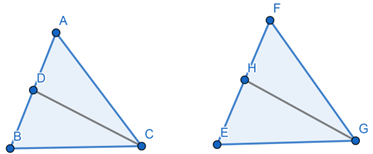
Given, $\triangle$$ABC$ $\sim\triangle$$FEG….(1)$
$(i)$ Corresponding angles of similar triangles
$\Rightarrow$ $\angle$BAC = $\angle$$EFG ….(2)$
And $\angle$$ABC$ = $\angle$$FEG …(3)$
$\Rightarrow$ $\angle$$ACB$ = $\angle$$FGE$
$\Rightarrow \frac{1}{2}\angle $ACB =$ \frac{1}{2}\angle FGE$
$\Rightarrow$ $\angle$$ACD =$ $\angle$$FGH$ and $\angle$$BCD =$ $\angle$$EGH ……(4)$
Consider $\triangle$$AC$D and $\triangle$$FGH$
$\Rightarrow$ From $(2)$ we have
$\Rightarrow$$\angle$$DAC =$ $\angle$$HFG$
From $(4)$ we have
$\Rightarrow$ $\angle$$ACD =$ $\angle$$EGH$
Also, $\angle$$ADC =$ $\angle$$FGH$
If the $\angle A=\angle F$, then by angle sum property of triangle $3^{rd}$ angle will also be equal.
By $AAA$ similarity, in two triangles, if the angles are equal, then sides opposite to the equal angles are in the same ratio (or proportional) and hence the triangles are similar.
$\therefore\triangle$$ADC$ $\sim\triangle$$FHG$
$(ii)$ By Converse proportionality theorem
$\Rightarrow \frac{C D}{G H}=\frac{A C}{F G}$
$(iii)$ Consider $\triangle$$DCB$ and $\triangle$$HGE$
From eq$(3)$ we have
$\Rightarrow$ $\angle$$DBC =$ $\angle$$HEG$
From $(4)$ we have
$\Rightarrow$ $\angle$BCD = $\angle$$FGH$
Also, $\angle$$BDC =$ $\angle$$EHG$
$\therefore\triangle$$DCB$ $\sim\triangle$$HGE$
Hence proved.
View full question & answer
Question 31 Mark
Two polygons of the same number of sides are similar, if (a) their corresponding angles are ________ and (b) their corresponding sides are ________. (equal, proportional)
Answer
Equal, Proportional
View full question & answer
Fill In The Blanks[1 Marks ] - Maths STD 10 Questions - Vidyadip