Questions

3 Marks Question

🎯

Test yourself on this topic

14 questions · timed · auto-graded

Question 13 Marks
If in two triangles, corresponding angles are equal, then their corresponding sides are in the same ratio (or proportion) and hence the two triangles are similar:
Answer
Image
This criterion is referred to as the $AAA$
$($Angle-Angle-Angle$)$ criterion of similarity of two triangles.
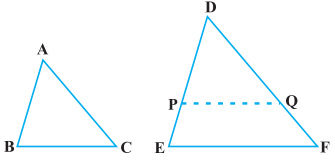
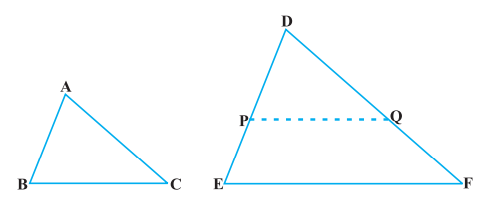
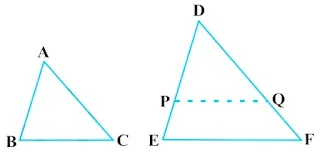
This theorem can be proved by taking two triangles $ABC$ and $DEF$ such that $\angle A =\angle D , \angle B =\angle E$ and $\angle C =\angle F ($see Fig. $6.24)$
Cut $DP = AB$ and $DQ = AC$ and join $PQ$.
So,
$\Delta ABC \cong \Delta DPQ$
$($Why $?)$
This gives
$\angle B =\angle P =\angle E \text { and } PQ \| EF .....($How$?)$
Therefore,
$\frac{ DP }{ PE }=\frac{ DQ }{ QF } .....($Why$?)$
i.e.,
$\frac{ AB }{ DE }=\frac{ AC }{ DF } .....($Why$?)$
Similarly,
$\frac{ AB }{ DE }=\frac{ BC }{ EF } \text { and so } \frac{ AB }{ DE }=\frac{ BC }{ EF }=\frac{ AC }{ DF } \text {. }$
View full question & answer
Question 23 Marks
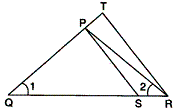
In Figure, $\frac{{QR}}{{QS}} = \frac{{QT}}{{PR}}$ and $\angle 1 = \angle 2.$ Show that $\triangle PQS \sim \triangle TQR .$
Answer
Given: In figure, $\frac{{QR}}{{QS}} = \frac{{QT}}{{PR}}$ and $\angle 1 = \angle 2$
To prove: $\triangle PQS \sim \triangle TQR$
Proof: In $\triangle PQR \because \angle 1= \angle 2$
$ \therefore PR = QP (1).......[ \because$ sides opposite to equal angle of a triangle are equal$]$
Now, $\frac{{QR}}{{QS}} = \frac{{QT}}{{PR}} ......$given
$\Rightarrow \frac{{QR}}{{QS}} = \frac{{QT}}{{QP}} (2).......$Using$(1)$
Again in $\triangle PQS$ and$ \triangle TQR $
$ \because \frac{{QR}}{{QS}} = \frac{{QT}}{{QP}}...........$From$(2) $
$ \therefore \frac{{QS}}{{QR}} = \frac{{QP}}{{QT}}$ and $\angle SQP = \angle RQT $
$ \therefore \triangle PQS \sim \triangle TQR ...........SAS$ similarity criterion
View full question & answer
Question 33 Marks
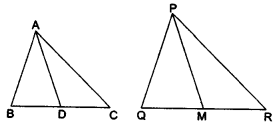
Sides $AB$ and $BC$ and median $AD$ of a triangle $ABC$ are respectively proportional to sides $PQ$ and $QR$ and median $PM$ of $\triangle PQR ($see figure$).$ Show that $\triangle A B C \sim \triangle P Q R$.
Answer

It is given that:
$\frac { A B } { P Q } = \frac { B C } { Q R } = \frac { A D } { P M }$
$\Rightarrow \quad \frac { A B } { P Q } = \frac { A D } { P M }$
$= \frac { B C } { Q R } = \frac { \frac { 1 } { 2 } B C } { \frac { 1 } { 2 } Q R } = \frac { B D } { Q M } .......(i)$
In $\triangle ABD$ and $\triangle PQM$, we have
$\frac { A B } { P Q } = \frac { A D } { P M } = \frac { B D } { Q M } [$from$(i)]$
$\therefore \quad \triangle A B D \sim \triangle P Q M [$by $SSS-$similarity criteria$].$
And also, $\angle B = \angle Q [$corresponding angles of similar triangles are equal$].$
Now, in $\triangle ABC$ and $\triangle PQR$, we have
$\angle B = \angle Q [$proved above$]$
and $\frac { A B } { P Q } = \frac { B D } { Q M } [$from$(i)].$
$\therefore \quad \triangle A B C \sim \triangle P Q R [$by $SAS-$similarity criteria$].$
View full question & answer
Question 43 Marks
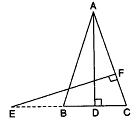
In the figure, $E$ is the point on side $CB$ produced on an isosceles triangle $ABC$ with $AB = AC.$ If $AD \bot BC$ and $EF \bot AC,$ prove that $\triangle ABD \sim \triangle ECF.$
Answer
$E$ is the point on side $CB$ produced on an isosceles triangle $ABC$ with $AB=AC.AD-BC \bot$ and $ EF \bot AC$. with $AB=AC$. Also, $AD \bot BC$ and $EF \bot AC.$
To prove: $\triangle ABD \sim \triangle ECF$
Proof: In $\triangle ABD$ and $\triangle ECF,$
$\therefore AB = AC ........$Given
$\therefore \angle ACB = \angle ABC ......$Angle opposite to equal sides of a triangle are equal
$\Rightarrow \angle ABC = \angle ACB$
$ \Rightarrow \angle ABD = \angle ECF..........(1)$
$\angle ADB = \angle EFC.........(2) [$Each equal to $90^\circ$ In view of$ (1)$ and $(2)]$
$\triangle ABD \sim \triangle ECF.............AA$ similarity criterion
View full question & answer
Question 53 Marks
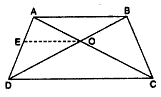
$ABCD$ is a trapezium in which $AB || DC$ and its diagonals intersect each other at the point $O.$ Show that $\frac{{AO}}{{BO}} = \frac{{CO}}{{DO}}$.
Answer
Given: $ABCD$ is a trapezium in which $AB||DC.$
ITs diagonals intersect each other at the point $O.$
To prove: $\frac{{AO}}{{BO}} = \frac{{CO}}{{DO}}$

Construction:
Through $O,$ draw a line $OE$ parallel to$ AB$ or $DC$ intersecting $AD$ at $E.$
Proof: In $\triangle ADC$
$\because OE||DC$
$\therefore \frac{{AO}}{{CO}} = \frac{{AE}}{{DE}}(1)......[$By basic proportionality theorem$]$
In $\triangle DBA,\,\because OE||AB$
$\therefore \frac{{DE}}{{AE}} = \frac{{DO}}{{BO}}.....[$By basic proportionality theorem$]$
$ \Rightarrow \frac{{DE}}{{AE}} = \frac{{DO}}{{BO}}......[$By basic proportionality theorem$]$
From $(1)$ and $(2) \frac{{AO}}{{CO}} = \frac{{BO}}{{DO}} \Rightarrow \frac{{AO}}{{BO}} = \frac{{CO}}{{DO}}$
View full question & answer
Question 63 Marks
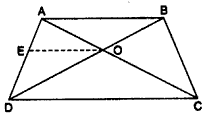
The diagonals of a quadrilateral $ABCD$ intersect each other at the point $O$ such that $\frac{{AO}}{{BO}} = \frac{{CO}}{{DO}}$. Show that $ABCD$ is a trapezium.
Answer
Given: The diagonals of a quadrilateral $ABCD$ intersect each other at the point $O$ such that $\frac{{AO}}{{BO}} = \frac{{CO}}{{DO}}$
To prove: $ABCD$ is trapezium.
Construction: Through $O$ draw a line $OE||BA$ intersecting $AD$ at $E.$
Proof: In $\triangle DBA$ $\because OE||BA$

$\therefore \frac{{DO}}{{BO}} = \frac{{DE}}{{AE}} \Rightarrow \frac{{CO}}{{AO}} = \frac{{DE}}{{AE}}$
$\because \frac{{AO}}{{BO}} = \frac{{CO}}{{DO}}\,[Given]$
$\Rightarrow \frac{{DO}}{{BO}} = \frac{{CO}}{{AO}} \Rightarrow \frac{{AO}}{{CO}} = \frac{{AE}}{{DE}}.........[$Taking reciprocals$]$
$\therefore $In $\triangle ADC$
$OE \parallel CD ...........[$By converse basic proportionality theorem$]$
But $OE \parallel BA$
BA $\parallel CD........[$By construction$]$
The quadrilateral $ABCD$ is a Trapezium.
View full question & answer
Question 73 Marks
Give two different examples of each of the following:
  1. similar figures.
  2. non-similar figures.
Answer
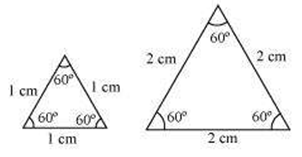
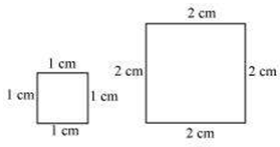
  1. Two examples of similar figures are:
    1. Two equilateral triangles with sides $1\ cm$ and $2 \ cm$ respectively
    2. Two squares with sides $1\ cm$ and $2\ cm$ respectively
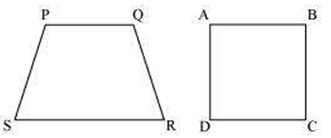
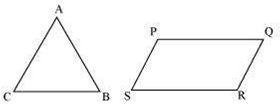
  2. Now two examples of non-similar figures are:
    1. Trapezium and square
    2. Triangle and parallelogram
View full question & answer
Question 83 Marks
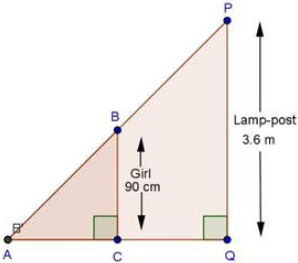
A girl of height $90\ cm$ is walking away from the base of a lamp-post at a speed of $1.2\ m/\sec.$ If the lamp is $3.6\ m$ above the ground, find the length of her shadow after $4$ seconds.
Answer
We have,

Height of girl $= 90\ cm = 0.9 \ m$
Height of lamp-post $= 3.6\ m$
Speed of girl $= 1.2\ m/sec$
Time taken $= 4 \sec.$
$\therefore$ Distance moved by girl $(CQ) =$ Speed $\times$ Time
$= 1.2 \times 4$
$= 4.8\ m$
Let length of shadow $(AC) = x\ cm$
In $\Delta ABC$ and $\Delta APQ$
$\angle ACB = \angle AQP [$Each $90^\circ ]$
$\angle BAC = \angle PAQ [$Common$]$
Then, $\Delta ABC \sim \Delta APQ [$By $AA $ similarity$]$
$\therefore \frac{{AC}}{{AQ}} = \frac{{BC}}{{PQ}} [$Corresponding parts of similar $\Delta$ are proportional$]$
$ \Rightarrow \frac{x}{{x + 4.8}} = \frac{{0.9}}{{3.6}}$
$\Rightarrow \frac{x}{{x + 4.8}} = \frac{1}{4}$
$\Rightarrow 4x = x + 4.8$
$\Rightarrow 4x - x = 4.8$
$\Rightarrow 3x = 4.8$
$\Rightarrow x = \frac{{4.8}}{3} = 1.6\ m$
$\therefore$ Length of shadow $= 1.6\ m$
View full question & answer
Question 93 Marks
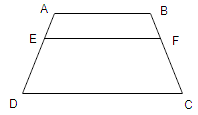
$ABCD$ is a trapezium with $AB || DC. E$ and $F$ are two points on non-parallel sides $AD$ and $BC$ respectively, such that $EF$ is parallel to $AB.$ Show that $\frac{AE}{ED}=\frac{BF}{FC}$ 
Answer
Given, In trapezium $ABCD,$
$AB || DC$ and $EF || DC$ 
To prove $\frac{AE}{ED}=\frac{BF}{FC}$ 
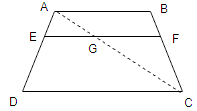
Construction: Join $AC$ to intersect $EF$ at $G$.

Proof Since, $AB || DC$ and $EF || DC$ 
$EF || AB [$since, lines parallel to the same line are also parallel to each other $]...... (i)$
In $\triangle ADC ,  EG || DC  [ \because EF || DC]$
By using basic proportionality theorem,
$\frac{AE}{ED}=\frac{AG}{GC} ....(ii)$
In $\triangle ABC,GF || AB  [ \because EF || AB$  from $(i)]$
By using basic proportionality theorem ,
$\frac{CG}{AG}=\frac{CF}{BF}$ or $\frac{AG}{GC}=\frac{BF}{CF}[$On taking reciprocal of the terms$]............. (iii)$
From Equations $(ii)$ and $(iii),$ we get
$\frac{AE}{ED}=\frac{BF}{FC}$ 
Hence Proved.
View full question & answer
Question 103 Marks
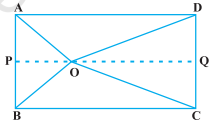
$O$ is any point inside a rectangle $ABCD$ see Fig. Prove that $OB^2+ OD^2= OA^2+ OC^2$.
Answer
Through $O,$ draw $PQ || BC$ so that $P$ lies on $AB$ and $Q$ lies on $DC.$
Now, $PQ || BC$
Therefore, $PQ \perp AB$ and $PQ \perp DC ( \angle B = 90^\circ $ and $\angle C = 90^\circ )$
So, $\angle BPQ = 90^\circ $ and $\angle CQP = 90^\circ $
Therefore, $BPQC$ and $APQD$ are both rectangles.
Now, from $\triangle OPB$
$ OB^2= BP^2+ OP^2...(1)$
Similarly, from $\triangle OQD,$
$ OD^2= OQ^2+ DQ^2...(2)$
From $\triangle OQC,$ we have
$OC^2= OQ^2+ CQ^2...(3)$
and from $\triangle OAP,$ we have
$OA^2= AP^2+ OP^2...(4)$
Adding $(1)$ and $(2),$
$OB^2+ OD^2= BP^2+ OP^2+ OQ^2+ DQ^2 $
$ = CQ^2+ OP^2+ OQ^2+ AP^2 ($As $BP = CQ$ and $DQ = AP)$
$ = CQ^2+ OQ^2+ OP^2+ AP^2 $
$ OB^2+ OD^2= OC^2+ OA^2 [$From $(3)$ and $(4)]$
Hence proved.
View full question & answer
Question 113 Marks
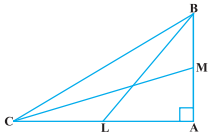
$BL$ and $CM$ are medians of ​$\triangle ​ABC$ right angled at $A.$ Prove that $4(BL^2+ CM^2) = 5BC^2$
Answer

$BL$ and $CM$ are medians of a $\triangle ABC$ in which $\angle A=90^\circ$
From $\triangle ABC, BC^2= AB^2+ AC^2....(i)$
From right angled $\vartriangle ABL,$
$BL^2= AL^2+ AB^2$
i.e $B{L^2} = {\left( {\frac{{AC}}{2}} \right)^2} + A{B^2}$
$\Rightarrow 4BL^2= AC^2+ 4AB^2.....(ii) $
From right-angled $\triangle CMA,$
$CM^2= AC^2+ AM^2$
i.e $C{M^2} = A{C^2} + {\left( {\frac{{AB}}{2}} \right)^2}[$mid-point$]$
$\Rightarrow C{M^2} = A{C^2} + \frac{{A{B^2}}}{4}$
$\Rightarrow 4C{M^2} = 4A{C^2} + A{B^2} .....(iii)$
Adding $(ii)$ and $(iii),$ we get
i.e.$4(BL^2+ CM^2)= 5(AC^2+ AB^2) = 5BC^2 [$From $(i)]$
View full question & answer
Question 123 Marks
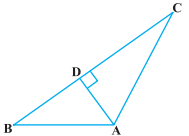
In the given figure, if $AD \bot BC$, prove that $AB^2+ CD^2= BD^2+ AC^2$.
Answer

In right angled $\triangle BDA$,
By pythagoras theorem
$A B^2=A D^2+B D^2 \ldots(\mathrm{i})$
And in right angled $\triangle CDA$ ,
By pythagoras theorem
$A C^2=C D^2+A D^2 \ldots \text { (ii) }$
On subtracting Eq(ii) from Eq(i) , we get
$A B^2-A C^2=\left[A D^2+B D^2\right]-\left[C D^2+A D^2\right] $
$ A B^2-A C^2=A D^2+B D^2-C D^2-A D^2$
$ A B^2-A C^2=B D^2-C D^2$
$\therefore AB^2+ CD^2= BD^2+ AC^2$
View full question & answer
Question 133 Marks
If one angle of a triangle is equal to one angle of the other triangle and the sides including these angles are proportional, then the two triangles are similar
Answer
Image
This criterion is referred to as the $SAS ($Side-Angle-Side$)$ similarity criterion for two triangles.
As before, this theorem can be proved by taking two triangles $ABC$ and $DEF$ such that $\frac{ AB }{ DE }=\frac{ AC }{ DF }(<1)$ and $\angle A =\angle D ($see Fig. $6.28)$. Cut $DP = AB, DQ = AC$ and join $PQ.$
$\text { Now, } PQ \| EF \text { and } \triangle ABC \cong \triangle DPQ $
$\text { So, } \angle A =\angle D , \angle B =\angle P \text { and } \angle C =\angle Q $
$\text { Therefore, } \Delta ABC \sim \Delta DEF $
$\text { We now take some examples to illustrate the use of these criteria. }$
View full question & answer
Question 143 Marks
If in two triangles, sides of one triangle are proportional to $($i.e., in the same ratio of $)$ the sides of the other triangle, then their corresponding angles are equal and hence the two triangles are similiar.
Answer
Image
This theorem can be proved by taking two triangles $ABC$ and $DEF$ such that $\frac{ AB }{ DE }=\frac{ BC }{ EF }=\frac{ CA }{ FD }(<1)($ see Fig. $6.26):$
Cut $DP = AB$ and $DQ = AC$ and join $PQ$.
It can be seen that $\frac{ DP }{ PE }=\frac{ DQ }{ QF }$ and $PQ \| EF$ (How?)
So, $\angle P =\angle E$ and $\angle Q =\angle F$.
Therefore,
$\frac{ DP }{ DE }=\frac{ DQ }{ DF }=\frac{ PQ }{ EF }$
So,
$\frac{ DP }{ DE }=\frac{ DQ }{ DF }=\frac{ BC }{ EF } \quad \text { (Why?) }$
So,
$BC = PQ \quad \text { (Why?) }$
Thus,
$\Delta ABC \cong \Delta DPQ$
(Why ?)
So,
$\angle A =\angle D , \angle B =\angle E \text { and } \angle C =\angle F \text { (How ?) }$
View full question & answer
3 Marks Question - Maths STD 10 Questions - Vidyadip