Question 13 Marks
$150$ spherical marbles, each of diameter $14\ cm,$ are dropped in a cylindrical vessel of diameter $7\ cm $ containing some water, which are completely immersed in water. Find the rise in the level of water in the vessel.
AnswerWe have,
The radius of spherical marble, $\text{r}=\frac{1.4}{2}=7\text{cm}$ and
The radius of the cylindrical vessel, $\text{R}=\frac{7}{2}\text{cm}=3.5\text{cm}$
Let the rise in the level of water in the vessel be $H.$
Now,
Volume of water rised in the cylindrical vessel $=$ Volume of $150$ spherical marbles
$\Rightarrow\pi\text{R}^2\text{H}=150\times\frac{4}{3}\pi\text{r}^3$
$\Rightarrow\text{R}^2\text{H}=200\text{r}^3$
$\Rightarrow3.5\times3.5\times\text{H}=200\times7\times7\times7$
$\Rightarrow\text{H}=\frac{200\times7\times7\times7}{3.5\times3.5}$
$\therefore\text{H}=5600\text{cm}$
So, the rise in the level of water in the vessel is $5.6\ cm.$
Disclaimer: The diameter of the spherical marbles should be $1.4\ cm$ instead $14\ cm$. The has been corrected above.
View full question & answer→Question 23 Marks
The volume of a sphere is $4851\ cm^3$. Find its curved surface area.
AnswerLet the radius of the sphere be $r.$
As,
Volume of the sphere $= 4851cm^3$
$\Rightarrow\frac{4}{3}\pi\text{r}^3=4851$
$\Rightarrow\frac{4}{3}\times\frac{22}{7}\times\text{r}^3=4851$
$\Rightarrow\text{r}^3=4851\times\frac{3\times7}{4\times22}$
$\Rightarrow\text{r}^3=\frac{9261}{8}$
$\Rightarrow\text{r}=\sqrt[3]{\frac{9261}{8}}$
$\Rightarrow\text{r}=\frac{21}{2}\text{cm}$
Now,
Curved surface area of the sphere $=4\pi\text{r}^2$
$=4\times\frac{22}{7}\times\frac{21}{2}\times\frac{21}{2}$
$=1386\text{cm}^2$
View full question & answer→Question 33 Marks
In a corner of a rectangular field with dimensions $35m × 22m,$ a well with $14m$ inside diameter is dug $8m$ deep. The earth dug out is spread evenly over the remaining part of the field. Find the rise in the level of the field.
AnswerWe have,
Length of the fie!, $l = 35m,$
Width of the field, $b = 22m,$
Depth of the well, $H = 8m$ and
Radius of the well, $\text{R}=\frac{14}{2}=7\text{m},$
Let the rise in the level of the field be $h.$
Now,
Volume of the earth on remaining part of the field= Volume of earth dug out
$⇒$ Area of the remaining field $×\ h\ =$ Volume of the well
$⇒ ($Area of the field$-$Area of base of the well$) \times\text{h}\pi\text{R}^2\text{H}$
$\Rightarrow(\text{lb}-\pi\text{R}^2)\times\text{h}=\pi\text{R}^2\text{H}$
$\Rightarrow(35\times22-\frac{22}{7}\times7\times7)\times\text{h}=\frac{22}{7}\times7\times7\times8$
$=(770-154)\times\text{h}=1232$
$\Rightarrow616\times\text{h}=1232$
$\Rightarrow\text{h}=\frac{1232}{616}$
$\therefore\text{h}=2\text{m}$
So, the rise in the level of the field is $2m.$
View full question & answer→Question 43 Marks
The surface areas of two spheres are in the ratio of $4 : 25.$ Find the ratio of their volumes.
AnswerLet the radii of the two spheres be $r$ and $R.$
As,
$\frac{\text{Surface area of the first sphere}}{\text{Surface area of the second sphere}}=\frac{4}{25}$
$\Rightarrow\frac{4\pi\text{r}^2}{4\pi\text{R}^2}=\frac{4}{25}$
$\Rightarrow\Big(\frac{\text{r}}{\text{R}}\Big)^2=\frac{4}{25}$
$\Rightarrow\frac{\text{r}}{\text{R}}=\sqrt{\frac{4}{25}}$
$\Rightarrow\frac{\text{r}}{\text{R}}=\frac{2}{5}\ ...(\text{i})$
The ratio of the volumes of the two spheres $=\frac{\text{Volume of the first sphere}}{\text{Volume of the second sphere}}$
$=\frac{\Big(\frac{4}{3}\pi\text{r}^3\Big)}{\Big(\frac{4}{3}\pi\text{R}^3\Big)}$
$=\Big(\frac{\text{r}}{\text{R}}\Big)^3$
$=\Big(\frac{2}{5}\Big)^3 [$Using $(i)]$
$=8:25$
So, the ratio of the volumes of the given spheres is $8 : 125$
View full question & answer→Question 53 Marks
$A\ 5-m-$wide cloth is used to make a conical tent of base diameter $14m$ and height $24m$. Find th cost of cloth used at the rate of $Rs. 25$ per metre.
AnswerLet the length of the cloth be $l\ m$
Given radius of cone $= 7m$ and heigth $= 24m$
Now,
Slant height $=\sqrt{\text{h}^2+\text{r}^2}$
$\Rightarrow\text{l}=\sqrt{\text{h}^2+\text{r}^2}$
$\Rightarrow\text{l}\sqrt{(24)^2+(7)^2}$
$\Rightarrow\sqrt{576+49}$
$\Rightarrow\text{l}=\sqrt{625}$
$\Rightarrow\text{l}=25\text{m}$
Area of the doth $=$ curved surface area of cone
$=\pi\text{r}\text{l}$
$=\frac{22}{7}\times7\times25$
$=22\times25$
$=550\text{m}^2$
Now,
Area of the doth $=$ length $×$ breadth
$⇒ 550 =$ length$\ ×\ 5$
$⇒$ length $=\frac{550}{5}$
$⇒$ length $110m$
Given cost of $1m$ doth $= Rs. 25$
$⇒$ cost od $110m$ cloth $=110 × 25$
$= Rs. 2750$
View full question & answer→Question 63 Marks
Two cubes each of volume $125cm^3$ are joined end to end to form a solid. Find the surface area of the resulting cuboid.
AnswerLet the edge of the cube be a.
As,
Volwne of the cube $= 125cm^3$
$\Rightarrow\text{a}^3=125$
$\Rightarrow\text{a}=\sqrt[3]{125}$
$\Rightarrow\text{a}=5\text{cm}$
So,
Length of the resulting cuboid, $l = 2 × 5 = 10cm,$
Breadth of the resulting cuboid, $b = 5cm$ and
Height of the resulting cuboid, $h = 5cm$
Now,
Surface area of the resulting cuboid $= 2 (lb + bh + hl)$
$= 2 × (10 × 5 + 5 × 5 + 5 × 10)$
$= 2 × (50 + 25 + 50)$
$= 2 × 125$
$= 250cm^2$
So, the surface area of the resulting cuboid is $250\ cm^2$.
View full question & answer→Question 73 Marks
Five identical cubes, each of edge $5\ cm, $ are placed adjacent to each other. Find the volume of the resulting cuboid.
AnswerWe have,
Length of the resulting cuboid, $l = 5 × 5 = 25\ cm,$
Breadth of the resulting cuboid, $b = 5\ cm$ and
Height of the resulting cuboid, $h = 5\ cm$
Now,
Volume of the resulting cuboid $= lbh$
$= 25 × 5 × 5$
$= 625\ cm^3$
View full question & answer→Question 83 Marks
A spherical cannon ball $28\ cm$ in diameter is melted and recast into a right circular conical mould, base of which is $35\ cm$ in diameter. Find the height of the cone.
AnswerDiameter of cannon ball $= 28\ cm$
Radius of the cannon ball $= 14\ cm$
Volume of ball $=\frac{4}{3}\pi\text{r}^3=\frac{4}{3}\pi\times(14)^3\text{cm}^3$
Diameter of base of cone $= 35\ cm$
Radius of base of cone $=\frac{35}{2}\text{cm}$
Let the height of the cone be $h \ cm.$
Volume of cone $=\frac{1}{3}\pi\text{r}^2\text{h}=\frac{1}{3}\pi\Big(\frac{35}{2}\Big)^2\times\text{h}\ \text{cm}^3$
From the above results and from the given conditions,
Volume of ball $=$ Volume of cone
Or, $\frac{4}{3}\pi\times(14)^3=\frac{1}{3}\pi\times\Big(\frac{35}{2}\Big)^2\times\text{h}$
$\Rightarrow\text{h}=\frac{\frac{4}{3}\times(14)^3}{\frac{1}{3}\pi\times\Big(\frac{3\pi}{2}\Big)^2}=\frac{4\times14\times14\times14\times2\times2}{35\times35}=35.84\text{cm}$
View full question & answer→Question 93 Marks
A spherical ball of radius $3\ cm$ is melted and recast into three spherical balls. The radii of two of these balls $1.5\ cm$ and $2\ cm.$ Find t radius of the third ball
AnswerRadius of sphere $= 3\ cm$
Radius of first ball $= 1.5\ cm$
Radius of second ball $= 2\ cm$
Let radius of the third ball be rem.
Volume of third ball $=$ Volume of original sphere $-$ Sum of volumes of other two balls
$=\frac{4}{3}\pi\times3^3=\big(\frac{4}{3}\pi\times\frac{3}{2}^3+\frac{4}{3}\pi\times2^3\big)$
$=\frac{4}{3}\pi\times3\times3\times3-\Big(\frac{4}{3}\pi\times\frac{3}{2}\times\frac{3}{2}\times\frac{3}{2}+\frac{4}{3}\pi\times2\times2\times2\Big)$
$=4\pi\times3\times3-\Big(\pi\frac{3\times2}{2}+\frac{4}{3}\pi\times2\times2\times2\Big)$
$=36\pi-\Big(\pi\frac{9}{2}+\frac{32}{3}\pi\Big)$
$=\Big(\frac{36\times6-9\times3-32\times2}{6}\Big)\pi$
$=\Big(\frac{216-27-64}{6}\Big)\pi=\frac{125\pi}{6}$
Therefore,
$\frac{4}{3}\pi\text{r}^3=\frac{125\pi}{6}$
Or, $\text{r}=\sqrt[3]{\frac{125\times3}{4\times6}}=\sqrt[3]{\frac{125}{8}}=\frac{5}{2}=2.5\text{cm}$
View full question & answer→Question 103 Marks
The volume of a hemisphere is $2425\frac{1}{2}\text{cm}^3.$ find its curved surface area.
AnswerLet r be the radius the hemisphere.
now, volume of hemisphere $2425\frac{1}{2}\text{cm}^3$
$\Rightarrow\frac{2}{3}\pi\text{r}^3=\frac{4851}{2}$
$\Rightarrow\frac{2}{3}\times\frac{22}{7}\times\text{r}^3=\frac{4851}{2}$
$\Rightarrow\frac{44}{21}\times\text{r}^3=\frac{4851}{2}$
$\Rightarrow\text{r}^3=\frac{4851\times21}{88}$
$\Rightarrow\text{r}=\sqrt[3]{1157.625}$
$\Rightarrow\text{r}=10.5\text{cm}$
Now,
Cueved surface area $2\pi\text{r}^2$
$=2\times\frac{22}{7}\times(10.5)^2$
$=\frac{44}{7}\times110.25$
$=693\text{cm}^2$
View full question & answer→Question 113 Marks
A solid metallic sphere of diameter $21\ cm$ is melted and recast into a number of smaller cones, each of diameter $3.5\ cm$ and height $3\ cm$ Find the number of cones so formed.
AnswerDiameter of sphere $= 21\ cm$
Radius of sphere $=\frac{21}{2}\text{cm}$
Volume of sphere $=\frac{4}{3}\pi\text{r}^3=\frac{4\times21\times21\times21\pi}{3\times2\times2\times2}=\frac{21\times21\times21\pi}{3\times2}\text{cm}^3$
Diameter of the cone$= 3.5\ cm$
Radius of the cone $=\frac{3.5}{2}=\frac{7}{4}\text{cm}$
Height $= 3\ cm$
Volume of each cone $=\frac{1}{3}\pi\text{r}^2\text{h}=\frac{1}{3}\pi\times3\Big(\frac{7}{4}\Big)^2=\Big(\frac{7}{4}\Big)^2\pi\text{cm}^3$
Total number of cones $=\frac{\text{Volume of sphere}}{\text{Volume of a cone}}=\frac{\frac{21\times21\times21\times\pi}{3\times2}}{\Big(\frac{7}{4}\Big)^2\pi}=\frac{21\times21\times21\times\pi\times4\times4}{3\times2\times\pi\times7\times7}=504$
View full question & answer→Question 123 Marks
A copper sphere of diameter $18\ cm$ is drawn into a wire of diameter $4\ mm$. Find the length of the wire.
AnswerWe have,
Radius of the sphere, $\text{R}=\frac{18}{2}=9\text{cm}$ and
Radius of the wire, $\text{r}=\frac{4}{2}=2\text{mm}=0.2\text{cm}$
Let the length of the wire be $l.$
Now,
Volume of the wire $=$ Volume of the copper sphere
$\Rightarrow\pi\text{r}^2\text{l}=\frac{4}{3}\pi\text{R}^3$
$\Rightarrow\text{l}=\frac{4\text{R}^3}{3\text{r}^2}$
$\Rightarrow\text{l}=\frac{4\times9\times9\times9}{3\times0.2\times0.2}$
$\therefore\text{l}=24300\text{cm}=243\text{m}$
So. the length of the wire is $243\ m.$
View full question & answer→Question 133 Marks
The diameter of a sphere is $42\ cm.$ It is melted and drawn into a cylindrical wire of diameter $2.8\ cm$. Find the length of the wire.
AnswerDiameter of sphere $= 42\ cm$
Radius of sphere $= 21\ cm$
Volume of sphere $=\frac{4}{3}\pi\text{r}^3=\frac{4}{3}\pi\times21\times21\times21\text{cm}^2$
Diameter of wire $= 2.8\ cm$
Radius of wire $= 1.4\ cm$
Let the length of the Wire be $cm.$
Volume of the wire $=\pi\text{r}^2\text{l}=\pi\times1.4\times1.4\times\text{l}$
The volume of the sphere is equal to the volume of the wire.
Therefore.
$\pi\times1.4\times1.4\times\text{l}=\frac{4}{3}\pi\times21\times21\times21$
$\text{l}=\frac{4\times21\times21\times21}{3\times1.4\times1.4}=6300\text{cm}=63\text{m}$
So, the wire is $63\ m$ long.
View full question & answer→Question 143 Marks
The radii of the circular ends of a frustum of height $6\ cm$ are $1\ cm$ and $6\ cm,$ respectively. Find the slant height of the frustum.
AnswerWe have,
Height of the frustum, $h = 6\ cm,$
Radii of tbe circular ends, $R = 14\ cm$ and $r = 6\ cm$
Let the slant height of the frustum be $l.$
Now,
$\text{l}=\sqrt{(\text{R}-\text{r})^2+\text{h}^2}$
$=\sqrt{(14-6)^2+6^2}$
$=\sqrt{8^2+6^2}$
$=\sqrt{64+36}$
$=\sqrt{100}$
$=10\text{cm}$
So, the slant heiglt of the frustum is $10\ cm.$
View full question & answer→Question 153 Marks
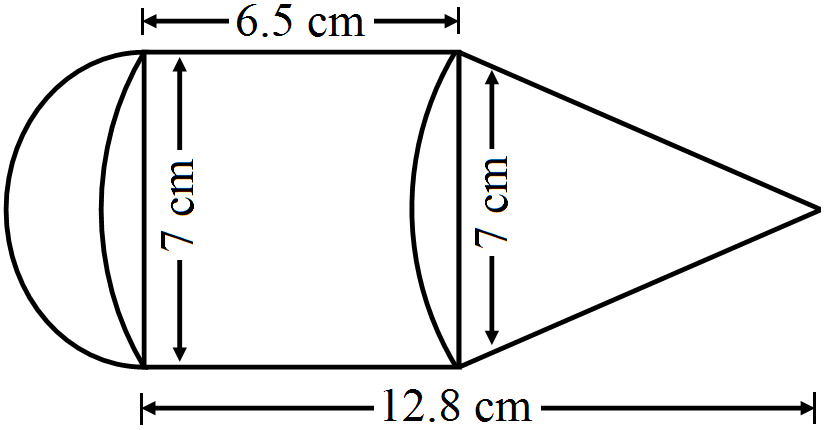
The given figure represents a solid consisting of a cylinder surmounted by a cone at one end and a hemisphere at the other. Find the volurne of the solid.
Answer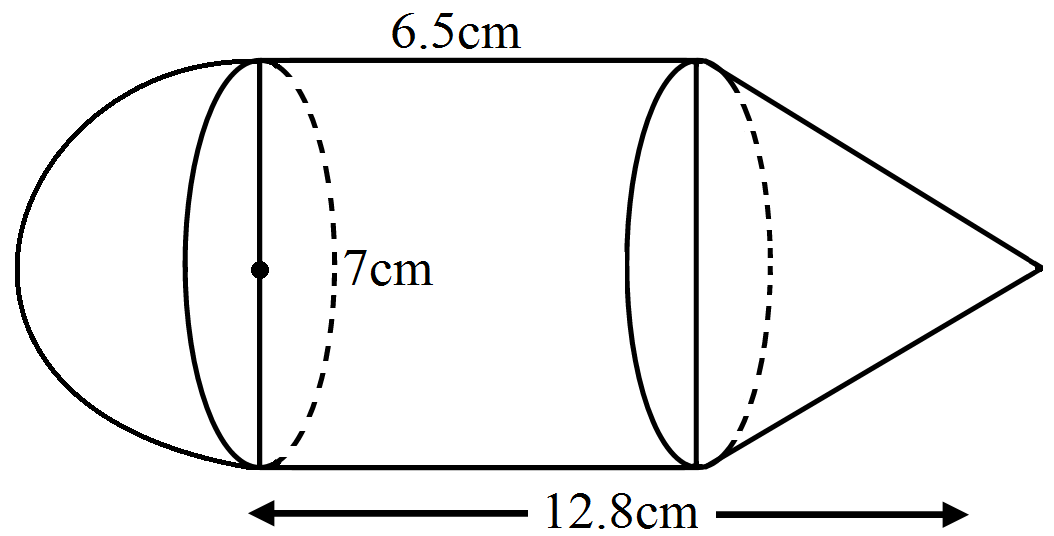
Height of cylinder $= 6.5cm$
height of cone $= h_2= (12.8 - 6.5)cm = 6.3cm$
Radius of cylinder = radius of cone
= radius of hemisphere
$=\Big(\frac{7}{2}\Big)\text{cm}$
Volume of solid = volume of cylinder + volume of cone + volume of hemisphere
$=\pi\text{r}^2\text{h}_1+\frac{1}{3}\pi\text{r}^2\text{h}_2+\frac{2}{3}\pi\text{r}^2\Big(\text{h}_1+\frac{1}{3}\text{h}_2+\frac{2}{3}\text{r}\Big)$
$=\Big[\frac{22}{7}\times3.5\times3.5\times\Big(6.5+6.3\times\frac{1}{3}+\frac{2}{3}\times3.5\Big)\Big]$
$=[(38.5)\times(6.5+2.1+2.33)]\text{cm}^3$
$=(38.5\times10.93)\text{cm}^3=420.80\text{cm}^3$ View full question & answer→Question 163 Marks
Water running in a cylindrical pipe of inneer diameter $7\ cm,$ is collected in a container at the rate of $192.5$ litres per minute. Find the rate o flow of water in the pipe in km/hr.
AnswerWe have,
Radius of cylindrical pipe, $\text{r}=\frac{7}{2}\text{cm}$ and
The rate of flow of water $= 192.5 L/min$
$=\frac{192.5\text{L}}{1\text{min}}$
$=\frac{192.5\times1000\text{cm}^3}{1\text{min}} ($As, $1\ L = 1000cm^3)$
$= 192500cm^3/min$
$⇒$ The volume of water flowing out from the cylindrical pipe in 1 min $= 192500cm^3$
Now, the rate of flow of water in the pipe $=\frac{\text{The volume or water flowing out from the cylindrical pipe}}{\pi\text{r}^2}$
$=\frac{192500}{\Big(\frac{22}{7}\times\frac{7}{2}\times\frac{7}{2}\Big)}$
$=\frac{192500}{77}$
$=5000\text{cm}/\text{min}$
$=\frac{5000\times60}{1\times100000}\text{km}/\text{hr}$
$=3\text{km}/\text{hr}$
So, the rate of flow of water in the pipe is $3\ km/hr.$
View full question & answer→Question 173 Marks
If the total surface area of a solid hemisphere is $462\ cm,$ find its volume.
AnswerTotal surface area of solid hemisphere $=3\pi\text{r}^2$
$\Rightarrow462=3\pi\text{r}^2$
$\Rightarrow462=3\times\frac{22}{7}\times\text{r}^2$
$\Rightarrow462=\frac{66}{7}\times\text{r}^2$
$\Rightarrow\text{r}^2=\frac{3234}{66}$
$\Rightarrow\text{r}^2=49$
$\Rightarrow\text{r}=7\text{cm}$
Now,
Volume of a solid hemisphere $=\frac{2}{3}\pi\text{r}^3$
$=\frac{2}{3}\times\frac{22}{7}\times7\times7\times7$
$=\frac{2156}{3}$
$=718.67\text{cm}^3$
View full question & answer→Question 183 Marks
How many lead shots each $3\ mm$ in diameter can be made from a cuboid of dimensions $9\ cm × 11\ cm × 12\ cm?$
AnswerWe have,
Radius of a lead shot, $\text{r}=\frac{3}{2}=1.5\text{mm}=0.15\text{cm}$ and
Dimensions of the cuboid are $9\ cm × 11\ cm × 12\ cm$
Now,
$=\frac{9\times11\times12}{\Big(\frac{4}{3}\pi\text{r}^3\Big)}$
$=\frac{9\times11\times12}{\Big(\frac{4}{3}\times\frac{22}{7}\times0.15\times0.15\times0.15\Big)}$
$=84000$
So, the number of lead shots that can be made from the cuboid is $84000.$
View full question & answer→Question 193 Marks
A solid metallic sphere of radius $8\ cm$ is melted and recast into spherical balls each of radius $2\ cm.$ Find the number of spherical balls obtained.
AnswerWe have,
Radius of the solid metallic sphere, $R = 8\ cm$ and
Radius of the spherical ball, $r = 2\ cm$
Now,
The number spherical balls obtained $=\frac{\text{Volume of the solid metallic spher}}{\text{Volume of a spherical ball}}$
$=\frac{\Big(\frac{4}{3}\pi\text{R}^3\Big)}{\Big(\frac{4}{3}\pi\text{r}^3\Big)}$
$=\Big(\frac{\text{R}}{\text{r}}\Big)^3$
$=\Big(\frac{8}{2}\Big)^3$
$=4^3$
$=64$
So, the number of spherical balls obtained is $64.$
View full question & answer→Question 203 Marks
Three metallic cubes whose edges are $3\ cm, 4\ cm$ and $5\ cm$, are melted and recast into a single large cube. Find the edge of the new cube formed.
AnswerWe have,
Edges of the cubes : $\mathrm{a}_1=3 \mathrm{~cm}, \mathrm{a}_2=4 \mathrm{~cm} $ and $ \mathrm{a}_3=5 \mathrm{~cm}$
Let the edge of the new cube be $ a.$
Now
Volume of the new cube $=\text{a}_1^3+\text{a}_2^3+\text{a}_3^2$
$\Rightarrow\text{a}^3=3^3+4^3+5^3$
$\Rightarrow\text{a}^3=27+64+125$
$\Rightarrow\text{a}^3={216}$
$\Rightarrow\text{a}=\sqrt[3]{216}$
$\therefore\text{a}=6\text{cm}$
so, the edge of the new cube so formed is $6\ cm$.
View full question & answer→Question 213 Marks
A cylinder with base radius $8\ cm$ and height $2\ cm$ is melted to form a cone of height $6\ cm.$ Calculate the radius of the base of the cone.
AnswerWe have,
Bose radius of the cylinder, $r = 8\ cm,$
Heigbt of tbe cylinder, $h = 2\ cm$ and
Height of the cone, $H = 6\ cm$
Let the base radius of the cone be $R.$
Now,
Volume of the coue $=$ Volume of tbe cyliuder
$\Rightarrow\frac{1}{3}\pi\text{R}^2\text{H}=\pi\text{r}^2\text{h}$
$\Rightarrow\text{R}^2=\frac{3\text{r}^2\text{h}}{\text{H}}$
$\Rightarrow\text{R}^2=\frac{3\times8\times8\times2}{6}$
$\Rightarrow\text{R}^2=64$
$\Rightarrow\text{R}=\sqrt{64}$
$\therefore\text{R}=8\text{cm}$
so, the radius of the base of the cone is $8\ cm$
View full question & answer→Question 223 Marks
If the area of the base of a right circular cone is $3850\ cm^2$ and its height is $84\ cm,$ then find the slant height of the cone.
AnswerWe have,
Height $= 84\ cm$
Let the radius and the slant height of the cone be $r$ and $l$, respectively.
As,
Arca of the base of the cone $= 385\ cm2$
$\Rightarrow\pi\text{r}^2=3850$
$\Rightarrow\frac{22}{7}\times\text{r}^2=3850$
$\Rightarrow\text{r}^2=3850\times\frac{7}{22}$
$\Rightarrow\text{r}^2=1225$
$\Rightarrow\text{r}^2=\sqrt{1225}$
$\therefore\text{r}=35\text{cm}$
Now,
$\text{l}=\sqrt{\text{h}^2+\text{r}^2}$
$=\sqrt{84^2+35^2}$
$=\sqrt{7056+1225}$
$=\sqrt{8281}$
$=91\text{cm}$
So, the slant height of the given cone is $91\ cm.$
View full question & answer→Question 233 Marks
Find the ratio of the volumes of a cylinder, a cone and a sphere, if each has the same diameter and same height$?$
AnswerLet the radius of the sphere be $r.$
We have,
The radius of the cone $=$ The radius of the cylinder $=$ The radius of the sphere$= r$ and
The height of the cylinder $=$ The height of the cone $=$ The height of the sphere $= 2r$
Now,
Volume of the cylinder $=\pi\text{r}^2(2\text{r})=2\pi\text{r}^3,$
Volume of the ocne $=\frac{1}{3}\pi\text{r}^2(2\text{r})=\frac{2}{3}\pi\text{r}^3$ and
Volume of the sphere $=\frac{4}{3}\pi\text{r}^3$
So,
The ratio of the volumes of the cylinder, the cone and the sphere $=2\pi\text{r}^3:\frac{2}{3}\pi\text{r}^3:\frac{4}{3}\pi\text{r}^3$
$=1:\frac{1}{3}:\frac{2}{3}$
$=3:1:2$
So, the ratio of the volumes of the cylinder, the cone and the sphere is $3 : 1 : 2.$
View full question & answer→Question 243 Marks
A solid metallic sphere of diameter $8\ cm$ is melted and drawn into a cylindrical wire of uniform width. If the length of the wire is $12m,$ then find its width.
AnswerWe have,
Radius of the metallic sphere, $\text{R}=\frac{8}{2}=4\text{cm}$ and
Height of the cylindrical wire, $h = 12m = 1200\ cm$
Let tbe radius of the base be $r.$
Now,
Volume of the cylindrical wire $=$ Volume of the metallic sphere
$\Rightarrow\pi\text{r}^2\text{h}=\frac{4}{3}\pi\text{R}^3$
$\Rightarrow\text{r}^2=\frac{4\text{R}^3}{3\text{h}}$
$\Rightarrow\text{r}^2=\frac{4\times4\times4\times4}{3\times1200}$
$\Rightarrow\text{r}^2=\frac{16}{225}$
$\Rightarrow\text{r}=\sqrt{\frac{16}{225}}$
$\therefore$ The width of the wire $= 2r$
$=2\times\frac{4}{15}$
$=\frac{8}{15}\text{cm}$
So. the width of the wire is $\frac{8}{15}\text{cm}$
View full question & answer→Question 253 Marks
A right cylindrical vessel is full of water. How many right cones having the same radius and height as those of the right cylinder will be needed to store that water$?$
AnswerLet the radius and height of the cone be $r$ and $h,$ respectively. Then,
Radius of the cylindrical vessel $= r$ and
Height of the cylindrical vessel $= h$
Now,
The number of cones $=\frac{\text{Volume of the cylindrical vessel}}{\text{Volume of a cone}}$
$=\frac{\pi\text{r}^2\text{h}}{\Big(\frac{1}{3}\pi\text{r}^2\text{h}\Big)}$
$=3$
So, the number of cones that will be needed to store the water is $3.$
View full question & answer→Question 263 Marks
A vessel is in the form of a hemispherical bowl surmounted by a hollow cylinder. The diameter of the hemisphere is $21\ cm$ and the total height of the vesel is $14.5\ cm$. find its capacity.
AnswerRadius of hemisphere $= 10.5\ cm$
Height of cylinder $= (14.5 10.5)\ cm = 4\ cm$
Radius of cylinder $= 10.5\ cm$
Capacity $=$ volume of cylinder $+$ volume of hemisphere
$=\Big(\pi\text{r}^2\text{h}+\frac{2}{3}\pi\text{r}^2\Big)\text{cm}^3=\pi\text{r}^2\Big(\text{h}+\frac{2}{3}\text{r}\Big)\text{cm}^3$
$=\Big[\frac{22}{7}\times10.5\times10.5\Big(4+\frac{2}{3}\times10.5\Big)\Big]\text{cm}^3$
$=(346.5\times11)\text{cm}^2=3811.5\text{cm}^2$
View full question & answer→Question 273 Marks
The surface area of a sphere is $2464\ cm^2$ lf its radius be doubled, what will be the surface area of the new sphere$?$
AnswerLet the original radius be $r.$
⇒ original surface area $=4\pi\text{r}^2=2464\text{cm}^2\ ...(1)$
Given new radius $=2\text{r}$
⇒ New surface area $4\pi(2\text{r})^2$
$=4\times4\pi\text{r}^2$
$=4\times4\pi\text{r}^2$
$=4\times2464\ ...(\text{From}(1))$
$=9856\text{cm}^2$
View full question & answer→Question 283 Marks
A spherical ball of diameter $21\ cm$ is melted and recast into cubes. each of side $1\ cm.$ Find the number of cubes so formed.
AnswerDiameter of the spherical ball $= 21\ cm$
Radius of the ball $\frac{21}{2}\text{cm}$
Volume of spherical ball $=\frac{4}{3}\pi\text{r}^3=\frac{4}{3}\times\frac{22}{7}\times\frac{21}{2}\times\frac{21}{2}\times\frac{21}{2}$
$=11\times21\times21=4851\text{cm}^3$
Volume of each cube$= 1^3= 1cm^3$
Number of cubes $=\frac{\text{Volume of spherical ball}}{\text{Volume of each cube}}=\frac{4851}{1}=4851$
View full question & answer→Question 293 Marks
Two cubes each of volume $27cm^3$ are joined end to end to form a solid. Find the surface area of the resulting cuboid.
AnswerLet the length of each side of each cube $= 5\ cm.$
Now,
Volume of each cuboid $= 27\ cm^3$
$⇒ s^3= 27$
$⇒ s = 3\ cm$
When two cubes of each side, $3\ cm$ is joined end to end, then a cuboid is formed.
Now, length of cubiod $(l) = 6\ cm,$
breadth of cubiod $(b) = 3\ cm$ and
height of cubiod $(h) = 3\ cm$
$\therefore$ Total surface area $= (lb + bh +lh)$
$= 2[(6 × 3)+(3 × 3)(3 × 6)]$
$= 2[18 + 9 + 18]$
$= 2 × 45$
$= 90\ cm^2$
View full question & answer→Question 303 Marks
The slant height of a conical mountain is $2.5\ km$ and the area of its base is $1.54\ km^2$. Find the height of the untain.
AnswerLet the radius of the base of the conical mountain be $r\ km.$
$⇒$ Area of the base of the conical mounrain $=\pi\text{r}^2$
$\Rightarrow1.54=\frac{22}{7}\times\text{r}^2$
$\Rightarrow\text{r}^2=\frac{10.78}{22}$
$\Rightarrow\text{r}^2=0..49$
$\Rightarrow\text{r}=0.7\text{ Km}$
Slant height of the conical mountain $(l) = 2.5\ km$
Let the height of the mountain be $h\ km.$
Now,
$\Rightarrow\text{l}^2=\text{h}^2+\text{r}^2$
$\Rightarrow(2.5)^2=\text{h}^2+(0.7)^2$
$\Rightarrow\text{h}=\sqrt{(2.5)^2-(0.7)^2}$
$\Rightarrow\text{h}-\sqrt{6.25-0.49}$
$\Rightarrow\text{h}=\sqrt{5.76}$
$\Rightarrow\text{h}=2.4\text{ Km}$
Thus, the height of the moutain is $2.4\ km.$
View full question & answer→Question 313 Marks
The radius and height of a solid right-circular cone are in the ratio of $5 : 12.$ If its volume is $314\ cm^3$, find its total surface area. $[$Take $\pi = 3.14.]$
AnswerLet the Radius be $5n$
And the heigth be $12n$
Volume $= 314cm^3$
$\frac{1}{3}\pi\text{r}^2\text{h}=314$
$\frac{1}{3}\times3.14\times(5)^2\times12=314$
$\frac{1}{3}\times3.14\times300\text{n}=314$
$3.14\times100=314$
$314\text{n}=314$
$\text{n}=\frac{314}{314}$
$\text{n}=1$
$\pi\text{r}(\text{l}+\text{r})$
$\text{l}^2=\sqrt{(12)^2+(5)^2}$
$\text{l}^2=\sqrt{144+25}$
$\text{l}^2=\sqrt{169}$
$\text{l}=13$
$\pi\text{r}(1+\text{r})\Rightarrow3.14\times5(13+5)$
$\Rightarrow15.70\times18$
$\Rightarrow282.6\text{cm}^3$
View full question & answer→Question 323 Marks
The curved surface area of a sphere is $5544\ cm^2$. Find its volume.
AnswerLet the radius of the sphere be $r.$
As,
Curved surface area or the sphere $= 5544\ cm^2$
$\Rightarrow4\pi\text{r}^2=5544$
$\Rightarrow4\times\frac{22}{7}\times\text{r}^2=5544$
$\Rightarrow\text{r}^2=441$
$\Rightarrow\text{r}=21\text{cm}$
Now,
Volume of the sphere $=\frac{4}{3}\pi\text{r}^3$
$=\frac{4}{3}\times\frac{22}{7}\times21\times21\times21$
$= 38808\ cm^3$
So, the volume of the spllere is $38808\ cm^3$.
View full question & answer→Question 333 Marks
Find the ratio of the volume of a cube to that of a sphere which will fit inside it.
AnswerLet the radius of the shere be $R$ and the edge of the cube be $a.$
As, the sphere is fit iuside the cube.
So, diameter of the sphere $=$ edge of the cube
$\Rightarrow2\text{R}=\text{a}\ ...(\text{i})$
Now,
The ratio of the volume of the cube to that of the sphere $=\frac{\text{Volume of the cube}}{\text{Volume of the sphere }}$
$=\frac{\text{a}^3}{\Big(\frac{4}{3}\pi\text{R}^3\Big)}$
$=\frac{(2\text{R})^3}{\Big(\frac{4}{3}\pi\text{R}^3\Big)} [$Using $(i)]$
$=\frac{3\times8\text{R}^3}{4\pi\text{R}^3}$
$=\frac{6}{\pi}$
$=6:\pi$
So, the ratio of the volume of the cube to that of the sphere is $6 : \pi$
View full question & answer→