MCQ 11 Mark
The ratio between the radius of the base and the height of a cylinder is $2 : 3$. If its volume is $1617cm^3$, the total surface area of the cylinder is:
- A
$ 308 \mathrm{~cm}^2 $
- B
$ 462 \mathrm{~cm}^2 $
- C
$ 540 \mathrm{~cm}^2 $
- ✓
$ 770 \mathrm{~cm}^2$
AnswerCorrect option: D. $ 770 \mathrm{~cm}^2$
Let the radius of the cylinder be $2x$ and $3x$.
Volume of the cylinder $=\pi\text{r}^2\text{h}$
$\Rightarrow1617=\pi\text{r}^2\text{h}$
$\Rightarrow1617=\pi(2\text{x})^2(3\text{x})$
$\Rightarrow1617=\frac{22}{7}\times(12\text{x}^3)$
$\Rightarrow\frac{343}{8}=\text{x}^3$
$\Rightarrow\text{x}=\frac{7}{2}$
So, radius $=2\Big(\frac{7}{2}\Big)=7\text{cm}$ and height $=3\Big(\frac{7}{2}\Big)=\frac{21}{2}\text{cm}$
Hence, the total surface area of the cylinder
$=2\pi\text{rh}+2\pi\text{r}^2$
$=2\pi\text{r}(\text{h}+\text{r})$
$=2\times\frac{22}{7}\times7\Big(\frac{21}{2}+7\Big)$
$=770\text{cm}^2$
View full question & answer→MCQ 21 Mark
A metallic cylinder of radius $8\ cm$ and height $2\ cm$ is melted and converted into a right circular cone of height $6\ cm$. The radius of the base of this cone is:
AnswerVolume of the cylinder = Volume of the cone
$\Rightarrow\pi(8)^2(2)=\frac{1}{3}\times\pi(\text{r})^2(6)$
$\Rightarrow\text{r}^2=64$
$\Rightarrow\text{r}=8\text{cm}$
Hence, the radius of the base of the cone is $8cm$.
View full question & answer→MCQ 31 Mark
A mason constructs a wall of dimensions $(270cm \times 300cm \times 350cm)$ with bricks, each of size $(22.5cm \times 11.25cm \times 8.75cm)$ and it is assumed that $1818$ space is covered by the mortar. Number of bricks used to construct the wall is:
- A
$11000$
- B
$11100$
- ✓
$11200$
- D
$11300$
AnswerCorrect option: C. $11200$
Dimensions of the wall are $= 270cm \times 300cm \times 350cm$.
So, the volume of the wall $= 270cm \times 300cm \times 350cm$.
$\frac{1}{8}\text{th}$ of the wall is covered eith mortar.
Volume of the wall filled bricks
$=\Big(\frac{7}{8}\times270\times300\times350\Big)\text{cm}^3$
Volume of each brick $=(22.5 \times 11.25 \times 8.75)cm^3$
Number of bricks used to construct the wall
$=\frac{\text{Volume of the wall filled with bricks}}{\text{Volume of each brick bricks}}$
$=\frac{\frac{7}{8}\times270\times300\times350}{22.5\times11.25\times8.75}$
$=\frac{\frac{7}{8}\times270\times300\times350\times100000}{225\times1125\times875}$
$=11200$
View full question & answer→MCQ 41 Mark
The shape of a glass (tumbler) is usually in the form of:
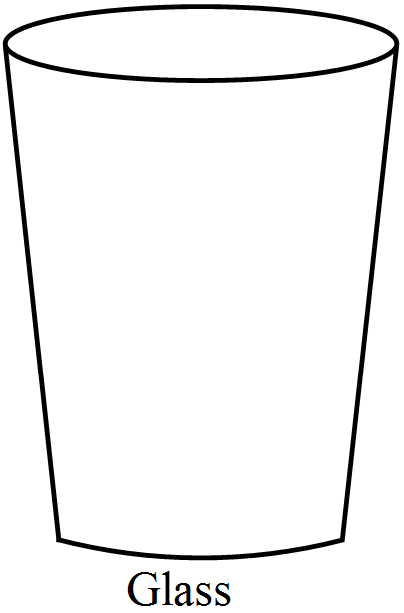
AnswerThe shape of a glass (tumbler) is usually in the from of a frustum of a cone.
View full question & answer→MCQ 51 Mark
How many bricks, each measuring $(25cm \times 11.25cm \times 6cm)$, will be required to construct a wall $(8m \times 6m \times 22.5cm)?$
- A
$8000$
- ✓
$6400$
- C
$4800$
- D
$7200$
AnswerCorrect option: B. $6400$
Number of bricks $=\frac{\text{Volume of the wall}}{\text{Volume of each brick}}$
$=\frac{(800\times600\times22.5)}{(25\times11.25\times6)}$
$=6400$
View full question & answer→MCQ 61 Mark
The volumes of two spheres are in the ratio $64 : 27$. The ratio of their surface areas is:
- A
$9 : 16$
- ✓
$16 : 9$
- C
$3 : 4$
- D
$4 : 3$
AnswerCorrect option: B. $16 : 9$
Let the radii of the speres be $r$ and $R$.
The volume of the spheres are in ratio $64 : 27$.
$\Rightarrow\frac{\frac{4}{3}\pi\text{r}^3}{\frac{4}{3}\pi\text{R}^3}=\frac{64}{27}$
$\Rightarrow\frac{\text{r}^3}{\text{R}^3}=\frac{64}{27}$
$\Rightarrow\frac{\text{r}^3}{\text{R}^3}=\frac{64}{27}$
$\Rightarrow\frac{\text{r}}{\text{R}}=\frac{4}{3}$
Ratio of the sirface area of the spheres
$=\frac{4\pi\text{r}^2}{4\pi\text{R}^2}$
$=\Big(\frac{\text{r}}{\text{R}}\Big)$
$=\Big(\frac{4}{3}\Big)^2$
$=\frac{16}{9}$
Hence, the ratio is $16 : 9$
View full question & answer→MCQ 71 Mark
A circus tent is cylindrical to a height of $4m$ and conical above it. If its diameter is $105m$ and its slant height is $40m$, the total area of canvas required is:
- A
$ 1760 m^2 $
- B
$ 2640 m^2 $
- C
$3960 m^2 $
- ✓
$7920 m^2$
AnswerCorrect option: D. $7920 m^2$
Total area of the canvas required
= Curved surface area of the cylinder + Curved surface area of the cone
$=2\pi\text{rh}+\pi\text{rl}$
$=\Big(2\times\frac{22}{7}\times\frac{105}{2}\times4\Big)+\Big(\frac{22}{7}\times\frac{105}{2}\times40\Big)$
$=(1320)+(6600)$
$=7920\text{m}^2$
View full question & answer→MCQ 81 Mark
A solid piece of iron in the fo of a cuboid of dimensions $(49cm \times 33cm \times 24cm)$ is moulded to orm a solid sphere. The $r$ dius of the sphere is:
AnswerSince the cuboid is moulded to from a solid sphere, the volume of sphere = volume of the cuboid
$\Rightarrow\frac{4}{3}\pi\text{r}^3=49\times33\times24$
$\Rightarrow\frac{4}{3}\times\frac{22}{7}\times\text{r}^3=49\times33\times24$
$\Rightarrow\text{r}^3=\frac{49\times33\times24\times3\times7}{22\times4}$
$\Rightarrow\text{r}^3=7\times7\times7\times3\times3\times3$
$\Rightarrow\text{r}=7\times3$
$\Rightarrow\text{r}=21\text{cm}$
View full question & answer→MCQ 91 Mark
If the areas of three adjacent faces of a cuboid are $x, y$ and $z$, respectively, the volume of the cuboid is:
- A
$\text{xyz}$
- B
$2\text{xyz}$
- ✓
$\sqrt{\text{xyz}}$
- D
$\sqrt[3]{\text{xyz}}$
AnswerCorrect option: C. $\sqrt{\text{xyz}}$
Given that the areas of the three adjacent faces of a cub oid are $x, y,$ and $z$.
This means,
$lb = x, bh = y, lh = z$
$\therefore lb × bh × lh = xyz$
$\therefore l^2b^2h^2= xyz$
$\therefore (lbh)^2= xyz$
$\therefore ($Volume of the cuboid$)^2= xyz$
$\therefore$ Volume of the cuboid $=\sqrt{\text{xyz}}$
View full question & answer→MCQ 101 Mark
The total surface area of a hemisphere of radius $7cm$ is:
- A
$(588\pi)\text{cm}^2$
- B
$(392\pi)\text{cm}^2$
- ✓
$(147\pi)\text{cm}^2$
- D
$(98\pi)\text{cm}^2$
AnswerCorrect option: C. $(147\pi)\text{cm}^2$
The total surface area of a hemisphere
$=3\pi\text{r}^2$
$=3\times\pi\times7^2$
$=147\pi\text{cm}^2$
View full question & answer→MCQ 111 Mark
A funnel is the combination of:
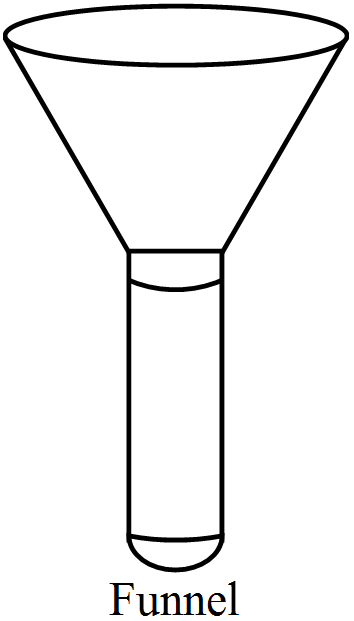
- A
- B
A cylinder and a hemisphere.
- ✓
A cylinder and frustum of a cone.
- D
AnswerCorrect option: C. A cylinder and frustum of a cone.
A funnel is the combination of a cylinder and frustum of a cone. the lower portion is cylindrical the upper poetion is a frustum of a cone.
View full question & answer→MCQ 121 Mark
The radii of the base of a cylinder and a cone are in the ratio $3 : 4$. If their heights are in the ratio $2 : 3$, the ratio between their volumes is:
- ✓
$9 : 8$
- B
$3 : 4$
- C
$8 : 9$
- D
$4 : 3$
AnswerCorrect option: A. $9 : 8$
Let the radiiof the base of the cylinder and the cone be $3r$ and $4r$ and their heights be $2h$ and $3h$ respectively.
Ratio of their volume $=\frac{\pi(3\text{r})^2(2\text{h})}{\frac{1}{3}\pi(4\text{r})^3(3\text{h})}$
$=\frac{\pi\times9\text{r}^2\times2\text{h}\times3}{\pi\times16\text{r}^2\times3\text{h}}$
$=\frac{9}{8}$
Hence, the ratio is $9 : 8$
View full question & answer→MCQ 131 Mark
A metallic solid sphere of radius $9\ cm$ is melted to form a solid linder of radius $9\ cm$. The height of the cylin er is:
- ✓
$12\ cm$
- B
$18\ cm$
- C
$36\ cm$
- D
$96\ cm$
AnswerCorrect option: A. $12\ cm$
The metallic solid sphere is melted to from a solid cylinder.
Let the height of the cylinder be h.
So, volume of the sphere = volume of the cylinder
$\Rightarrow\frac{4}{3}\pi\text{r}_1^3=\pi\text{r}^2\text{h}$
$\Rightarrow\frac{4}{3}\text{r}_1=\text{h}$
$\Rightarrow\text{h}=\frac{4}{3}\times9=12\text{cm}$
View full question & answer→MCQ 141 Mark
A cubical ice-cream brick of edge $22\ cm$ is to be distributed among some children by filling ice-cream cones of radius $2\ cm$ and height $7\ cm$ up to the brim. How many children will get the ice-cream cones?
- A
$163$
- B
$263$
- ✓
$363$
- D
$463$
AnswerGiven that the cubical ice cream brick
$= 22^3$
Volume of each ice-cream cone $=\frac{1}{3}\pi\text{r}^2\text{h}$
$=\frac{1}{3}\times\frac{22}{7}\times(2)^2\times7$
So, the number of ice-cream cones
$=\frac{\text{Volume of the cubical ice-cream brick}}{\text{Volume of each ice-cream cone}}$
$=\frac{22\times22\times22}{\frac{1}{3}\times\frac{22}{7}\times(2)^2\times7}$
$=\frac{22\times22\times22\times7\times3}{22\times4\times7}$
$=363$
Hence, the number of ice-cream cones is $363$.
View full question & answer→MCQ 151 Mark
A shuttlecock used for playing badminton is the combination of:
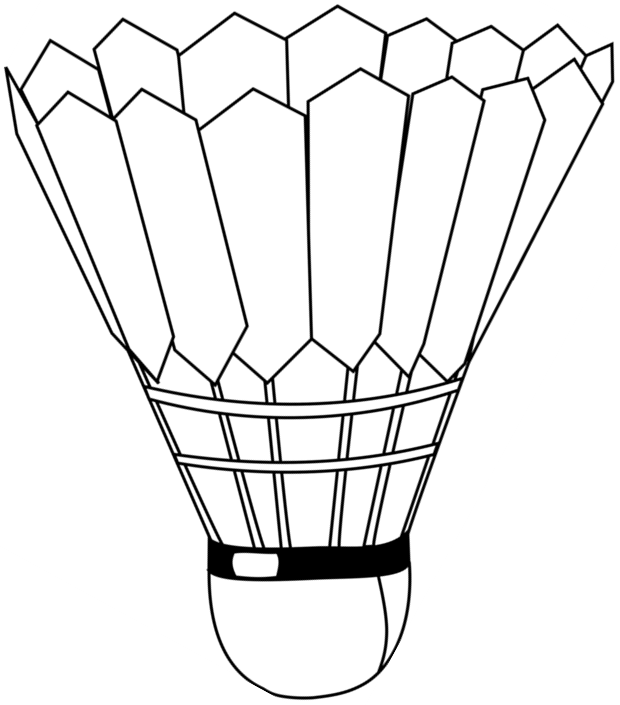
- A
Cylinder and a hemisphere.
- ✓
Frustum of a cone and a hemispher.
- C
- D
AnswerCorrect option: B. Frustum of a cone and a hemispher.
A shuttlecock used for playing badminton is the combination of a frustum of a cone and hemisphere, the lower portion being the hemisphere and the portion above that being the frustum of the cone.
View full question & answer→MCQ 161 Mark
On increasing the radii of the base and the height of a cone by $20%$, its volume will increase by:
- A
$20 \%$
- B
$40 \%$
- C
$60 \%$
- ✓
$72.8 \%$
AnswerCorrect option: D. $72.8 \%$
Let the radius and height of the cone be $r$ and $h$ respectively.
Origunal volume $=\frac{1}{3}\pi\text{r}^2\text{h}$
On increasing each by 20%, the new radius and height
become $\text{r}+\frac{1}{5}\text{r}=\frac{6}{5}\text{r}$ and $\text{h}+\frac{1}{5}\text{h}=\frac{6}{5}\text{h}.$
New volume $=\frac{1}{3}\pi\Big(\frac{6}{5}\text{r}\Big)^2\Big(\frac{6}{5}\Big)\text{h}$
$=\frac{1}{3}\pi\Big(\frac{36}{25}\text{r}^2\Big)\Big(\frac{6}{5}\text{h}\Big)$
$=\frac{216}{125}\Big(\frac{1}{3}\pi\text{r}^2\text{h}\Big)$
$=\frac{216}{125}$ (Original volume)
So, change in the volume
$=\frac{216}{125}$ (Original volume) - (Original volume)
$=\frac{91}{125}$ (Original volume)
Increase percentage $=\frac{\frac{91}{125}(\text{Original volume})}{\text{Original volume}}\times100$
$=72.8\%$
View full question & answer→MCQ 171 Mark
The radii of the circular ends of a bucket of height $40\ cm$ are $24\ cm$ and $15\ cm$. The slant height (in cm) of the bucket is:
AnswerSlant height of the buckrd
$=\sqrt{(\text{R}-\text{r})^2+\text{h}^2}$
$=\sqrt{(24-15)^2+40^2}$
$=\sqrt{9^2+40^2}$
$=\sqrt{81+1600}$
$=\sqrt{1681}$
$=41\text{cm}$
View full question & answer→MCQ 181 Mark
Twelve solid spheres of the same size are made by melting a solid metallic cylinder of base diameter $2\ cm$ and height $16\ cm$. The diameter of each sphere is:
- ✓
$2\ cm$
- B
$3\ cm$
- C
$4\ cm$
- D
$6\ cm$
AnswerCorrect option: A. $2\ cm$
Radius of the cylinder $=\frac{2}{2}=1\text{cm}$
$\text{h}=16\text{cm}$
Since twelve solid spheres of the same size are made by melting a solid metallic cylinder of base diameter $2\ cm$ and height $16\ cm$,
$12\times\frac{4}{3}\pi\text{r}^3=\pi\text{R}^2\text{h}$
$\Rightarrow12\times\frac{4}{3}\text{r}^3=\text{R}^2\text{h}$
$\Rightarrow12\times\frac{4}{3}\times\Big(\frac{\text{d}}{2}\Big)^3=(1)^2\times16$
$\Rightarrow16\times\Big(\frac{\text{d}}{2}\Big)^3=(1)^2\times16$
$\Rightarrow\Big(\frac{\text{d}}{2}\Big)^3=1$
$\Rightarrow\frac{\text{d}^3}{8}=1$
$\Rightarrow\text{d}^3=8$
$\Rightarrow\text{d}=\pm2$
Since the diameter connot be negative, $d = 2\ cm$.
View full question & answer→MCQ 191 Mark
If the radius of the base of a right circular cylinder is halved, keeping the height the same, then the ratio of the volume of the cylinder thus obtained to the volume of original cylinder is:
- A
$1 : 2$
- B
$2 : 1$
- C
$1 : 4$
- ✓
$4 : 1$
AnswerCorrect option: D. $4 : 1$
Let the radius and height of the culinder be $r$ and $h$ respectively.
Since the radius is halved keeping the height the same,
The new radius is $\frac{\text{r}}{2}.$
$\frac{\text{Volume of the new cylinder}}{\text{Volume of the original cylinder}}$
$=\frac{\pi\text{r}^2\text{h}}{\pi\Big(\frac{\text{r}}{2}\Big)^2\text{h}}$
$=\frac{4}{1}$
So, the ratio is $4 : 1$
View full question & answer→MCQ 201 Mark
A cylindrical pencil sharpened at one end is a combination of:
- ✓
- B
A cylinder and frustum of a cone.
- C
A cylinder and a hemisphere.
- D
Answer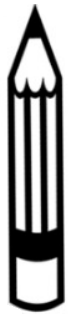
A cylindrical pencil sharpened at one edge is the combination of a cylinder and a cone. observe the fingure, the lover portion is a cylinder and the upper tapering portion is a cone.
View full question & answer→MCQ 211 Mark
The diameter of the base of a cylinder is $4\ cm$ and its height is $14\ cm.$ The volume of the cylinder is:
- ✓
$ 176 \mathrm{~cm}^3 $
- B
$ 196 \mathrm{~cm}^3 $
- C
$ 276 \mathrm{~cm}^3 $
- D
$ 352 \mathrm{~cm}^3$
AnswerCorrect option: A. $ 176 \mathrm{~cm}^3 $
Volume of the cylinder $=\pi\text{r}^2\text{h}$
$=\frac{22}{7}\times2\times2\times14$ $....($Since the diameter $= 4\ cm)$
$=176\text{cm}^3$
View full question & answer→MCQ 221 Mark
The number of solid spheres, each of diameter $6\ cm$, that can mabe by melting a solid metal cylinder of height $45\ cm$ and diameter $4\ cm$, is:
AnswerLet the number of solid spheres be $n$.
Since the solid metal cylinder is meltes and recast into n solid sheres,
Volume of n solid aphere = volume of the solid metal cylinder
$\Rightarrow\text{n}\times\frac{4}{3}\pi\text{R}^2\text{h}$
$\Rightarrow\text{n}=\frac{3\text{R}^2\text{h}}{4\text{r}^3}$
$\Rightarrow\text{n}\frac{3\times2^2\times45}{4\times3^3}$
$($since diameter of the cylinder $= 4\ cm$ and diameter of each sphere $= 6\ cm)$
$\Rightarrow\text{n}=5$
Hence, $5$ silid spheres can be formed.
View full question & answer→MCQ 231 Mark
The heights of two circular cylinders of equal volume are in the ratio $1 : 2$. The ratio of their radii is:
- A
$1:\sqrt{2}$
- ✓
$\sqrt{2}:1$
- C
$1:2$
- D
$1:4$
AnswerCorrect option: B. $\sqrt{2}:1$
Let the height of the two cylinders be $h$ and $2h$,
And the radii of the cylinders be $r_1$ and $r_2$ respectively
Since the volume of the cylinders are equal,
$\pi(\text{r}_1)^2\text{h}=\pi(\text{r}_2)^2(2\text{h})$
$\Rightarrow\frac{\text{r}_1^2}{\text{r}_2^2}=\frac{2}{1}$
$\Rightarrow\frac{\text{r}_1}{\text{r}_2}=\frac{\sqrt{2}}{1}$
Hence, the ratio of their radii is $\sqrt{2}:1$
View full question & answer→MCQ 241 Mark
If the radius of a sphere becomes $3$ times, then its volume will become:
- A
$3$ times
- B
$6$ times
- C
$9$ times
- ✓
$27$ times
AnswerCorrect option: D. $27$ times
Let the radius of the sphere be $r$.
So, the volume of the shere $=\frac{4}{3}\pi\text{r}^3$
If the radius becomes $3r$,
The volume $=\frac{4}{3}\pi(3\text{r})^3=27\times\frac{4}{3}\pi\text{r}^3=27$ times the original sphere.
View full question & answer→MCQ 251 Mark
A hollow cube of internal edge $22\ cm$ is filled with spherical marbles of diameter $0.5\ cm$ and $\frac{1}{8}$ space of the cube remains unfilled. Number of marbles required is
- ✓
$142296$
- B
$142396$
- C
$142496$
- D
$142596$
AnswerCorrect option: A. $142296$
Volume of the cube with edge $22cm = (22)^3$
Given that $\frac{1}{8}$ of the cube remains unfilled.
So, $\frac{7}{8}$ of the volume of the cube is filled.
Let the number of marbles required be $n$.
Thus, $\frac{7}{8}\times(22)^3=\text{n}\times\frac{4}{3}\pi(0.25)^3$ $....($Since diameter $0.5\ cm)$
$\Rightarrow\frac{7}{8}\times(22)^3=\text{n}\times\frac{4}{3}\times\frac{22}{7}\times(0.25)^3$
$\Rightarrow\text{n}\frac{7\times(22)^3\times3\times7}{8\times4\times22\times(0.25)^3}$
$\Rightarrow\text{n}=142296$
Hence, the number of marbles required is $142296$.
View full question & answer→MCQ 261 Mark
A cube of side $6\ cm$ is cut into a number of cubes, each of side $2\ cm.$ The number of cubes formed is:
AnswerVolume of the cube $= (6cm \times 6cm \times 6cm)$
Volume of each small $= (2cm \times 2cm \times 2cm)$
number of b cubes formed
$=\frac{\text{Volume of the cube}}{\text{Volume of each small cube}}$
$=\frac{6\times6\times6}{2\times2\times2}$
$=27$
View full question & answer→MCQ 271 Mark
The height of a cylinder is $14\ cm$ and its curved surface area is $264cm^2$. The volume of the cylinder is:
- A
$ 308 \mathrm{~cm}^3 $
- ✓
$ 396 \mathrm{~cm}^3 $
- C
$ 1232 \mathrm{~cm}^3 $
- D
$ 1848 \mathrm{~cm}^3$
AnswerCorrect option: B. $ 396 \mathrm{~cm}^3 $
The curved surface are of the cylinder $=2\pi\text{r}\text{h}$
$\Rightarrow264=2\times\frac{22}{7}\times\text{r}\times14$
$\Rightarrow\text{r}=3\text{cm}$
Volume of the cylinder $=\pi\text{r}^2\text{h}$
$=\frac{22}{7}\times3\times3\times14$
$=396\text{cm}^3$
View full question & answer→MCQ 281 Mark
The volume of a cube is $2744cm^2$. Its surface area is:
- A
$196 \mathrm{~cm}^2$
- ✓
$ 1176 \mathrm{~cm}^2$
- C
$ 784 \mathrm{~cm}^2$
- D
$ 588 \mathrm{~cm}^2$
AnswerCorrect option: B. $ 1176 \mathrm{~cm}^2$
Let the edge of the cube be $x\ cm$.
$ \text { Volume of a cube }=x^3 $
$ \Rightarrow 2744=x^3 $
$ \Rightarrow x=14 \mathrm{~cm}$
$\text { So, the surface area of the cube }=6 x^2$
$ =6(14)^2 $
$ =1176 \mathrm{~cm}^2$
View full question & answer→MCQ 291 Mark
The shape of a gilli in the gilli-danda game is a combination of:

- A
- B
- ✓
Two cones and a cylinder.
- D
Two cylinders and a cone.
AnswerCorrect option: C. Two cones and a cylinder.
The shape of a gill in the gilli-danda is a combination of two and a cylinder. the cones at either ends withthe culinder in the middle.
View full question & answer→MCQ 301 Mark
A metallic cone of base radius $2.1\ cm$ and height $8.4\ cm$ is melted and moulded into a sphere. The radius of the sphere is:
- ✓
$2.1\ cm$
- B
$1.05\ cm$
- C
$1.5\ cm$
- D
$2\ cm$
AnswerCorrect option: A. $2.1\ cm$
$2.1\ cm$
View full question & answer→MCQ 311 Mark
The circular ends of a bucket are of radii $35\ cm$ and $14\ cm$ and the height of the bucket is $40\ cm$. Its volume is:
- A
$60060 \mathrm{~cm}^3$
- ✓
$ 80080 \mathrm{~cm}^3 $
- C
$ 70040 \mathrm{~cm}^3$
- D
$80160 \mathrm{~cm}^3$
AnswerCorrect option: B. $ 80080 \mathrm{~cm}^3 $
Volume of the buclet = Volume of the frustum of the cone
$=\frac{1}{3}\pi\text{h}[\text{R}^2+\text{r}^2+\text{rr}]$
$=\frac{1}{3}\times\frac{22}{7}\times40[35^2+14^2+(35\times14)]$
$=\frac{880}{21}\times1911$
$=80080\text{cm}^3$
Hence, the volume of the bucket is $80080 \mathrm{~cm}^3$.
View full question & answer→MCQ 321 Mark
The radius (in cm) of the largest right circular cone that can be cut out from a cube of edge $4.2\ cm$ is:
- ✓
$2.1$
- B
$4.2$
- C
$8.4$
- D
$1.05$
AnswerThe diameter of such a cone is equal to the edge of the cube.
So, the diameter $= 4.2cm$.
Hence, the radius $= 2.1cm$.
View full question & answer→MCQ 331 Mark
The diameter of a sphere is $14\ cm$. Its volume is:
AnswerCorrect option: C. $ 1437 \frac{1}{3} \mathrm{~cm}^3 $
Diameter $= 14\ cm$
So, the radius $= 7\ cm$
Volume of the sphere $=\frac{4}{3}\pi\text{r}^3$
$=\frac{4}{3}\times\frac{22}{7}\times(7)^3$
$=1437\frac{1}{3}\text{cm}^3$
View full question & answer→MCQ 341 Mark
If the radii of the ends of a bucket are $5\ cm$ and $15\ cm$ and it is $24\ cm$ high, then its surface area is:
- A
$ 1815.3 \mathrm{~cm}^2 $
- ✓
$ 1711.3 \mathrm{~cm}^2 $
- C
$ 2025.3 \mathrm{~cm}^2 $
- D
$ 2360 \mathrm{~cm}^2$
AnswerCorrect option: B. $ 1711.3 \mathrm{~cm}^2 $
$\text{l}=\sqrt{\text{h}^2+(\text{R}-\text{r})^2}$
$\Rightarrow\text{l}=\sqrt{24^2+(15-5)}$
$\Rightarrow\text{l}=\sqrt{576+100}$
$\Rightarrow\text{l}=\sqrt{676}$
$\Rightarrow\text{l}=26\text{cm}$
Surface area of the bucket
$=\pi\big[\text{r}^2+\text{l}(\text{R}+\text{r})\big]$
$=3.14\times\big[5^2+26(15+5)\big]$
$=3.14\times[545]$
$=1711.3\text{cm}^2$
View full question & answer→MCQ 351 Mark
The ratio of the total surface area to the lateral surface area of a cylinder with base radius $80\ cm$ and height $20\ cm$ is:
- A
$2 : 1$
- B
$3 : 1$
- C
$4 : 1$
- ✓
$5 : 1$
AnswerCorrect option: D. $5 : 1$
The ratio of the total surface area to the lateral surface area
$=\frac{\text{Total surface area}}{\text{Lateral surface area}}$
$=\frac{2\pi\text{r}(\text{h}+\text{r})}{2\pi\text{rh}}$
$=\frac{\text{h+r}}{\text{h}}$
$=\frac{20+80}{20}$
$=\frac{5}{1}$
So, the required ratio is $5 : 1$
View full question & answer→MCQ 361 Mark
The radius of the base of a cone is 5cm and its height is 12cm. Its curved surface area is:
- A
$60\pi\text{cm}^2$
- ✓
$65\pi\text{cm}^2$
- C
$30\pi\text{cm}^2$
- D
$\text{None of these}$
AnswerCorrect option: B. $65\pi\text{cm}^2$
Slant height, $\text{l}=\sqrt{\text{r}^2+\text{h}^2}$
$\Rightarrow\text{l}=\sqrt{5^2+12^2}$
$\Rightarrow\text{l}=\sqrt{25+144}$
$\Rightarrow\text{l}=\sqrt{169}$
$\Rightarrow\text{l}=13\text{cm}$
Curved surface area of the cone $=\pi\text{rl}$
$=\pi\times5\times13$
$=65\pi\text{cm}^2$
View full question & answer→MCQ 371 Mark
The surface areas of two spheres are in e ratio $16: 9$. The ratio o their volumes is:
- ✓
$ 64: 27 $
- B
$ 16: 9 $
- C
$ 4: 3 $
- D
$ 16^3: 9^3$
AnswerCorrect option: A. $ 64: 27 $
Given that the surface areas of the two spheres are in the ratio $16 : 9$.
So, $\frac{4\pi\text{r}^2}{4\pi\text{R}^2}=\frac{16}{9}$
$\Rightarrow\frac{\text{r}^2}{\text{R}^2}=\frac{16}{9}$
$\Rightarrow\frac{\text{r}}{\text{R}}=\frac{4}{3}$
Let the volume of the sphere with radius r and R be $V_1$ and $V_2$ respectively.
$\frac{\text{V}_1}{\text{V}_2}=\frac{\frac{4}{3}\pi\text{r}^3}{\frac{4}{3}\pi\text{R}^3}$
$\Rightarrow\frac{\text{V}_1}{\text{V}_2}=\Big(\frac{\text{r}}{\text{R}}\Big)^3$
$\Rightarrow\frac{\text{V}_1}{\text{V}_2}=\Big(\frac{4}{3}\Big)^3=\frac{64}{27}$
Hence, the ratio of their volumes is $64.27$.
View full question & answer→MCQ 381 Mark
The diameters of two circular ends of a bucket are $44\ cm$ and $24\ cm$, and the height of the bucket is $35\ cm$. The capacity of the bucket is:
- A
$31.7$ litres.
- ✓
$32.7$ litres.
- C
$33.7$ litres.
- D
$34.7$ litres.
AnswerCorrect option: B. $32.7$ litres.
Since the diameter of the circular ends of the bucket are $44\ cm$ and $24cm$, the radii of thr circular end are $22\ cm$ and $12cm$.
Capacity of the bucket = volume of the bucket
$=\frac{1}{3}\pi\text{h}\big[\text{R}^2+\text{r}^2+\text{Rr}\big]$
$=\frac{1}{3}\times\frac{22}{7}\times35\times\big[22^2+12^2+(22\times12)\big]$
$=32.7\text{ litres}$
Hence, the capacity of the bucket is $32.7$ litres.
View full question & answer→MCQ 391 Mark
A metallic spherical shell of internal and external diameters $4\ cm$ and $8\ cm$, respectively, is melted and recast in the form of a cone of base diameter 8cm. The height of the cone is:
- A
$12\ cm$
- ✓
$14\ cm$
- C
$15\ cm$
- D
$8\ cm$
AnswerCorrect option: B. $14\ cm$
The radii od the spherical shell is $2\ cm$ and $2\ cm$.
Volume of the spherical shell $=\frac{4}{3}\pi\big(\text{R}^3-\text{r}^3\big)$
$=\frac{4}{3}\pi\big(\text{R}^3-\text{2}^3\big)$
$=\frac{4}{3}\pi(56)$
Radius of the cone $= 4\ cm$
Volume of the cone $=\frac{1}{3}\pi\text{r}^2\text{h}$
$=\frac{1}{3}\pi(4)^2\text{h}$
$\Rightarrow16\text{h}=4(56)$
$\Rightarrow\text{h}=14\text{cm}$
View full question & answer→MCQ 401 Mark
A cone is cut by a plane parallel to its base and the upper part is removed. The part that is left over is called:
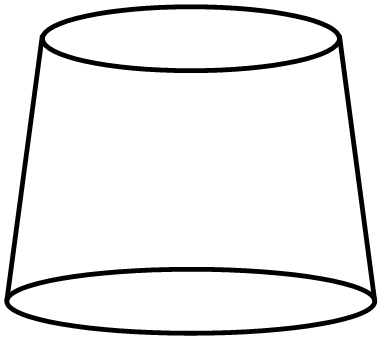
AnswerA cone is cut by a plane parallel to its base the upper part is remove. part that is left over is called the frutum of a cone.
View full question & answer→MCQ 411 Mark
The height of a conical tent is $14m$ and its floor area is $346.5m^2$. How much canvas, $1.1$ wide, will be required for it?
- A
$490m$
- ✓
$525m$
- C
$665m$
- D
$860m$
AnswerCorrect option: B. $525m$
Area of the floor of a conical tent $=\pi(\text{r})^2$
$\Rightarrow\pi\text{r}^2=346.5$
$\Rightarrow\text{r}^2=\Big(\frac{3465}{10}\times\frac{7}{22}\Big)$
$\Rightarrow\text{r}^2=\frac{441}{4}$
$\Rightarrow\frac{21}{2}\text{cm}$
Slant height of the cone, $\text{l}=\sqrt{\text{r}^2+\text{h}^2}$
$\Rightarrow\text{l}=\sqrt{\Big(\frac{21}{2}\Big)^2+14^2}$
$\Rightarrow\text{l}=\sqrt{\frac{1225}{4}}$
$\Rightarrow\text{l}=\frac{32}{2}\text{m}$
Area of the canvas = curved surface area of the conical tent
⇒ Area of the canvas $=\pi\text{r}\text{l}$
⇒ Area of the canvas $=\frac{22}{7}\times\frac{21}{2}\times\frac{35}{2}=577.5\text{m}^2$
Lenght of the canvas $=\frac{\text{Area of the canvas}}{\text{Width of the canvas}}$
$=\frac{577.5}{1.1}$
$=525\text{m}$
View full question & answer→MCQ 421 Mark
A rectangular sheet of paper $40cm \times 22cm$, is rolled to form a allow cylinder of height $40\ cm$. The radius of e cylinder {in cth) is:
- ✓
$3.5$
- B
$7$
- C
$\frac{80}{7}$
- D
$5$
AnswerSince the height of the cylinder is given to be $40\ cm,$ the sheet to paper when converted to a cylinder,
Has its circum ference to be $22\ cm.$
So, circum ference $= 22\ cm$
$\Rightarrow2\pi\text{r}=22$
$\Rightarrow2\times\frac{22}{7}\times\text{r}=22$
$\Rightarrow\text{r}=3.5\text{cm}$
Hence, the radius of the cylinder is $3.5\ cm.$
View full question & answer→MCQ 431 Mark
The area of the base of a right circular cone is $154cm^2$ and its height is 14cm. Its curved surface area is:
- ✓
$154\sqrt{5}\text{cm}^2$
- B
$154\sqrt{7}\text{cm}^2$
- C
$77\sqrt{7}\text{cm}^2$
- D
$77\sqrt{5}\text{cm}^2$
AnswerCorrect option: A. $154\sqrt{5}\text{cm}^2$
Area of the base of the cone $= 154$
$\Rightarrow\pi\text{r}^2=154$
$\Rightarrow\frac{22}{7}\times\text{r}^2=154$
$\Rightarrow\text{r}^2=49$
$\Rightarrow\text{r}=7\text{cm}$
$\text{l}=\sqrt{\text{r}^2+\text{h}^2}$
$\Rightarrow\text{l}=\sqrt{7^2+14^2}$
$\Rightarrow\text{l}=\sqrt{49+196}$
$\Rightarrow\text{l}=\sqrt{245}$
$\Rightarrow\text{l}=7\sqrt{5}\text{cm}$
Curve surface area of the cone $=\pi\text{rl}$
$=\frac{22}{7}\times7\times7\sqrt{5}$
$=154\sqrt{5}\text{cm}^2$
View full question & answer→MCQ 441 Mark
The ratio between the volume of two spheres is $8 : 27$. What is the ratio between their surface areas?
- A
$2 : 3$
- B
$4 : 5$
- C
$5 : 6$
- ✓
$4 : 9$
AnswerCorrect option: D. $4 : 9$
Let the radii of the spheres be $R$ and $r$.
Ratio of volumes $=\frac{\frac{4}{3}\pi\text{R}^3}{\frac{4}{3}\pi\text{r}^3}$
$\Rightarrow\frac{\frac{4}{3}\pi\text{R}^3}{\frac{4}{3}\pi\text{r}^3}=\frac{8}{27}$
$\Rightarrow\Big(\frac{\text{R}}{\text{r}}\Big)^3=\Big(\frac{2}{3}\Big)^3$
$\Rightarrow\frac{\text{R}}{\text{r}}=\frac{2}{3}$
Ratio between their surface areas
$=\frac{4\pi\text{R}^2}{4\pi\text{r}^2}$
$\Rightarrow\Big(\frac{\text{R}}{\text{r}}\Big)^2$
$=\Big(\frac{2}{3}\Big)^2$
$=\frac{4}{9}$
View full question & answer→MCQ 451 Mark
The total surface area of a cube is $864cm^2$. Its volume is:
- A
$ 3456 \mathrm{~cm}^3 $
- B
$ 432 \mathrm{~cm}^3 $
- ✓
$ 1728 \mathrm{~cm}^3 $
- D
$ 3456 \mathrm{~cm}^3$
AnswerCorrect option: C. $ 1728 \mathrm{~cm}^3 $
Let the edge iof the cube be $x\ cm$.
Total surface area of a cube $=6 x^2$
$ \Rightarrow 6 x^2=864 $
$ \Rightarrow x^2=144 $
$ \Rightarrow x=12 \mathrm{~cm}$
So, the volume of the cube $=x^3$
$ =(12)^3 $
$ =1728 \mathrm{~cm}^3$
View full question & answer→MCQ 461 Mark
A medicine capsule is in the shape of a cylinder of diameter $0.5\ cm$ with a hemisphere tucked at each end. The length of the entire capsule is $2\ cm$. The capacity of the capsule is:
- A
$ 0.33 \mathrm{~cm}^2 $
- B
$ 0.34 \mathrm{~cm}^2 $
- C
$ 0.35 \mathrm{~cm}^2 $
- ✓
$ 0.36 \mathrm{~cm}^2$
AnswerCorrect option: D. $ 0.36 \mathrm{~cm}^2$
Radiud of the capsule $= 0.25\ cm$
Let the length of the cylindrical part of the capsule be x cm.
So, $0.25 + x + 0.25 = 2$
$\Rightarrow 0.5 + x = 2$
$\Rightarrow x = 1.5$
Capacity of the capsule
= 2 × (Volume of the hemisphere) + (Volume of the cylinder)
$=2\times\Big(\frac{2}{3}\pi\text{r}^3\Big)+(\pi\text{r}^2\text{h})$
$=2\times\Big(\frac{2}{3}\times\frac{22}{7}\times0.25^3\Big)+\Big(\frac{22}{7}\times0.25^2\times1.5\Big)$
$=0.36\text{cm}^2$
View full question & answer→MCQ 471 Mark
The slant height of a bucket is $45\ cm$ and the radii of its top and bottom are $28\ cm$ and $7\ cm$, respectively. The curved surface area of the bucket is:
- A
$ 4953 \mathrm{~cm}^2 $
- B
$ 4952 \mathrm{~cm}^2 $
- C
$ 4951 \mathrm{~cm}^2 $
- ✓
$ 4950 \mathrm{~cm}^2$
AnswerCorrect option: D. $ 4950 \mathrm{~cm}^2$
The curved surface area of the bucket.
$=\pi\text{l}(\text{R}+\text{r})$
$=\frac{22}{7}\times45\times(28+7)$
$=4950\text{cm}^2$
Hence, the curved surface area of the bucket is $ 4950 \mathrm{~cm}^2$.
View full question & answer→MCQ 481 Mark
The sum of length, breadth and height of a cuboid is $19\ cm$ and its diagonal is $\sqrt[5]{5}\text{cm}.$ Its surface area is
- A
$361 \mathrm{~cm}^2$
- B
$125 \mathrm{~cm}^2$
- ✓
$236 \mathrm{~cm}^2$
- D
$486 \mathrm{~cm}^2$
AnswerCorrect option: C. $236 \mathrm{~cm}^2$
Given that $l + b + h = 19$
$ \Rightarrow(l+b+h)^2=19^2 $
$ \Rightarrow l^2+b^2+h^2+2 l b+2 b h+2 l h=361 $
$ \Rightarrow l^2+b^2+h^2+2(l b+b h+l h)=361$
$\text { Wen know that, the diagonal of a cuboid }=l^2+b^2+h^2$
That is, $(5\sqrt{5})^2=\text{l}^2+\text{b}^2+\text{h}^2$
So, from (i), we get
$(5\sqrt{5})^2+2(\text{lb}+\text{bh}+\text{lh})=361$
$⇒ 125 + 2(lb + bh + lh) = 361$
$⇒ 2(lb + bh + lh) = 236$
$⇒$ Sirface area $= 236cm^2$
Hence, the surface area of the cuboid is $236\ cm^2$
View full question & answer→MCQ 491 Mark
The volume of a hemisphere is $19404\ cm^3$. The total surface area of the hemisphere is:
- ✓
$ 4158 \mathrm{~cm}^2 $
- B
$ 16632 \mathrm{~cm}^2 $
- C
$ 8316 \mathrm{~cm}^2 $
- D
$ 3696 \mathrm{~cm}^2$
AnswerCorrect option: A. $ 4158 \mathrm{~cm}^2 $
Volume of hemisphere $=\frac{2}{3}\pi\text{r}^3$
$\frac{2}{3}\pi\text{r}^3=19404$
$\frac{2}{3}\times\frac{22}{7}\text{r}^3=19404$
$\text{r}^3=19404\times\frac{3\times7}{2\times22}$
$\text{r}^3=9261$
$\text{r}^3=21^3$
$\text{r}=21\text{cm}$
Surface area of hemisphere $=3\pi\text{r}^2$
$=3\times\frac{22}{7}\times21^2$
$=4158\text{cm}^2$
View full question & answer→MCQ 501 Mark
The radii of two cylinders are in the ratio $2 : 3$ and their heights are in the ratio $5 : 3$. The ratio of their volumes is:
- A
$27 : 20$
- ✓
$20 : 27$
- C
$4 : 9$
- D
$9 : 4$
AnswerCorrect option: B. $20 : 27$
Let the radii of the two cylinders be $2x$ and $3x$,
and the heights of the two cylinders be $5y$ and $3y$ respectively
Ratio of the volume of the cylinders $=\frac{\pi(2\text{x})^2(5\text{y})}{\pi(3\text{x})^2(3\text{y})}$
$=\frac{20}{27}$
That is, the ratio of their volume is $20 : 27$.
View full question & answer→