Questions

[4 marks Questions]

🎯

Test yourself on this topic

14 questions · timed · auto-graded

Question 14 Marks
How can ethanol and ethanoic acid be differentiated on the basis of their physical and chemical properties?
Answer
Ethanol $(CH_(3)CH_(2)OH)$ Physical Properties Ethanoic acid $(CH_(3)COOH)$
1 It has a pleasant smell. 1. It has a vinegar like strong smell.
2 It has a buring taste. 2. It has a sour / Acidic taste.
3 It's $M.P =156 K$ 3. It's $M.P. =290 K$
4 It's $B.P. =351 K$ 4. It's $B.P =391 K$
Chemical Properties
5 It reacts with $NaHCO _3$ and $CO _2$ gas doesnit evolve 5. It reacts with $NaHCO _3$ and $CO _2$ gas is evolved
6 Pink colour or $KMnO _4$ disappears when ethanol reacts with $KMnO _4$. 6. Pink colour of $KMnO _4$ doesn't disappear when $CH _3 COOH$ reacts with $KMnO _4$
View full question & answer
Question 24 Marks
Explain the given reactions with the examples
$(a)$ Hydrogenation reaction
$(b)$ Oxidation reaction
$(c)$ Substitution reaction
$(d)$ Saponification reaction
$(e)$ Combustion reaction
Write the reactions.
Answer
(a) Hydrogenation reaction : The addition of hydrogen to the unsaturated molecule to make it saturated is known as hydrogenation.
Image
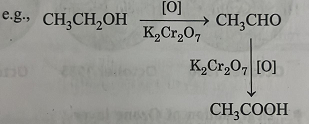
(b) Oxidation reaction : The reactions in which an oxidising agent supply nascent oxygen for oxidation are called oxidation reactions.
Image
(c) Substitution reaction : When one atom or a group of atoms replaces or substituties another atom or a group of atoms from the molecule, it is known as substitution reaction.
e.g., $CH _4+ Cl _2 \xrightarrow{\text { Sunlight }} CH _3 Cl + HCl$
(d) Saponification reaction : When esters are hydrolysed in the presence of a base $( NaOH )$ then the reaction is called saponification reaction.
e.g., $CH _3 COOCH _3+ NaOH \longrightarrow$$CH _3 COONa + CH _3 OH$
(e) Combustion reaction : Organic compounds burn readily in air to form $CO _2$ and water vapour along with lot of heat. This is known as combustion reaction.
e.g., $C _2 H _5 OH +3 O _2 \longrightarrow CO _2+3 H _2 O +$ Energy
View full question & answer
Question 34 Marks
$(A)$ Why is the conversion of ethanol to ethanoic acid an oxidation reaction?
$(B)$ A mixture of oxygen and ethyne is burnt for welding. Can you tell why a mixture of ethyne and air is not used?
Answer
→ Oxidation reaction means addition of oxygen or removal of hydrogen in to the compound.
During conversion of ethanol to ethanoic acid hydrogen is removed from it and oxygen is added in to ethanol. Therefore it is called oxidation reaction.
Example.
Image
→ We need very high temperature for welding process, but when ethyne is burnt in air, incomplete combustion takes place, so large amount of smoke is produced and temperature is very low. As a result, it is necessary to occur complete combustion to obtain high temperature for welding process. As a result mixture of ethyne and oxygen is useful for welding.
Image
View full question & answer
Question 44 Marks
Explain covalent bonding in hydrogen molecule $\left( H _2\right)$.
Answer
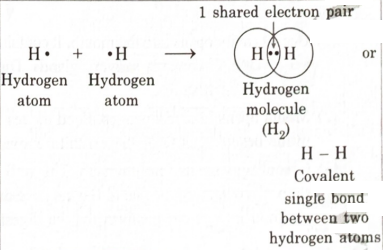
→ The atomic number of hydrogen is $1$. So, $H$-atom possess $1 e ^{-}$.
→ $H$ - atom requires 1 more electron to achieve the closed shell configuration of nearby inert element, helium.
→ Hence, two $H$ - atom, each having $1 e ^{-}$. will share their one electron by forming a covalent bond, and forms $H _2$ - molecule.
→ Both these atoms will attain dual closed shell configuration like that of helium.
Image
→ The electron pair that takes part in sharing is called bonding electron pair or bond electron pair.
→ The single line between two hydrogen atoms represent single covalent bond.
View full question & answer
Question 54 Marks
Explain the mechanism of cleansing action of soap.
Answer
  • The molecules of soap are sodium or potassium salts of long chain carboxylic acids.
  • Two ends of soap molecule possess different properties.
  • One end is hydrophilic and it dissolves in water, while the other end is hydrophobic and it dissolves in hydrocarbons.
  • When soap is at the surface of water, the hydrophobic ‘tail’ of soap will not be soluble in water and the soap will align along the surface of water with the ionic end in water and the hydrocarbon ‘tail’ protruding out of water.


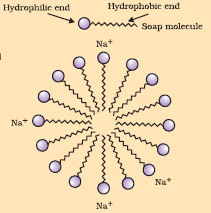
        [Formation of micelles]
  • Inside water, these molecules have a particular orientation that keeps the hydrocarbon portion out of the water.
  • This happens due to the formation of clusters of molecules in which the hydrophobic tails are in the interior part of the cluster and the ionic ends are on the surface of the cluster.
  • This formation is called a micelle.
  • Soap in the form of a micelle collects the oily dirt in the centre of it and is able to clean.
  • These micelles exist in solution as a colloid.
  • Micelles do not cluster to precipitate because of ion-ion repulsion.
  • Thus, the dirt suspended in the micelles is also easily rinsed away.
  • The soap micelles are large enough to scatter light, hence a soap solution appears cloudy.
View full question & answer
Question 64 Marks
Explain: Mechanism of micelle formation.
Answer
  • The molecules of soap are sodium or potassium salts of long chain carboxylic acids.
  • Two ends of soap molecule possess different properties.
  • One end is hydrophilic and it dissolves in water, while the other end is hydrophobic and it dissolves in hydrocarbons.
  • When soap is at the surface of water, the hydrophobic ‘tail’ of soap will not be soluble in water and the soap will align along the surface of water with the ionic end in water and the hydrocarbon ‘tail’ protruding out of water.


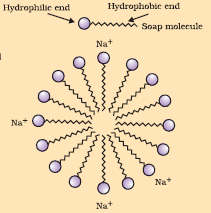
        [Formation of micelles]
  • Inside water, these molecules have a particular orientation that keeps the hydrocarbon portion out of the water.
  • This happens due to the formation of clusters of molecules in which the hydrophobic tails are in the interior part of the cluster and the ionic ends are on the surface of the cluster.
  • This formation is called a micelle.
  • Soap in the form of a micelle collects the oily dirt in the centre of it and is able to clean.
  • These micelles exist in solution as a colloid.
  • Micelles do not cluster to precipitate because of ion-ion repulsion.
  • Thus, the dirt suspended in the micelles is also easily rinsed away.
  • The soap micelles are large enough to scatter light, hence a soap solution appears cloudy.
View full question & answer
Question 74 Marks
Explain the chemical reactions of ethanoic acid.
Answer
  • $(1)$ Esterification reaction:
  • Reaction of a carboxylic acid and an alcohol in the presence of an acid catalyst forms ester and water.
  • This reaction is called an esterification reaction.
  • Ethanoic acid reacts with absolute ethanol in the presence of an acid catalyst to form ester and water.
$CH _3- C - OH + HO - CH _2- CH _3 \stackrel{\text { Acid }}{\rightleftharpoons} CH _3- C - O - CH _2 CH _3+ H _2 O \|$ Ethanol \|| Water $O \ O$ Ethanoic acid Ethyl acetate (Ester)
  • Esters are sweet smelling liquids and are used in making perfumes and flavouring agents.
  • A reaction of an ester with an alkali forming an alcohol and sodium salt of carboxylic acid is called saponification reaction.
  • On treating with sodium hydroxide, which is an alkali (base), the ester is converted back to alcohol and sodium salt of carboxylic acid.
$CH _3 COOC _2 H _5 \xrightarrow{ NaOH } C _2 H _5 OH + CH _3 COONa$ Ethyl acetate Ethanol Sodium acetate
  • $(2)$ Reaction with a base (Neutralisation)
  • Like mineral acids (HCI, $HNO_3$, $H_2SO_4$), carboxylic acid reacts with a base to form salt and water.
  • This is called neutralisation reaction.
  • Ethanoic acid reacts with sodium hydroxide and forms sodium ethanoate (salt) and water.
$CH _3- C - OH + HO - Na \rightarrow CH _3- C - ONa + H _2 O \|$ Sodium \|| Water O hydroxide O Ethanoic acid Sodium ethanoate
  • $(3)$ Reaction with carbonates and hydrogen carbonates: [2 Marks]
  • Ethanoic acid reacts with carbonates and hydrogencarbonates to form a salt, water and carbon dioxide.
  • Here, the salt formed is sodium acetate.
  • $2 CH _3 COOH + Na _2 CO _3 \rightarrow 2 CH _3 COONa + H _2 O + CO _2$
Ethanoic Sodium Sodium Water Carbon acid carbonate acetate dioxide
  • $CH _3 COOH + NaHCO _3 \rightarrow CH _3 COONa + H _2 O + CO _2$​​​​​​​
Ethanoic Sodium Sodium Water Carbonacid hydrogencarbonate acetate dioxide
View full question & answer
Question 84 Marks
Explain the chemical properties of ethanoic acid.
Answer
  • $(1)$ Esterification reaction:
  • Reaction of a carboxylic acid and an alcohol in the presence of an acid catalyst forms ester and water.
  • This reaction is called an esterification reaction.
  • Ethanoic acid reacts with absolute ethanol in the presence of an acid catalyst to form ester and water.
  • $CH _3- C - OH + HO - CH _2- CH _3 \stackrel{\text { Acid }}{\rightleftharpoons} CH _3- C - O - CH _2 CH _3+ H _2 O \| \mid$ Ethanol \|| Water O O Ethanoic acid Ethyl acetate (Ester)
  • Esters are sweet smelling liquids and are used in making perfumes and flavouring agents.
  • A reaction of an ester with an alkali forming an alcohol and sodium salt of carboxylic acid is called saponification reaction.
  • On treating with sodium hydroxide, which is an alkali (base), the ester is converted back to alcohol and sodium salt of carboxylic acid.
  • $CH _3 COOC _2 H _5 \xrightarrow{ NaOH } C _2 H _5 OH + CH _3 COONa$ Ethyl acetate Ethanol Sodium acetate
  • $(2)$ Reaction with a base (Neutralisation)
  • Like mineral acids $\left( HCl , HNO _3, H _2 SO _4\right)$, carboxylic acid reacts with a base to form salt and water.
  • This is called neutralisation reaction.
  • Ethanoic acid reacts with sodium hydroxide and forms sodium ethanoate (salt) and water.
  • $CH _3- C - OH + HO - Na \rightarrow CH _3- C - ONa + H _2 O \|$ Sodium \|| Water O hydroxide O Ethanoic acid Sodium ethanoate
  • $(3)$ Reaction with carbonates and hydrogen carbonates: [2 Marks]
  • Ethanoic acid reacts with carbonates and hydrogencarbonates to form a salt, water and carbon dioxide.
  • Here, the salt formed is sodium acetate.
  • $2 CH _3 COOH + Na _2 CO _3 \rightarrow 2 CH _3 COONa + H _2 O + CO _2$
  • Ethanoic Sodium Sodium Water Carbon acid carbonate acetate dioxide
  • $CH _3 COOH + NaHCO _3 \rightarrow CH _3 COONa + H _2 O + CO _2$
  • Ethanoic Sodium Sodium Water Carbonacid hydrogencarbonate acetate dioxide
View full question & answer
Question 94 Marks
What is the Catenation property of carbon which enables carbon to form a large number of compounds?
Answer
  • Catenation property of carbon :
  • Carbon has the unique ability to form bonds with other atoms of carbon, giving rise to large number of molecules.
  • This property of carbon is called catenation.
  • Carbon compounds consist of long chains of carbon, branched chains of carbon or in the ring form or cyclic form.
  • Carbon atom may be linked with other atoms by single, double or triple bonds.
  • Compounds of carbon, which are linked by only single bonds between the carbon atoms are called saturated compounds.
  • Compounds of carbon, having double or triple bonds between the carbon atoms are called unsaturated compounds.
  • No other element exhibits the property of catenation to the extent seen in carbon compounds.
  • Silicon forms compounds with hydrogen which have chains of upto seven or eight atoms, but these compounds are very reactive.
  • The carbon-carbon bond is very strong and hence it is stable.
  • Since carbon has a valency of four, it is capable of bonding with four other atoms of carbon or atoms of some other monovalent elements.
  • Compounds of carbon are formed with oxygen, hydrogen, nitrogen, sulphur, chlorine and many other elements giving rise to compounds with specific properties which depend on the elements other than carbon present in the molecule.
  • The bond formed by carbon with most other elements are very strong, which makes compounds exceptionally stable.
  • Carbon being small in size, it enables the nucleus to hold on to the shared pairs of electrons strongly.
  • Hence, strong bonds are formed by carbon.
View full question & answer
Question 104 Marks
Write a note on ‘Allotropes of carbon’.
Answer
  • The element carbon exists in nature in different forms with different physical properties, but identical chemical properties.
  • These forms are called allotropes of carbon.
  • Carbon possesses three allotropes :
  • $(1)$ Diamond, $(2)$ Graphite and $(3)$ Fullerene.
  • These three allotropes consist of pure carbon.
  • Diamond, graphite or fullerene when burnt in air, form carbon dioxide gas, which is colourless and odourless and turns lime water milky, Hence, chemical properties of these allotropes are same.
  • $(1)$ Diamond:
  • $(a)$ Structure: [$2$ Marks]
  • In diamond, each carbon atom is bonded to four other carbon atoms forming a rigid three-dimensional tetrahedral structure.
  • [$(a)$ Tetrahedral arrangement of carbon atoms in diamond $(b)$ Three dimensional structure of diamond]
  • $(b)$ Physical properties of diamond: [$2$ Marks]
  • Carbon atoms are arranged tetrahedrally in diamond; and it is the hardest natural substance known.
  • Carbon atoms are closely packed in diamond, hence, it has a high density. ( $3.51 g cm ^{-3}$ )
  • Diamond possess numerous covalent bonds, hence, its melting point is quite high. ($4203 \ K$)
  • There are no free electrons electrons in a diamond crystal, therefore, diamond is a non-conductor of electricity.
  • Diamonds are transparent because of their high refractive index $(2.5).$
  • Diamonds can be synthesised by subjecting pure carbon to very high pressure and temperature.
  • These synthetic diamonds are small but are indistinguishable from natural diamonds.
  • $(2)$ Graphite:
  • $(a)$ Structure :
  • In graphite, each carbon atom is bonded to three other carbon atoms in the same plane giving a hexagonal array.
  • One of these bonds is a double bond, and thus the valency of carbon is satisfied.Graphite structure is formed by the hexagonal arrays being placed in
  •  layers one above  the other.
  • [$(a)$ The structure of graphite $(b)$ Hexagonal arrangement of layers]
  • $(b)$ Physical properties of graphite:
  • Graphite is smooth and slippery.
  • The density of graphite is lower than diamond. $\left(2.22 g cm ^{-3}\right)$.
  • In graphite, three valence electrons are used for bond formation and hence, one valence electron is free to move.
  • As a result, graphite is a good conductor of heat and electricity.
  • $(3)$ Fullerene: [$2$ Marks]
  • Fullerenes form another class of carbon allotropes.
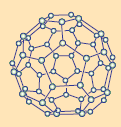
  • The first one to be identified was $C -60$, which has carbon atoms arranged in the shape of football.
  • Since this looked like the geodesic dome designed by the US architect Buckminster Fuller, the molecule was named fullerene

[The structure of C - 60 Buckminster Fullerene]
View full question & answer
Question 114 Marks
Explain the tetravalency of carbon.
Answer
 → The atomic number of carbon is $6$ .
$
C _{( Z =6)}=\begin{array}{ll}
K & L \\
2 & 4
\end{array}
$
→ Hence, there are $2$ electrons in its first $( K )$ shell and $4$ in second $(L)$ shell i.e. outer most shell. Thus, carbon has $6$ . protons and $6$ electrons.
- The reactivity of an element is explained by its tendency to attain a completely filled outer shell to attain noble gas configuration.
→ Elements forming ionic compounds achieve noble gas configuration by either losing or gaining electrons from the outer most shell. The ease of carbon is different since it has $4$ electrons in its outermost shell.
→ Carbon has to either gain or lose $4$ electrons to attain noble gas configuration. The problem in doing this is discussed below :
$(1)$ Carbon can gain $4$ electrons to form $C ^{4-}$ anion. If carbon does this, it will be difficult for the nucleus with $6$ protons to hold $10$ electrons ( $6$ existing $+4$ borrowed) i.e. $4$ extra electrons.
$(2)$ Carbon can lose $4$ electrons to form $C ^{4+}$ cation. This would require a large amount of energy to remove $4$ electrons leaving behind a carbon cation with $6$ protons in its nucleus holding on to just $2$ electrons.
Solution :
To overcome these problems, carbon neither accepts, nor gains but shares its valence electrons with other atoms of carbon or with atoms of other elements. The shared electrons belong to the outer shells of both the atoms. This way both the atoms attain noble gas configuration.
→ The bond formed by sharing of electrons in this manner is known as covalent bond.
→ Not only carbon but many other elements form molecules by sharing electrons and forming covalent bonds.
View full question & answer
Question 124 Marks
What are structural isomers? Give examples.
Answer
  • Compounds having the same molecular formula but different structural formulae are known as structural isomers.
  • Examples:
  • (1) Structural isomers of butane $\left(\mathrm{C}_4 \mathrm{H}_{10}\right)$
  • (a)
H H H H | | | | H - C - C - C - C - H OR $\mathrm{CH}_3-\mathrm{CH}_2-\mathrm{CH}_2-\mathrm{CH}_3$ | | | | n-Butane (Butane) H H H H
  • (b)
H H H | | | H - C - C - C - H OR $\mathrm{CH}_3-\mathrm{CH}-\mathrm{CH}_3$ | | | | H | H $\mathrm{CH}_3$ H – C – H Isobutane | (2-Methylpropane) H
  •  (2) Structural isomers of pentane $\left(\mathrm{C}_5 \mathrm{H}_{12}\right)$
  • $\mathrm{CH}_3-\mathrm{CH}_2-\mathrm{CH}_2-\mathrm{CH}_2-\mathrm{CH}_2$ n-Pentane
(Pentane) $\text { (b) } \mathrm{CH}_3-\mathrm{CH}-\mathrm{CH}_2-\mathrm{CH}_2 \text { Isopentane | (2-Methylbutane) } \mathrm{CH}_3 \mathrm{CH}_3 \text { (c) } \mathrm{CH}_3-\mathrm{C}-\mathrm{CH}_3 \text { Neopentane | } \mathrm{CH}_3(2,2-$Dimethyl-propane$)$
  • (3) Structural isomers of hexane $\left(\mathrm{C}_6 \mathrm{H}_{14}\right)$
  • (a) $\mathrm{CH}_3-\mathrm{CH}_2-\mathrm{CH}_2-\mathrm{CH}_2-\mathrm{CH}_2-\mathrm{CH}_2$ n-Hexane
(Hexane) (b) $\mathrm{CH}_3-\mathrm{CH}-\mathrm{CH}_2-\mathrm{CH}_2-\mathrm{CH}_2$ 2-Methylpentane | $\mathrm{CH}_3$ (c) $\mathrm{CH}_3-\mathrm{CH}_2-\mathrm{CH}-\mathrm{CH}_2-\mathrm{CH}_3$ 3-Methylpentane | $\mathrm{CH}_3$ (d) $\mathrm{CH}_3-\mathrm{CH}-\mathrm{CH}-\mathrm{CH}_3$ 2,3-Dimethylbutane | | $\mathrm{CH}_3 \mathrm{CH}_3 \mathrm{CH}_3$ | (e) $\mathrm{CH}_3-\mathrm{C}-\mathrm{CH}_2-\mathrm{CH}_3$ 2,2-Dimethylbutane | $\mathrm{CH}_3$
View full question & answer
Question 134 Marks
What is meant by homologous series? Mention its characteristics.
Answer
  • A series of organic compounds in succession which differ by a definite group $($like $–CH_{2^-})$ is called homologous series.
  • Characteristics:
  • $(1)$ Each member of the homologous series contains same elements and functional group.
  • $(2)$ Each member of the series can be expressed by general molecular formula viz. each member of alkane series can be expressed by general formula $C_nH_{2n+2}$.
  • $(3)$ The difference in molecular formula between two successive members of the series is equal to $CH_2$.
  • $(4)$ There is difference of $14 ~u$ between molecular masses of any two successive members of the series.
  • $(5)$ Same number of prefix or suffix is applied to each member of the series in their nomenclature.
  • $(6)$ Each member of homologous series contains same functional group and gives same chemical reaction.
  • $(7)$ The molecular mass of the member of series increases due to increase in the atoms of carbon and hydrogen. Hence, the physical properties based on the molecular masses of the members viz. boiling point, melting point, density, solubility, etc. have gradual change.
View full question & answer
Question 144 Marks
What are functional groups? Give examples.
Answer
  • An atom or a group of atoms which imparts specific properties to the compound is called a functional group.
  • Chemical reactions of different organic compounds containing same functional group are same.
  • Chemical reactions and properties of organic compounds containing different functional groups are different.
  • Free valency or valencies of the group are shown by the single line (-).
  • The functional group is attached to the carbon chain by replacing one or more hydrogen atom or atoms.
  • Examples : Some examples of functional groups are as follows :
  • Some functional groups in carbon compounds
Hetero-atom Class of compounds Formula of functional group
Cl / Br Halo-(Chloro / bromo) Alkane - Cl, - Br (Substitutes for hydrogen atom)
Oxygen 1. Alcohol - OH
  2. Aldehyde
  3. Ketone
  4. Carboxylic acid O || - C - OH
View full question & answer
[4 marks Questions] - Science STD 10 Questions - Vidyadip