Questions · Page 1 of 2

[1 Mark Questions]

🎯

Test yourself on this topic

50 questions · timed · auto-graded

Question 11 Mark
Give an example of a plant hormone that promotes growth.
Answer
  • An example of a plant hormone that promotes growth: Auxin.
View full question & answer
Question 21 Mark
Which of the following diagram is correct? Why?
Answer
  • Diagram $(a)$ is correct, because roots show positive geotropism and stem shown negative geotropism.
View full question & answer
Question 31 Mark
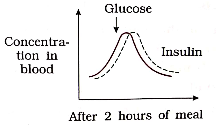
A graph shows change after a lunch of a healthy individual whose diet is rich in sweets.
What you explain from it?
Answer
  • When the sugar level rises in blood, pancreas releases more insulin to regulate blood sugar level.
  • As blood sugar level falls, insulin secretion is reduced by feedback mechanism.
View full question & answer
Question 41 Mark
Identify $(a), (b), (c)$ and $(d)$ in the given figure. Give one name of the hormone secreted from each of any two of them.
Answer
  • $(a)$ Pineal gland-Melatonin hormone
  • $(b)$ Pituitary gland-Growth hormone
  • $(c)$ Thyroid gland-Thyroxine
  • $(d)$ Thymus gland-Thymocine
View full question & answer
Question 51 Mark
Label $(a), (b), (c)$ and $(d)$ in the given figure showing the pathway of thermal impulse.
Answer
  • $(a)$ Sensory neuron
  • $(b)$ Relay neuron
  • $(c)$ Motor neuron
  • $(d)$ Effector $=$ muscle in skin
View full question & answer
Question 61 Mark
Why is chemical signal required along with electrical impulses in higher animals?
Answer
  • In higher animals, electrical impulses bring immediate response to only those cells that are connected by nervous tissue while chemical signals reaching to each and every cells of body.
View full question & answer
Question 81 Mark
Give the scientific terms used to represent the Winding of tendril around a support.
Answer
  • Thigmotropism
View full question & answer
Question 101 Mark
Give the scientific terms used to represent the Growing of a pollen tube towards ovule
Answer
  • Chemotropism
View full question & answer
Question 131 Mark
Identify me : I am controlling your daily activities such as walking, riding a bicycle, picking up object, etc.
Answer
  • Cerebellum
View full question & answer
Question 141 Mark
Deficiency of growth hormone : ......... :: Deficiency of ......... : diabetes
Answer
  • Dwarfism, Insulin
View full question & answer
Question 151 Mark
Which event is indicated in the diagram? Which hormone is responsible for it?
Answer
  • Positive phototropism in shoot is indicated in the diagram. Auxin is responsible for it.
View full question & answer
Question 161 Mark
Movement dependent on growth: Tendrils of pea:: Movement independent of growth: ........
Answer
  • Drooping of leaves of chhui-mui
View full question & answer
Question 171 Mark
Who am I? I am present in greater concentration areas of rapid cell division, such as in fruits and seeds.
Answer
  • Cytokinin
View full question & answer
Question 181 Mark
State the correct sequence of impulse for spinal reflex.
Answer
  • Receptors in skin → sensory neuron → spinal cord → motor neuron → effector (muscles)
View full question & answer
Question 191 Mark
Identify me: I am a hormone generally for an emergency, increases breathing rate but reduce blood flow to digestive system and skin.
Answer
  • Adrenaline
View full question & answer
Question 201 Mark
Trace the sequence of events which Occur when a bright light is focused on your eyes?
Answer
  • Stimulus (bright light) → photo receptors of eyes
↓Pupil ← motor ← mid ← sensory nerves
constrict nerve brain /neurons
(neuron)
View full question & answer
Question 211 Mark
Give the correct sequence of conduction of impulse.
Answer
  • Correct sequence of conduction of
  • impulse: Dendrite → cell body → axon → nerve ending → synapse → dendrite
View full question & answer
Question 231 Mark
Explain the terms : Synapse
Answer
  • In the arrangement of two consecutive neurons the axon fibre endings of one neuron and the dendrite endings of the next neuron having a microscopic gap is called synapse.
View full question & answer
Question 241 Mark
Explain the terms : Central Nervous System
Answer
  • A controlling and coordinating system of body which consists of brain and spinal cord is called central nervous system.
View full question & answer
Question 251 Mark
Explain the terms : Receptors
Answer
  • The specialised structures that receive stimuli from external environment are called receptors.
View full question & answer
Question 261 Mark
Explain the terms : Endocrine gland
Answer
  • The ductless glands that secret hormones are called endocrine gland.
View full question & answer
Question 271 Mark
Explain the terms : Hormone
Answer
  • A chemical messenger, synthesised or secreted in extremely small quantities by endocrine glands. and poured directly in blood is called hormone.
View full question & answer
Question 281 Mark
Explain the terms : Tropism
Answer
  • The growth related movement in the plant organs, which are induced as a response to directional stimulus is called tropism.
View full question & answer
Question 291 Mark
Explain the terms : Coordination
Answer
  • Different organs of the body jointly function systematically against the stimuli and react to express proper response against the stimuli is called coordination.
View full question & answer
Question 301 Mark
Explain the terms : Response
Answer
  • The reaction of living organisms against the stimulus induced by the change in the external environment is called response.
View full question & answer
Question 311 Mark
Explain the terms : Stimulus
Answer
  • The changes, that take place in the external environment of living organisms (plants, animals, microorganisms, etc.) and induce definite types of reactions or responses, are called stimuli (singular-stimulus).
View full question & answer
Question 321 Mark
State the secretory site and function of growth hormone releasing factor.
Answer
  • Growth hormone releasing factor: Secretory site: Hypothalamus.
  • Function: Stimulates the pituitary gland to release growth hormone.
View full question & answer
Question 331 Mark
Secretion of which hormone in males and in females is responsible for pubertal changes?
Answer
  • Secretion of testosterone in males and estrogen in females causes changes associated with puberty
View full question & answer
Question 341 Mark
Why are hormones called chemical messengers?
Answer
  • Hormones are called chemical messengers because they carry information in the form of chemicals that regulate the biological processes of body.
View full question & answer
Question 351 Mark
How do muscle cells change their shape?
Answer
  • Muscle cells have special proteins that change both their shape and arrangement in cells, so muscle cells change their shape.
View full question & answer
Question 361 Mark
How do animal muscles move?
Answer
  • When a nerve impulse reaches the muscle, the muscle fibre can move due to stimulation.
View full question & answer
Question 371 Mark
How do we know that we have eaten enough?
Answer
  • The sensation of feeling full is because of a centre that is associated with hunger, located in separate part of the fore-brain.
View full question & answer
Question 381 Mark
Which separate areas are there in fore brain?
Answer
  • There are separate areas specialised for hearing, smell, sight, etc. in fore-brain.
View full question & answer
Question 391 Mark
What are components of peripheral nervous system?
Answer
  • The peripheral nervous system consists of cranial nerves arising from brain and spinal nerves arising from the spinal cord.
View full question & answer
Question 401 Mark
State any two examples of movement in order to protect ourselves.
Answer
  • When bright light is focussed on eyes, we constrict pupils, we pull our hand when we touch a hot object. These are the examples of movement in order to protect ourselves.
View full question & answer
Question 411 Mark
By what is nervous tissue made-up of? What is its special ability?
Answer
  • The nervous tissue is made-up of an organised network of neurons. It is specialised for conducting information via electrical impulses.
View full question & answer
Question 421 Mark
What is gustatory receptors? Where they located?
Answer
  • The receptors which detect taste are called gustatory receptors. They are located on the surface of tongue.
View full question & answer
Question 431 Mark
What is an impulse?
Answer
  • Information that is transmitted through the nerves in form of electro-chemical signals are called impulse.
View full question & answer
Question 441 Mark
What is the response of roots to gravity? What is this phenomenon known as?
Answer
  • A root give positive response to gravity, this phenomenon is called positive geotropism.
View full question & answer
Question 451 Mark
Name the structural and functional unit of nervous system.
Answer
  • The neuron (nerve cell) is the structural and functional unit of nervous system.
View full question & answer
Question 461 Mark
State one function of cerebellum.
Answer
Part Function
Cerebellum Coordination of the movement of the body and maintenance of body equilibrium.
View full question & answer
Question 471 Mark
Name the most important part of the human brain.
Answer
  • The most important part of the human brain is cerebrum which is the largest part of the brain.
View full question & answer
Question 481 Mark
Name the three components of a nerve cell.
Answer
  • The three components of a nerve cell are a cyton, an axon and one or more dendrons.
View full question & answer
Question 491 Mark
Name the two systems of control and coordination in higher animals.
Answer
  • The nervous system and the endocrine system are the two systems of control and coordination in higher animals.
View full question & answer
Question 501 Mark
Where is auxin synthesised and where does it diffuses?
Answer
  • Auxin is synthesised at the shoot tip and it diffuses towards the side of the shoot which is in shade.
View full question & answer
[1 Mark Questions] - Science STD 10 Questions - Vidyadip