Questions

[3 Mark Questions]

🎯

Test yourself on this topic

39 questions · timed · auto-graded

Question 23 Marks
Explain asexual mode of reproduction in Rhizopus with the help of spore formation. Also state its importance.
Answer
SELF
View full question & answer
Question 53 Marks
$(a)$ What is unisexual and bisexual flower ? Give its example
$(b)$ What are the changes in flower after fertilisation
Answer
SELF
View full question & answer
Question 113 Marks
What are the functions of nervous tissue? How muscle tissue respond to nervous impulses?
Answer
  • Functions of nervous tissue:
  • It collects information from receptors of sense organs, sends it to brain via spinal cord.
  • Brain processes (Analyses) information, makes decisions based on information and conveys decisions to effectors such as muscles or glands.
  • Muscle tissue respond to nervous impulse:
  • When a nerve impulse reaches the muscle, the muscle fibre moves.
  • The movement at the cellular level begins.
  • Muscle cells will move by changing their shape so that they shorten.
  • Muscle cells have special proteins that change both their shape and their arrangement in the cell in response to
  • nervous electrical impulses.
  • Thus, muscle tissue brings about movement.
View full question & answer
Question 123 Marks
Give scientific reason : It is advisable to take iodized salt in daily food.
Answer
  • The hormone thyroxin is secreted from the thyroid gland.
  • It is an iodized hormone (rich in iodine).
  • Thyroxin is not formed when there is deficiency of iodine in the blood.
  • As a result, the condition called hypothyrodism occurs in which the size of the thyroid gland gets gradually enlarged, this disease is called goitre.
  • The iodized table salt provides proper amount of iodine for the formation of thyroxin in the thyroid gland.
  • Hence, it is advisable to take iodized salt in daily food.
View full question & answer
Question 133 Marks
Give scientific reason : The diabetic patient is given injections of insulin.
Answer
  • It is necessary to maintain a definite blood sugar level in the human body.
  • In the patients of diabetes the blood sugar level remains high due to the deficiency of insulin hormone from the pancreas.
  • This higher blood sugar level causes several harmful effects.
  • To prevent the diabetic patient from such harmful effects the blood sugar level is required to be maintained at
  • certain definite level.
  • Insulin is a hormone that reduces blood sugar level.
  • Hence, the diabetic patient is given injections of insulin.
View full question & answer
Question 143 Marks
Give scientific reason : Unlike animals, the plants do not show immediate response.
Answer
  • All organisms show response to stimuli.
  • However, the animals possess nervous system and sense organs, which are absent in plants.
  • Animals use the nervous system as well as endocrine system for control and coordination of all their activities, while he plants possess only hormones to coordinate their activities.
  • The hormones diffuse from cell to cell quite slowly in plants while most animals have blood for rapid transport of hormones.
  • Because of all these reasons, the plants do not show immediate response.
View full question & answer
Question 153 Marks
Give scientific reason : Response to stimuli is the characteristic of every living organism.
Answer
  • All living organisms experience the effects of changes in the atmosphere that surrounds them and tend to respond differently against them.
  • The living organisms show a slow or rapid response to stimuli such as heat, cold, sound, touch, pressure, etc.
  • Responses are expressed against these stimuli through hormones in plants and nervous system as well as hormones in animals.
  • e.g. The plants bend in the direction of light.
  • Man shows shivering effect in severe cold and perspiration in hot season.
  • Thus, the response to stimuli is the characteristic of every living organisms.
View full question & answer
Question 163 Marks
Explain feedback mechanism for regulation of hormone secretion.
Answer
  • Hormones should be secreted in precise quantities as and when required.
  • If body is not provided with adequate quantity of hormone then its functions suffer.
  • For this, we need a mechanism through which this regulation is achieved.
  • The timing and amount of hormone secretion are regulated by feedback mechanisms.
  • e.g., if the sugar level in blood rises, it is detected by the cells of pancreas which respond by producing more insulin. Insulin helps in regulating blood sugar level.
  • As the blood sugar level falls, insulin secretion is reduced.
View full question & answer
Question 173 Marks
Explain disorders caused by hormonal imbalance in human beings.
Answer
  • Hormones are secreted in appropriate quantities.
  • Imbalance in the concentration of hormone causes disorders.
  • Such hormonal disorders are as follows:
  • $(1)$ Giants:
  • Due to excess secretion of growth hormone, individual becomes extremely tall.
  • $(2)$ Dwarfism:
  • Deficiency of growth hormone in childhood leads to dwarfism (very short).
  • $(3)$ Goitre:
  • Iodine deficiency in our diet affect the synthesis of thyroxin and cause goitre.
  • Due to enlarged thyroid gland, swelling in neck region seen.
  • $(4)$ Diabetes:
  • If insulin is not secreted in appropriate amounts, the sugar level rises in the blood.
  • It causes diabetes.
View full question & answer
Question 183 Marks
State the properties of animal hormones.
Answer
  • Properties of animal hormones are as follows:
  • $(1)$ They are specific chemical compounds secreted from specific endocrine glands.
  • $(2)$ Hormones are chemical coordinators.
  • $(3)$ They show their action on specific target cells, tissues or organs.
  • $(4)$ They are transported through blood.
  • $(5)$ Their secretion is in extremely small quantities. Hyper secretion or deficiency of hormone can lead to disorders.
View full question & answer
Question 193 Marks
Which hormone is secreted under the fight or flight situation? State its effects.
Answer
  • Adrenaline hormone is secreted from adrenal gland in the body under the fight or flight situation.
  • The effect of adrenaline in body are as follows:
  • $(1)$ The heartbeats become faster, resulting in supply of more oxygen to our muscles.
  • $(2)$ The blood supply to the digestive system and skin is reduced due to contraction of muscles around small arteries in these organs.
  • This diverts the blood to our skeletal muscles.
  • $(3)$ The breathing rate increases because of the contractions of diaphragm and the rib muscles.
  • All these responses together enable the animal body to be ready to deal with the situation of fight or flight.
View full question & answer
Question 213 Marks
Explain in short: Chemical communication or hormonal coordination.
Answer
  • As nerve impulses does not reach each and every cells of animal body, there is another means of communication between cells.
  • Hormonal coordination achieved by special chemical compounds, called hormones.
  • Hormones are known as chemical coordinators and diffused by those cells which have specific molecules on their surface.
  • Hormonal coordination is slower but it can potentially reach all cells of the body.
  • Hormonal coordination is effective in both plants and animals.
  • Compared to electrical impulse it is steady and persistent.
View full question & answer
Question 223 Marks
Explain the statement: Electrical impulses are an excellent means for coordination with its own limitations.
Answer
  • In case if a quick response to stimuli is to be made, electrical impulses are used.
  • They are excellent means for coordination.
  • The transmission of impulse in nerve fibre occurs very quickly.
  • It is excellent for control and coordination.
  • But electric impulses have following limitations:
  • $(1)$ Electric impulses will reach only those cells that are connected by nervous tissue.
  • $(2)$ Electric impulses will not coordinate with each and every cell in the animal body.
  • $(3)$ Nerve cells cannot continually create and transmit electric impulses. The cell will take some time to reset its mechanism before it can generate and transmit a new impulse.
View full question & answer
Question 233 Marks
How is coordination in plants different from coordination in animals?
Answer
  • Coordination in plants is different from coordination in animals as follows:
  • $(1)$ Animals have a nervous system for controlling and coordinating the activities of the body. But plants have neither a nervous system nor muscles.
  • $(2)$ Unlike that in animals, the plants do not possess any muscular tissue or any specialised protein, even then the plant cells change their shape by changing the quantity of water contained therein.
  • The cell expands or swells when the amount of water therein increases and the cells shrink or contract when the amount of water is reduced (decreased).
  • $(3)$ Unlike that in animals, the plants have tissue no tissue to pass any message from one tissue to the other. Yet the plant cells can pass electrical and chemical signals and thereby convey this information from one cell to another.
View full question & answer
Question 253 Marks
State the types of movement in plants with examples.
Answer
  • Plants show two different types of movement.
  • $(1)$ Growth dependent movement:
  • When a seed germinates, the root goes down, the stem comes up into the air.
  • The directional movement of a seedling is caused by growth.
  • If it is prevented from growing, it will not show any movement.
  • $(2)$ Growth independent movement:
  • When we touch the leaves of a chhui-mui (‘touch-me-not’ plant of the Mimosa family), they begin to fold up and droop.
  • The leaves of such plant move very quickly in response to touch.
  • There is no growth involved in this movement.
View full question & answer
Question 263 Marks
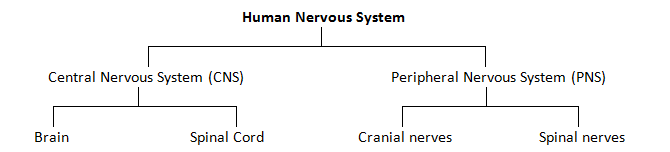
State the organization of human nervous system and general functions of it.
Answer
  • General functions:
  • $(1)$ $CNS$ receives information from external environment and other parts of the body and bring about integration.
  • $(2)$ Spinal cord is involved in reflex action.
  • $(3)$ Brain is the main coordinating centre of the body.
  • $(4)$ Brain allows us to think and take actions based on that thinking.
  • $(5)$ Peripheral nervous system communicates between $CNS$ and the other parts of the body.
View full question & answer
Question 273 Marks
How does the design of the body solve a problem when immediate response is needed? Where should such connection be made?
Answer
Self
View full question & answer
Question 283 Marks
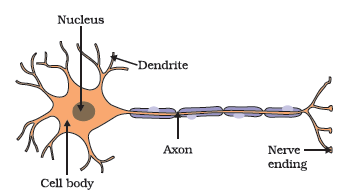
Identify the parts of a neuron in a diagram:
$(1)$ where information is acquired,
$(2)$ through which information travels as an electrical impulse, and
$(3)$ where this impulse must be converted into a chemical signal for onward transmission.
Answer
  • Parts of a neuron: $a$-nucleus, $b$-cell body, $c$- dendrite, $d$-axon, $e$-nerve ending.
  • $(1)$ Information acquired at the end of the dendrite tip $(c)$ of a nerve cell.
  • $(2)$ Information travels through dendrite, cell body and along the axon $(d)$ to its end as an electrical impulse.
  • $(3)$  At synapse, this impulse is converted into a chemical signal for onward transmission.
View full question & answer
Question 293 Marks
What are receptors? State the example, location and function of different receptors in human body.
Answer
  • A specialised structure in human body that receives external stimuli is called receptor.
  • These receptors are located in our sense organs.
  • Types of receptors are as follows:
Example Location Function
$(1)$ Gustatory receptors on the surface of the tongue to detect taste
$(2)$ Olfactory receptors Nasal epithelium to detect smell
$(3)$ Thigmo receptors in the skin to detect touch
$(4)$ photo receptors in the eyes to detect vision
$(5)$ Audio (phono) receptors in the internal ear to detect sound
View full question & answer
Question 303 Marks
Why are there controlled movements in living organisms?
Answer
  • Movement is a characteristic of living organisms.
  • Various movements are connected with each other to perform specific functions.
  • Each kind of a change in the environment induce an appropriate movement for the response.
  • The movement depends on the event that triggers it.
  • To recognise various events in the environment, there are controlled movements.
View full question & answer
Question 313 Marks
What is the difference between the manner in which movement take place in a sensitive plant and the movement in our legs?
Answer
Movement in a sensitive plant Movement in our legs
$1$. It occurs in response to touch. $1$. It is voluntary action as per our need.
$2$. Neural signals are not involved in such movement. $2$. Neural signals from cerebellum are involved in such movements.
$૩$. No specific protein is present in plant cells for it. $3$. A specific protein is present in our muscle cells for it.
$4$. Plant cells change their shape by changing the amount of water in it. $4$. A Special proteins change both their shape and their arrangement in response to nervous impulses due to which the muscle cells shorten.
View full question & answer
Question 323 Marks
Difference between: Nervous System and Endocrinal System
Answer
Nervous System Endocrinal System
$1$. Its structural and functional unit is a neuron (nerve cell). $1$. Its functional unit is a hormone.
$2$. In human body it comprises central nervous system, peripheral nervous system and autonomous nervous system. $2$. In human body it comprises of various endocrine glands.
$૩$. Its function is to collect the information, its analysis and interpretation and convey the responsive message to the motor organs. $3$. Its function is to produce stimulatory or inhibitory effect on the tissues or organs through the medium of hormones.
$4$. The coordination that occurs through the nervous System is very rapid as the impulses pass through the nerve fibres. $4$. The coordination that occurs through the endocrine system is a relatively slow process as the hormone flows through the blood stream to reach the target organ.
View full question & answer
Question 333 Marks
Difference between: Response in Plants and Response in Animals
Answer
Response in Plants Response in Animals
$1$. Plants do not possess nervous system but only possess hormones for expressing their response. $1$. Animals possess both, the nervous system and endocrine system for expressing their response.
$2$. The response in plants is not rapid and needs more time to be observed. $2$. The response in animals is rapid and seen immediately.
$૩$. The response in plants is limited. $3$. The response in animals is not limited.
$4$. There are no muscular tissues in plants to show the response. $4$. There are muscular tissues in animals through which the response is shown.
$5$. In plants, there is no specific tissue for the transmission of information to different parts of the body. $5$. In animals there is specific nervous tissue for the transmission of information to different parts of the body.
View full question & answer
Question 343 Marks
Explain the movement in pea plant due to growth.
Answer
  • The pea plant climb up other plants or fences with the help of tendrils.
  • These tendrils are sensitive to touch.
  • When tendrils come in contact with any support, the part of the tendril in contact with the object does not grow as rapidly as the part of the tendril away from the object.
  • This causes the tendril to circle around the object and thus cling to it.
  • Growth of pea plant is directional and respond slowly to stimuli.
View full question & answer
Question 353 Marks
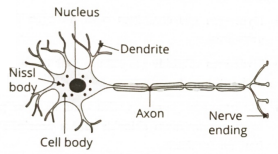
Draw the structure of a neuron and explain its function.
Answer
Image
⇒ Functions of Neurons
(1) Neurons form an organised reticular structure which forms nervous tissue.
(2) Neurons carry sensations or instructions from receptors.
(3) From their sensations or instructions are carried as electric impulse.
(4) Further this impulse is converted into chemical signal so that it can be spread further.
View full question & answer
Question 363 Marks
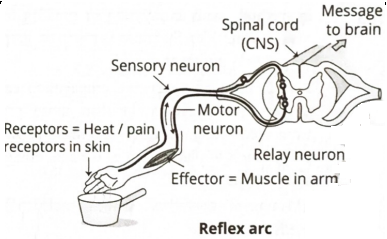
Explain Reflex action in detail.
Answer
Reflex action is such a situation in which, we do not think about but express an immediate response to changes in the environment for eg : We move our hands immediately after touching the hot pan.
→ In normal conditions any sensory impulse travel through the spinal cord to the brain which is protected in the skull. The brain thinks about it In response it sends impulse to the muscle. The arm can the be moved as the muscles contract. All these actions take a lot of time. Whereas, reflex action is very fast and it is carried out for protecting our body.
→ In the above example the sensation of heat is received by the nerves. Nerves directly innervate the muscles. So this action is completed very quickly Usually this type of structure is known as Reflex arc. Reflex arc is created in spinal cord, where the motor olfactory nerve and sensory nerve meet.
Image
Animals have very little or none of the complex neuron network needed for thinking. So it is quite likely that reflex arcs have evolved as efficient ways of functioning in the absence of true thought processes. Even after complex neuron networks have come into existence, reflex arcs continue to be more efficient for quick responses.
View full question & answer
Question 373 Marks
Give examples of reflex arc.
Answer
Examples of reflex arc are :
(1) Due to sudden light on eyes, pupil contracts.
(2) Sudden reaction to extreme cold or extreme hot water.
(3) Movement of diaphragm
(4) Sudden closing of the eye when something comes near the eye.
(5) Coughing
(6) Moving the hand as soon as nail is hurted etc.
View full question & answer
Question 383 Marks
How are involuntary actions and reflex actions different from each other?
Answer
Involuntary actionReflex action
1. An action which is not in control of any organism is
called involuntary action.
1. An immediate response unplanned sequence or action and nearly instantaneous response to a stimulus is called reflex action.
2. It is controlled by Mid-brain and hind-brain2. It is immediate response to stimuli.
3. It is not an immediate quick response to a sensation.3. There is an immediate, rapid response to sensation
4. Involuntary action is done by involuntary organs.4. Reflex actions are done by voluntary organs.
5. External stimulus is not necessary to carry out action5. External stimulus is necessary to carry out action
View full question & answer
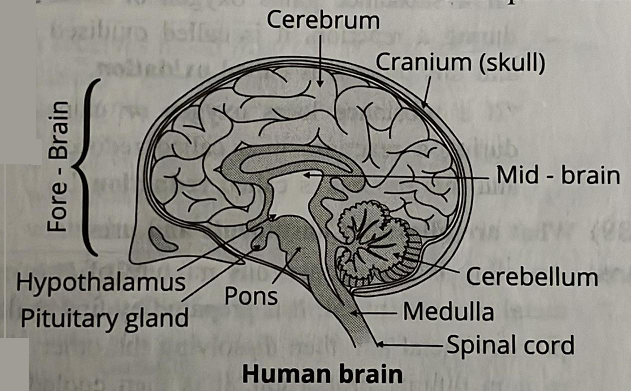
Question 393 Marks
Explain with diagram the structure of human brain.
Answer
The nervous system present in the mid axis of the body is called CNS (Central Nervous System). The central nervous system consists of the brain and spinal cord.
Image
→ Spinal cord is made up of nerves which supply information to think about. Brain is the main coordinating organ of the body CNS receive information from all parts of the body and integrate it.
→ The spinal cord carries the sensation as impulses to the brain. The brain sends its feedback sensation to the muscles.
→ There are 12 pairs of cranial nervous in the brain connecting head and upper body while 31 pairs of spinal nerves connecting the rest of the body constitutes the Peripheral Nervous System (PNS) which receives and coordinates instructions from all parts of the body.
→ In order to perform some voluntary actions like writing, talking, moving a chair, clapping etc brain has to send messages to the muscles. The PNS helps the brain to send these messages. Thus the brain allows us to think and further act based on our thinking.
View full question & answer
[3 Mark Questions] - Science STD 10 Questions - Vidyadip