In bringing an electric charge $q$ from infinity to a point $P$ in the electric field of a charge $Q$, work has to be done against the electric force exerted by $Q$ on $q$, keeping $q$ always in equlibrium.
This work done is stored in charge $q$ in the form of electric potential energy $U$ at that point $P.$
If charge $q$ is a unit positive charge $(i.e., q = + 1 C)$, electric potential energy $U$ at point $P$ is called the electric potential of charge $Q$ at that point $P.$
Definition of electric potential :
The work done in bringing a unit positive charge from infinity to a particular point in the electric field, against the electrostatic force due to the electric field is called the electric potential at that point.
Hence,
Electric potential $( V )=\frac{\text { Work done }( W )}{\text { Electric charge }( q )} \ldots . .(12.2)$
As the SI unit of work $(W)$ is joule $(J)$ and that of charge $(q)$ is coulomb $(C)$, the SI unit of electric potential is joule / coulomb $(J/C).$ It is called the volt.
In bringing an electric charge $q$ from infinity to a point $P$ in the electric field of a charge $Q$, work has to be done against the electric force exerted by $Q$ on $q$, keeping $q$ always in equlibrium.
This work done is stored in charge $q$ in the form of electric potential energy $U$ at that point $P.$
If charge $q$ is a unit positive charge $(i.e., q = + 1 C)$, electric potential energy $U$ at point $P$ is called the electric potential of charge $Q$ at that point $P.$
Definition of electric potential :
The work done in bringing a unit positive charge from infinity to a particular point in the electric field, against the electrostatic force due to the electric field is called the electric potential at that point.
Hence,
Electric potential $( V )=\frac{\text { Work done }( W )}{\text { Electric charge }( q )} \ldots . .(12.2)$
As the $SI$ unit of work $(W)$ is joule $(J)$ and that of ch: is joule / coulomb $(J / C)$. It is called the volt.
An electric charge is a fundamental and an intrinsic property of a matter, like mass.
There are two types of electric charges:
$(1)$ positive charge and $(2)$ negative charge.
By convention, the charge acquired by a glass rod (rubbed with silk cloth) is called positive charge and the charge acquired by an ebonite rod (rubbed with woollen cloth) is called negative charge.
The charge carried by a proton is positive and that carried by an electron is negative.
Magnitude (value) of electric charge on a proton and on an electron is same.
Further, a body gets positively charged if it loses electrons and negatively charged if it gains electrons.
Unlike (i.e., opposite) charges attract each other and like (i.e., similar) charges repel each other.
The SI unit of electric charge is the coulomb which is denoted by the letter $C$.
An electron possesses a negative charge of $1.6 × 10^{-19}$ C whereas a proton possesses a positive charge of $1.6 × 10^{-19}$ C.
An electric charge is a fundamental and an intrinsic property of a matter, like mass.
There are two types of electric charges:
$(1)$ positive charge and $(2)$ negative charge.
By convention, the charge acquired by a glass rod (rubbed with silk cloth) is called positive charge and the charge acquired by an ebonite rod (rubbed with woollen cloth) is called negative charge.
The charge carried by a proton is positive and that carried by an electron is negative.
Magnitude (value) of electric charge on a proton and on an electron is same.
Further, a body gets positively charged if it loses electrons and negatively charged if it gains electrons.
Unlike (i.e., opposite) charges attract each other and like (i.e., similar) charges repel each other.
The $SI$ unit of electric charge is the coulomb which is denoted by the letter $C$.
An electron possesses a negative charge of $1.6 × 10^{-19}$C whereas a proton possesses a positive charge of $1.6 × 10^{-19}$C.
If the current $l$ through a resistor is increased by $100\%$ (assume that the temperature of the resistor remains unchanged), find the percentage increase in power dissipated.
Answer
Power dissipated $P =I^2 R$
Current after increased by $100 \%=l^{\prime}$
$=I+\frac{100 I}{100}$
$=2 I$
So, new power $P ^{\prime}=I^{\prime 2} R =(2 I)^2 R =4 I^2 R$
$\therefore \text { Percentage increa }$
$=\frac{p^{\prime}-P}{P} \times 100 \%$
$=\frac{4 I^2 R-l^2 R}{I^2 R} \times 100 \%$
$=\frac{I^2 R(4-1)}{I^2 R} \times 100 \%$
$=3 \times 100 \%$
$=300 \%$
$\therefore \text { Percentage increase in power dissipation }$
The equivalent resistance of a series combination of two resistors is $9 \Omega$ and the equivalent resistance of a parallel combination of the same two resistors is $2 \Omega$. Find the resistances of the resistors.
Answer
Suppose two unknown resistances are $x$ and $y$
When the resistors are connected in parallel
$\frac{x y}{x+y}=2 \Omega$ and when they are connected in series
$x+y=9 \Omega$.
So, $\frac{x y}{9}=2$
$\therefore xy =18 \Omega$
Now,
From $x+y=9, y=9-x$
$\therefore x(9-x)=18$
$\therefore 9 x-x^2=18$
$\therefore x^2-9 x+18=0$
$\therefore x^2-6 x-3 x+18=0$
$\therefore x(x-6)-3(x-6)=0$
$\therefore(x-3)(x-6)=0$
$\therefore x=3 \Omega$ or $x=6 \Omega$
Hence $y=9-x=9-3=6 \Omega$ or $y=9-6=3 \Omega$
Thus, $x=3 \Omega$ and $y=6 \Omega$ or $x=6 \Omega$ and $y=3 \Omega$.
A hot plate of an electric oven connected to a $220 \ V$ line has two resistance coils A and B , each of $24 \Omega$ resistance, which may be used separately, in series, or in parallel. What are the currents in the three cases?
Answer
Here, the potential difference $V =220 V$
The resistance of each coil $R_A=R_S=24 \Omega$
$(1)$ When each of the coils A or B is connected separately, the current through each coil is
$I=\frac{V}{R_A} \text { or } \frac{V}{R_B}$
$=\frac{220}{24}=9.166 A$
$(2)$ When the coils $A$ and $B$ are connected in series, the equivalent resistance of the circuit $R_S=R_A+R_B=24+$ $24=48 \Omega$
So, the current through the series combination
$I=\frac{V}{R_S}$
$=\frac{220}{48}$
$=4.58 A \approx 4.6 A$
$(3)$ When the coils $A$ and $B$ are connected in parallel, the equivalent resistance $R_p$ of the circuit is given by
i.e., when $44 \Omega$ resistance is connected with $220 \ V$ line, $5 A$ current would flow through the given circuit.
Now, suppose ' $n$ ' resistors, each of resistance $R$, are required to be connected in parallel, so that the total resistance $R_{\text {total }}$ becomes $44 \Omega$.
Hence, $\frac{1}{R_{\text {total }}}=\frac{1}{R}+\frac{1}{R} \ldots n$ times
$\circ=\frac{1+1+\cdots n \text { times }}{R}=\frac{n}{R}$
$\therefore R _{\text {total }}=\frac{R}{n}$
Now, $R_{\text {total }}=44 \Omega$ and $R=176 \Omega$
So, $44=\frac{176}{n}$
$\therefore n=\frac{176}{4}=4$
Thus, $4$ resistors each of $176 \Omega$ connected in parallel will result in total resistance of $44 \Omega$ causing a current of $5 ~A$ to flow when connected to $220 \ V$ line.
A copper wire has diameter $0.5 \ mm$ and resistivity of $1.6 \times 10^8 \Omega m$. What will be the length of this wire to make its resistance $10 \Omega$ ? How much does the resistance change if the diameter is doubled?
Write the disadvantages of series circuits for demostic wiring.
Answer
$(1)$ In a series circuit the current is constant throughout the electric circuit.
So it is obviously impracticable to connect an electric bulb and an electric heater in series because they need currents of widely different values to operate properly.
$(2)$ In a series circuit when one component (or electrical appliance) fails due to some defect, the circuit is broken and none of the components (or electrical appliances) works.
$(3)$ In a series circuit all the electrical appliances have only one switch due to which they cannot be turned ON or OFF separately.
$(4)$ In a series circuit electrical appliances of different power ratings do not get the same voltage $(220 V)$ as that of the power supply line because the voltage is shared by all the appliances.
The appliances get less voltage and hence do not work properly.
What is a free electron? Explain conducting and nonconducting materials in terms of it.
Answer
In an atom, the electrons move around the nucleus whereas the protons remain bounded in the nucleus.
In the atoms of metallic materials, the attractive force prevailing between the valence electrons (negative electric charge) and the nucleus (positive electric charge) is comparatively very small.
During the formation of metallic materials, these electrons get separated from their parent atoms and move in a random manner in the conductor. Such electrons are known as 'Free electrons'.
These (free) electrons are free to move within the material, but they cannot leave the material.
This is because they do not have enough energy to do so.
These free electrons are responsible for the conduction of electric current.
Electric current can flow very easily through those materials which contain a large number of free electrons.
So they are called conductors.
e.g., Metals such as copper, silver and aluminium are called conducting materials.
The materials, which do not contain free electrons and hence do not conduct electric charges are called insulators. e.g., Rubber, glass, plastic and leather are insulators.
Compare the power used in the $2 \Omega$ resistor in each of the following circuits : $(i)$ a $6 V$ battery in series with $1 \Omega$ and $2 \Omega$ resistors $(ii)$ a $4 V$ battery in parallel with $12 \Omega$ and $2 \Omega$ resistors.
Answer
$(i)$ As $1 \Omega$ resistor and $2 \Omega$ resistor are connected in series, the equivalent resistance $R_S=1+2=3 \Omega$
Now, the voltage of the battery $V =6 V$
So, the current flowing through the circuit,
$I_S=\frac{V}{R_S}=\frac{6}{3}=2 A$
In a series combination the same current $2 \ A$ flows through each resistor.
Hence the current flowing through $2 \Omega$ resistor is also $2 \ A$ .
Power used in $2 \Omega$ resistor,
$P_1=I^2{ }_S R$
$=(2)^2 \times 2=8 W$
$(ii)$ As $12 \Omega$ resistor and $2 \Omega$ resistor are connected in parallel and $4 \ V$ battery is connected in parallel with thsi parallel combination of resistors.
The p.d. across $2 \Omega$ resistor will also be $4 \ V.$
An electric iron consumes energy at a rate of $840 \ W$ , when heating is at the maximum rate and $360 \ W$ , when heating is at the minimum. The voltage is $220 \ V$ . What are the current and the resistance in each case?
Answer
From equation of electric power, we know that the power input is $P = VI$.Thus, the current $I =\frac{ P }{ V }$
When heating is at the maximum rate,
$I =\frac{840 W}{220 V}=3.82 A$;
and the resistance of the electric iron is
$R=\frac{V}{I}=\frac{220 V}{3.82 A}=57.60 \Omega$
When heating is at the minimum rate,
$I =\frac{360 W}{220 V}=1.64 A$;
and the resistance of the electric iron is
$R =\frac{ V }{ I }=\frac{220 W}{1.64 A}=134.15 \Omega$.
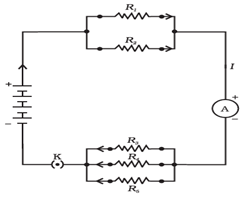
If in figure $12.24, R_1=10 \Omega, R_2=40 \Omega, R_3=30 \Omega, R_4=20 \Omega, R_5=60 \Omega$ and a $12 \ V$ battery is connected to the arrangement. Calculate A . the total resistance in the circuit and $B$ . the total current flowing in the circuit.
Answer
A. Suppose, we replace the parallel resistors $R_1$ and $R_2$ by an equivalent resistor of resistance, $R$ : Similarly we replace the parallel resistors $R_3, R_4$ and $R_5$ by an equivalent single resistor of resistance $R$ ". Then using equation of equivalent resistance of parallel combination of resistances, we have $\frac{1}{R^{\prime}}=\frac{1}{10}+\frac{1}{40}=\frac{5}{40}$; that is $R^{\prime}=8 \Omega$.
[An electric circuit showing the combination of series and parallel resistors]
Similarly, $\frac{1}{R^{n \prime}}=\frac{1}{30}+\frac{1}{20}+\frac{1}{60}=\frac{6}{60}$; that is, $R^{\prime \prime}=10 \Omega$.
Thus, the total resistance, $R=R^{\prime}+R^{\prime \prime}=18 \Omega$.
B. To calculate the current, we use the Ohm's law, and get
$I =\frac{ V }{ R }=\frac{12 V}{18 \Omega}=0.67 A \text {. }$
What is electrical resistivity of a material? State its $SI$ unit and define it.
Answer
It is found that the resistance $R$ of a uniform metallic conductor depends on its length $l$, on its area of crosssection $A$, the nature of its material and temperature.
Precise measurements have shown that at a given temperature,
$R \propto l$ and $R \propto \frac{1}{A}$
Combining above two relations,
$R \propto \frac{l}{A}$
$\therefore R =\rho \frac{l}{A} \ldots . . .(12.6)$
Where $\rho$ (rho) is a constant of proportionality and is called the electrical resistivity of the material of the conductor.
From equation $(12.6),$
$\rho=\frac{R A}{l}.......(12.7)$
$\therefore$ The $SI$ unit of $\rho$
The SI unit of resistance $x$
$=\frac{\text { The SI unit of area of cross-sections }}{\text { The SI unit of length }}$
$=\frac{\Omega m ^2}{m}$
$=\Omega m \text { (ohm-metre) }$
In equation $(12.7)$, if $A =1$ unit and $l=1$ unit, $\rho=R$.
The electrical resistivity of a material is the resistance of a conductor (of that material) having unit length and unit area of cross-section.
State the Ohm's law. Explain how is used to define the $SI$ unit of resistance.
Answer
Ohm's law:
The current flowing through a conductor, such as a metallic wire, is directly proportional to the potential difference across its ends, provided its temperature and other physical conditions remains the same.
If $I$ is the current flowing through a conductor and $V$ is the potential difference (or voltage) across its ends, then according to Ohm's law, $I \propto V$ (at constant temperature).
This can also be written as,
$V \propto I$
$\therefore V=(\text { constant }) I$
$\therefore \frac{V}{ I }=\text { constant }$
$= R \ldots . .(12.4)$
$V= IR$
In equation $(12.4)$, R is constant for the given metallic wire at a given temperature and is called its resistance. Resistance is the property of a conductor to oppose the flow of charges through it.
The $SI$ unit of resistance is ohm. It is represented by the Greek letter $\Omega$ (Omega).
According to Ohm's law,
$R=\frac{V}{I} .$
Definition of the $SI$ unit of resistance:
If the potential difference across the two ends of a conductor is $1 V$ and the current through it is $1 \ A$ , then the resistance $R$ of the conductor is $1 \Omega$.
How is electric current expressed ? Describe about its SI unit also.
Answer
Electric current is expressed as net amount of electric charge passing through the cross - section of a conductor in unit time. - In other words, electric current is the time rate of flow of electric charge. $\sim$ If net charge $Q$ passes through the cross-section of a given conductor in time $t$ then electric current $I$ passing through that conductor is given by, $ I=\frac{Q}{t} $ SI unit of electric charge is coulomb, shown by symbol $C$. SI unit of electric current is ampere, shown by symbol $A$. ⇒ From above equation $ 1 A=1 \frac{C}{s} $ ⇒ Definition of 1 ampere : ⇒ In equation (1), if $Q=1 C$ and $t=1 s$ then $I=$ $1 \frac{C}{s}=1 A$ and so SI unit of electric current can be defined as follows. ⇒ "When net electric charge passing through cross-section of a given conductor in $1 s$ is $1 C$ then electric current passing through that conductor is said to be $1 . A$."
Define potential difference. Mention its $S I$ unit and give its definition also.
Answer
Amount of work done in moving a unit positive charge from one point to another point in an electric circuit carrying some current is called electric potential difference between those two points. → If $W$ amount of electrical work is done in moving $Q$ amount of positive charge between two points in an electric circuit carrying some current then by definition potential difference between those two points is given by : $ V=\frac{W}{Q} $ → SI unit of electric potential difference $ =\frac{\text { joule }(J)}{\operatorname{coulomb}(C)}=\text { volt }(V) $ → Above unit is named after Italian physicist, Alessandro Volta. ⇒ Definition of one volt : → When $1 J$ amount of electrical work is done in moving $1 C$ positive charge from one point to another point in an electric circuit carrying some current then electric potential difference between those two points is said to be $1 V$.
Which law gives relation between potential difference across a metallic wire and current through it ? Describe it in brief.
Answer
Ohm's law gives relation between potential difference across a metallic wire and current through it. This law was deduced experimentally by German physicist, George Simon Ohm. It can be stated as follows. °Statement : → "Potential difference $(V)$ across a current carrying metallic wire is directly proportional to current $(I)$ flowing through it, provided temperature of wire remains constant." → Mathematically, $V \propto I$ $ \therefore \quad \frac{V}{I}=\text { constant } $ → Here ratio $\frac{V}{I}$ remains constant for a given metallic wire at a given temperature. Such a constant ratio is called "resistance" of a given metallic wire, shown by symbol $R$. It is the property of a conductor to resist the flow of charges through it. Thus, $ \frac{V}{I}=R $ → Electrical component having resistance is called "resistor" → SI unit of resistance is ohm, shown by symbol $\Omega$. → Equation (2) gives mathematical form of Ohm's law. Writing $S I$ units in equation (2), $ \frac{\text { volt }}{\text { ampere }}= Ohm $ → Using symbols, $\Omega=\frac{V}{A}=V A^{-1}$
Why does the cord of an electric heater not glow while the heating element does ?
Answer
→ Cord of an electric heater is made of copper wire which has low resistivity and low resistance. Hence for given current passing through it for given time, amount of heat produced in it is also small according to $H=I^2 R t$. Hence it does not glow as it does not become hot. → An electric heater is made up of coil of alloy like Nichrome which has high resistivity and high resistance. Hence for given current passing through it for given time, amount of heat produced in it is also large according to $H=I^2 R t$. Hence it becomes red hot because of quick rise in temperature due to Joule's heating. That is why heating element start glowing.
Using an example of electric bulb, explain how electric heating is used to produce light.
Answer
For emission of light from electric bulb, material and design of its filament should be such that it can retain most of heat generated in it, so that it can become very hot as soon as we switch it on and it can emit light. Moreover, filament must not melt at this high temperature. Tungsten is a metal which is quite strong with very high melting point $\left(3380^{\circ} C \right)$. Hence it is used for making filaments of electric bulbs. Inside the bulb, filament is kept on insulating support and made thermally isolated. For long life of filament, bulb is generally filled with chemically inactive gases like nitrogen and argon. It should be noted that most of the power consumed by filament of a bulb, appears in the form of heat and only a small part is emitted in the form of light. Since emission of light from a bulb is possible only at very high temperature, electric bulb is an example of useful electrical heating.