Questions

[3 Mark Questions]

🎯

Test yourself on this topic

26 questions · timed · auto-graded

Question 13 Marks
A convex mirror used for rear-view on an automobile has a radius of curvature of $3.00 m$. If a bus is located at $5.00 m$ from this mirror, find the position, nature and size of the image.
Answer
Here,
$R=+3.00 m \quad(\because$ given mirror is convex $)$
$u=-5.00 m(\because$ object distance is always negative)
$v=?$
$h^{\prime}=?$
(i) For spherical mirror, $f=\frac{R}{2}=\frac{+3.00 m}{2}$
$\therefore f=+1.50 m$
* Now, according to mirror formula,
$\frac{1}{f} =\frac{1}{v}+\frac{1}{u}$
$\therefore \quad \frac{1}{v} =\frac{1}{f}-\frac{1}{u}=\frac{1}{(+1.50)}-\frac{1}{(-5.00)}$
$\therefore \frac{1}{v}  =\frac{1}{1.50}+\frac{1}{5.00}=\frac{5.00+1.50}{(1.50)(5.00)}$
$\therefore \frac{1}{v}  =\frac{6.50}{7.50} \Rightarrow v=\frac{7.50}{6.50}=+1.15 m$
$\Rightarrow$ Image will be formed on the back side of mirror, at $1.15 m$ from the pole of mirror.
$(ii)$ Now, magnification is,
$m=-\frac{v}{u}=-\frac{(+1.15 m)}{(-5.00 m)}$
$\therefore m=+0.23  \Rightarrow \frac{h^{\prime}}{h}=0.23$
$\Rightarrow h^{\prime}=0.23 h$
$\Rightarrow$ Image will be
$(i)$ virtual and erect
$(ii)$ diminished ( $\because m$ is positive)
$(\because|m|<1)$
$(iii)$ of height 0.23 times the height of object ( $\because$ $h^{+}=0.23 h$ )
(iv) formed on the back side of mirror, at $1.15 m$ from the mirror
$(\because v=+1.15 m )$
View full question & answer
Question 23 Marks
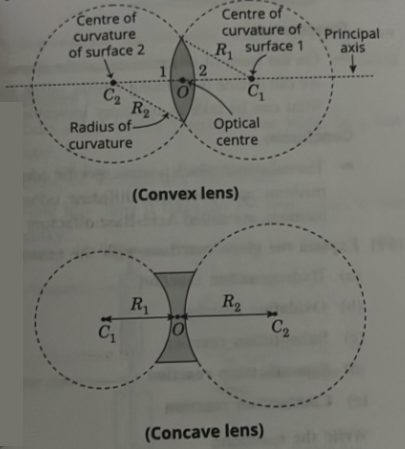
Explain about $(i)$ Centres of curvature $(ii)$ Principal axis $(iii)$ Optical Centre $(iv)$ Radius of curvature $(v)$ Aperture in case of convex or concave lens.
Answer
Image
(i) Centres of curvature $\left(C_1\right.$ and $\left.C_2\right)$ :
A spherical lens, either convex or concave has two spherical surfaces, which can be considered as parts of two spheres. Centres of these spheres are known as centres of curvature of given spherical lens, shown by symbols $C_1$ and $C_2$.
(ii) Principal axis :
An imaginary straight line, passing through centres of curvature of a given spherical lens is called its principal axis.
(iii) Optical centre $(O)$ :
The centroid of a given spherical lens is called its optical centre, shown by symbol $O$. When radii of curvatures of both the spherical surfaces of a given spherical lens are equal, its optical centre is the mid point of $C_1$ and $C_2$
→ Light ray passes through optical centre of a spherical lens without any deviation (provided media on both the sides of a lens are same)
(iv) Radius of curvature $( R )$ :
Spherical surface of given spherical lens can be considered as a part of a sphere. Radius of this sphere is called radius of curvature is given spherical surface of a given spherical lens, shown by symbol $R$.
→ Two spherical surfaces of a given spherical lens may have different radii of curvature, shown by symbols $R_1$ and $R_2$.
→ When $R_1=R_2$, double convex lens is called equi-convex lens and similarly double concave lens is called equi-concave lens.
(v) Aperture :
Diameter of circular out-line of given spherical lens is called its aperture.
View full question & answer
Question 33 Marks
Explain about refractive index in detail.
Answer
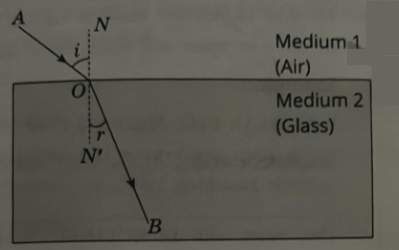
When a light ray propagating in first transparent medium is made incident obliquely on the surface of second transparent medium, it changes the direction of propagation in the second medium. For a given pair of transparent media, the extent of change in direction of propagation of incident light ray is expressed in terms of a physical quantity, called "Refractive Index" of second medium with respect to first medium, shown by symbol $n_{21}$. Its value is equal to constant appearing on R.H.S. of Snell's law. This value depends on speed of light in first and second transparent medium. Since speed of light is different in different media, value of refractive index is different for different pairs of media.
→ Speed of light is maximum in vacuum, equal to $3 \times 10^8 ms ^{-1}$. In air, it is very slightly less than this value. In water and glass, speed of light is reduced considerably.
→ Relative refractive index :
Image
→ Consider a ray of light, travelling from medium $1$ into medium $2$ as shown in the figure. Suppose speeds of light in media $1$ and $2$ are respectively $v_1$ and $v_2$.
→ Now, refractive index of medium $2$ with respect to medium $1$ is given by ratio of speed of light in medium $1$ to speed of light in medium $2$. It is shown by symbol $n_{21}$. Thus,
$n_{21}=\frac{v_1}{v_2}$
→ Similarly, refractive index of medium $1$ with respect to medium $2$ is shown by symbol $n_{12}$ and it is given as :
$n_{12}=\frac{v_2}{v_1}$
→ Absolute refractive index of a given medium $\left(n_m\right)$
When first medium is air or vacuum, refractive index of second medium with respect to first medium is known as absolute refractive index of second medium, shown by symbol $n_2$ or $n_{m^*}$ If speed of light in air or vacuum is $c$ and speed of light in a given medium is $v$ then absolute refractive index of this medium is given by
$n_m=\frac{c}{v}$
→ In practice, absolute refractive index of a given medium is called its refractive index only.
→ Refractive indices of water, crown glass and diamond are found to be respectively $1.33, 1.52$ and $2.42$ .
→ A medium having greater refractive index is said to be optically denser. Conversely, a medium having smaller refractive index is said to be optically rarer.
→ Thus, optical density of a given medium gives measure of its ability to refract the incident light.
→ It should be noted that optical density of a medium is different than its mass density. A medium with greater optical density may have smaller mass density. For example refractive index of kerosene is $1.44$ which is greater than refractive index of water which is $1.33$ . Hence optical density of kerosene is greater than that of water but mass density of kerosene is smaller than that of water.
 
View full question & answer
Question 43 Marks
Define magnification produced by a spherical mirror. What does its value indicate? Also mention its formula. Discuss about its sign for real and virtual image.
Answer
→ Magnification produced by a given spherical mirror is defined as a ratio of height of image $\left(h^{\prime}\right)$ to the height of object $(h)$. It is shown by symbol $m$. Thus by definition.
$
m=\frac{h^{\prime}}{h}
$
→ Magnification produced by a spherical mirror gives how many times size of image is as compared to size of object.
→ Generally, object is placed upright above the principal axis and so its height $h$ is taken positive.
→ Since real image is inverted, its height $h$ ' is taken negative and so for real image, value of $m$ is obtained negative by definition.
→ Conversely, since virtual image is erect, its height $h^{\prime}$ is taken positive and so for virtual image value of $m$ is obtained positive by definition.
n Thus, when magnification is negative, image is real and when magnification is positive, image is virtual.
→ For spherical mirrors, formula of magnification is as follows.
$
m=-\frac{v}{u}
$
where $v$ and $u$ denote image distance and object distance respectively. (which are to be determined as per new cartesian sign convention system).
View full question & answer
Question 53 Marks
Give Four points of difference between concave mirror and convex mirror.
Answer
Concave MirrorConvex Mirror
Its principal focus is real.Its principal focus is virtual.
Its focal length and radius of curvature are negative.Its focal length and radius of curvature are positive.
Image formed by it is either real or virtualImage formed by it is always virtual.
Image formed by it is either in front of it or on the back of it.Image formed by it is always on the back of it.
Size of image formed by it is either equal to or greater
than or smaller than size of object.
Size of image formed by it is always smaller than J6 of object.L4
It is used as a shaving mirror, make-up mirror, doctor's head mirror, search light mirror and as a head light mirror in the vehicles.It is used as antitheft mirror in show rooms, as side view
mirror and as rear view mirror in the vehicles.
View full question & answer
Question 63 Marks
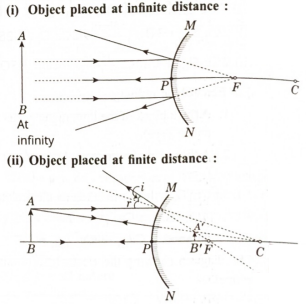
Using proper ray diagram, explain formation of image, formed by convex mirror for an object placed at
$(i)$ infinite distance (practically very far) and at
$(ii)$ finite distance from the mirror. Also summarise the results in the form of a table showing position, size and nature of image.
Answer
Image
•Position, size and nature of image formed by a convex mirror.
Position of the object Position of the image Size of the image Nature of the image
At infinity At the focus F, behind the mirror Highly diminished,
point-sized
Virtual and erect
Between infinity and the pole P of the mirror Between P and F, behind the mirror Diminished Virtual and erect
View full question & answer
Question 73 Marks
What is called a spherical mirror? Describe its two types with proper diagrams.
Answer
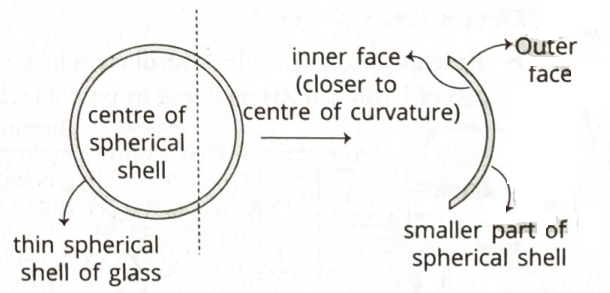
When reflecting face of a mirror is made spherical, it is called a spherical mirror.
Image
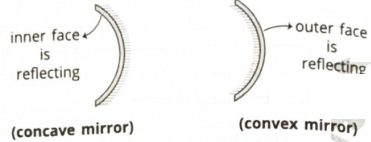
⇒ To prepare a spherical mirror, a thin spherical shell of glass is cut, parallel to any of its diameters.Then we separate the smaller part. Now if its inner face is made reflecting then we get a concave mirror and if its outer face is made reflecting then we get a convex mirror.
Image
In above diagrams, backsides of both the mirrors are shown shaded which are non-reflecting. For a large shining spoon, its inner face can be treated nearly like a concave mirror whereas its outer face can be treated nearly like a convex mirror.
View full question & answer
Question 83 Marks
What is called reflection of light ? Using a proper diagram, explain about incident ray, reflected ray, angle of incidence, angle of reflection and plane of incidence.
Answer
Image
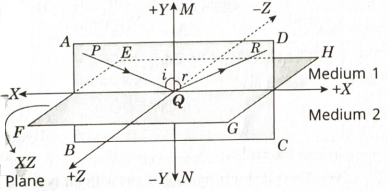
→ As shown in the figure, above $X Z$ plane, there is optical medium $1$ and below this plane there is optical medium $2$.
→ When a ray of light $P Q$ travelling in medium $1$ strikes on the surface of medium $2$ at point $Q$, it gets bounced and then it travels along $Q R$. Here this process of bouncing is called reflection of light, ray $P Q$ is called incident ray, ray $Q R$ is called reflected ray, point $Q$ is called point of incidence (or point of reflection). In short striking ray is called incident ray and bouncing ray is called reflected ray.
→ A Angle made by incident ray with the normal drawn at the point of incidence is called angle of incidence. It is shown by symbol $i$. In above figure, $i=$ $\angle P Q M$.
→ A Angle made by reflected ray with the normal drawn at the point of incidence is called angle of reflection. It is shown by symbol $r$. In above figure, $r=\angle M Q R$.
→ Plane passing through incident ray, normal drawn at the point of incidence and reflected ray is called plane of incidence. In above figure, $A B C D$ is a part of plane of incidence.
View full question & answer
Question 113 Marks
Which things do we need to remember in an exercise of tracing the family trees of species?
Answer
  • In an exercise of tracing the family trees of species, we need to remember following things
  • There are multiple branches possible at each and every stage of this process.
  • Evolution is not as if one species is eliminated to give rise to a new one.
  • A new species has emerged does not mean that the old species will disappear.
  • It depends on the interactions with the environment.
  • It is not necessary that the newly generated species are in any way better than the older one.
  • Natural selection and genetic drift have together led to formation of a population that cannot reproduce with the original one.
  • This creates isolation, which further lead to speciation.
View full question & answer
Question 123 Marks
Give the scientific reason : Sometimes in the earth’s crust the imprint of the entire body or the organs are maintained.
Answer
  • The dead bodies of plants or animals, in presence of oxygen and moisture, undergo decomposition with the help of microorganisms.
  • But sometimes in certain environmental conditions their bodies or organs do not get decomposed fully.
  • The dead body may be entangled in mud and the same may be covered by dry stony covering.
  • This prevents the dead body to decompose further.
  • The mud settles around the dead body or organ in the shape of the later, and form stony covering.
  • In this stony covering the imprint of the body or the organ is formed as a fossil.
  • That is why, sometimes in the earth’s crust the imprint of the dead body or the organs are maintained.
View full question & answer
Question 133 Marks
How do Mendel’s experiments show that traits may be dominant or recessive?
Answer
  • Mendel’s conducted, cross fertilisation between pure tall plant $(TT)$ and pure short plant $(tt)$ which resulted in all tall $(Tt)$ plant in $F_1$ generation.
  • This shows that single copy of $T$ is enough to make the plant tall.
  • It shows that one trait which is expressed in the presence of its contrasting form.
  • This is dominant trait and the other remains unexpressed in the presence of its contrasting form is recessive trait.
View full question & answer
Question 143 Marks
Give the scientific reason : The sex of the children is determined by father.
Answer
  • The man produces two types of sperms.
  • $50\%$ of the sperms produced contain $X$ as a sex chromosome, while the remaining $50\%$ of the sperms contain $Y$ as a sex chromosome.
  • The Woman produces all the ova of only one type, i.e., containing only one X-chromosome as a sex chromosome.
  • A child who inherits an X-chromosome from her father will be a girl and one who inherits a Y-chromosome from him will be a boy.
  • Thus, in human beings, the type of sperm that participates in the process of fertilisation, determines the sex of the child. Hence, the sex of the children is determined by father or by the paternal chromosomes in sperm.
View full question & answer
Question 153 Marks
Explain in short: Molecular phylogeny
Answer
  • During cell division, changes in the $DNA$ leads to changes in the proteins.
  • These changes accumulate from one generation to the next.
  • Molecular phylogeny is therefore used to trace the changes in $DNA$ backwards in time and find out how each change diverged from the other.
  • Approach of molecular phylogeny is based on the idea that more distantly related organisms will accumulate a greater number of differences in their $DNA$.
  • Such studies trace the evolutionary relationships and this relationship among different organisms is shown by molecular phylogeny which also matches with the classification scheme.
View full question & answer
Question 173 Marks
How do Mendel’s experiments show that traits are inherited independently?
Answer
  • Mendel performed dihybrid experiment on pea plants.
  • A tall plant with round seeds was crossed with a short plant with wrinkled seeds.
  • $F_1$ progeny plants were all tall with round seeds.
  • $F_1$ progeny are used to generate $F_2$ progeny by self-pollination.
  • Along with parental combinations, $F_2$ progeny showed new combinations too.
  • Some of them were tall with wrinkled seeds while some others were short with round seeds.
  • It means factors (genes) controlling for seed shape and height of plant recombine to form new combinations in $F_2$ offsprings.
  • Thus, tall/ short trait and the round seed/ wrinkled seeds trait are inherited independently.
View full question & answer
Question 183 Marks
Explain asexual mode of reproduction in Rhizopus with the help of spore formation. Also state its importance.
Answer
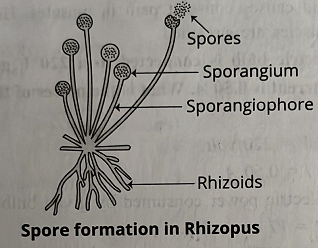
→ Rhizopus is thread like structure that is developed on bread. It produces thin, delicate fibers which are fungal filaments. The fibers form an irregular lattice. It is called hyphae.
→ Some fibers of hyphae grow in upward direction. On tip of it a round structure is observed which is known as sporangia which contain cell or spores.
→ Spores are transported by air. During the appropriate conditions they develop into new Rhizopus individuals.
Image
→ Importance : Many spores are produced by Sporangi so they can spread very quickly
View full question & answer
Question 193 Marks
Explain the construction of cross section of flower.
Answer
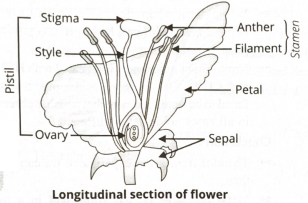
Description : A flower is the shoot of the plant converted for the process of reproduction. It is developed from a bud. Corolla gives support to the flower and four layers are arranged on thalamus.
→ (1) Sepal Layer
(2) Petal Layer
(3) Stamen Layer
(4) Pistil Layer
(1) Sepal Layer : It is made up of sepals. They are the outermost layer. They protect the flower in budding stage but they do not participate in the process of reproduction.
(2) Petal Layer : It is the second layer. It attracts the vector for the process of pollination. It do not participate in the process of reproduction.
(3) Stamen Layer : It is the third layer. It takes part in the process of reproduction. Yellows colour pollen grains are formed from it which are useful in the process of fertilisation.
(4) Pistil Layer : It is the female reproductive part present in the centre of the flower. It contains ovary, style and stigma.
→ Stigma is sticky or with rough surface. It gives a place for pollen grains to stick.
Style is responsible for growing pollen tube. It connects ovary and style.
→ Ovary contains egg, which when fertilised get converted into fruit. After fertilisation egg get converted into seed.
→ The flower may be unisexual when it contains either stamen or pistil or bisexual when it contains both stamen and pistil.
View full question & answer
Question 203 Marks
Explain asexual reproduction in Hydra with the help of diagram.
Answer
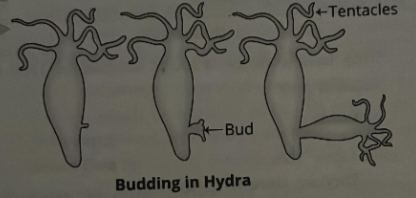
→ Hydra belongs to phylum Coelenterata. Asexual reproduction is carried out in it by the process of budding
→ Here, regenerative cells are used for budding. In Hydra, a bud develops as an outgrowth due to repeated cell division at one specific site.
→ These buds develop into tiny individuals and when fully mature, detach from the parent body and become new independent individuals.
Image
View full question & answer
Question 213 Marks
(a) What is unisexual and bisexual flower ? Give its example
(b) What are the changes in flower after fertilisation
Answer
(a) → The flower is said to be unisexual when it contains either stamen or pistil. For eg : Watermelon, papaya.
→ The flower is said to be bisexual when it contains both stamen and pistil. For eg : Hibiscus, mustard, peas.
(b) → After fertilisation sepal, petal, style, ovary shrivel and fall off.
→ Ovules gets converted into seed.
→ Ovary gets converted into fruit.
→ In some fruit, sepals are connected with the fruit.
View full question & answer
Question 223 Marks
Explain : Process of Regeneration.
Answer
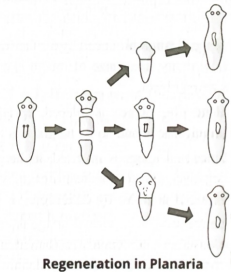
→ Many fully differentiated organisms have the ability to give rise to new individual organisms from their body parts. That is, if the individual is somehow cut or broken up into many pieces, many of these pieces grow into separate individuals.
→ For example, simple animals like Hydra and Planaria can be cut into any number of pieces and each piece grows into a complete organism. This is known as Regeneration.
Image
→ Regeneration is carried out by specialised cells. These cells proliferate and make large numbers of cells. From this mass of cells, different cells undergo changes to become various cell types and tissues. These changes take place in an organised sequence referred to as development.
→ However, regeneration is not the same as reproduction since most organisms would not normally depend on being cut up to be able to reproduce.
View full question & answer
Question 233 Marks
Explain Vegetative Propagation in detail.
Answer
→ There are many plants in which parts like the root, stem and leaves develop into new plants under appropriate conditions.
→ This property of vegetative propagation is used in methods such as layering or grafting to grow many plants like Sugarcane, roses or grapes for agricultural purposes.
→ Plants raised by vegetative propagation can bear flowers and fruits earlier than those produced from seeds. Such methods also make possible the propagation of plants such as banana, orange, rose and jasmine.
→ This type of vegetation loss the capacity to produce seeds.
→ Another advantage of vegetative propagation is that all plants produced are genetically similar enough to the parent plant to have all its characteristics.
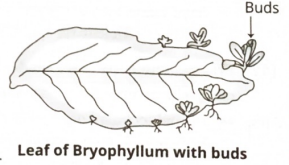
→ Similarly buds produced in the notches along the leaf margin of Bryophyllum fall on the soil and develop into new plants.

Image
View full question & answer
Question 243 Marks
Fragmentation is the mode of reproduction of multicellular organism. Explain.
Answer
→ In multicellular organisms with relatively simple body organisation, simple reproductive methods can still work. Spirogyra for example simply breaks up into smaller pieces upon maturation. These pieces or fragments grow into new individuals.
→ This is not true for all multicellular organisms. They cannot simply divided cell by cell. The reason is that many multicellular organisms as we have seen are not simply a random collection of cell. Specialised cells are organised as tissues and tissues are organised into organs.
→They have been placed at definite position in the body. In such a carefully organised situation, cell by cell division would be impractical. Multi-cellular organisms therefore need to use more complex ways of reproduction.
→ A basic strategy used in multi-cellular organisms is that different cell types perform different specialised functions. Following this general pattern, reproduction in such organisms is also the function of a specific type.
→ How is reproduction achieved from a single cell type, if the organism itself consists of many cell types? The answer is that there must be a single type in the organism that is capable of growing, proliferating and making other cell types under the right circumstances.
View full question & answer
Question 253 Marks
Explain the reproductive organs of Flowering plants.
Answer
→ The reproductive parts of angiosperms are located in the flower. We have already studied the different parts of a flower - sepals, petals, stamens and pistil. Stamens and pistil are the reproductive parts of a flower which contain the germ cell.
→ Petals and sepals protect the flower in budding stage. They do not take part in reproduction.
→ The flower may be unisexual (papaya, watermelon) when it contains either stamens or pistil or bisexual (Hibiscus, mustard) when it contains both stamen and pistil.

Image
⇒ Stamen is the male reproductive part and it produces pollen grains that are yellowish in colour. You must have seen this yellowish powder that often sticks to our hands if we touch the stamen of a flower.
⇒ Pistil is present in the centre of a flower and is the female reproductive part. It is made of three parts.
(1) The swollen bottom part is the ovary.
(2) Middle elongated part is the style.
(3) Terminal part which may be sticky is the stigma.
⇒ Stigma is usually sticky. The ovary contains ovules and each ovule has an egg cell. The male germ-cell produced by pollen grain fuses with the female gamate present in the ovule. This fusion of the germ-cells or fertilisation gives us the zygote which is capable of growing into a new plant.
View full question & answer
Question 263 Marks
Explain Binary fission in amoeba and multiple fission in Plasmodium.
Answer
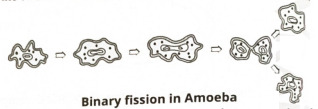
For unicellular organisms, cell division or fission leads to the creation of new individuals. Many different patterns of fission have been observed. Many bacteria and protozoa simply split into two equal halves during cell division. In organisms such as Amoeba, the splitting of the two cells during division can take place in any plane.
Image
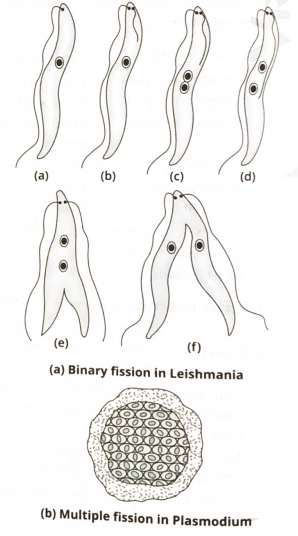
→ However, some unicellular organisms show somewhat more organisation of their bodies such as seen in Leishmania (which cause Kala azar), which have a whip-like structure at one end of the cell. In such organisms, binary fission occurs in a definite orientation in relation to these structures.
→ Other single - celled organisms such as the malarial parasite, Plasmodium, divide into many daughter cells simultaneously by multiple fission.

Image
View full question & answer
[3 Mark Questions] - Science STD 10 Questions - Vidyadip