Questions

[3 Mark Questions]

🎯

Test yourself on this topic

27 questions · timed · auto-graded
Question 13 Marks
Obtain the relation between the focal length and radius of curvature in the case of a concave mirror.
Answer
SELF
View full question & answer
Question 33 Marks
Draw neat ray diagrams and describe the position, nature and size of the image formed by a concave mirror of small aperture for the following positions of the object placed in front of it: (2 Mark Each) $(1)$ At infinity $(2)$ At a finite distance beyond $C$ $(3)$ At $C$ $(4)$ Between $C$ and $F$ $(5)$ At $F$ (6) Between $P$ and $F$
Answer
SELF
View full question & answer
Question 43 Marks
An object of size $7.0 \ cm$ is placed at $27 \ cm$ in front of a concave mirror of focal length $18 \ cm$. At what distance from the mirror should a screen be placed, so that a sharp focussed image can be obtained? Find the size and the nature of the image.
Answer
  • Here, Object size $h =7.0 cm$
  • Object distance $u=-27 cm$
  • Focal length $f =-18 cm(\because$ Concave mirror $)$
  • Image distance $v=$ ?
  • Image size $h^{\prime}=$ ?
  • From mirror formula: $\frac{1}{v}+\frac{1}{u}=\frac{1}{f}$
  • $\frac{1}{v}=\frac{1}{f}-\frac{1}{u}$
  • $=\frac{1}{-18}-\frac{1}{(-27)}$
  • $=-\frac{1}{18}+\frac{1}{27}$
  • $=\frac{-3+2}{54}=\frac{-1}{54} cm$
  • $\therefore v=54 cm$
  • The negative (minus) sign of $v$ indicates that the image is formed on the same side of the object.
  • So, screen should be held in front of the mirror at a distance of $54 \ cm$ from the mirror.
  • The image can be obtained on the screen and hence, it is real.
  • Now, magnification $m =\frac{h \prime}{h}=-\frac{v}{u}$
  • $\therefore h^{\prime}=-h\left(\frac{v}{u}\right)$
  • $=-7.0\left(\frac{-54}{-27}\right)$
  • $=-14 \ cm$
  • The negative (minus) sign of $h^{\prime}$ shows that the image is inverted and hence would be real.
View full question & answer
Question 53 Marks
An object is placed at a distance of $10 \ cm$ from a convex mirror of focal length $15 \ cm$. Find the position and nature of the image.
Answer
  • Here, Object distance $u=-10 \ cm$
  • Focal length of the mirror $f=+15 \ cm(\because$ Convex mirror)
  • Image distance $v=$ ?
  • Using the mirror formula $\frac{1}{f}=\frac{1}{u}+\frac{1}{v}$
  • We have
  • $\frac{1}{v}=\frac{1}{f}-\frac{1}{u}$
  • $=\frac{1}{(+15)}-\frac{1}{(-10)}$
  • $=\frac{1}{15}+\frac{1}{10}$
  • $=\frac{2+3}{30}$
  • $=\frac{5}{30}=\frac{1}{6} \ cm$
  • $\therefore v=6 \ cm$
  • The positive (plus) sign of $v$ indicates that the image is formed behind the mirror.
  • Now, magnification $m=-\frac{v}{u}=-\frac{6}{-10}=+0.6$
  • Positive value of magnification indicates that the image is virtual and erect.
  • The magnitude of magnification is $0.6$ , which is less than $1$ . This shows that the image is diminished.
View full question & answer
Question 63 Marks
A concave lens of focal length $15 \ cm$ forms an image at $10 \ cm$ from the lens. How far is the object placed from the lens? Draw the ray diagram.
Answer
SELF
View full question & answer
Question 73 Marks
One-half of a convex lens is covered with a black paper. Will this lens produce a complete image of the object? Verify your answer experimentally. Explain your observations.
Answer
SELF
View full question & answer
Question 83 Marks
Name the type of mirror used in the following situations : $(a)$ Headlights of a car $(b)$ Side / rear-view mirror of a vehicle $(c)$ Solar furnace Support your answer with reason.
Answer
  • $(a)$ For headlights of a car, a concave mirror is used.
  • The light source is kept at the focus of the mirror. On reflection, a strong parallel beam of light emerges out.
  • $(b)$ For side / rear-view mirror of a vehicle, convex mirror is used.
  • This is because its field of view is very large and it forms a virtual, erect and diminished image of the object behind the vehicle, which enables a driver to see most of the traffic behind him / her.
  • $(c)$ For a solar furnace, a concave mirror is used.
  • Light from the Sun, on reflection from the mirror, is concentrated at the focus of the mirror, producing heat and temperature increases sharply up to $180 °C - 200 °C$.
View full question & answer
Question 93 Marks
Define the magnification produced by a lens. Explain it in brief.
Answer
  • The magnification produced by a lens is defined as the ratio of the height of the image to the height of the object.
  • It is represented by the letter $m.$
  • If $h$ is the height of the object and $h$' is the height of the image formed (given) by a lens, then the magnification produced by the lens is given by
  • $m=\frac{\text { Height of the image }}{\text { Height of the object }}=\frac{h \prime}{h} \ldots . . .(10.16)$
  • Magnification produced by a lens is also related to the object distance $u$ and the image distance $v.$
  • This relationship is given by
  • Magnification $m=\frac{h 1}{h}=\frac{v}{u} \ldots . .. (10.17)$
View full question & answer
Question 103 Marks
Explain a double concave lens, simply called a concave lens, in brief.
Answer


  • A lens having two spherical surfaces curved inwards is called a double concave lens or simply a concave lens.
  • It is thicker at the edges than at the middle.
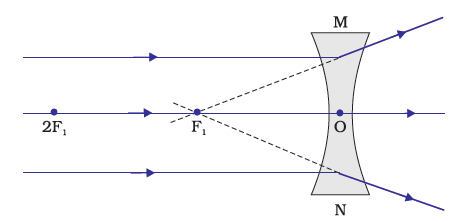
  • Concave lens diverges light rays as shown in the figure. Hence, concave lens is called a diverging lens.
View full question & answer
Question 113 Marks
Why does a pencil partly immersed in water in a glass tumbler appears displaced at the interface of air and water?
Answer
  • In case of a pencil partly immersed in water, the light reaching us from the portion of the pencil inside water seems to come from a different direction, compared to the part above water.
  • This makes the pencil appear displaced at the interface of air and water.
  • The letters appear raised when viewed through a glass slab, a coin in a glass tumbler filled with water appears raised and a lemon kept in water in a glass viewed from the sides, appears bigger than its actual size.
  • Further, we observe that the extent of the effect is different for different pairs of media. e.g., the apparent bending of a pencil at the interface of air and water is different from the apparent bending of the pencil at the interface of air and any other liquid like kerosene or turpentine.
  • Similarly, the apparent rise of a coin in a glass tumbler changes when it is filled with a liquid other than water.
  • The above day-to-day observations indicate that when travelling obliquely from one transparent medium to another, the direction of propagation of light in the second medium changes.
  • This change occurs at the boundary separating the two media.
View full question & answer
Question 133 Marks
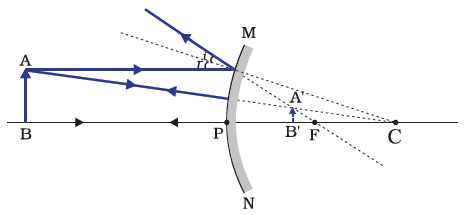
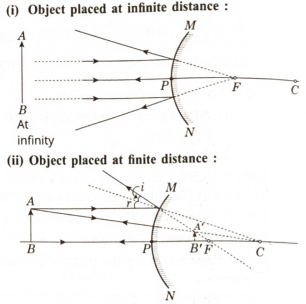
Draw a ray diagram showing the position, nature and size of the image formed by a convex mirror of small aperture, when an object is placed infinite distance from the mirror and give the description about the position, nature and size of the image.
Answer
  • Position of the object: At infinite distance from the mirror
  • Position of the image: At the principal focus F, behind the mirror.
  • Nature of the image: Virtual and erect
  • Size of the image relative to that of the object: Highly diminished (a point-like)
View full question & answer
Question 143 Marks
Write the uses of concave mirrors.
Answer
  • Uses of concave mirrors are as follows:
  • $(1)$ Concave mirrors are used as reflectors in torches, search-lights, headlights of motor vehicles, etc. to get powerful parallel beams of light.
  • $(2)$ Concave mirrors are often used as shaving mirrors/ make-up mirrors to see a larger image of the face.
  • $(3)$ Concave mirrors are used by the dentists to see large images of the teeth of patients.
  • $(4)$ Large concave mirrors are used to concentrate sunlight to produce heat in solar cookers, solar furnaces, etc.
  • $(5)$ A concave mirror is used as a doctor's head mirror to focus light on the body parts like eyes, ears, nose, throat, etc. to be examined.
  • $(6)$ Large concave mirrors are also used in reflecting telescopes.
View full question & answer
Question 163 Marks
When is it said that an image has been formed of an object? Clarify about the types of image.
Answer
  • When a number of rays, starting from a point on an object, after reflection or refraction, meet at another point or appear to meet (i.e., give illusion of meeting at another point), then the second point is called the image of the first point.
  • There are two types of images: $(1)$ Real image and $(2)$ Virtual image.
  • $(1)$ Real image:
  • When the rays of light actually meet at a point after reflection or refraction, the image formed is called a real image.
  • Real image can be obtained on a screen.
  • Real image is always inverted.
  • $(2)$ Virtual image:
  • When the rays of light, after reflection or refraction, do not actually meet at a point but appear to meet, the image formed is called a virtual image.
  • Virtual image cannot be obtained on a screen.
  • Virtual image is always erect.
View full question & answer
Question 173 Marks
Write the laws of reflection of light.
Answer
  • The laws of reflection of light are as follows:
  • $(1)$ The angle of incidence is equal to the angle of reflection, i.e., $i = r$.
  • $(2)$ The incident ray, the normal to the mirror at the point of incidence and the reflected ray, all lie in the same plane.
  • Important notes:
  • $(i)$ These laws of reflection are applicable to all the types of reflecting surfaces including spherical surfaces.
  • $(ii)$ Moreover, these laws can also be applied to both regular as well as irregular reflection.
  • $(iii)$ A ray of light which is incident normally on a mirror is reflected back along its own path, i.e., $i = r = 0$.
  • $(iv)$ Silver metal is one of the best reflectors of light.
View full question & answer
Question 183 Marks
The refractive index of diamond is $2.42.$ What is the meaning of this statement?
Answer
  • Refractive index of diamond
  • $=\frac{\text { Speed of light in vacuum / air }}{\text { Speed of light in diamond }}$
  • $\therefore$ Speed of light in diamond
  • $=\frac{\text { Speed of light in vacuum /air }}{\text { Refractive index of diamond }}$
  • This expression states that the speed of light in diamond is $\frac{1}{2.42}$ times the speed of light in vacuum/air. e.,
  • Speed of light in diamond $=\frac{3 \times 10^8}{2.42}$
  • $=1.24 \times 10^8 ms^{-1}$
  • In other words, it can also be said that, the ratio of the speed of light in vacuum / air to the speed of light in diamond is equal to $2.42$ .
View full question & answer
Question 193 Marks
Obtain the position, nature and size of the image formed by a plane mirror from the formula for magnification.
Answer
SELF
View full question & answer
Question 203 Marks
What is called reflection of light ? Using a proper diagram, explain about incident ray, reflected ray, angle of incidence, angle of reflection and plane of incidence.
Answer
Image
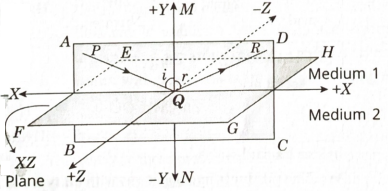
→ As shown in the figure, above $X Z$ plane, there is optical medium 1 and below this plane there is optical medium 2.
→ When a ray of light $P Q$ travelling in medium 1 strikes on the surface of medium 2 at point $Q$, it gets bounced and then it travels along $Q R$. Here this process of bouncing is called reflection of light, ray $P Q$ is called incident ray, ray $Q R$ is called reflected ray, point $Q$ is called point of incidence (or point of reflection). In short striking ray is called incident ray and bouncing ray is called reflected ray.
→ A Angle made by incident ray with the normal drawn at the point of incidence is called angle of incidence. It is shown by symbol $i$. In above figure, $i=$ $\angle P Q M$.
→ A Angle made by reflected ray with the normal drawn at the point of incidence is called angle of reflection. It is shown by symbol $r$. In above figure, $r=\angle M Q R$.
→ Plane passing through incident ray, normal drawn at the point of incidence and reflected ray is called plane of incidence. In above figure, $A B C D$ is a part of plane of incidence.
View full question & answer
Question 213 Marks
What is called a spherical mirror? Describe its two types with proper diagrams.
Answer
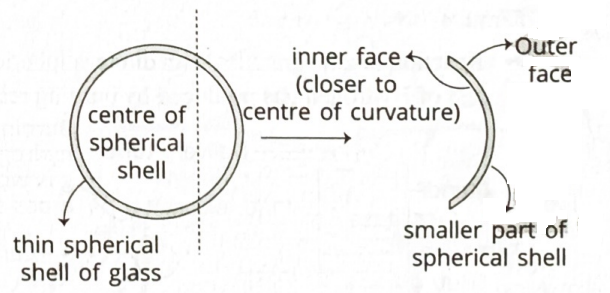
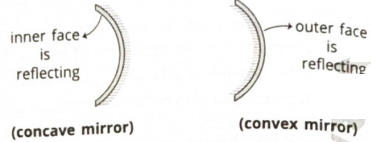
When reflecting face of a mirror is made spherical, it is called a spherical mirror.
Image
⇒ To prepare a spherical mirror, a thin spherical shell of glass is cut, parallel to any of its diameters.Then we separate the smaller part. Now if its inner face is made reflecting then we get a concave mirror and if its outer face is made reflecting then we get a convex mirror.
Image
In above diagrams, backsides of both the mirrors are shown shaded which are non-reflecting. For a large shining spoon, its inner face can be treated nearly like a concave mirror whereas its outer face can be treated nearly like a convex mirror.
View full question & answer
Question 223 Marks
Using proper ray diagram, explain formation of image, formed by convex mirror for an object placed at
(i) infinite distance (practically very far) and at
(ii) finite distance from the mirror. Also summarise the results in the form of a table showing position, size and nature of image.
View full question & answer
Question 233 Marks
Give Four points of difference between concave mirror and convex mirror.
Answer
Concave MirrorConvex Mirror
Its principal focus is real.Its principal focus is virtual.
Its focal length and radius of curvature are negative.Its focal length and radius of curvature are positive.
Image formed by it is either real or virtualImage formed by it is always virtual.
Image formed by it is either in front of it or on the back of it.Image formed by it is always on the back of it.
Size of image formed by it is either equal to or greater
than or smaller than size of object.
Size of image formed by it is always smaller than J6 of object.L4
It is used as a shaving mirror, make-up mirror, doctor's head mirror, search light mirror and as a head light mirror in the vehicles.It is used as antitheft mirror in show rooms, as side view
mirror and as rear view mirror in the vehicles.
View full question & answer
Question 243 Marks
Define magnification produced by a spherical mirror. What does its value indicate? Also mention its formula. Discuss about its sign for real and virtual image.
Answer
→ Magnification produced by a given spherical mirror is defined as a ratio of height of image $\left(h^{\prime}\right)$ to the height of object $(h)$. It is shown by symbol $m$. Thus by definition.
$
m=\frac{h^{\prime}}{h}
$
→ Magnification produced by a spherical mirror gives how many times size of image is as compared to size of object.
→ Generally, object is placed upright above the principal axis and so its height $h$ is taken positive.
→ Since real image is inverted, its height $h$ ' is taken negative and so for real image, value of $m$ is obtained negative by definition.
→ Conversely, since virtual image is erect, its height $h^{\prime}$ is taken positive and so for virtual image value of $m$ is obtained positive by definition.
n Thus, when magnification is negative, image is real and when magnification is positive, image is virtual.
→ For spherical mirrors, formula of magnification is as follows.
$
m=-\frac{v}{u}
$
where $v$ and $u$ denote image distance and object distance respectively. (which are to be determined as per new cartesian sign convention system).
View full question & answer
Question 253 Marks
Explain about refractive index in detail.
Answer
When a light ray propagating in first transparent medium is made incident obliquely on the surface of second transparent medium, it changes the direction of propagation in the second medium. For a given pair of transparent media, the extent of change in direction of propagation of incident light ray is expressed in terms of a physical quantity, called "Refractive Index" of second medium with respect to first medium, shown by symbol $n_{21}$. Its value is equal to constant appearing on R.H.S. of Snell's law. This value depends on speed of light in first and second transparent medium. Since speed of light is different in different media, value of refractive index is different for different pairs of media.
→ Speed of light is maximum in vacuum, equal to $3 \times 10^8 ms ^{-1}$. In air, it is very slightly less than this value. In water and glass, speed of light is reduced considerably.
→ Relative refractive index :
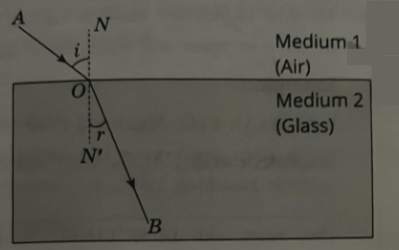
Image
→ Consider a ray of light, travelling from medium 1 into medium 2 as shown in the figure. Suppose speeds of light in media 1 and 2 are respectively $v_1$ and $v_2$.
→ Now, refractive index of medium 2 with respect to medium 1 is given by ratio of speed of light in medium 1 to speed of light in medium 2. It is shown by symbol $n_{21}$. Thus,
$
n_{21}=\frac{v_1}{v_2}
$
→ Similarly, refractive index of medium 1 with respect to medium 2 is shown by symbol $n_{12}$ and it is given as :
$
n_{12}=\frac{v_2}{v_1}
$
→ Absolute refractive index of a given medium $\left(n_m\right)$
When first medium is air or vacuum, refractive index of second medium with respect to first medium is known as absolute refractive index of second medium, shown by symbol $n_2$ or $n_{m^*}$ If speed of light in air or vacuum is $c$ and speed of light in a given medium is $v$ then absolute refractive index of this medium is given by
$
n_m=\frac{c}{v}
$
→ In practice, absolute refractive index of a given medium is called its refractive index only.
→ Refractive indices of water, crown glass and diamond are found to be respectively 1.33, 1.52 and 2.42 .
→ A medium having greater refractive index is said to be optically denser. Conversely, a medium having smaller refractive index is said to be optically rarer.
→ Thus, optical density of a given medium gives measure of its ability to refract the incident light.
→ It should be noted that optical density of a medium is different than its mass density. A medium with greater optical density may have smaller mass density. For example refractive index of kerosene is 1.44 which is greater than refractive index of water which is 1.33 . Hence optical density of kerosene is greater than that of water but mass density of kerosene is smaller than that of water.

View full question & answer
Question 263 Marks
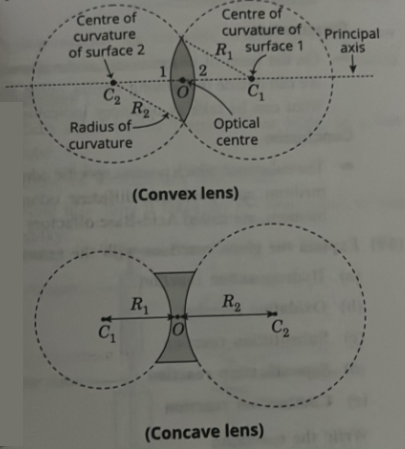
Explain about (i) Centres of curvature (ii) Principal axis (iii) Optical Centre (iv) Radius of curvature (v) Aperture in case of convex or concave lens.
Answer
Image
(i) Centres of curvature $\left(C_1\right.$ and $\left.C_2\right)$ :
A spherical lens, either convex or concave has two spherical surfaces, which can be considered as parts of two spheres. Centres of these spheres are known as centres of curvature of given spherical lens, shown by symbols $C_1$ and $C_2$.
(ii) Principal axis :
An imaginary straight line, passing through centres of curvature of a given spherical lens is called its principal axis.
(iii) Optical centre $(O)$ :
The centroid of a given spherical lens is called its optical centre, shown by symbol $O$. When radii of curvatures of both the spherical surfaces of a given spherical lens are equal, its optical centre is the mid point of $C_1$ and $C_2$
→ Light ray passes through optical centre of a spherical lens without any deviation (provided media on both the sides of a lens are same)
(iv) Radius of curvature $( R )$ :
Spherical surface of given spherical lens can be considered as a part of a sphere. Radius of this sphere is called radius of curvature is given spherical surface of a given spherical lens, shown by symbol $R$.
→ Two spherical surfaces of a given spherical lens may have different radii of curvature, shown by symbols $R_1$ and $R_2$.
→ When $R_1=R_2$, double convex lens is called equi-convex lens and similarly double concave lens is called equi-concave lens.
(v) Aperture :
Diameter of circular out-line of given spherical lens is called its aperture.
View full question & answer
Question 273 Marks
A convex mirror used for rear$-$view on an automobile has a radius of curvature of $3.00 m$. If a bus is located at $5.00 m$ from this mirror, find the position, nature and size of the image.
Answer
Here,
$R=+3.00 m \quad(\because$ given mirror is convex $)$
$u=-5.00 m(\because$ object distance is always negative$)$
$v=?$
$h^{\prime}=?$
$(i)$ For spherical mirror, $f=\frac{R}{2}=\frac{+3.00 m}{2}$
$\therefore f=+1.50 m$
* Now, according to mirror formula,
$\frac{1}{f} =\frac{1}{v}+\frac{1}{u}$
$\therefore \frac{1}{v} =\frac{1}{f}-\frac{1}{u}=\frac{1}{(+1.50)}-\frac{1}{(-5.00)}$
$\therefore \frac{1}{v} =\frac{1}{1.50}+\frac{1}{5.00}=\frac{5.00+1.50}{(1.50)(5.00)}$
$\therefore \frac{1}{v} =\frac{6.50}{7.50} \Rightarrow v=\frac{7.50}{6.50}=+1.15 m$
$\Rightarrow$ Image will be formed on the back side of mirror, at $1.15 m$ from the pole of mirror.
$(ii)$ Now, magnification is,
$m=-\frac{v}{u}=-\frac{(+1.15 m)}{(-5.00 m)}$
$\therefore m=+0.23 \Rightarrow \frac{h^{\prime}}{h}=0.23$
$ \Rightarrow h^{\prime}=0.23 h$
$\Rightarrow$ Image will be
$(i)$ virtual and erect
$(ii)$ diminished $( \because m$ is positive$)$
$(\because|m|<1)$
$(iii)$ of height $0.23$ times the height of object
$( \because \ h^{+}=0.23 h )$
$(iv)$ formed on the back side of mirror, at $1.15 m$ from the mirror
$(\because v=+1.15 m )$
View full question & answer
[3 Mark Questions] - Science STD 10 Questions - Vidyadip