Questions

[1 Mark Questions]

🎯

Test yourself on this topic

39 questions · timed · auto-graded

Question 21 Mark
Smallest energy transfer : secondary consumers to tertiary consumers ::
largest energy transfer : ....
Answer
  • producers level
View full question & answer
Question 31 Mark
A food chain comprising hawk, snake, paddy and mice. If $15,000 \ J$ of energy available to mice then how much energy will be in paddy and how much energy will be available to hawk.
Answer
  • $15,000 \ J$ of energy will be in paddy and $150 \ J$ of energy will be available to hawk.
View full question & answer
Question 41 Mark
Among the following, which have posed a threat to the environment?
Body spray, bacteria, aerosols, $CFCs$, wild grass
Answer
  • Body spray, aerosols, $CFCs$
View full question & answer
Question 51 Mark
Give the full form of : $CFCs, UNEP$
Answer
  • $CFCs $- Chloroflurocarbons
  • $UNEP$ - United Nations Environment Programme
View full question & answer
Question 61 Mark
When a population of animal $‘X’$ is introduced into the biotic community of an ecosystem, the number of lions increased while the number of deer decreased. Which is correct option for animal $‘X’?$
Answer
  • $X$ animal is a predator of deer and a prey of lion.
View full question & answer
Question 71 Mark
Who am I?
I am a product of oxygen under the influence of $UV$ radiation and I absorb $UV$ rays.
Answer
  • Ozone $(O_3)$
View full question & answer
Question 81 Mark
Use of disposable plastic plates should be prevented because .... (Complete the sentence.)
Answer
  • It is made-up of non-biodegradable substance.
View full question & answer
Question 91 Mark
Define the terms : Artificial ecosystem
Answer
  • An ecosystem which is created and maintained by humans is called artificial ecosystem.
View full question & answer
Question 101 Mark
Define the terms : Food web
Answer
  • The network of overlapping food chains operating in an ecosystem is called a food web.
View full question & answer
Question 111 Mark
Define the terms : Consumers
Answer
  • Those organisms which are dependent on producers for their nutritional requirement are called consumers.
View full question & answer
Question 121 Mark
Define the terms : Producers
Answer
  • All green plants and certain bacteria which can produce food by the process of photosynthesis are called producers.
View full question & answer
Question 131 Mark
Define the terms : Non-biodegradable substances
Answer
  • The substances that cannot be converted into harmless simpler forms by the action of microorganisms are called non-biodegradable substances.
View full question & answer
Question 141 Mark
Define the terms : Biodegradable substances
Answer
  • The substances which can be disposed off naturally by the action of micro-organisms/ decomposers are called biodegradable substances.
View full question & answer
Question 151 Mark
Define the terms : Biological magnification
Answer
  • A phenomenon of progressive increase in the concentration of non-biodegradable substances in organisms at each successive trophic level is known as biological magnification.
View full question & answer
Question 161 Mark
Define the terms : Decomposers
Answer
  • The microorganisms that breakdown the complex organic substances into simple inorganic substances are known as decomposers.
View full question & answer
Question 171 Mark
Define the terms : Ecosystem
Answer
  • A system formed by an interaction between biotic components and the physical environment is called an ecosystem.
View full question & answer
Question 181 Mark
Why is straight-line food chain is not common in the natural ecosystem?
Answer
  • In the natural ecosystem each organism is generally eat two or more other kinds of organisms which is in turn are eaten by several other organisms. So, straight-line food chain is not common in the natural ecosystem.
View full question & answer
Question 191 Mark
Which chemical is used in fire extinguishers? How it is harmful?
Answer
  • $CFCs$ (chlorofluorocarbons) is used in fire extinguishers.
  • It is harmful as it leads to depletion of ozone layer.
View full question & answer
Question 201 Mark
List two methods of safe disposal of the non-biodegradable waste.
Answer
  • $(1)$ By recycling $(2)$ By underground dumping
View full question & answer
Question 211 Mark
Mention the amount of solar energy captured by the green plants out of the total energy that reaches on the earth from the sun and mention the percentage of energy, which is transferred from one trophic level to next higher one.
Answer
  • The green plants in a terrestrial ecosystem capture about $1 \%$ of the energy of sunlight falling on their leaves.
  • An average $10 \%$ energy is transferred from one trophic level to the next higher one.
View full question & answer
Question 231 Mark
Among snake, insects, frog, plants, hawk which one is an organism of fourth trophic level?
Answer
  • Snake
View full question & answer
Question 241 Mark
Why all food chains begin with organisms that contain chlorophyll?
Answer
  • Chlorophyll containing organisms are able to capture solar energy and covert this into chemical energy. Because of it energy flow is continued in an ecosystem.
View full question & answer
Question 251 Mark
In a given food web,
$(1)$ Identify which one is secondary as well as tertiary consumers.
$(2)$ Identify which one has minimum conc. of pesticides.
Answer
  • $(1)$ Hawk $(2)$ Producers, i.e., food grains, Small plants, grass.
View full question & answer
Question 261 Mark
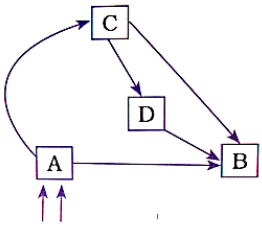
In the chart of energy flow given below identify the decomposers and explain your choice:
Answer
  • In the chart $B$ indicates decomposers. They decompose dead materials available from $A, C$ and $D.$
View full question & answer
Question 271 Mark
Define the terms : Food chain
Answer
  • Living organisms of an ecosystem depend on each other for their food requirement and form a chain turmed as food chain.
View full question & answer
Question 281 Mark
Why are autotrophs called producers and heterotrophs called consumers?
Answer
  • Autotrophs are green plants which perform photosynthesis and produce organic compounds (carbohydrates). So, they are called producers.
  • Heterotrophs consume food from other organisms. So they are called consumers.
View full question & answer
Question 291 Mark
Name the natural cleansing agent in an ecosystem.
Answer
  • Decomposers (e.g., bacteria, fungi) and Scavengers (e.g., kite, crow).
View full question & answer
Question 311 Mark
What is the function of ozone in the upper atmosphere?
Answer
  • Ozone shields the surface of the earth from harmful ultraviolet radiation from the sun.
View full question & answer
Question 321 Mark
Construct food chain from following organisms:
$(a)$ Frog, insects, birds, grass.
$(b)$ Fish, algae, small animals, large fish
Answer
  • $(a)$ Grass → Insects → frog → birds
  • $(b)$ Algae → small animals → fish → large fish
View full question & answer
Question 331 Mark
Can any single organism occupy two different trophic levels? Yes or no. Explain.
Answer
  • Yes. Rat occupies herbivores trophic level as primary consumer and also occupies carnivores trophic level as secondary consumer.
View full question & answer
Question 341 Mark
Which trophic level has maximum and which trophic level has minimum number of organisms?
Answer
  • In a food chain, maximum number of organisms are at first trophic level (at producers level) and minimum number of organisms are at fourth trophic level (higher carnivores).
View full question & answer
Question 351 Mark
How many trophic levels occur in food chain?
Answer
  • There are three or four trophic levels in a food chain.
View full question & answer
Question 361 Mark
What are various orders of food chain named as?
Answer
  • Various levels of food chain are named as trophic levels.
View full question & answer
Question 371 Mark
What happens to the dead plants and dead animals?
Answer
  • Decomposers decompose complex organic matter into inorganic constituents that are present in dead plants and dead animals.
View full question & answer
Question 381 Mark
Which is main functional unit of an environment?
Answer
  • Ecosystem is main functional unit of an environment.
View full question & answer
[1 Mark Questions] - Science STD 10 Questions - Vidyadip