Questions

[2 Mark Questions]

🎯

Test yourself on this topic

28 questions · timed · auto-graded

Question 12 Marks
Give the scientific reason : The main responsible factor for depletion of ozone layer is $CFC$.
Answer
  • The ozone layer in stratosphere absorbs harmful ultraviolet radiation from the sunlight and prevents it from reaching the earth.
  • $CFC$ (Chlorofluorocarbon) adds chlorine $(Cl^-)$ in atmosphere.
  • The chlorine atom reacts with ozone and removes an atom of oxygen one by one.
  • One atom of chlorine can decompose many molecules of ozone in this fashion.
  • $CFC$ thus causes about $80 \ %$ of the total depletion of ozone.
  • Thus, the main responsible factor for depletion of ozone layer is $CFC$.
View full question & answer
Question 22 Marks
Give the scientific reason : It is necessary to prevent the uncontrolled use of pesticides and other chemicals.
Answer
  • Pesticides and other chemicals are used in order to protect the crops from diseases or pests.
  • Such chemicals are non-biodegradable.
  • The amount of these chemicals increases in the soil or water bodies due to uncontrolled use of it.
  • From soil or water they enter in the body of plants and then it passes in trophic levels of food chain.
  • They get accumulated progressively at each trophic level as these chemicals are not degradable.
  • Due to bio-magnification, high concentration of such chemical causes lethal effects on higher level carnivores animals. Some such chemicals prove lethal for organisms of lower trophic level too.
  • These chemicals reach upto human beings too through food.
  • Thus, it is necessary to prevent the uncontrolled use of pesticides and other chemicals.
View full question & answer
Question 32 Marks
Give the scientific reason : The trophic relationships of organisms occur in form of food webs.
Answer
  • In nature, organisms are interlinked for food to form food chain.
  • Among various ecosystems, each one is having definite food chain.
  • But single organism is never dependent only on one organism for food.
  • So trophic relationships for food can never be explained as straight chain.
  • The individuals involved in food chain of one ecosystem are also linked with food chains of other ecosystems.
  • So, trophic relations for food do not operate in isolation but interlinked to form complex net called food web.
  • Thus, the trophic relationships of organisms occur in form of food web.
View full question & answer
Question 42 Marks
Give the scientific reason : Energy flow is always unidirectional in an ecosystem.
Answer
  • The solar energy enters in an ecosystem through the process of photosynthesis performed by green plants.
  • The energy that is captured by green plants does not revert back to the sun.
  • From green plants energy passes to upper trophic levels of consumers.
  • Energy obtained by herbivores does not come back to the green plants.
  • As it moves progressively through the various trophic levels it is no longer available to the previous level.
  • Thus, energy flow is always unidirectional in an ecosystem.
View full question & answer
Question 52 Marks
Give the scientific reason : Consumers are directly or indirectly dependent on green plants for energy.
Answer
  • In ecosystem, green plants absorb solar energy and transform it in chemical energy.
  • Thus at first trophic level green plants produce food by transforming chemical energy from available solar energy.
  • Consumers consume other organisms or their products as food for their energy requirement.
  • Flow of energy occurs in form of food from green plants to herbivores and from it to carnivores.
  • Consumers are heterotrophic so their energy requirement is satisfied from lower trophic level.
  • Thus, consumers are directly or indirectly dependent on green plants for energy.
View full question & answer
Question 62 Marks
If all the wastes we generate is biodegradable, will this have no impact on the environment?
Answer
  • If all the waste we generate is biodegradable and if properly allowed it to decompose, then it will have no impact on the environment.
  • They should be properly managed
View full question & answer
Question 72 Marks
What are the problems caused by the non-biodegradable wastes that we generate?
Answer
  • The problems caused by the generated non-biodegradable wastes are as follows :
  • $(1)$ It causes biological magnification.
  • $(2)$ They keep on accumulating in nature causing pollution.
  • $(3)$ They prevent growth of vegetation when dumped underground.
  • $(4)$ They may be inert and simply persist in the environment for a long time and may harm various members of the ecosystem.
  • $(5)$ There is imbalance of the food chains causing problems in ecosystem.
View full question & answer
Question 82 Marks
Will the impact of removing all the organisms in a trophic level be different for different trophic levels ? Can the organisms of any trophic level be removed without causing any damage to the ecosystem ?
Answer
  • The impact of removing all the organisms in a trophic level will be different for different trophic levels.
  • Removal of producers will affect all the organisms of successive trophic levels.
  • It will be a threat the survival.
  • The removal of organisms at higher trophic level will lead to increase in organisms of lower trophic level.
  • Removal of organisms of any trophic level will cause the damage to the ecosystem.
View full question & answer
Question 92 Marks
What will happen if we kill all the organisms in one trophic level ?
Answer
  • If we kill all the organisms in one trophic level then organisms of ext trophic level will not get food (chemical energy) and the entire food chain gets disturbed.
  • All the organisms which are dependent on these are died.
  • On the other hand, the organisms at the lower trophic level will increase in abundance.
  • Due to this, ecosystem will be in imbalance.
View full question & answer
Question 102 Marks
How can you help in reducing the problem of waste disposal? Give any two methods.
Answer
  • We can help in reducing the problem of waste disposal by following methods :
  • $(1)$ Biodegradable domestic wastes such as left-over food, fruit and vegetable peels, dry leaves and other wastes of gardens, etc. can be burried in a pit.
  • They are converted into compost and used as manure.
  • $(2)$ Waste materials such as tin, cans, paper, glass, metallic articles are recycled.
  • Through the process of recycling such materials are reused to form new products.
View full question & answer
Question 112 Marks
What is ozone and how does it affect any ecosystem?
Answer
  • Ozone is a molecule formed by three atoms of oxygen in the presence of $UV$ (Ultraviolet) rays.
  • Ozone performs an essential function at the higher levels of the atmosphere.
  • However, at ground level it is a deadly poison.
  • Ozone absorbs shorter wavelength $UV$ rays from the sun.
  • Thus it protects the living system on earth.
View full question & answer
Question 122 Marks
Give the scientific reason : The production of household waste can be reduced by few common steps.
Answer
  • $(1)$ Buy loose fruits and vegetables in order to avoid packaging.
  • $(2)$ Limit the use of disposable items such as razors, pens, nappies, paper napkins, cups, plates, etc.
  • $(3)$ Buy reusable carry bags from super-markets. Stop using plastics.
  • $(4)$ Use rechargeable batteries.
  • $(5)$ Do not throw old clothes and shoes but donate them.
  • $(6)$ Reuse the back of papers as scrap paper.
  • $(7)$ Biodegradable wastes can be decomposed by composting at home.
  • This will reduce the amount of wastes which go out of the house.
  • Thus, follow the principle of reuse, recycle and reduce which can substantially reduce the amount of household waste.
View full question & answer
Question 132 Marks
Give any two ways in which non-biodegradable substances would affect the environment.
Answer
  • $(1)$ Non-biodegradable substances such as pesticides cause soil and water pollution.
  • It may cause biological magnification.
  • $(2)$ Non-biodegradable substances block the functions of an ecosystem, i.e., transfer of energy and elements may stop.
View full question & answer
Question 142 Marks
Why is garden considered as an ecosystem?
Answer
  • All the interacting organisms in an area together with the abiotic constituents of the environment form an ecosystem.
  • Various kinds of plants such as grasses, trees, shrubs and many flower bearing plants and animals like frogs, squirrels, calotes, insects, birds, etc., are found in garden.
  • All these organisms interact with each other.
  • Their growth, reproduction and other activities are affected by the abiotic components such as light, wind, water, minerals, soil, etc.
  • So, a garden is considered as an ecosystem.
View full question & answer
Question 152 Marks
What is the role of decomposers in the ecosystem?
Answer
  • Decomposers feed on the excretory substances as well as dead bodies of plants and animals.
  • Bacteria and fungi are decomposers.
  • They breakdown the complex organic substances into simple inorganic substances.
  • Such simple inorganic substances are used up by the plants again.
  • So, they play an important role in cyclic pathway of the elements.
View full question & answer
Question 162 Marks
Write a short note on : Environment
Answer
  • All organisms including plants, animals and microorganisms and their physical surrounding with which they interact is called environment.
  • All biotic and abiotic components of the environment are dependent on each other for maintaining balance.
  • Therefore, the different components of the environment are interlinked and interdependent.
  • The environment varies from place to place due to variation in climate, soil-type and topography.
  • All plants and animals adapted to the environment in which they are born and live.
  • A change in any component of environment may cause discomfort and affect normal life of living organisms.
View full question & answer
Question 172 Marks
Give any two ways in which biodegradable substances would affect the environment.
Answer
  • (1) Biodegradable substances get degraded by microbial activity releasing simple component back to nature.
  • These components help to sustain the life of other organisms.
  • (2) During the biodegradation certain gases may be released in atmosphere causing pollution.
View full question & answer
Question 182 Marks
Why are some substances bio-degradable and some non-biodegradable?
Answer
  • Some substances such as paper, vegetables, peels peels, etc. are acted upon by decomposers and get converted into simple form are called biodegradable.
  • Biodegradable substances are natural substances.
  • Some synthetic substances such as plastic, polythene, etc. cannot be degraded by microbial activity are called non-biodegradable.
View full question & answer
Question 192 Marks
Describe two types of waste based on their decomposition.
Answer
(1) Biodegradable waste: The waste, which can be degraded / decomposed by biological process, is called biodegradable waste eg. Vegetables fruits peels etc.
(2) Non-biodegradable Waste: The waste, which can not be degraded / decomposed by any biodegradable waste. eg. Glass, plastic, polythene etc.
View full question & answer
Question 202 Marks
Distinguish between : Biodegradable waste Nonbiodegradable waste.
Answer
BiodegradableNon-biodegradable
1. The are decomposed (broken down) by biological processes1. They can not be decomposed (brokendown) by biological processes
2. There are not pollutants. They are eco-friendly.2. There are pollutants They are not eco-friendly
3. Eg. Wool, paper cotton fruits, leaves,vegetable, peels, etc.3. Eg. DDT, polythene bags, plastic, Metals, synthetic fibers etc.
View full question & answer
Question 212 Marks
What could be the components of the garden ecosystem ?
Answer
→ There are grass, trees, ornamental plants like rose, mogra, sunflower in the garden. They are producers. There are also animals and consumers like insects, frogs, birds, rabbits, squirrel etc.
→ Garden ecosystem is an example of artificial or man-made ecosystem.
View full question & answer
Question 222 Marks
If all the waste we generate is biodegradable, will this have no impact on the environment?
Answer
Biodegradable wastes are decomposed by bacteria and fungi into simpler form which can be used by producers as raw materials. But all the waste becomes biodedgrable then following problem can arise.
(1) Decomposition process is slow process, so accumalation of waste for too long will produce bad smell which can be harmful to man.
(2) Dumping of this waste can be breeding source of so many harmful microbes or insects.
View full question & answer
Question 232 Marks
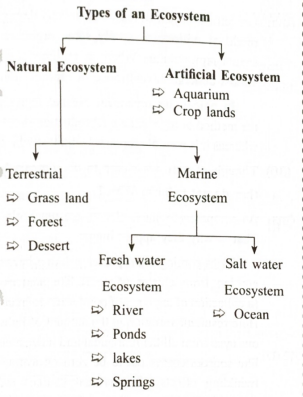
Explain the types of an ecosystem.
Answer
There are two major types of an ecosystem.
(1) Natural ecosystem
(2) Artificial or man-made ecosystem.
Image
View full question & answer
Question 242 Marks
Explain following words.
(1) Producers
(2) Consumers
Answer
(1) Producers : Green plants, cyanobacteria (Bluegreen algae) contain chlorophyll. They perform photosynthesis using the sun-light. They produce food (organic compounds). So they are called autotrophs. They store extra organic compounds.
(2) Consumers : They are dependent on stored food of producers. So they are called consumers. They are directly or indirectly dependent on food produced by producers.
→ Consumers are mainly classified into herbivores, carnivores, omnivores and parasites.
View full question & answer
Question 252 Marks
Find out the inappropriate pair from the following and correct it.
(a)Bio-magnificationAccumulation of chemicals at each stage of the food chain
(b)EcosystemBiotic components of the environment
(c)AquariumMan-made ecosystem
(d)ParasiteAn organism that obtains nutrition from other organisms
Answer
(b) Ecosystem : The system formed of both biotic and abiotic components.
View full question & answer
Question 262 Marks
Answer in one word for each sentences.
Sentence A : The physical and biological world where living organisms live
Sentence B : The phase of food chain where energy is converted from one form to another.
Sentence C : Physical factors like temperature, rainfall, wind, soil, etc of an ecosystem.
Sentence D : Organisms, which are directly or indirectly dependent on producers for their food.
Answer
(A) Environment
(B) Trophic level
(C) Abiotic factors
(D) Consumers
View full question & answer
Question 272 Marks
What is biological magnification? Will the levels of this magnification be different at different levels of the ecosystem?
Answer
→ Uncontrolled use of pesticides and other chemicals to protect crops from diseases or pests increases the concentration of there chemicals in soil and water.
→ From the soil or water, they enter into the plant bodies and then into the herbivores and carnivores.
→ These chemicals do not degrade, they accumulate progressively at each trophic level. The phenomenon is known as biological magnification.
View full question & answer
Question 282 Marks
Will the impact of removing all the organisms in a trophic level be different for different trophic levels ? Can the organisms of any trophic level be removed without causing any damage to the ecosystem ?
Answer
Yes, the impact of removing all the organisms in a trophic level will be different for different trophic levels. For example, if we remove the producers, there will be no food for the consumers so all the consumers of different trophic levels also die,
View full question & answer
[2 Mark Questions] - Science STD 10 Questions - Vidyadip