Questions

[4 marks Questions]

🎯

Test yourself on this topic

11 questions · timed · auto-graded

Question 14 Marks
Distinguish between : Producer organisms and Consumer organisms
Answer
Producer organisms Consumer organisms
$1$. These are autotrophic organisms. $1$. These are heterotrophic organisms.
$2$. They transform solar energy into chemical energy and prepare food through photosynthesis for themselves as well as for other organisms. $2$. They consume other organisms or their products for their food.
$૩$. Green plants in terrestrial ecosystem and various types of algae in aquatic ecosystem are producers. $3$. Animals are consumers in any ecosystem.
$4$. Producers are not divided in any specific category. $4$. Consumers are divided as herbivores, carnivores, omnivores and parasites categories.
View full question & answer
Question 34 Marks
Explain: Food web
Answer
 
  • Living organisms depend on each other for their food requirement and form a food chain.
  • Among the various ecosystems, each one is having definite food chain.
  • The trophic inter-relationship between animals in nature cannot be explained as simple chains only.
  • The length and complexity of food chains vary greatly.
  • Each organism is generally eaten by two or more other kinds of organisms which in turn are eaten by several other organisms.
  • So, instead of a straight-line food chain, the relationship can be shown as a series of branching lines called a food web.
View full question & answer
Question 44 Marks
State the points of explanation which are derived from the study of flow of energy in an ecosystem.
Answer
  • From the study of flow of energy in an ecosystem, following points of explanation are derived :
  • $(1)$ The green plants capture only about $1 \%$ of the energy from the total available solar energy and convert it into food.
  • $(2)$ A large amount of energy is lost as heat to the environment during the flow of energy from one trophic level to next.
  • $(3)$ Compared to producers, consumers utilise more energy.
  • $(4)$ Continuous supply of energy is required for an ecosystem.
  • $(5)$ At every trophic level, organisms utilise energy for growth, reproduction, etc.
  • $(6)$ On an average, $10 \%$ of available energy gets transferred from one trophic level to next in food chain.
  • $(7)$ Food chains generally consist of three or four steps. After four trophic levels very little usable energy remains in the food chain.
  • $(8)$ Producers occur in the largest number whereas top level carnivores are in the smallest number.
View full question & answer
Question 54 Marks
Describe energy flow in an ecosystem.
Answer
  • Each step or level of food chain forms a trophic level.
  • Energy flow begins with producers in it.
  • The producers (green plants) are at the first trophic level.
  • They absorb light energy and through photosynthesis convert it in chemical energy as a food.
  • The energy then moves up to higher level organisms like herbivores.
  • After that when carnivores eat herbivores, energy is transfered to carnivores.
  • Thus, the flow of energy takes place from producer organisms to various levels of consumers.
  • So, entrance for solar energy in an ecosystem is green plant which form the source of energy for consumers.
  • Chemical energy is helpful for the processes of living world.
  • The flow of energy in an ecosystem is always unidirectional.
  • The energy that is captured by green plants does not revert back to the sun and the energy which passes to the herbivores does not come back to the autotrophs.
  • As energy moves progressively through the various trophic levels it is no longer available to the previous level.
View full question & answer
Question 64 Marks
Explain the components of an ecosystem.
Answer
  • Each ecosystem consists of two main components:
  • (1) Abiotic components:
  • All the non-living constituents of an ecosystem are included in the abiotic components.
  • Abiotic components are the physical factors like temperature, rainfall, wind, soil, light, minerals, etc.
  • (2) Biotic components:
  • All living organisms of an ecosystem are included in the biotic components.
  • Organisms can be grouped as producers, consumers and decomposers according to their food habit.
  • Their mode of sustenance forms the trophic relationship in the environment.
  • (i) Producers:
  • Those organisms which can make organic compounds like sugar and starch from inorganic substances using solar energy in presence of chlorophyll are called producers.
  • e.g., Certain bacteria, various kinds of algae and all green plants.
  • (ii) Consumers:
  • Those organisms which consume the food produced either directly from producers or indirectly by feeding on other consumers are called consumers.
  • e.g., Non-chlorophyllous and heterotrophic organisms.
  • Consumers can be divided into four categories.
(iii) Decomposers:
  • The microorganisms which breakdown the complex organic substances into simple inorganic substances are called decomposers.
  • e.g., Certain bacteria and fungi, breakdown the dead remains and waste products of organisms.
View full question & answer
Question 74 Marks
Explain the components of ecosystem.
Answer
Ecosystem consists of 2 components.
(1) Biotic components (2) Abiotic components
→ Biotic components : All the living organism constitute biotic component of ecosystem. It includes three types of organisms.
→ Producers: The organism which can prepare their own food material from inorganic substances using solar energy are called as produces, they can also be called as autotrophs. eg Blue green algae, all green plants.
→ Consumers : These organisms consumers other organisms or their products as food. All animals are included in this category. They can be further classified as
(a) Herbivores : These animals consumer plants eg. Goat, Cow etc.
(b) Carnivores: These animals consumer herbivores eg. Lion, Shake, frog etc.
(c) Omnivores : These animals consumer both plants and animals eg. Human.
(d) Parasites : Line \& on feed on host body and causes harm to them. eg Plasmodium, head lice etc.
→ Decomposers : The organisms which converts complex compounds of dead plants and animals into simpler form. They are also called as reducers. eg. Bacteria, Fungi.
→ Abiotic Components : They are non-living components which includes physical environment like Air, temperature, soil texture, water etc.
View full question & answer
Question 84 Marks
Explain the flow of energy in the ecosystem
Answer
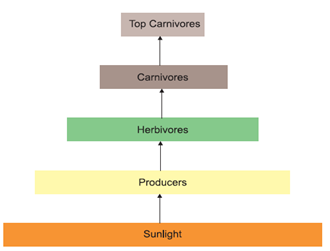
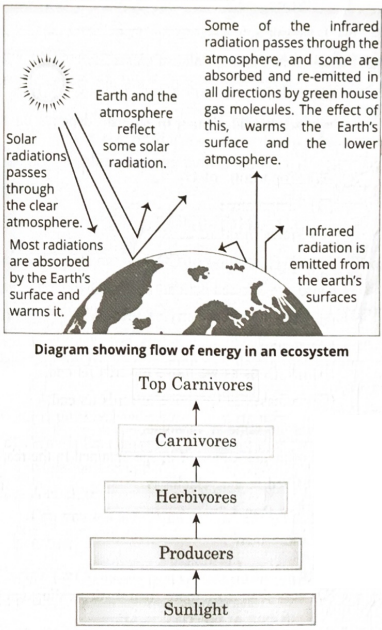
→ We know that, the food we eat acts as a fuel to provide us energy to do work. Thus the interactions among various components of the environment involves flow of energy from one component of the system to another. As we have studied, the autotrophs capture the energy present in sunlight and convert it into chemical energy. This energy supports all the activities of the living world.
→ From autotrophs, the energy goes to the heterotrophs and decomposers. However, as we studied in the previous chapter on "Sources of Energy", when one form of energy is changed to another, some energy is lost to the environment in forms which cannot be used again. The flow of energy between various components of the environment has been extensively studied. Some of the conclusions are as follows :
→ The green plants in a terrestrial ecosystem capture about $1 \%$ of the energy of sunlight that falls on their leaves and convert it into food energy.
→ When green plants are eaten by primary consumers, a great deal of energy is a lost as heat to the environment, some amount goes into digestion and in doing work and the rest goes towards growth and reproduction. An average of $10 \%$ of the food eaten is turned into its own body and made available for the next level of consumers.
→ Thus we can say that, $10 \%$ can be taken as the average value for the amount of organic matter that is present at each step and reaches the next level of consumers. Little energy is available for the next level of consumers.
Image
→ From the figure, two things become clear Firstly, the flow of energy is unidirectional. The energy that is captured by the autotrophs does not revert back to the solar input and the energy which passes to the herbivores does not come back to autotrophs. As it moves progressively through the various trophic levels it is no longer available to the previous level. Secondly, the energy available at each trophic leyel gets diminished progressively due to loss of energy at each level.
View full question & answer
Question 94 Marks
Describe : Various food chains.
Answer
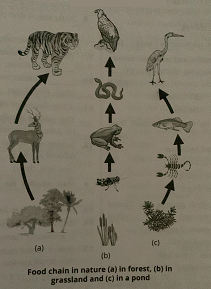
→ Various organisms feed on one another. This series of organisms taking part at various biotic levels form a food chain.
→ Three different food chains are mentioned in the following diagram.
Image
(Note : It is not necessary to draw diagram)
(1) Food chain in forest :
→ Plants $\rightarrow$ herbivores $\rightarrow$ Carnivores $\rightarrow$ Top Carnivores
(2) Food chain in grassland :
→ $
\text { Grass } \rightarrow \text { Insects } \rightarrow \text { Frogs } \rightarrow \text { reptiles } \rightarrow \text { Birds }
$
(3) Food chain in a pond :
→ Aquatic plants $\rightarrow$ Scorpion $\rightarrow$ Fishes $\rightarrow$ Birds like herons
(Note : In food chain, scorpions are generally found on land (Ground-feeding animals). Example of crabs are more suitable than scorpions.)
→ Each step of the food chain constitutes a nutrient level (trophic level). The autotrophs or the producers are at the first trophic level. They fix up the solar energy and make it available for heterotrophs or the consumers. The herbivores or the primary consumers come at the second trophic level small carnivores or the secondary consumers at the third and larger carnivores or the tertiary consumers form the fourth trophic level.
View full question & answer
Question 104 Marks
Explain the location, importance and degradation of ozone layer.
Answer
→ Location of Ozone Layer : The stratosphere is located at the height of $50 km$ above the surface of the earth. Ozone layer is present in this stratosphere.
→ Importance of Ozone layer : Ozone atom protects the organisms on earth by absorbing the UV radiations of 310 to $200 nm$ (nanometer) wavelength.
Image
⇒ Degradation of Ozone layer :
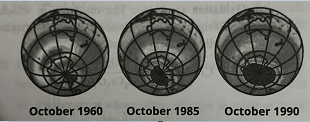
→ Depletion of stratospheric ozone is a serious global problem. It is registered for the first time in the year 1980.
→ Depletion of Ozone layer has been reported all over the earth.
→ Ozone depletion in the south pole region has been $40 \%$ to $50 \%$. Such a large phenomenon is called an ozone hole. Such ozone hole has also been reported in the North pole region.
→ Spread of Ozone holes even in human habitation areas exists.
→ Whether this will happen or not depends on weather conditions and existence of impurities in the atmosphere.
→ Addition of chlorine (Cl) in the atmosphere is the main responsible factor for the depletion of the ozone layer.
Image
→ The reaction of Chlorine molecule with ozone, remover oxygen molecules one by one. In this splitting, one molecule of chlorine splits $1,00,000$ atoms of ozone.
→ CFC (Chlorofluorocarbon) is considered the major compound responsible for $80 \%$ of the total depletion of stratospheric ozone.
→ Freon, used in refrigerators and air conditioners, is one of these substances.
View full question & answer
Question 114 Marks
Discuss the formation of Ozone layer.
Answer
→ Ozone $\left(O_3\right)$ is a molecule formed by three atoms of oxygen. While Oxygen $\left( O _2\right)$ is essential for all aerobic forms of life, Ozone is a deadly poison ous, However, at the higher levels of the atmosphere, Ozone performs an essential function. It shields the surface of the earth from ultraviolet (uv) radiation. from the sun. This radiation is highly damaging to organisms. For example., it causes skin cancer in human beings.
→ Ozone at the higher levels of the atmosphere is a product of $( UV )$ radiation acting on oxygen $\left( O _2\right)$ molecule. The higher energy UV radiations split apart some molecular. Oxygen $\left( O _2\right)$ into free oxygen $(O)$ atoms.
→ These free oxygen atoms then combine with the molecular oxygen to form ozone as shown in the following reaction.
(1) $O _2 \xrightarrow{ UV } O + O$
(2) $O + O _2 \rightarrow O _3$ (Ozone)
→ The amount of ozone in the atmosphere began to drop sharply in the $1980 s$. This decrease has been linked to synthetic chemicals like chlorofluorocarbons (CFCs). Which are used as refrigerants and in fire extinguishers. In 1987, the United Nations Environment Programme (UNEP) succeeded in forging an agreement to freeze CFC production at 1986 levels
View full question & answer
[4 marks Questions] - Science STD 10 Questions - Vidyadip