Questions

[2 Mark Questions]

🎯

Test yourself on this topic

36 questions · timed · auto-graded

Question 12 Marks
State the organs of human respiratory system.
Answer
The organs of the human respiratory system are:
    1. Nose (or nasal cavity) – for inhaling air and filtering out dust and other particles.
    2. Pharynx – the throat, a passage for both air and food.
    3. Larynx – also known as the voice box, it contains the vocal cords.
    4. Trachea – the windpipe, a tube that carries air to the lungs.
    5. Bronchi – two main branches from the trachea that lead to the left and right lungs.
    6. Bronchioles – smaller branches of the bronchi within the lungs.
    7. Alveoli – tiny air sacs in the lungs where gas exchange occurs (oxygen enters the blood, and carbon dioxide is removed).
    8. Lungs – the main organs where oxygen is absorbed into the bloodstream and carbon dioxide is expelled.
View full question & answer
Question 22 Marks
What would be the consequences of a deficiency of haemoglobin in our bodies?
Answer
A deficiency of haemoglobin in our bodies leads to a disease called anaemia.
Due to this, cells of our body do not get sufficient oxygen for cellular respiration, which may lead to release less energy. Weakness, fatigue, tiredness, etc. conditions may arise.
View full question & answer
Question 32 Marks
How are the alveoli designed to maximise the exchange of gases?
Answer
The alveoli are located at the terminal ends of bronchioles. They are balloon- like structures provides large surface area for exchange of gases with an extensive network of blood vessels.
View full question & answer
Question 42 Marks
What are the necessary conditions for autotrophic nutrition and what are its by - products ?
Answer
The necessary conditions for autotrophic nutrition are : (1) Presence of chlorophyll, (2) Absorption light energy, (3) Splitting of water molecules and (4) Reduction of carbon dioxide to carbohydrates.
Oxygen is the by - product.
View full question & answer
Question 62 Marks
How are fats digested in our bodies? Where does this process take place?
Answer
Large fat globules break into small fine droplets by the effect of bile salts of bile juice. This is called emulsification of fats.
Pancreatic lipase acts on emulsified fats to break it and finally intestinal lipase digests fats into fatty acids and glycerol. This process take place in small intestine.
View full question & answer
Question 72 Marks
How is the amount of urine produced regulated?
Answer
The amount of urine formed depends on how much excess water there is in the body, and on how much of dissolved waste there is to be excreted. More water and dissolved wastes in the body will produce more urine. On the other hand, less water and less dissolved wastes will produced less urine.
View full question & answer
Question 82 Marks
Why is it necessary to separate oxygenated and deoxygenated blood in mammals and birds?
Answer
It is necessary to separate oxygenated and deoxygenated blood in mammals and birds because it allows a highly efficient supply of oxygen to the body and this is useful in their high energy needs for to maintain constant body temperature.
View full question & answer
Question 92 Marks
What happens if blood vessels develops a leak? ###What happens when we are injured and start bleeding?
Answer
In the situation when we are injured we start bleeding. This bleeding is stopped by clotting mechanism. Generally, the excessive bleeding would lead to a loss of pressure resulting in reduction of the efficiency of the pumping system.
To avoid this, the blood has platelet cells which circulate around the body and plug these leaks by helping to clot the blood at the point of injury.
View full question & answer
Question 102 Marks
How are the lungs designed in human beings to maximise the area for exchange of gases ?
Answer
The respiratory passage in the lungs. divides into smaller and smaller tubes which finally terminate in balloon-like structures alveoli.
The alveoli present in lungs provide the maximum area for exchange of gases in human beings.
View full question & answer
Question 112 Marks
How is oxygen and carbon dioxide transported in human beings?
Answer
In human beings, the respiratory pigment haemoglobin has high affinity for oxygen, so it Is mostly transported by haemoglobin. Carbon dioxide is more soluble in water than oxygen and hence it is mostly transported in dissolved form in our blood.
View full question & answer
Question 122 Marks
What advantage over an aquatic organism does a terrestrial organism have with regard to obtaining oxygen for respiration?
Answer
The amount of dissolved oxygen is fairly low in aquatic environment as compared to the amount of oxygen in the air. So, terrestrial organisms fulfil their oxygen demand with low breathing rate as compared to aquatic organisms.
View full question & answer
Question 132 Marks
Where do plants get each of the raw materials required for photosynthesis?
Answer
Raw materials required for photosynthesis :
(1) CO2 : Plants get it from atmosphere.
(2) H2O : Plants root absorbed it from soil.
(3) Energy : Plants get it directly from sun.
View full question & answer
Question 142 Marks
How do desert plants differ from other plants grown in normal habitat on the basis of reduction of CO2?
Answer
Plants grown in normal habitat take up carbon dioxide during day and synthesise carbohydrates during day time. Whereas desert plants take up carbon dioxide at night and prepare an intermediate which is acted upon by the energy absorbed by chlorophyll during the day.
View full question & answer
Question 152 Marks
Why the energy and the materials from outside are needed in our body? What is the source for these?
Answer
When we walk or ride a bicycle or do any apparent activity, we are using up energy. Even when we are not doing any apparent activity, energy is needed to maintain a state of order in our body.
We also need materials from outside in order to grow, develop, synthesise protein and other substances needed in the body.
The food we eat is the source of energy and materials.
View full question & answer
Question 162 Marks
What are outside raw materials used for by an organisms?
Answer
 Name of outside raw materials Used for
1.CO2, H2O1.Photosynthesis by plants
2.Carbon based food source, O22.Respiration by aerobic organisms
View full question & answer
Question 172 Marks
Why is diffusion insufficient to meet the oxygen requirement of multicellular organisms like humans?
Answer
In multicellular organisms like human, all the cells are not in direct contact with the surrounding environment. The body structure is more complex and the body size is also large. Therefore, simple diffusion will not be sufficient to send oxygen to every cell. It has been estimated that a period of 3 years would be needed to carry a molecule of O2 from our lungs to reach our toes through diffusion.
So, diffusion is insufficient to meet the oxygen requirement of multicellular organisms like humans.
View full question & answer
Question 182 Marks
Why are molecular movements needed for life?
Answer
Living organisms are made up of cells and tissues. Due to natural wear and tear, the orderliness of structure of body may be lost. Therefore, molecular movements are needed for repair and maintenance of the body. This keeps the body alive.
View full question & answer
Question 192 Marks
Explain: Why using visible movement as the defining characteristic of life is not enough.
Answer
Running, chewing, shouting, etc. are common examples of voluntary movements. Even animals/human when asleep, show breathing which is one kind of involuntary movement.
The growth of plant is considered as a movement.
Involuntary movements in animals and growth related movements in plants may not be visible. But still they indicate life. Molecular movements are also invisible, which still keep the bodies alive.
So, using visible movement as the defining characteristic of life is not enough.
View full question & answer
Question 202 Marks
Define:
Excretion
Answer
The biological process involved in removal of nitrogenous metabolic wastes from the body is called excretion.
View full question & answer
Question 212 Marks
Define:
Transpiration
Answer
A process of loss of water in the form of vapour from the aerial parts of the plant is known as transpiration.
View full question & answer
Question 232 Marks
Define:
Respiration
Answer
A process of breakdown of food source such as glucose, in presence or in absence of oxygen inside the living cell to provide energy for cellular need is called respiration.
View full question & answer
Question 242 Marks
Define:
Digestion
Answer
A process by which complex food components are transformed into simple, soluble and absorbable form with the help of enzymes is called digestion.
View full question & answer
Question 252 Marks
Define:
Heterotrophs
Answer
Those organism which utilise complex food material prepared by other organisms are called heterotrophs.
View full question & answer
Question 262 Marks
Define:
Autotrophs
Answer
Those organisms which utilise simple inorganic sources in the form of carbon dioxide and water and synthesise complex food are called autotrophs.
View full question & answer
Question 272 Marks
Define:
Photosynthesis
Answer
A process of synthesis of simple form of carbohydrate, i.e. glucose with the use of solar energy, water and carbon dioxide in presence of chlorophyll is called photosynthesis.
View full question & answer
Question 282 Marks
Define:
Nutrition
Answer
A process of transfer of a source of energy from outside the body of the organism to the inside is called nutrition.
View full question & answer
Question 292 Marks
Answer
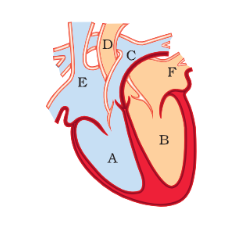
(1) A - Right ventricle, B - Left ventricle, E - Right atrium, F - Left atrium.
(2) Tricuspid valve and Bicuspid valve
(3) E - Right atrium, tricuspid valve and A - Right ventricle
(4) F - Left atrium, bicuspid valve and B - Left ventricle
View full question & answer
Question 322 Marks
Fill the blanks in given table with reference to digestion process in human :
OrganFood componentEnzymeProduct after digestion
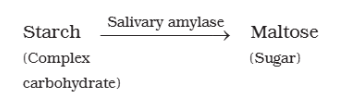
MouthStarch_____(i)_____Simple sugar
Stomach_____(ii)_____PepsinSimple protein
Small intestineProtein_____(iii)_____Amino acids
FatLipase_____(iv)_____
Answer
(i) Amylase (ii) Protein (iii) Trypsin (iv) Fatty acid and glycerol
View full question & answer