Questions

[3 Mark Questions]

🎯

Test yourself on this topic

43 questions · timed · auto-graded

Question 13 Marks
Answer
(1) Several factors such as infections, injury or restricted blood flow to kidney reduce the activity of kidneys. This leads to accumulation of toxic nitrogenous substances, gradually may lead to kidney failure.
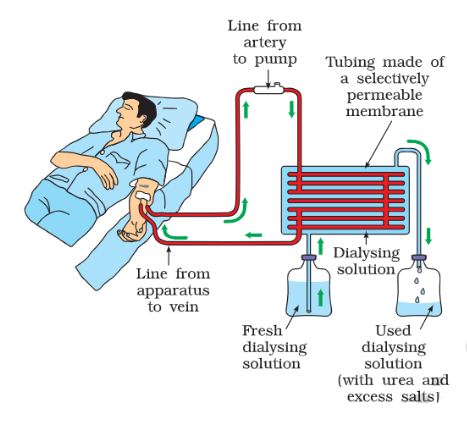
(2) An artificial kidney is a device to remove nitrogenous waste products from the blood through dialysis.
(3) Artificial kidneys contain a number of tubes with a semi-permeable lining, suspended in a tank filled with dialysing fluid. This fluid has same osmotic pressure as blood but nitrogenous nitrogenous wastes are absent.
As shown in diagram, patient's blood is passed through tubes. During this, nitrogenous waste products from blood pass into dialysing fluid by diffusion. The purified blood is pumped back into the patient's vein.
View full question & answer
Question 23 Marks
Your neighbour is a chain-smoker. He often suffers from cough and lung infection. His relatives often tell him to leave smoking.
(1) How inhaled air is filtered in the upper part of respiratory tract ?
(2) Which is the effect of smoking on the upper part of respiratory tract?
(3) Why do you call smoking as injurious to health?
Answer
(1) The upper part of respiratory tract is provided with small hair-like structures called cilia, which help to remove germs, dust and other harmful particles from inhaled air.
(2) Smoking destroys hair like cilia due to which germs, dust, smoke and other harmful chemicals enter lungs and causes harm.
(3) Smoking reduces the breathing efficiency of lungs, may cause various infection and even lung cancer. So, called it is injurious to health. Cigarette contains nicotine which can cause cancer to the respiratory organs.
View full question & answer
Question 33 Marks
Your uncle often complains about indigestion of after having oily food. He consults a doctor and is diagnosed with stone in gall bladder. Doctor advised him to remove gall bladder surgically.
(1) What is the function of gall bladder?
(2) Which process initiates the digestion of oils?
(3) After surgery, which type of food should be given to uncle?
Answer
(1) Gall bladder stores bile juice.
(2) Emulsification (i.e., bile salts breakdown large oil globules into fine small droplets) process initiate the digestion of oils.
(3) After surgery, food with low fat content, i.e., less oil, ghee, butter, etc. is advisable.
View full question & answer
Question 43 Marks
Your younger brother complains about pain in teeth. You often notice that he frequently eats chocolates and pastries. Even he likes to eat sweets.
(1) What do you think about the pain in teeth?
(2) Which advise will you give to your brother?
(3) What will happen if this problem is untreated?
Answer
(1) Sugar content is very high in chocolates, pastries and sweets. Bacteria act on sugars and produce acidic substances. Acids soften the enamel, i.e., cause dental caries or tooth decay.
Masses of bacterial cells together with food particles stick to the teeth to form dental plaque. This is responsible for pain in teeth.
(2) Brushing the teeth after eating, will remove plaque.
(3) If this problem is untreated, microorganisms may invade the gums causing inflammation and infection.
View full question & answer
Question 53 Marks
Compare the functioning of alveoli in the lungs and nephrons in the kidneys with respect to their structure and functioning.
Answer
Alveoli Nephrons
1.It is a structural and functional unit of lung1.It is a structural and functional unit of kidney.
2.Alveoli are balloon-like structures at the terminal region of bronchioles.2.Nephrons are long-coiled tube-like structures having Bowman's capsule at the tip.
3.The alveoli provide a surface for exchange of gases.3.Filtration of blood for removing of nitrogenous wastes take place in nephron units.
4.The wall of the alveoli contain an extensive network of blood vessels.4.A cluster of blood capillaries associated with Bowman's capsule called glomerulus and tubular part of nephron is surrounded by network of blood capillaries.
View full question & answer
Question 63 Marks
What are the differences between the transport of materials in xylem and phloem?
Answer
In xylem In phloem
1.Water and minerals are transported.1.Food especially carbohydrate, sucrose is translocated.
2.Transpiration pull becomes the major driving force for transport in xylem2.Osmotic pressure is responsible for translocation in phloem.
3.Generally ATP is not used for transport of material in xylem.3.Phloem tissue uses ATP for translocation of food materials.
4.Vessels and tracheids are involved in transport4.Sieve tube and companion cells are involved in translocation.
View full question & answer
Question 73 Marks
Describe double circulation of blood in human beings. Why is it necessary?
Answer
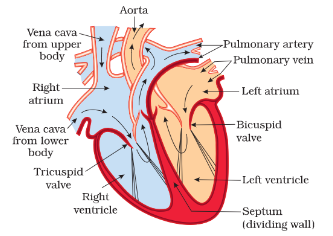
Blood passes through the heart twice during each cycle in human beings. This is called double circulation.
[Deoxygenated blood from different organs is drained and finally through vena cava it is poured in right atrium. From here this blood is transported to lungs via right ventricle. In lungs, blood become oxygenated and is again transported to left atrium. From here it transports in left ventricle and then by aorta to different body parts.]
It is necessary because it allows a highly efficient supply of oxygen to the body cells, which fulfill the high energy need of body.
View full question & answer
Question 83 Marks
What are the differences between aerobic and anaerobic respiration? Name some organisms that use the anaerobic mode of respiration.###Differentiate between Aerobic respiration and Anaerobic respiration.
Answer
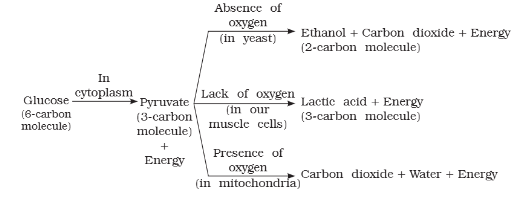
Aerobic respiration Anaerobic respiration
1.O2 is used in this process.1.O2 is not used in this process.
2.At the end of this process CO2 and H2O are produced.2.At the end of this process in medium of plant origin Ethanol and CO2 are produced and in medium of animal origin only lactic acid is produced and no CO2.
3.In aerobic respiration complete oxidation of glucose molecules occurs, in which one mole of glucose on oxidation releases much greater energy.3.In anaerobic respiration glucose molecules are incompletely oxidized, so one mole of glucose releases less energy along with the organic by - products.
4.There are two phases in aerobic respiration, the first phase occurs in the cytoplasm and does not utilize O2. The second phase occurs in the mitochondria and utilizes O2.4.There is only one phase in anaerobic respiration. It occurs in the cytoplasm. It occurs entirely in the absence of O2.
Name of organisms that use the anaerobic mode of respiration : Yeast and some other fungi, certain bacteria, endoparasites.
View full question & answer
Question 93 Marks
What are the methods used by plants to get rid of excretory products?
Answer
Unlike animals, the plants do not possess any special organs or system for excretion. However, the plants excrete their wastes in different ways :
(1) O2 produced during photosynthesis by the green plants is set free directly in the atmosphere.
(2) Plants remove surplus water by the process of transpiration through the stomata.
(3) Sometimes plants store certain wastes in the cells of their leaves which are ultimately shed off.
(4) Certain plants store wastes in the cellular vacuoles of their cells.
(5) Other waste products such as resin and gum are stored especially in old xylem.
(6) Plants excrete some waste substances into the soil around them.
View full question & answer
Question 103 Marks
What is excretion? What strategy is used by animals to do this?
Answer
The biological process involved in the removal of harmful nitrogenous metabolic wastes from the body is called excretion. Various metabolic activities in animal body generate these nitrogenous waste materials which should be excreted out.
Different organisms use varied strategies for excretion.
$\rightarrow$ Many unicellular organisms remove these wastes by simple diffusion from the body surface into surrounding water.
$\rightarrow$ Complex multi-cellular animals use specialised excretory organs to perform the same function.
View full question & answer
Question 113 Marks
How is food transported in plants?
Answer
The transport of soluble products of photosynthesis is called translocation.
$\rightarrow$ Translocation occurs in the part of the vascular tissue known as phloem.
$\rightarrow$ Besides, the products of photosynthesis, the phloem transports amino acids and other substances. These substances are especially delivered to roots, fruits, seeds and to growing organs where it is stored.
$\rightarrow$ The translocation of food and other substances takes place in the sieve tubes with the help of adjacent companion cells both in upward and downward directions.
$\rightarrow$ The translocation in phloem is achieved by utilising energy.
$\rightarrow$ Sucrose (Sugar/Carbohydrate) is transferred into phloem tissue using energy from ATP. This increases the osmotic pressure of the tissue causing water to move into it.
$\rightarrow$ This pressure moves the material in the phloem to tissues having less pressure. The phloem thus moves material according to the plant's need.
e.g., In the spring, sugar stored in root or stem tissue is transported to the buds which need energy to grow.
View full question & answer
Question 123 Marks
Why a proper system of transportation is essential in plants?
Answer
Plants are autotrophic. They take in simple substances in the form of inorganic compounds from their environment.
CO2 is taken from atmosphere by leaves for photosynthesis. From soil raw materials like N, P and other substances are absorbed by roots.
$\rightarrow$ If the distances between soil contacting organs and chlorophyll containing organs are small, energy and raw materials can easily diffuse to all parts of the plant body.
$\rightarrow$ But if these distances become large, then diffusion processes will not be sufficient.
$\rightarrow$ So, in higher plants to provide raw materials in leaves and energy in roots, a proper transportation system is essential.
View full question & answer
Question 133 Marks
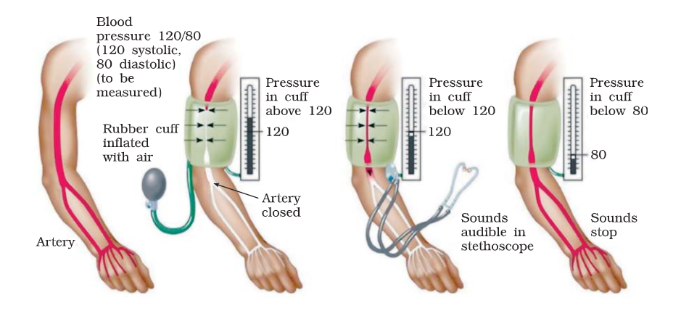
Answer the following questions regarding blood pressure :
(1) What is called blood pressure?
(2) What is called systolic and diastolic pressure?
(3) What is the normal value of systolic and diastolic pressure?
(4) Which instrument is use to measure blood pressure?
(5) What is hypertension? How it is caused?
View full question & answer
Question 143 Marks
What is lymph? How it is formed and transported? State the functions of it.###What is lymph? Write its function.
Answer
Lymph is a colourless fluid involved in transportation. It is also called tissue fluid.
Through the pores present in the wall of capillaries some amount of plasma, proteins and blood cells escape into intercellular spaces in the tissues to form the lymph or tissue fluid.
Lymph is similar to the plasma of blood but contains less protein.
Lymph drains into lymphatic capillaries from the intercellular spaces, which join to form large lymph vessels that finally open into larger veins.
Functions : (1) Lymph carries digested and absorbed fat from intestine.
(2) It drains excess fluid from intercellular space back into the blood.
View full question & answer
Question 153 Marks
Explain: The heart is our pump.###Explain the circulation path of blood in human heart. ###Draw the schematic sectional view (diagram) of human heart and also describe the circulation of blood in heart.
View full question & answer
Question 163 Marks
Write about blood and what are the features for an effective transport system.
Answer
Blood is a red colour fluid connective tissue.
$\rightarrow$ It consists of a fluid medium called plasma in which cells are suspended.
$\rightarrow$ Blood cells are red blood corpuscle (erythrocytes), white blood corpuscle (leucocytes) and platelets.
$\rightarrow$ Plasma transports food, carbon dioxide, salts and nitrogenous wastes in dissolved form. Oxygen is carried by red blood corpuscles.
The features for an effective transport system are as follows:
(1) A pumping organ to push blood throughout the body.
(2) A network of tubes to reach all the tissues.
(3) A system in place to ensure this network can be repaired if damaged.
View full question & answer
Question 183 Marks
Why respiratory pigment is essential in human beings?
Answer
When the body size of animals is large, the diffusion pressure alone cannot be sufficient to deliver oxygen to all parts of the body in short time.
If diffusion were to move oxygen in our body, it is estimated that it would take 3 years for a molecule of oxygen to get to our toes from our lungs.
Instead, respiratory pigment haemoglobin present in the red blood corpuscles, take up oxygen from the air in the lungs and carry it to tissues and cells of body through blood circulation. Oxygen is released to oxygen deficient tissue. Haemoglobin has a high affinity for oxygen, so it carries oxygen to all the cells of the body.
So, respiratory pigment is essential in human beings.
View full question & answer
Question 193 Marks
What requirements are essential for terrestrial animals for exchange of respiratory gases?
Answer
Terrestrial animals use the oxygen in the atmosphere for respiration. This oxygen is absorbed by different organs in different animals.
Following requirements are essential for terrestrial animals:
$\rightarrow$ All these organs have a structure that increases the surface area which is in contact with the oxygen-rich atmosphere.
$\rightarrow$ Since the exchange of oxygen and carbon dioxide has to take place across this surface, it is very fine and delicate.
$\rightarrow$ In order to protect this surface, it is usually placed within the body.
$\rightarrow$ There have to be passages that will take air to the surface for exchange of gases.
$\rightarrow$ There is a mechanism for moving the air in and out of this area where the oxygen is absorbed.
View full question & answer
Question 203 Marks
Explain gaseous exchange in plants.###Why do in plants sometimes CO2 eliminate and sometimes O2 in air?
Answer
Plants exchange gases through stomata and the large intercellular spaces of cells that are in contact with air. Carbon dioxide and oxygen are exchanged by diffusion.
$\rightarrow$ Carbon dioxide and oxygen can go into cells or away from them and diffuse out into the air.
$\rightarrow$ The direction of diffusion depends upon the environmental conditions and the requirements of the plant.
$\rightarrow$ At night, when there is no photosynthesis elimination of CO2 is major exchange activity taking place.
$\rightarrow$ During the day CO2 produced during respiration is used up for photosynthesis, hence there is no CO2 release.
$\rightarrow$ Instead, oxygen release is the major event during day.
View full question & answer
Question 213 Marks
Write short note: ATP
View full question & answer
Question 223 Marks
What is the role of hydrochloric acid (HCI) in digestion of food?###What are the functions of the acid in our stomach?
Answer
Role or Functions of the acid :
(1) Acid destroys the bacteria and other microorganisms that enter the stomach, along with the food.
(2) It converts the inactive enzyme pepsinogen into active enzyme pepsin.
(3)It provides acidic medium required for the action of pepsin.
Pepsin can digest proteins present in food only in acidic medium.
(4) Insoluble mineral salts get dissolved in acid.
View full question & answer
Question 233 Marks
What are the differences between autotrophic nutrition and heterotrophic nutrition?###Write three differences between autotrophic nutrition and heterotrophic Nutrition.
Answer
Autotrophic Nutrition Heterotrophic Nutrition
1.It occurs in green plants and some bacteria.1.It occurs in animals and fungi.
2.In such mode of nutrition, food is synthesised from inorganic components. i.e., CO2 and H2O.2.In such mode of nutrition food is consumed from other organisms.
3.Photosynthesis is important process for autotrophic nutrition.3.Food digestion is important for such nutrition.
View full question & answer
Question 243 Marks
Explain in details about small intestine.
Answer
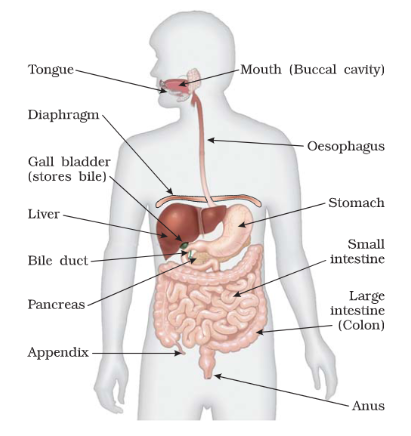
Small intestine is the longest part of the alimentary canal which is fitted into a compact space because of extensive coiling in human beings.
The length of the small intestine differs in various animals depending on the food they eat. Herbivores eating grass need a longer small intestine to allow the cellulose to be digested. Meat is easier to digest, hence carnivores like tigers have a shorter small intestine.
Digestion in small intestine : Small intestine is the longest part of the alimentary canal. It is the site of the complete digestion of carbohydrates, proteins and fat.
From the stomach, the food enters the small Intestine. Small intestine receives bile juice from liver and pancreatic juice from pancreas.
(1) Action of bile juice : The food coming from stomach is acidic and bile makes it alkaline for the pancreatic enzymes to act.
Bile salts break large fat globules present in food down into smaller globules. This process is called emulsification. This process increases the efficiency of enzyme action.
(2) Action of pancreatic juice : The pancreas secretes pancreatic juice which contains enzymes like trypsin for digesting proteins. pancreatic amylase for carbohydrates and lipase for breaking down emulsified fats.
(3) Action of intestinal juice : The wall of small intestine contain glands which secrete intestinal juice.
The enzymes present in it finally convert the proteins to amino acids, complex carbohydrates into glucose and fats into fatty acids and glycerol.
Absorption of digested food : Digested food is taken up by the walls of the intestine. The inner lining of the small intestine has numerous fingerlike projection called villi. Villi increase the surface area for absorption. The villi are richly supplied with blood vessels, which increase the efficiency of absorption of digested food.
View full question & answer
Question 263 Marks
How autotrophs meet their requirement of raw materials?
Answer
Autotrophs meet their requirement of raw materials by following :
(1) CO2 used in photosynthesis is taken from atmosphere through stomatal pores.
(2) Water used in photosynthesis is taken up from the soil by the roots in terrestrial plants.
(3) Other materials like nitrogen, phosphorous, iron and magnesium are taken up from the soil.
Nitrogen is an essential element used in the synthesis of proteins and other nitrogenous compounds. Nitrogen is taken up in the form of inorganic nitrates or nitrites. If may be taken up as organic compounds which have been prepared by bacteria from atmospheric nitrogen.
View full question & answer
Question 283 Marks
What is photosynthesis? Enlist the events that take place in process, giving the equation of photosynthesis.
Answer
A process by which carbon dioxide and water is converted into carbohydrates in presence of sunlight and chlorophyll is called photosynthesis.
Equation for the process of photosynthesis :
$6 CO _2+12 H _2 O \xrightarrow[\text { Chlorophyll }]{\text { Sunlight }} \underset{\text { Glucose }}{ C _6 H _{12} O _6}+6 O _2+6 H _2 O$
The following events occur in photosynthesis:
(1) Absorption of light energy by chlorophyll.
(2) Conversion of light energy into chemical energy, and splitting of water molecules into hydrogen and oxygen.
(3) Reduction of carbon dioxide into carbohydrate (glucose).
View full question & answer
Question 293 Marks
Write short note on autotrophic nutrition.
Answer
Autotrophic nutrition is shown by all photosynthetic organisms.
Photosynthesis is a process in which carbon dioxide and water are converted into carbohydrates in the presence of sunlight and chlorophyll.
All the green plants show autotrophic nutrition, by which they produce starch and some proteins.
Carbohydrates are utilised for providing energy to the plants. The excess carbohydrates are stored in form of starch, which is a complex carbohydrate. It serves as the internal reserve energy to be used as and when required.
View full question & answer
Question 303 Marks
How do living things get their food?###Explain the types of organisms on the basis the modes of nutrition.
Answer
The requirement for energy and materials is common in all organisms.
On the basis of the mode of nutrition, organisms are of two types:
(1) Autotrophs: These organisms use simple
food material obtained from inorganic sources in the form of carbon dioxide and water.
Green plants and some bacteria are autotrophs.
(2) Heterotrophs: These organisms utilise
complex substances from other organisms and broken down into simpler ones. To achieve this, organisms use bio-catalysts called enzymes.
The heterotrophs survival depends directly or indirectly on autotrophs.
Animals and fungi are heterotrophs.
View full question & answer
Question 313 Marks
Give scientific reason:
Respiration is important to keep the organism in living state.
Answer
The living cells of the body need energy for performing various vital functions. The energy is obtained by the biological oxidation of organic nutrients in the cell.
The process of breakdown of food sources for cellular needs either using oxygen or without oxygen is called respiration. The energy, so released is for continuation of various functions and thereby maintaining the living state of the organism. Thus. respiration is essential for life.
View full question & answer
Question 323 Marks
Give scientific reason:
Bile is an important digestive juice though it does not contain any digestive enzymes.
Answer
Bile is a greenish yellow alkaline digestive juice secreted from the liver cells. Bile contains bile salts, certain bile pigments but does not contain any digestive enzymes.
The bile salts turn the acidic food from stomach, alkaline and thereby provide alkaline medium for further reactions in intestine. Pancreatic enzymes and intestinal enzymes need alkaline medium. Bile salts emulsify the large fat globules into a very large number of very minute fat droplets and thereby greatly increase the exposed surface area of fat for the rapid action of lipases. Hence bile is an important digestive juice though it does not contain any digestive enzymes.
View full question & answer
Question 333 Marks
Give scientific reason:
The length of small intestine of herbivorous is relatively much longer than that of carnivorous.
Answer
The length of small intestine is different in different animals and that depends upon the nature of food taken by the animal.
The carnivorous eat flesh. The digestion of flesh as food is quite easy and rapid and there is very small amount of roughage. Hence these animals have short small intestine. The herbivorous eat grass and other vegetation. The cellulose of the plant cells is a complex substance and its complete digestion needs more space and time and hence longer small intestine and longer large intestine. Hence, the length of small intestine of herbivorous is relatively much longer than that of carnivorous.
View full question & answer
Question 343 Marks
Give scientific reason:
HCl (Hydrochloric acid) is an important constituent of gastric juice.
Answer
For the chemical digestion of food in stomach, the stomach secretes gastric juice from its gastric glands. HCl is one of the constituents of gastric juice.
HCl destroys the bacteria and other micro-organisms entering along with the ingested food and thereby prevent the decay of food in stomach. HCl provides acidic medium for the action of gastric enzyme. HCl converts inactive enzyme pepsinogen into an active enzyme pepsin. Pepsin acts in acidic medium on proteins and starts their digestion and convert them into preoteoses and peptones. Thus, HCl is an important constituent of gastric juice.
View full question & answer
Question 353 Marks
Give scientific reason:
The parasitic mode of nutrition is harmful for the host organism.
Answer
In parasitic nutrition, one organism depends fully for obtaining its nutritional needs. directly on other living organism. The latter is called a host from whom the parasite directly obtains food. The parasitic organism keeps close contact with the host and sucks or absorbs. nutrients from its body. The host goes on becoming weaker physically and physiological. The health of host thus is affected. Thus, the parasitic mode of nutrition is harmful for the host organism.
View full question & answer
Question 363 Marks
Give scientific reason:
The stomata in leaves keep on opening and closing.
Answer
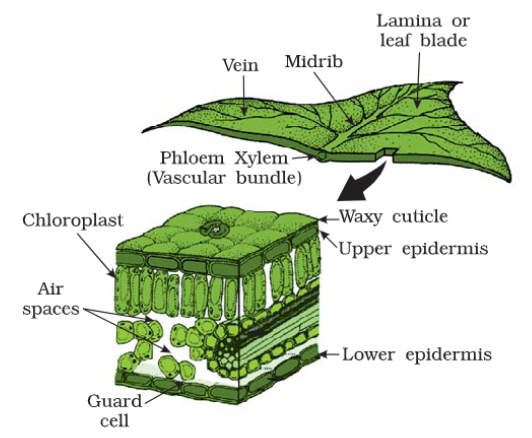
On one or both the surfaces of the leaves of flowering plants, there are numerous stomata as minute pores. Each of these pores is guarded by a pair of guard cells. The opening and closing of the stomata is controlled by these guard cells, which contain chloroplasts. When water enters the guard cells, the latter swell and cause the opening of stomata and when the guard cells lose water, the guard cells contract and cause the closing of stomata. Thus, the stomata in leaves keep on opening and closing due to entry and exit of water in the guard cells.
View full question & answer
Question 373 Marks
Give scientific reason:
The organisms possessing chlorophyll are autotrophs.
Answer
The organisms, possessing chlorophyll, can trap and utilize the solar energy to synthesize their own food using CO2 and water. This process of trapping the solar energy for synthesis of ones own food is called photosynthesis and the mode of nutrition of such organisms is called autotrophic. In photosynthesis, the food synthesized is the simplest hexose sugar-glucose, which is utilized for obtaining energy. The surplus glucose is stored as reserve food in the form of starch. Hence, the organisms possessing chlorophyll are autotrophs.
View full question & answer
Question 383 Marks
Give scientific reason:
The wall of the artery is thick and elastic while that of vein is relatively thin.
Answer
The arteries carry blood from the heart towards different organs. When the ventricles contract, the blood is pushed in the arteries under high pressure. In order to withstand this pressure, the arteries must have thick and elastic walls.
The veins receive blood from different organs and carry it to the heart. The blood in the veins flows at relatively low pressure. Hence, the wall of the veins is relatively thin and less elastic.
View full question & answer
Question 393 Marks
Give scientific reason:
Lymph separates from the blood and remixes with the blood.
Answer
The lymph oozes out through the pores in thin walls of the blood capillaries, as a fluid from the blood flowing through the capillaries. It flows very slowly in the intercellular spaces between the tissue cells. The intercellular spaces have no walls of their own and are called lymph capillaries. These lymph capillaries meet and join with each other to form larger ones which finally open in a vein to pour its contents. Thus, lymph, as a colourless watery fluid collects in a large lymph vessels that finally open in particular veins in the body to pour its contents back in blood.
View full question & answer
Question 403 Marks
Give scientific reason:
The right side chambers of the heart have deoxygenated blood and left side chambers have oxygenated blood in them.
Answer
The four-chambered heart, in man, is formed of two atria and two ventricles. All the four chambers of the heart are separated from each other by septa.
Deoxygenated blood from different organs of the body (except lungs) is brought through superior and inferior vena cava and poured in the right atrium and then into the right ventricle. Similarly oxygenated blood from the two lungs is brought through pulmonary veins and poured in the left atrium and then into the left ventricle. The four-chambered heart prevents the mixing of oxygenated blood with deoxygenated blood. Hence, the right side chambers of the heart have deoxygenated blood and the left side chambers have oxygenated blood in them.
View full question & answer
Question 413 Marks
Give scientific reason:
Translocation in the phloem takes place in both upward and downward directions.
Answer
The phloem transports amino acids, various plant hormones and other organic substances in addition to the products of photosynthesis.
Carbohydrates are synthesized in the leaves due to photosynthesis. These carbohydrates are transported to the roots and stem through phloem. The plant hormones synthesized in shoot apex flow downwards through the phloem and the plant hormones synthesized in the root apex and the food reserve stored in roots are transported upwards through the phloem. Thus, the translocation in the phloem takes place in both, upward and downward directions.
View full question & answer
Question 423 Marks
Give scientific reason:
In very tall plants, the suction force created due to transpiration is the main conducting force for water and mineral ions through the xylem.
Answer
The xylem tissue in all the organs of a plant remains connected to each other and forms a continuous path for the flow of water, etc. Thus, us a continuous water column is formed therein.
Mere root pressure, created in small herbs, is not sufficient to push water and minerals to the great height of very tall plants. The plants adopt another way to reach the target of fulfilling the water requirement. Evaporation of water molecules in the form of vapour occurs through stomata. Due to that a suction force arises in the cells. of leaves. This suction force comes into being from the cells of the leaves and is gradually experienced in the xylem of roots. As a result, the water column in the xylem rises up. Hence in very tall plants, the suction force created due to transpiration is the main conducting force for water and mineral ions through the xylem.
View full question & answer
Question 433 Marks
Give scientific reason:
Proper transportation (conducting) system is necessary in higher plants.
Answer
The green leaves of plants obtain CO2 from the atmosphere and synthesize carbohydrates. The plants, through their roots, absorb water and other raw mineral elements essential for the constitution of the body, from the soil. In higher plants the distance between the roots and the leaves being more, the water, mineral elements and the products of photosynthesis cannot be sent to all the different parts of the plant body, merely by diffusion from cell to cell. Therefore, in order to distribute all these substances rapidly and timely, a proper transportation (conducting) system is necessary in higher plants.
View full question & answer