Questions

[3 Mark Questions]

🎯

Test yourself on this topic

31 questions · timed · auto-graded

Question 13 Marks
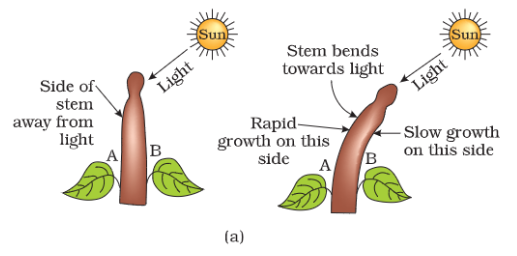
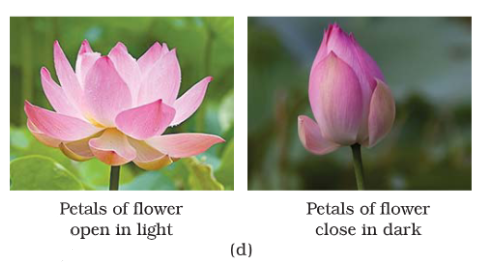
You were visiting your friend's house. You observed some indoor plants in drawing room. You noticed that shoots of all plants slightly moved towards open window. Aunty told you that she had often changed the position of the arrangement of plants. But in any position shoots of plants showed same behaviour.
(1) Which movements are shown by plants?
(2) Which hormone is responsible for such movement in plant?
(3) How such hormone is functioning in plant body?
(4) Which arrangement do you suggest for plants to show straight growth of shoot?
Answer
(1) Phototropism
(2) Auxin
(3) Auxin is synthesised at shoot tip and it diffuses towards shady side of the shoot. It stimulates the cells to grow longer on the side of the shoot which is away from light.
(4) Generally plants that are arranged in open area where they get direct sunlight, may grow straight shoots.
View full question & answer
Question 23 Marks
Your father-mother are in a age-group at forty plus. On their routine blood test, some disturbance in their blood tests were reported. Your family doctor advised your father to walk regularly and consume a diet containing low sugar. Doctor insisted your mother to take 25 mg elthroxine tablet daily.
(1) From your study, what do you think about the report of the blood test of your father?
(2) Which gland is not functioning properly and which hormone is not secreted in appropriate amount in your father's body?
(3) Which gland is affected in your mother's body?
(4) Why elthroxine tablet is suggested by the doctor?
Answer
(1) Blood sugar level may be more than the normal level in the blood of father.
(2) Pancreas, insulin
(3) Thyroid gland
(4) Elthroxine is a synthetic thyroxine. It fulfills the deficiency of thyroxine.
View full question & answer
Question 33 Marks
You saw a tragic road accident resulting in death of two persons. The reason for that is bike rider tried to overtake the truck from wrong-side with overspeed. He was not wearing a helmet that caused head injury.
You were scared because you also have same habit to drive activa without wearing helmet. Your father often warned you that to drive vehicle without a driving licence is a crime.
(1) Which part of brain is involved into learning how to drive vehicle?
(2) Injury to which part of brain leads to instant death of an individual? Why?
(3) Which gland became more active when you saw the accident? Which hormone was poured in blood? What changes did you feel in body?
Answer
(1) Cerebrum and Cerebellum
(2) Medulla oblongata. Because all involuntary activities are controlled by it. Injury to that part disturbs all involuntary functions and leads to instant death.
(3) Adrenal gland became more active. Adrenaline hormone was poured in blood.
Perspiration, increased heartbeats and breathing rate, etc. were the changes felt in the body.
View full question & answer
Question 43 Marks
Explain feedback mechanism for regulation of hormone secretion.
Answer
Hormones should be secreted in precise quantities as and when required. If body is not provided with adequate quantity of hormone then its functions suffer.
For this, we need a mechanism through which this regulation is achieved. The timing and amount of hormone secretion are regulated by feedback mechanisms.
e.g., If the sugar level in blood rises, it is detected by the cells of pancreas which respond by producing more insulin. Insulin helps in regulating blood sugar level. As the blood sugar level falls, insulin secretion is reduced.
View full question & answer
Question 53 Marks
For a particular situation which hormone prepares the human body for either fighting or running away from the situation? State the effect of this hormone in animal body.
Answer
Adrenaline hormone is secreted from adrenal gland in the body under the fight or flight situation.
The effect of adrenaline in body are as follows:
(1) The heartbeats become faster, resulting in supply of more oxygen to muscles.
(2) The blood supply to the digestive system and skin is reduced due to contraction of muscles around small arteries in these organs. This diverts the blood to skeletal muscles.
(3) The breathing rate increases because of the contractions of diaphragm and the rib muscles.
All these responses together enable the animal body to be ready to deal with the situation of fight or flight.
View full question & answer
Question 63 Marks
How is the movement of leaves of the sensitive plant different from the movement of a shoot towards light?
View full question & answer
Question 73 Marks
Explain the statement: Electrical impulses are an excellent means for coordination with its own limitations.
Answer
In case if a quick response to stimuli is to be made, electrical impulses are used. They are excellent means for coordination.
$\rightarrow$ The transmission of impulse in nerve fibre occurs very quickly. It is excellent for control and coordination.
But electric impulses have following limitations:
(1) Electric impulses will reach only those cells that are connected by nervous tissue.
(2) Electric impulses will not coordinate with each and every cell in the animal body.
(3) Nerve cells cannot continually create and transmit electric impulses. The cell will take some time to reset its mechanism before it can generate and transmit a new impulse.
View full question & answer
Question 83 Marks
State the types of movement in plants with examples.
Answer
Plants show two different types of movement.
(1) Growth dependent movement: When a seed germinates, the root goes down, the stem comes up into the air.
The directional movement of a seedling is caused by growth. If it is prevented from growing, it will not show any movement.
(2) Growth independent movement: When we touch the leaves of a chhui-mui ('touch-me-not plant of the Mimosa family), they begin to fold up and droop. The leaves of such plant move very quickly in response to touch. There is no growth involved in this movement.
View full question & answer
Question 93 Marks
What are the functions of nervous tissue? How muscle tissue respond to nervous impulses ?
Answer
Functions of nervous tissue : It collects information from receptors of sense organs, sends it to brain via spinal cord. Brain processes (Analyses) information, makes decisions based on information and conveys decisions to effectors such as muscles or glands.
Muscle tissue respond to nervous impulse : When a nerve impulse reaches the muscle, the muscle fibre moves. The movement at the cellular level begins. Muscle cells will move by changing their shape so that they shorten. Muscle cells have special proteins that change both their shape and their arrangement in the cell in response to nervous electrical impulses. Thus, muscle tissue brings about movement.
View full question & answer
Question 103 Marks
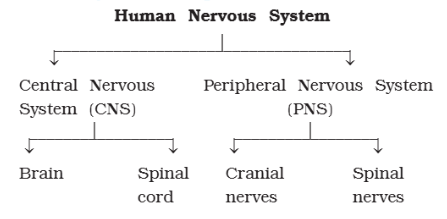
State the organization of human nervous system and general functions of it.
View full question & answer
Question 113 Marks
How does the design of the body solve a problem when immediate response is needed? Where should such connection be made?
Answer
Reflex are in the body design solve a problem, when immediate response needed.
$\rightarrow$ By reflex are, the process of detecting signal or the input and responding to it by an output action is completed quickly.
$\rightarrow$ The thinking about sensation of external stimulus is not involved in case of immediate response.
$\rightarrow$ Nerves from different body parts to the brain meet in the spinal cord.
$\rightarrow$ In case of immediate response, impulse is not transmitted from spinal cord to brain.
reflex are connection : Thus a neural pathway for the sensory and motor messages that pass through the spinal cord forms the reflex arc. A very rapid response is shown through it.
The following example can clarify the meaning of reflex are:
Suppose by mistake and unknowingly one touches a hot object by one's hand. One would withdraw the hand all of a sudden without giving a slightest thought. Here the hot object is the source of stimulus.
This stimulus activates the sensory nerve fibre in the hand and carry that impulse to the spinal cord. The sensory centres in the spinal cord receive the stimulus and transmits the response to the motor centre of the spinal cord. This motor message is transmitted through the motor nerve fibre to definite muscles of the hand, which upon contraction, withdraws the hand. The hand or its muscles act as effector organ. This entire neural path from the sensory or receptor organ, to the effector organ is a reflex arc.
View full question & answer
Question 123 Marks
Why reflex arcs have been evolved in animals? Explain.
Answer
Reflex arcs have been evolved in animals because the thinking process of the brain is not fast enough.
$\rightarrow$ Many animals have very little or none of the complex neuron network needed for thinking.
$\rightarrow$ So it is quite likely that reflex arcs have evolved as efficient way of functioning in the absence of true thought processes. However, even after complex neuron networks have come into existence, reflex arcs continue to be more efficient for quick responses.
View full question & answer
Question 133 Marks
Explain why we give slow response compared to reflex in any activity involved thinking.
Answer
Thinking is a complex activity and it is bound to involve a complicated interaction of many nerve impulses from many neurons.
$\rightarrow$ Thinking centres are located in fore-brain. It receives signals through nerves (Sensory) from various parts of the body. Thinking centres analyse the signals and prepare the instructions. From brain instructions are transmitted to effector organ through nerves (Motor).
$\rightarrow$ It takes more time to respond.
$\rightarrow$ In reflex action, instruction is generally given by spinal cord. So, the time to transmit impulse from organs to brain and from brain back to organ is saved in reflex action. That is why we give slow response when thinking is involved.
View full question & answer
Question 143 Marks
What is the meaning of reflex actions? Give examples.
Answer
Reflex action is involuntary instant action without the involvement of brain for bringing about important reaction needed for survival.
Examples of reflex action:
(1) Removal or withdrawal of hand or leg when anything sharp or hot touches unknowingly
(2) Coughing, Sneezing, Yawning
(3) Knee jerk response
(4) Movement of diaphragm
(5) Contriction of pupil in bright light
(6) Mouth starts watering when smell or sight of favourite/delicious food is there.
View full question & answer
Question 153 Marks
Answer
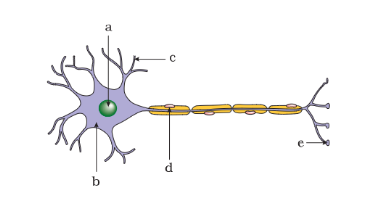
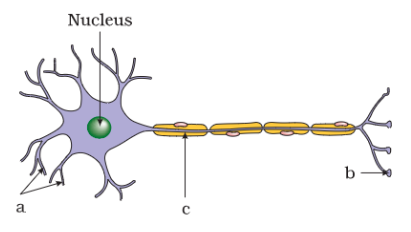
Parts of a neuron : a - nucleus, b - cell body, c - dendrite, d - axon, e - nerve ending.
(1) Information acquired at the end of the dendrite tip (c) of a nerve cell.
(2) Information travels through dendrite, cell body and along the axon (d) to its end as an electrical impulse.
(3) At synapse, this impulse is converted Into a chemical signal for onward transmission.
View full question & answer
Question 173 Marks
Why are there controlled movements in living organisms?
Answer
Movement is a characteristic of living organisms.
$\rightarrow$ Various movements are connected with each other to perform specific functions.
$\rightarrow$ Each kind of a change in the environment induce an appropriate movement for the response.
$\rightarrow$ The movement depends on the event that triggers it.
$\rightarrow$ To recognise various events in the environment, there are controlled movements.
View full question & answer
Question 193 Marks
Answer
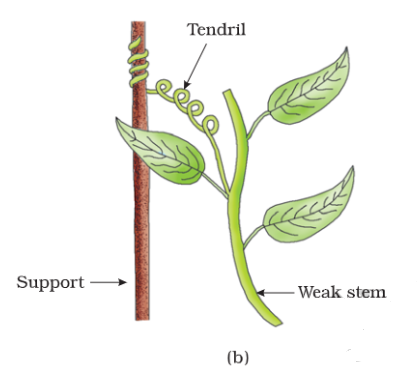
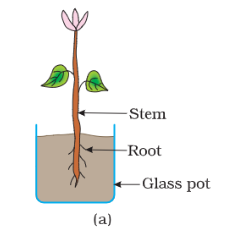
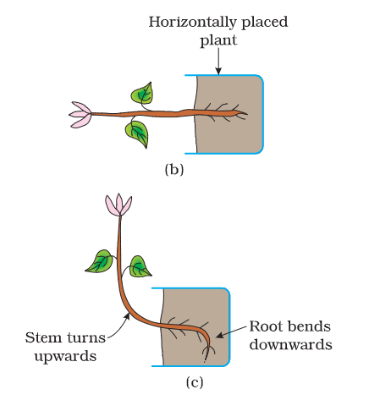
(1) The growth of root is negative phototropic and positive geotropic. The growth of stem is positive phototropic.
(2) When the plant was placed as in fig. (b), both stem and root were initially horizontal.
(3) The entire plant growth does not occur parallel to the soil surface because stem grows towards light and away from gravity.
(4) This experiment explains tropic movements due to growth in plant.
View full question & answer
Question 203 Marks
Answer
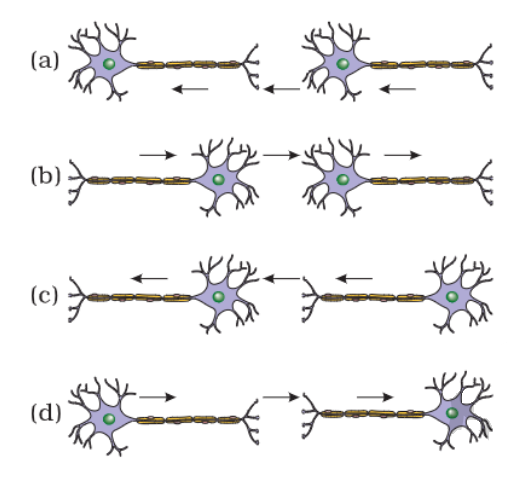
(1) Diagram (c) shows correct pathway for the conduction of impulse.
(2) A microscopic gap between nerve ending of axon of a neuron and dendrites of next neuron is called synaptic junction.
(3) Neuromuscular junction.
View full question & answer
Question 213 Marks
Give scientific reason:
It is advisable to take iodized salt in daily food
Answer
The hormone thyroxin is secreted from the thyroid gland. It is an iodized hormone (rich in iodine). Thyroxin is not formed when there is deficiency of iodine in the blood. As a result, the condition called hypothyrodism occurs in which the size of the thyroid gland gets gradually enlarged, this disease is called goitre. The iodized table salt provides proper amount of iodine for the formation of thyroxin in the thyroid gland.
Hence, it is advisable to take iodized salt in daily food.
View full question & answer
Question 223 Marks
Give scientific reason:
The diabetic patient is given injections of insulin.
Answer
It is necessary to maintain a definite blood sugar level in the human body. In the patients of diabetes the blood sugar level remains high due to the deficiency of insulin hormone from the pancreas. This higher blood sugar level causes several harmful effects. To prevent the diabetic patient from such harmful effects the blood sugar level is required to be maintained at certain definite level. Insulin is a hormone that reduces blood sugar level. Hence, the diabetic patient is given injections of insulin.
View full question & answer
Question 233 Marks
Give scientific reason:
The hormones secreted from the endocrine glands are present everywhere in the body.
Answer
The hormones are secreted from the endocrine glands which are ductless glands. These glands are richly supplied with blood. The secretions are directly poured in the blood stream. As the blood circulates in all the parts of the body, these hormones are carried and hence present everywhere in the body.
View full question & answer
Question 243 Marks
Give scientific reason:
The foot is very suddenly lifted off as soon as it comes in contact with a burning coal.
Answer
It is a reflex action-In this phenomenon, the impulse commencing from the sensory organ (the skin of the foot) enters into the spinal cord through the sensory nerve fibres. The impulse is analysed in the spinal cord and the responsive motor impulse is transmitted through the motor nerve fibres to the effector organ (the foot muscles) to contract and thereby show the response. So the foot is very suddenly lifted off as soon as it comes in contact with a burning coal.
View full question & answer
Question 253 Marks
Give scientific reason:
The central nervous system is very well protected.
Answer
The central nervous system comprises of a brain and a spinal cord.
Brain is contained in a fluid-filled balloon which absorbs mechanical shocks and thereby protect it from any severe injuries. Moreover, the brain is enclosed in a strong bony box-the cranium of the skull and the spinal cord is enclosed in a long and strong bony vertebral column. Thus, the central nervous system (of the human) is very well protected.
View full question & answer
Question 263 Marks
Give scientific reason:
The roots in plants grow against the direction of light.
Answer
The roots in plants show positive tropic movement in the direction of water and gravitational force, i.e., The roots show positive hydrotropism and positive geotropism.
Thus, the roots bend in the direction of water and gravitational force. So it grows against the direction of light.
View full question & answer
Question 273 Marks
Give scientific reason:
Unlike animals, the plants do not show immediate response.
Answer
All organisms show response to stimuli. However, the animals possess nervous system and sense organs, which are absent in plants. Animals use the nervous system as well as endocrine system for control and coordination of all their activities, while the plants possess only hormones to coordinate their activities. The hormones diffuse from cell to cell quite slowly in plants while most animals have blood for rapid transport of hormones. Because of all these reasons, the plants do not show immediate response.
View full question & answer
Question 283 Marks
Give scientific reason:
Response to stimuli is the characteristic of every living organism.
Answer
All living organisms experience the effects of changes in the atmosphere that surrounds them and tend to respond differently against them.
The living organisms show a slow or rapid response to stimuli such as heat, cold, sound, touch, pressure, etc. Responses are expressed against these stimuli through hormones in plants and nervous system as well as hormones in animals. e.g.. The plants bend in the direction of light. Man shows shivering effect in severe cold and perspiration in hot season.
Thus, the response to stimuli is the characteristic of every living organisms.
View full question & answer
Question 293 Marks
Answer
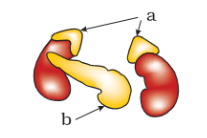
(1)
Name Location
aAdrenal glandaAt the anterior of kidneys
bPancreasbUnder the stomach in abdomen
(2) Functions of 'b' (Pancreas) : Secretes insulin and regulates blood sugar level. Secretes pancreatic juice and help in digestion.
(3) In a fear or tense condition 'a' (adrenal gland) is stimulated and secretes adrenaline hormone.
View full question & answer
Question 303 Marks
Answer
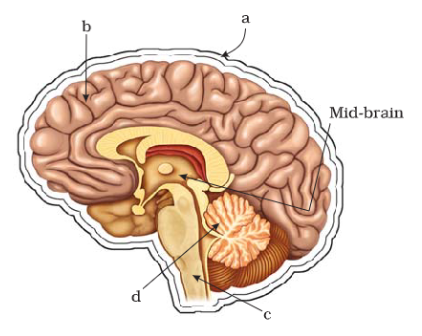
(1) a - Cranium (bony box).
Function: It protects brain.
(2) b - Cerebrum
(3) d - Cerebellum. It is responsible for precision of voluntary actions and maintaining the posture and balance of the body.
(4) c - Spinal cord. For quick response, the reflex arc is formed by it.
View full question & answer