Questions

[4 marks Questions]

🎯

Test yourself on this topic

21 questions · timed · auto-graded

Question 14 Marks
What is the difference between the manner in which movement take place in a sensitive plant and the movement in our legs?
Answer
Movement in a sensitive plantMovement in our legs
$\rightarrow$ It occurs in response to touch$\rightarrow$ It is voluntary action as per our need.
$\rightarrow$ Neural signals are not involved in such movement.$\rightarrow$ Neural signals from cerebellum are involved in such movements.
$\rightarrow$ No specific protein is present in plant cells for it$\rightarrow$ A specific protein is present in our muscle cells for it
$\rightarrow$ Plant cells change their shape by changing the amount of water in it.$\rightarrow$ A special proteins change both their shape and their arrangement in response to nervous impulses due to which the muscle cells shorten
View full question & answer
Question 24 Marks
Compare and contrast nervous and hormonal mechanisms for control and coordination in animals.
Answer
Nervous mechanismHormonal mechanism
$\rightarrow$ Neuron is the main functional unit in nervous mechanism.$\rightarrow$ Hormone acts as chemical messenger in hormonal mechanism.
$\rightarrow$ Impulse is generated at dendrite and it passes along the axon through cell body.$\rightarrow$ Hormone is secreted from endocrine gland and is transported through blood circulation.
$\rightarrow$ The neural responses are quick.$\rightarrow$ The hormonal actions are slow.
$\rightarrow$ Its effect is short lasting$\rightarrow$ Its effect is long lasting.
$\rightarrow$ Impulse is delivered to other neuron, gland or muscle cells.$\rightarrow$ Information is received by target cells who have specific molecules on their surfaces.
View full question & answer
Question 34 Marks
How are involuntary actions and reflex actions different from each other?
Answer
Involuntary actionsReflex actions
$\rightarrow$ These are controlled by medulla a part of hind-brain.$\rightarrow$ These are controlled by spinal cord in general
$\rightarrow$ Functioning of internal body parts are involuntary actions$\rightarrow$ It is involuntary response to external stimuli without the knowledge of cerebrum.
$\rightarrow$ Such actions go on continued under normal condition also. e.g., heartbeats, breathing. peristalsis, etc$\rightarrow$ It is shown under a condition of emergency. Such as to pull hand away on touching to hot object.
$\rightarrow$ It occurs in controlled rhythmic way$\rightarrow$ It is a quick action.
View full question & answer
Question 44 Marks
How does phototropism occur in plant?
View full question & answer
Question 54 Marks
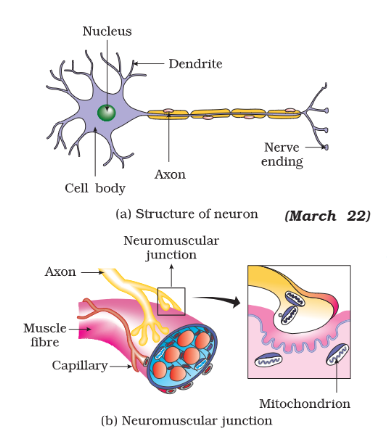
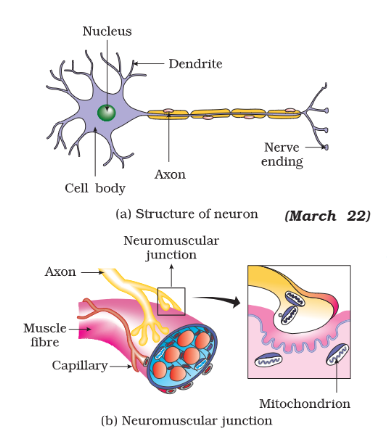
Draw the structure of a neuron and explain its function.
View full question & answer
Question 64 Marks
Explain disorders caused by hormonal imbalance in human beings.
Answer
Hormones are secreted in appropriate quantities. Imbalance in the concentration of hormone causes disorders. Such hormonal disorders are as follows:
(1) Giants: Due to excess secretion of growth hormone, individual becomes extremely tall.
(2) Dwarfism: Deficiency of growth hormone in childhood leads to dwarfism (very short).
(3) Goitre: Iodine deficiency in our diet affect the synthesis of thyroxin and cause goitre. Due to enlarged thyroid gland, swelling in neck region seen.
(4) Diabetes: If insulin is not secreted in appropriate amounts, the sugar level rises in the blood. It causes diabetes.
View full question & answer
Question 74 Marks
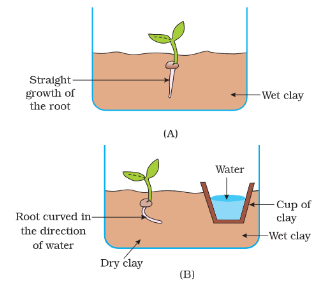
Design an experiment to demonstrate hydrotropism.
View full question & answer
Question 84 Marks
Describe plant hormones.###State the names of plant hormones and their effects.
Answer
Plant hormones: They help to coordinate growth, development and response to environment.
They are synthesised at places away from where they act and simply diffuse to the area of action.
(i) Growth promoting hormones:
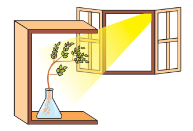
(1) Auxin: It is synthesised at the shoot tip. It helps cells to grow longer. When light is coming from one side of the plant, auxin diffuses towards the side of the shoot which is in shade. Specific concentration of auxin stimulates the cells to grow longer on the side of the shoot which is away from light. Thus plant appears to bend towards light. The auxin is responsible for phototropism.
(2) Gibberellin: It helps in the growth of the stem.
(3) Cytokinin: It is naturally present in higher concentration in areas where rapid cell division occurs. In fruits and seeds, it is found in more concentration.
It promotes cell division.
(ii) Growth inhibiting hormone
Abscisic acid: It inhibits plant growth. Its effects include wilting of leaves.
View full question & answer
Question 94 Marks
Explain in short: Chemical communi- cation or hormonal coordination.
Answer
As nerve impulses does not reach each and every cells of animal body, there is another means of communication between cells.
(i) Hormonal coordination achieved by special chemical compounds, called hormones.
(ii) Hormones are known as chemical coordinators and diffused by those cells which have specific molecules on their surface.
(iii) Hormonal coordination is slower but it can potentially reach all cells of the body.
(iv) Hormonal coordination is effective in both plants and animals.
(v) Compared to electrical impulse it is steady and persistent.
View full question & answer
Question 104 Marks
What is meant by 'Tropisms'? Explain with an example.
Answer
If the movement in a plant organ is induced by an external and directional stimulus, then it is called tropism or tropic movement.
The process induced by a stimulus is called a response or reaction. If the growth of the plant organ is towards the direction of the stimulus, it is called positive tropism and if the growth of the plant organ is in the opposite direction of the stimulus, it is called negative tropism.
Factors inducing stimulus: Light, gravitational force, water, chemical and physical touch are the common factors that induce stimuli.
Types of tropisms based on response shown by the plant organs:
(1) Phototropism: The reaction of plant organ in response to stimulus in the form of light is called phototropism or phototropic movement.
e.g., Root system of plant shows negative phototropism and the shoot system shows positive phototropism.
(2) Geotropism : The reaction of plant organ in response to the direction of the gravitational force is called geotropism.
e.g., Root system shows positive geotropism and the shoot system shows negative geotropism.
(3) Hydrotropism: The reaction or response of plant organ in response to the direction of water is called hydrotropism.
e.g., The root system shows positive hydrotropism and the stem and leaves show negative hydrotropism.
(4) Chemotropism: The reaction of plant organ in response to the direction of chemical substance is called chemotropism.
e.g., The elongation of the pollen tube in the direction of the micropyle of the ovule during fertilisation is the example of positive chemotropism.
(5) Thigmotropism: The reaction of plant organ in response to the direction of touch is called thigmotropism.
e.g., The tendrils coil spirally along the supporting object that comes in contact with the tendril. It is an example of positive thigmotropism.
View full question & answer
Question 114 Marks
How is coordination in plants different from coordination in animals?
Answer
Coordination in plants is different from coordination in animals as follows:
(1) Animals have a nervous system for controlling and coordinating the activities of the body. But plants have neither a nervous system nor muscles.
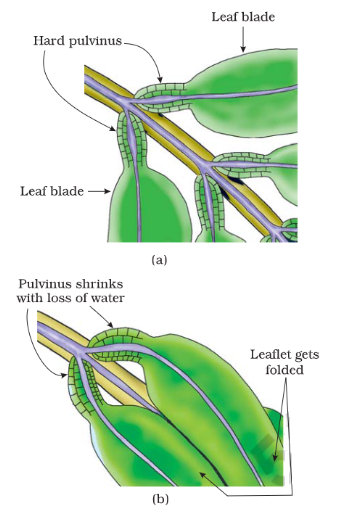
(2) Unlike that in animals, the plants do not possess any muscular tissue or any specialised protein, even then the plant cells change their shape by changing the quantity of water contained therein. The cell expands or swells when the amount of water therein increases and the cells shrink or contract when the amount of water is reduced (decreased).
(3) Unlike that in animals, the plants have no tissue to pass any message from one tissue to the other. Yet the plant cells can pass electrical and chemical signals and thereby convey this information from one cell to another.
View full question & answer
Question 124 Marks
How does the sensitive plant detect the touch and how do the leaves move in response?
View full question & answer
Question 134 Marks
Write short notes : (1) Fore - brain (2) Movement of voluntary muscles
Answer
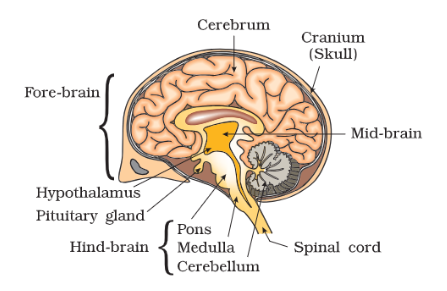
(1) Fore-brain: It consists mainly of cerebrum, which is a main thinking part of the brain.
It receives sensory impulses from various receptors.
$\rightarrow$ The fore-brain has separate areas specialised for hearing, smell, sight and so on.
$\rightarrow$ There are separate areas of association where sensory information is interpreted by putting it together with information from other receptors as well as with information already stored in the brain.
$\rightarrow$ Based on all this, a decision is made about how to respond.
It has motor areas which control the movement of voluntary muscles.
$\rightarrow$ It has a separate centre associated with hunger.
(2) Movement of voluntary muscles: Muscle tissue respond to nervous impulse: When a nerve impulse reaches the muscle, the muscle fibre moves. The movement at the cellular level begins. Muscle cells will move by changing their shape so that they shorten. Muscle cells have special proteins that change both their shape and their arrangement in the cell in response to nervous electrical impulses. Thus, muscle tissue brings about movement.
View full question & answer
Question 144 Marks
(1) Describe human brain with specific functions of its different parts.###Explain : Human brain
(2) The following functions are related to Fore-brain and Hind-brain, classify the following activities :
(i) Hearing (ii) Salivation (iii) Blood pressure (iv) Sight (v) Smell (vi) Vomit
View full question & answer
Question 154 Marks
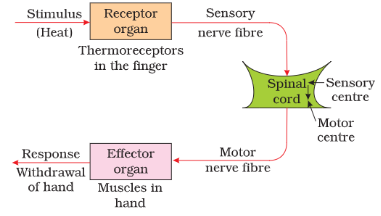
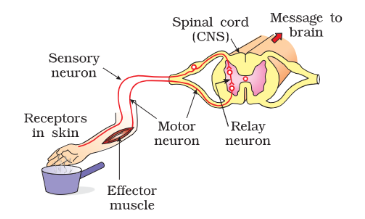
Explain reflex arc. Explain spinal reflex.###Explain how is hand pulled away from the hot object reflexly.
View full question & answer
Question 164 Marks
Explain how nervous impulses travel in the body.
View full question & answer
Question 174 Marks
What is a movement? What are the different purposes for which movements are seen in organisms? Give suitable examples.
Answer
Change in position of an organism is called movement. Movement is one characteristic feature of living beings.
Movements are seen for following purposes in organisms:
(1) Some movements are growth related. e.g., a seed germinates and grows. Seedling develops and shoot system comes out from soil.
(2) Running, playing, chewing, etc. are the examples of movement which are not related to growth but for other functions.
(3) Some movements are seen as a response to change in the environment of the organism or for their advantage. e.g., amoeba expands pseudopodia to ingest food particles, buffaloes chew cud to break-up tough food for better digestion.
(4) Some movements are seen for protection. e.g., our pupils constricted when bright light falls on eyes, we pull our hand instantly while touching a hot object.
View full question & answer
Question 184 Marks
Distinguish between:
Plant hormones and Animal hormones
Answer
 Plant hormones Animal hormones
1.Plant hormones are secreted by plant cells but no specific glands are there.1.Animal hormones are secreted from endocrine glands.
2.Plant hormones are either growth promoting or growth inhibiting.2.There is no inhibitor hormone for growth in animals.
3.Plant hormones reach to their target site by simple diffusion.3.Animal hormones reach to their target site through blood circulation
4.Secretion of it is not regulated by feedback mechanism.4.Secretion of some hormones regulated by feedback mechanism.
View full question & answer
Question 194 Marks
Distinguish between:
Cerebrum and Cerebellum
Answer
Cerebrum Cerebellum
1.It is a major part of the fore-brain.1.It is a part of the hind-brain.
2.It coordinates thoughts and various other senses2.It coordinates the functions of voluntary muscles and thereby maintains the body equilibrium.
3.It is the largest and most complex part of the brain.3.It is a part lying behind the cerebrum, on the dorsal side beneath the pons.
View full question & answer
Question 204 Marks
Distinguish between:
Nervous System and Endocrinal System
Answer
 Nervous System Endocrinal System
1.Its structural and functional unit is а neuron (nerve cell).1.Its functional unit is a hormone.
2.In human body it comprises central nervous system, peripheral nervous system and autonomous nervous system2.In human body it comprises of various endocrine glands.
3.Its function is to collect the information, its analysis and interpretation and convey the responsive message to the motor organs.3.Its function is to produce stimulatory or inhibitory effect on the tissues or organs through the medium of hormones.
4.The coordination that occurs through the nervous system is very rapid as the impulses pass through the nerve fibres.4.The coordination that occurs through the endocrine system is a relatively slow process as the hormone flows through the blood stream to reach the target organ.
View full question & answer
Question 214 Marks
Distinguish between:
Response in Plants and Response in Animals
Answer
 Response in Plants Response in Animals
1.Plants do not possess nervous system but only possess hormones for expressing their response.1.Animals possess both, the nervous system and endocrine system for expressing their response.
2.The response in plants is not rapid and needs more time to be observed.2.The response in animals is rapid and seen immediately.
3.The response in plants is limited.3.The response in animals is not limited.
4.There are no muscular tissues in plants to show the response.4.There are muscular tissues in animals through which the response is shown.
5.In plants, there is no specific tissue for the transmission of information to different parts of the body5.In animals there is specific nervous tissue for the transmission of information to different parts of the body
View full question & answer
[4 marks Questions] - Science STD 10 Questions - Vidyadip