Questions

[4 marks Questions]

🎯

Test yourself on this topic

9 questions · timed · auto-graded

Question 24 Marks
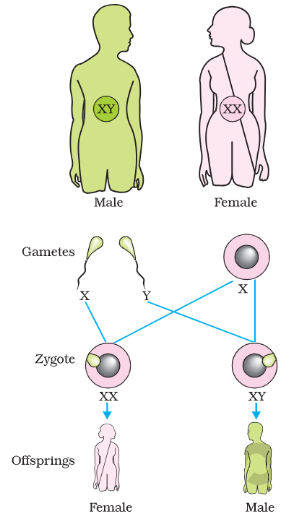
Describe the sex determination in human beings.###Explain the process of sex determination in humans.
View full question & answer
Question 34 Marks
What is sex determination? State the different methods of sex determination in animals.
Answer
The unisexual organism is either a male or a female. The mechanism by which the sex of an individual is determined is called sex determination.
The organism that develops from the fertilised egg (zygote) may be a male or a female offspring.
Methods of sex determination in animals: Different species of animals utilize different methods for their sex determination.
e.g., (1) In a few reptiles, the sex determination is dependent on the environmental factor. i.e.. temperature. The egg (zygote) may develop into a male turtle or a female turtle, is determined by temperature.
When a temperature is over $30^{\circ}\text {C} $, the eggs of turtle, develop into female.
The eggs of crocodiles exposed to the high temperature induce the development of male whereas the lower temperature induces the development of female crocodiles.
(2) In human beings the sex of the individual is determined by sex chromosomes and is thus genetically determined. The genes inherited from parents decide the sex of the offspring.
Exception: The animal such as certain snail can change its sex. The sex therein, is not genetically determined.
View full question & answer
Question 44 Marks
Which mechanism of inheritance is used by all sexually reproducing organisms?###How does the mechanism of heredity work?
Answer
Both parents contribute equally to the Inheritance of the progeny during sexual reproduction.
$\rightarrow$ Depending on the genes/factors inherited from parents, the traits in the progeny are decided.
$\rightarrow$ Each offspring has two sets of genes of which one is paternal and other maternal one.
$\rightarrow$ The genes are transmitted through parent's chromosomes.
$\rightarrow$ The diploid chromosome number is reduced to haploid by meiotic division at the time of gamete formation.
$\rightarrow$ When haploid germ cell (gamete) of male and female parents fuse to form zygote during fertilisation.
$\rightarrow$ Zygote is the first cell of new progeny.
$\rightarrow$ The normal number of chomosomes in the offspring in restored because it receives two copies of each chromosome, one each from the male and female parent through gametes involved in fertilisation.
$\rightarrow$ This ensures the stability of the DNA of the species.
Such mechanism of inheritance is used by all sexually reproducing organisms.
View full question & answer
Question 54 Marks
How do proteins control the characteristics? Explain with suitable example.###How are traits controlled by genes?
Answer
Cellular DNA is the information source for making proteins in the cell.
$\rightarrow$ Gene is a section of DNA that provides information for specific protein.
$\rightarrow$ Such protein may act as an enzyme.
$\rightarrow$ Enzyme stimulates specific reaction in an organism.
$\rightarrow$ The product that is formed in the reaction imparts specific characteristic.
Example: Tallness is a characteristic or trait of garden pea plant.
$\rightarrow$ Plant height depends on the amount of a particular plant hormone synthesized, which in turn trigger the growth.
$\rightarrow$ The amount of the plant hormone synthesized depends upon the efficiency of the process for synthesising respective enzyme.
$\rightarrow$ If specific enzyme/protein works efficiently, more hormone is released and the plant becomes tall.
$\rightarrow$ If the gene for tallness is altered, the enzyme is less efficient, the amount of hormone formed will also be less. Consequently making plant short.
Thus, genes control characteristics or traits via synthesis of proteins.
View full question & answer
Question 64 Marks
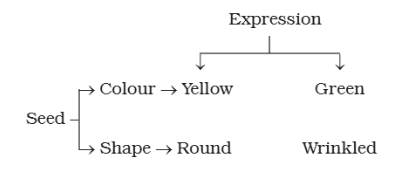
Explain the inheritance of shape and colour of the seed of pea plant (Pisum sativum).###Explain the independent inheritance of two separate characters in pea plant on the basis of Mendel's experiment.
View full question & answer
Question 74 Marks
The gene 'T' for the character of tallness in pea plant is dominant and gene 't' is recessive. Explain it on the basis of Mendel's experiment.###Explain the inheritance of any one character in two successive generations.
Answer
Mendel selected garden pea plant (Pisum sativum) as an experimental material. The pea plant shows various characters and atleast two contrasting expressions for each of the characters.
Mendel selected height of the pea plant. The two contrasting expressions for the height of pea plants are tall plants and short plants.
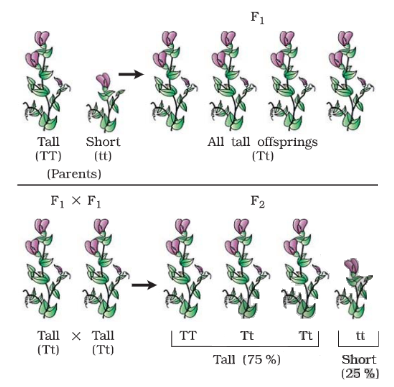
Mendel crossed the tall parent (P) plant, (TT), with another short parent (P) plant (tt), and obtained all tall plants in F1 generation. None of the short plants were produced in F1 generation. They were also not of medium height. It means that only one parental characteristic was expressed in the offsprings.
When the plants of F1 generation were allowed to self-pollinate, about 75% plants were tall and about 25% were short in the F2 generation. Thus, the genes for tallness and shortness both are capable of being inherited from the parents of F1 generation.
This indicates that both the tallness and shortness traits were inherited in the F1 plants, but only the tallness trait was expressed.
$\rightarrow$ This led Mendel to propose that two copies of factor (gene) controlling traits are present in sexually reproducing organism.
$\rightarrow$ These two may be identical or may be different.
Image
This experiment indicates that the genes TT or genes Tt is the genetic constitution for tall plants while tt for the short plant. It means that only presence of gene T is responsible for the expression of tallness while the absence of dominant gene T and tt genes produces shortness.
Thus, tallness in pea plant is the dominant, trait and shortness is the recessive trait.

View full question & answer
Question 84 Marks
Explain creation of diversity over succeeding generation.
View full question & answer
Question 94 Marks
You observed trait of earlobe whether they are free or attached in four different couples, along with their children.
(1) Couple has all the children with free ear- lobe even mother has attached earlobe. What do you think about father's earlobe?
(2) Couple has children with 1 : 1 ratio for free and attached earlobe. What do you think about their father-mother for this trait?
(3) In a couple, both father and mother have attached earlobe. What do you think about their children?
(4) A couple has four children, out of which three have free earlobe and one has attached earlobe. What do you think about their parents?
Answer
(1) Father shows free earlobe.
(2) Any one parent has attached earlobe and other parent has free earlobe with contrasting genes.
(3) Their children will show attached earlobe.
(4) Both parent have free earlobe with contrasting genes for earlobe.
View full question & answer
[4 marks Questions] - Science STD 10 Questions - Vidyadip