Questions

[4 marks Questions]

🎯

Test yourself on this topic

13 questions · timed · auto-graded

Question 14 Marks
Write the uses of concave mirrors
Answer
Uses of concave mirrors are as follows:
(1) Concave mirrors are used as reflectors in torches, search-lights, headlights of motor vehicles. etc. to get powerful parallel beams of light
(2) Concave mirrors are often used as shaving mirrors/make-up mirrors to see a larger image of the face.
(3) Concave mirrors are used by the dentists to see large images of the teeth of patients.
(4) Large concave mirrors are used to concentrate sunlight to produce heat in solar cookers, solar furnaces, etc.
(5)A concave mirror is used as a doctor's head mirror to focus light on the body parts like cyes, cars, nose, throat, etc. to be examined.
(6) Large concave mirrors are also used in reflecting telescopes.
Image formation by a convex mirror
To locate the image formed by a convex mirror for different positions of an object.
Procedure:
Take a convex mirror. Hold it in one hand.
Hold a pencil in the upright position in the other hand.
Observe the image of the pencil in the mirror.
→Is the image crect or inverted? is it diminishe or enlarged?
Move the pencil away from the mirror slowly
→Does the image become smaller or larger?
Repeat this activity carefully.
→ State whether the image will move closer to or farther away from the focus as the object is moved away from the mirror.
Observation:
→When we hold a pencil in the upright postrion in front of a convex mirror, the image of the pencil is observed on the hack side of the mirror, ie, in the mirror itself.
The image is erect and virtual.
The image is diminished in size relative to the object.
→When the pencil is moved away from the mirror slowly, the image becomes smaller and smaller, moving away from the mirror.
→On repeating this activity, we find that as the object is moved away from the mirror, the image moves closer to the focus of the mirror.
Conclusion:
→This activity confirms all the characteristics of the images formed by a convex mirror for different positions of the objeer and it is tabulated as follows:
Position of the objectPosition of the imageSize of the imageNature of the image
At infinityAt the focus F. behind the mirrorHighly diminished, point-sizedVirtual and erect
Between Infinity and the pole of the mirrorBetween Pand F. behind the mirrorDiminishedVirtual and erect
View full question & answer
Question 24 Marks
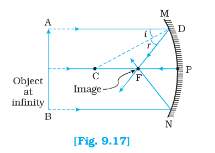
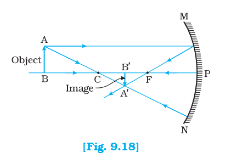
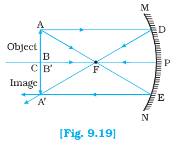
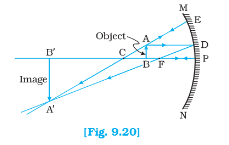
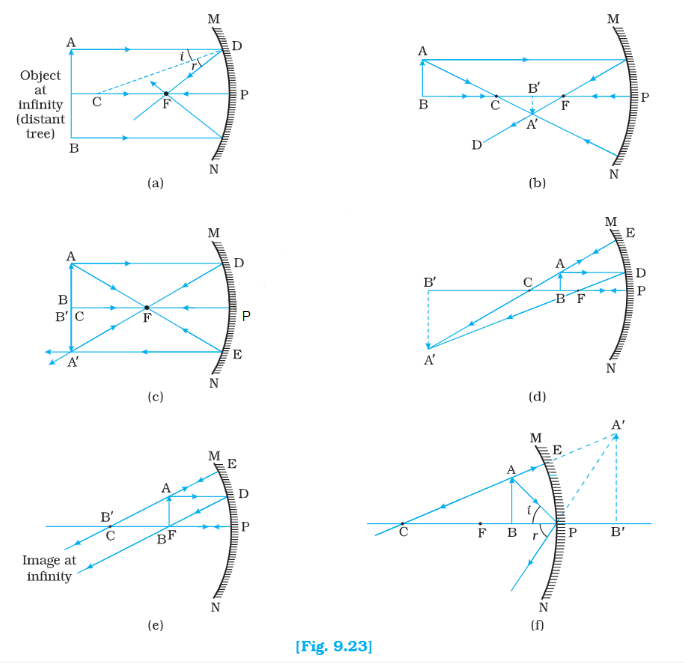
Draw neat ray diagrams and describe the position, nature and size of the image formed by a concave mirror of small aperture for the following positions of the object placed in front of it:
(1) At infinity
(2) At a finite distance beyond C
(3) At C
(4) Between C and F
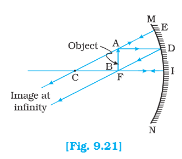
(5) At F
(6) Between P and F
Answer
(1) Position of the object: At infinity

Image

Position of the image: At principal focus F
Nature of the image:Real and inverted
Size of the image relative to that of the object: Highly diminished (or point-sized)
(2) Position of the object: At a finite distance beyond C (centre of curvature)
Image

Position of the image: Between F and C
Nature of the image: Real and inverted
Size of the image relative to that of the object: Diminished
(3) Position of the object: At C (centre of curvature)
Image
Position of the image: At C (centre of curvature)
Nature of the image: Real and inverted
Size of the image: Same as that of the object.
(4) Position of the object: Between C and F (centre of curvature and principal focus)

Image
Position of the image: Beyond C (centre of curvature)
Nature of the image: Real and inverted
Size of the image relative to that of the object: Enlarged
(5) Position of the object: At F (principal focus)
Image
Position of the image: At infinity
Nature of the image :Real and inverted
Size of the image relative to that of the object: Highly enlarged
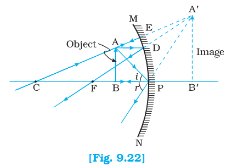
(6) Position of the object: Between Pnd F (pole and principal focus)
Image
Position of the image: Behind the mirror
Nature of the image: Virtual and crect
Size of the image relative to that of the object: Enlarged and bigger than the object.
[Note: The image being virtual a dotted line.]

View full question & answer
Question 34 Marks
State the sign convention for lenses.
Answer
Sign convention for spherical lenses:
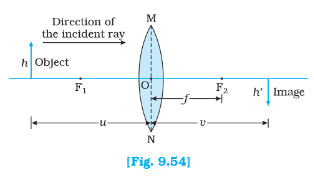
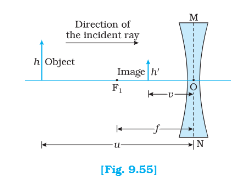
In this case, optical centre O of the lens is taken as the origin and the principal axis of he ins is taken as the X-axis of the co-ordinate system. The Y-axis passes through O and lies in the plane of the figure.
(1) The object is always placed to the left of the lens as in case of a spherical mirror. This implies that light rays from the object fall on the lens from the left hand side.
(2) All distances parallel to the principal axis are measured from optical centre O of the lens.
(3) The distances measured in the direction of the incident ray are taken as positive while those measured in the direction opposite to the direction of the incident ray are taken as negative.
(4) The height measured above the principal axis of the lens and perpendicular to it. i.e.. in the upward direction is taken as positive, while that measured below the principal axis and perpendicular to it. i.e., in the downward direction, is taken as negative
Sign convention for a convex lens:
Image
Object distance = - u
Object height =+h
Image distance =+ v for a real image
Image = - h' for a real image
Focal length = +f
Sign convention for a concave lens:
Image

Object distance =-u
Image distance = - v
Focal length =-f
Object height = + h
Image height =+h'

View full question & answer
Question 44 Marks
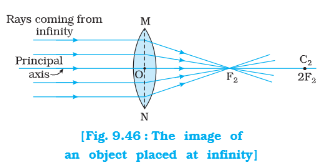
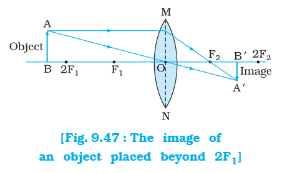
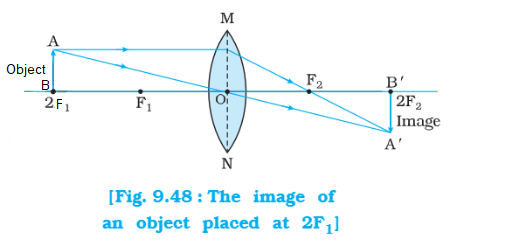
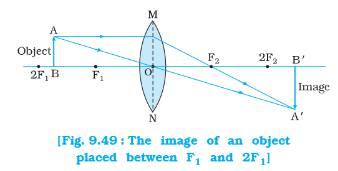
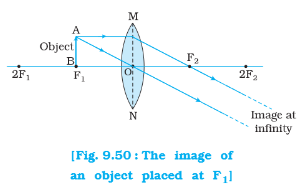
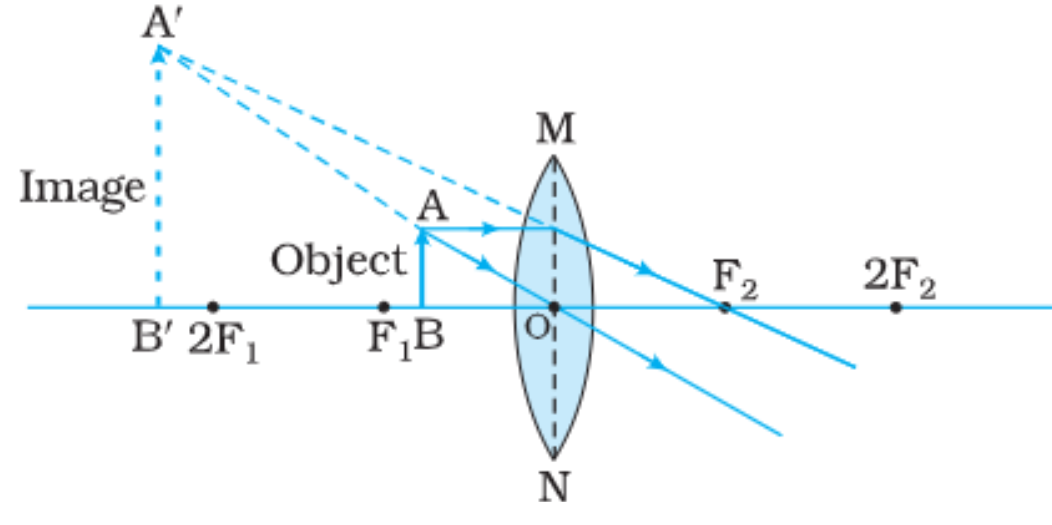
With neat and labelled ray diagrams, describe the position, nature and relative size of the image formed when an extended object AB is placed at the following positions in front of a convex lens:
(1) At infinite distance
(2) Beyond 2F1
(3) At 2F1
(4) Between F1 and 2F1
(5) At the principal focus F1
(6) Between principal focus F1 and optical centre O
View full question & answer
Question 54 Marks
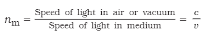
Explain the term absolute refractive index.
View full question & answer
Question 64 Marks
A concave mirror is commonly used in torche, draw a ray diagram to show working of this optical instrument.
View full question & answer
Question 74 Marks
Which are the main four rays used to locate the image of a point-like object formed by reflection of light from a spherical mirror?###An object is placed in front of a spherical mirror. With neat and labelled ray diagrams. explain how the position of its image is located.
Answer
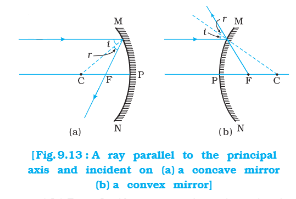
(1) Ray 1 (A ray, parallel to the principal axis): A ray parallel to the principal axis, after reflection, will pass through the principal focus in case of a concave mirror or appear to diverge from the principal from th focu convex mirror (see figure 9.13).Image
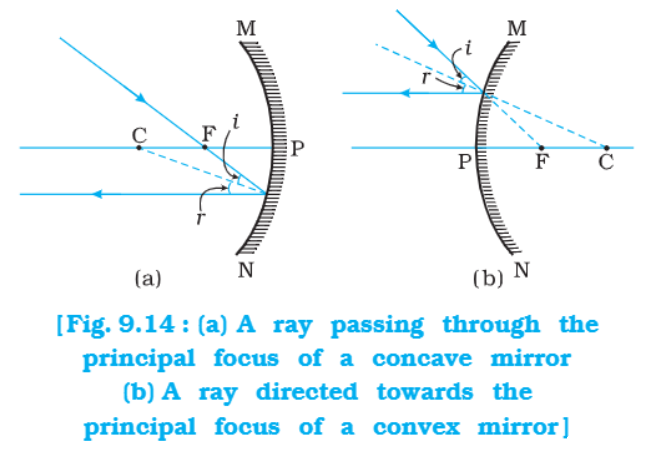
(2) Ray 2 (A ray passing through the principal focus): A ray passing through the principal focus of a concave mirror or a ray which is directed towards the principal focus of a convex mirror, after reflection. will emerge parallel to the principal axis (see figure 9.14).
Image
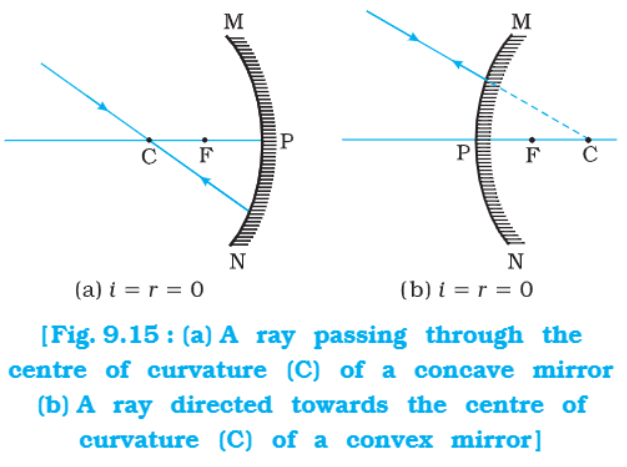
(3) Ray 3 (A ray passing through the centre of curvature): A ray passing through the centre of curvature of a concave mirror or directed in the direction of the centre of curvature of a convex mirror, after reficction, is reflected back along the same path.
Because in this case, i=0 and hence r=0 (see figure 9.15).
Image
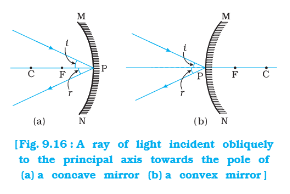
(4)Ray 4 (A ray of light incident obliquely to the principal axis, towards the pole (P), on a spherical mirror: A ray incident obliquely to the principal axis, towards a point P (Pole of the mirror), on the concave mirroг ог a convex mirror, is reflected obliquely.
The incident and reflected rays follow the laws of reflection at the point of incidence (Point P), making equal angles with the principal axis (see ligure 0.161.)
Image
View full question & answer
Question 84 Marks
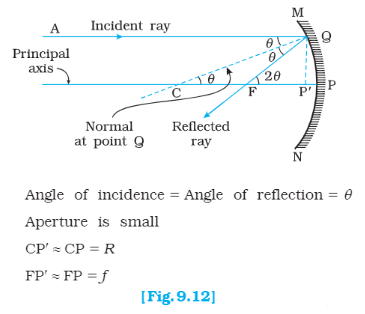
Obtain the relation between the focal length and radius of curvature in the case of a concave mirror###Derive the relation R = 2f in the case of a concave mirroг.
View full question & answer
Question 94 Marks
Define and explain the following tens in the context of spherical mirrors:
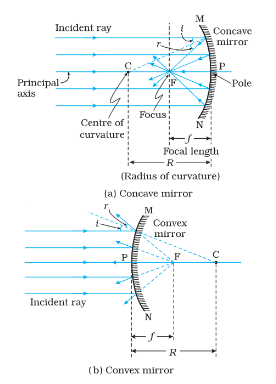
(1) Pole (2) Centre of curvature, (3) Radius of curvature, (4) Principal axis,(5) Principal focus (focal point), (6) Focal length and (7) Aperture
Draw neat labelled diagrams to illustrate the same.
Answer
Define and explain the following tens in the context of spherical mirrors:
(1) Pole (2) Centre of curvature, (3) Radius of curvature, (4) Principal axis,(5) Principal focus (focal point), (6) Focal (7) Aperture
Draw neat labelled diagrams to illustrate the same.
Image
(1) Pole: The centre of the reflecting surface of a spherical mirror is a point called the pole.
→The pole lies on the surface of the mirror.
→It is usually represented by the letter P.
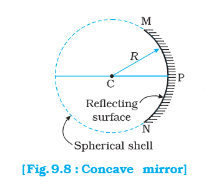
(2) Centre of curvature: The centre of curvature of a spherical mirror is the centre of the hollow sphere, of which the reflecting surface of the spherical mirror forms a part.
→Centre of curvature is not a part of the mirror. It lies outside its reflecting surface. →The centre of curvature of a concave mirror lies in front of it. However, it lies behind the mirror in case of a convex mirror [see figure 9.10]
→It is usually represented by the letter C
(3) Radius of curvature: The radius of curvature of a spherical mirror is the radius of the hollow sphere, of which the reflecting surface of the spherical mirror forms a part.
→The distance PC represents the radius of curvature of a spherical mirror, 1.e., PCR [see figure 9.101
→ It is usually represented by the letter R
(4) Principal axis: The imaginary straight-line passing through the pole (P) and the centre of curvature (C) of a spherical mirror is called the principal axis.
→ Principal axis is normal to the spherical mirror at its pole P.
(5) Principal focus (focal point): The point on the principal axis of a concave mirror, at which rays of light incident on the mirror in the direction parallel to the principal axis (actually) meet/intersect after reflection from the mirror is called the principal focus of the concave mirror.
When rays parallel to the principal axis are incident on a convex mirror, the reflected rays appear to come from a point on the principal axis. This point is called the principal focus of the convex mігтог.
→The principal focus of a concave mirror lies in front of the mirror and it is a real point.
→The principal focus of a convex mirror lies behind the mirror and it is a virtual point.
→ It is usually represented by the letter F.
(6) Focal length: The distance between the pole (P) and the principal focus (F) of a spherical mirror is called the focal length.
→The distance PF represents the focal length of a spherical mirror. i.e.. PFf [see figure 9.10]
→ It is usually represented by the letter f.
(7) Aperture: The diameter of the edge of
the reflecting surface of a spherical mirror is called its aperture.
→ The distance MN aperture of the spherical mirror. (see figure 9.10)
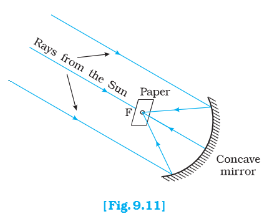
To show the converging nature of a concave mirror and find its focal length.
Procedure:
Hold a concave mirror in your hand and direct its reflecting surface towards the Sun.
Direct the light reflected by the mirror on to a sheet of paper held close to the mirror.
Move the sheet of paper back and forth gradually until you find on the paper sheet a bright, sharp spot of light.
Hold the mirror and the paper in the same position for a few minutes.
→ What do you observe? Why 2?
Image
Observation:
→The paper initially turns blackish, then burns producing smoke. Eventually it catches fire.
The light from the Sun is converged at a point, as a sharp bright spot by the mirror. In fact, this spot of light is the image of Sun on the sheet of paper.
This point is the principal focus concave mirror.
The heat produced due to concentration of sunlight ignites the paper.
Conclusion:
→The distance of this image of the sun from the pole of the mirror gives the approximate ws value of the focal length of the concave mirror.
View full question & answer
Question 104 Marks
What is a spherical mirror? State its types.
Answer
A mirror whose reflecting surface is a part of a hollow sphere is called a spherical mirror. One side of the mirror is well-polished and reflecting and the other side is opaque. The reflecting surface of a spherical mirror is curved inwards or outwards.
Based on this aspect, spherical mirrors are of two types:
(1) Concave mirror: A spherical mirror with reflecting surface curved inwards is called a concave mirror.
A parallel beam of light generally converges after reflection from such mirror, hence it is called a converging mirror.
e.g.. The inner curved surface of a shining spoon can be approximated to a concave mirror
Image
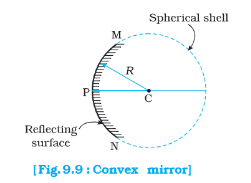
(2) Convex mirror: A spherical mirror withreflecting surface curved outwards is called a convex mirror.
A parallel beam of light generally diverges after reflection from such mirror, hence it is called a diverging mirror.
e.g.. The outer curved surface of a shining spoon can be approximated to a convex mirror
Image
View full question & answer
Question 114 Marks
Difference between :
Convex lens and Concave lens
Answer
Convex lensConcave lens
1. It is thick at the centre and thin at the edges.1. It is thin at the centre and thick at the edges
2. It converges parallel rays incident on it.2. It diverges parallel rays incident on it
3. It forms a real or virtual image of an object depending on the position of the object.3. It always forms a virtual image.
4. The virtual image obtained with it is always enlarged.4. The virtual image obtained with it is always diminished.
View full question & answer
Question 124 Marks
Difference between :
Real Image and Virtual Image
Answer
Real Image Virtual Image
1.In this case, the rays of light emanating from an object meet after reflection or refraction and hence, an image is formed.1.In this case, the rays of light emanating from an object (when extended backwards) appear to meet after reflection or refraction.
2.It can be obtained on a screen.2.It cannot be obtained on a screen.
3.It is inverted compared to an object.3.It is erect compared to an object
4.In case of a spherical mirror it is formed towards the reflecting surface in front of the mirror.4.In case of a spherical mirror it is formed behind the reflecting surface of the mirror i.e.. in the mirror itself.
View full question & answer
Question 134 Marks
Difference between :
Concave mirror and Convex mirror
Answer
Concave mirror Convex mirror
1.Its inner surface is reflecting.1.Its outer surface is reflecting.
2.It forms a real or virtual image of an object depending on the position of the object.2.It always forms a virtual image.
3.The real image can be smaller or of the same size as the size of the object or bigger than the object. The virtual image is always bigger than the object.3.The image is always smaller than the object.
4.This mirror is used in a torch, headlight of vehicles, search-light, solar cooker, etc.4.This mirror is used as a rear-view mirror in vehicles.
View full question & answer