Magnification produced by a rear-view mirror fitted in vehicles…
✓
is always less than 1.
B
is always equal to 1.
C
is always more than 1.
D
can be more than or less than 1 depending upon the position of the object in front of the mirror.
Answer
Correct option: A.
is always less than 1.
(A) is always less than 1. Hint: Convex mirror is used as rear-view mirror in vehicles. Image formed by it is always virtual, erect and diminished in size compared to the object. So, magnification of image formed by it is less than 1.
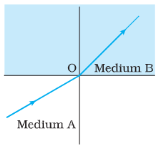
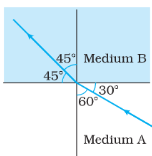
As shown in the following figure, a light ray travels from medium A to medium B. Then refractive index of medium A relative to medium B would be _______.
What is the angle of refraction for a light ray incident normal to the surface of a medium?
A
$90^{\circ} $
B
$60^{\circ} $
C
$30^{\circ} $
✓
$0^{\circ} $
Answer
Correct option: D.
$0^{\circ} $
(D) $0^{\circ} $ Hint : According to general form of Snell's law $n_1 \sin i=n_2 \sin r$. As $i=0^{\circ}$, then $r=0^{\circ}$ because value of $n_1$ and $n_2$ are never zero.
If the absolute refractive indices of water and glass are $\frac{4}{3}$ and $\frac{3}{2}$ respectively, then what is the ratio of the speed of light in water to that in glass?
A
$2$
B
$\frac{8}{9}$
✓
$\frac{9}{8}$
D
$\frac{1}{2}$
Answer
Correct option: C.
$\frac{9}{8}$
(C) $\frac{9}{8}$ Hint: Taking water as medium 1 and glass as medium 2, speed of light in water would be v1 and speed of light in glass would be v2. Here, $n_1=\frac{4}{3}$ and $n_2=\frac{3}{2}$ Now, $n_{21}=\frac{n_2}{n_1}=\frac{v_1}{v_2}$ $\therefore \frac{3 / 2}{4 / 3}=\frac{v_1}{v_2} \quad \therefore \frac{v_1}{v_2}=\frac{9}{8}$
If the absolute refractive indices of water, benzene and sapphire are 1.33, 1.50 and 1.77 respectively, then which medium has maximum relative refractive Index?
✓
Sapphire relative to water
B
Sapphire relative to benzene
C
Benzene relative to water
D
Water relative to benzene
Answer
Correct option: A.
Sapphire relative to water
(A) Sapphire relative to benzene Hint : $n_{21}=\frac{n_2}{n_1}$ $\therefore n_{21}$ is maximum, when $n_2$ is maximum and $n_1$ is minimum. Hence, it is obvious that in the present case, medium 1 must be water and medium 2 must be sapphire. $\therefore$ Refractive index of sapphire with respect to water would be maximum.
Which of the lenses with focal length 10 cm, 20 cm, 25 cm and 50 cm has maximum power?
A
50 cm
B
25 cm
C
20 cm
✓
10 cm
Answer
Correct option: D.
10 cm
(D) 10 cm Hint : From power $P=\frac{1}{f}$, the lens with less focal length $f$ has more power $P$. So, the lens with focal length 10 cm has maximum power.
The distance between the object at 40 cm from a plane mirror and its image is ______.
A
40 cm
✓
80 cm
C
20 cm
D
60 cm
Answer
Correct option: B.
80 cm
(B) 80 cm Hint: The distance between the object and its image $=|u|+|v|$ $\begin{array}{l}=40+40 \quad(\because \text { Here, }|u|=|v|) \\ =80 cm\end{array}$
(B) infinity Hint : In case of plane mirror $|v|=|u|$, also according to the New Cartesian sign convention, $v$ is positive and $u$ is negative. Now, from the mirror formula $\frac{1}{f}=\frac{1}{u}+\frac{1}{v},$ for a plane mirror, as $|v|=|u|$ and $u$ is negative while $v$ is positive, we get $\frac{1}{f}=0 \quad \therefore f=\infty$ (infinity)
Which of the following lenses would you prefer to use while reading small letters found in a dictionary?
A
A convex lens of focal length 50 cm
B
A concave lens of focal length 50 cm
✓
A convex lens of focal length 5 cm
D
A concave lens of focal length 5 cm
Answer
Correct option: C.
A convex lens of focal length 5 cm
(C) A convex lens of focal length 5 cm [Hint: Since a convex lens gives a magnified image of the object and the smaller the focal length, the more the magnifying power.]
No matter how far you stand from a mirror, your image appears erect. The mirror is likely to be
A
only plane
B
only concave.
C
only convex
✓
either plane or convex.
Answer
Correct option: D.
either plane or convex.
(D) either plane or convex. [Hint: Both give erect images. The size of image in plane mirror is same as the object but it is diminished in convex mirror.]