Questions

[2 Mark Questions]

🎯

Test yourself on this topic

32 questions · timed · auto-graded

Question 12 Marks
Muscles become stretched during excessive exercise. Give reason.
Answer
→ Excessive and continuous energy is required for excessive exercise. It requires more $O _2$ supply. But due to lack of proper $O _2$ anaerobic respiration is performed.
→ In muscles glucose is converted into lactic acid; which produces less energy. Accumulation of lactic acid causes constant pain in muscles. Hence, the muscles are stretched.
View full question & answer
Question 22 Marks
Write difference between : Atrium and Ventricle.
Answer
Atrium Ventricle
$1.$ Its chamber are located in the anterior of the heart. $1.$ Its chamber are located in the posterior of the heart.
$2.$ Its wall is thin. $2.$ It wall is thick.
$3.$ It receives blood from various organs and lungs. $3.$ It receives blood from
the atrium.
$4.$ It flows the blood with pressure into the ventricles. $4.$ It flows the blood with pressure to different parts of the body.
View full question & answer
Question 32 Marks
Give scientific reason : Trachea consists of cartilage rings.
Answer
Trachea is muscular duct. It has ' $C$ ' shaped rings of cartilage present in the trachea to prevent its collapse when the air is not passing through it. It is located in the larynx region and ensures that the pathway of air does not become blocked.
View full question & answer
Question 42 Marks
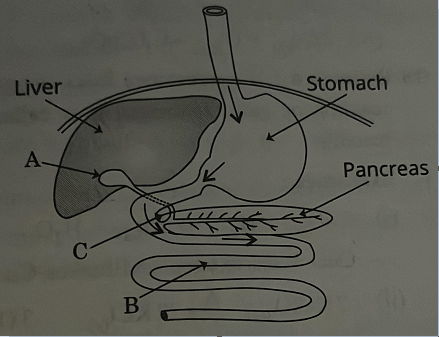
Name $A, B$ and $C$ in the below figure and state its work.
Answer
Image
$(A)$ It is Gall bladder. It stores bile juice. Due to contraction of muscles bile juice moves into intestine.
$(B)$ It is intestine. It contains finger like projections called villi. It absorbs digested food.
$(C)$ It is bile duct. It contains secretion from liver and pancreas for digestion of food.
View full question & answer
Question 52 Marks
Column-I Column-II
$1$ Autotrophic Nutrition $(A)$ Leeches
$2$ Heterotrophic Nutrition $(B)$ Paramoecium
$3$ Parasitic Nutrition $(C)$ Deer
$4$ Digestion in Vacuole $(D)$ Green plants
Answer
$(1-D) \quad(2-C) \quad(3-A) \quad(4-B)$
View full question & answer
Question 62 Marks
Explain in detail bile juice.
Answer
→ Liver releases bile juice It is yellowish green color alkaline digestive juice and is stored in $5$ gall bladder.
→ Bile juice released from bile duct and liver goes into small intestine and helps in the process of digestion. It converts the acidic food from stomach into alkaline.
→ Enzymes present in pancreatic juice provide a medium for alkaline.
→ Bile salts convert large fat globules into small fat globules. So it increases surface area for digestion of fat and making the process of digestion easier.
View full question & answer
Question 72 Marks
State the route of respiratory gases in the human body.
Answer
External nostril $\rightarrow$ Nasal passage $\rightarrow$ Internal nostrils $\rightarrow$ pharynx $\rightarrow$ larynx $\rightarrow \rightarrow$ trachea $\rightarrow$ bronchi $\rightarrow$ alveoli.
View full question & answer
Question 82 Marks
Explain the importance of mucus in digestive system.
Answer
$(1)$ Mucus present in saliva is useful in chewing, forming morsle and swallowing the food.
$(2)$ Mucus present in the wall of stomach protects the stomach from acidic effect caused due to $HCl$ and pepsin.
$(3)$ Mucus present in the intestine helps in the transportation and absorption of food.
$(4)$ It is also helpful in removing undigested particles from the anus.
View full question & answer
Question 92 Marks
How do guard cells regulate the opening and closing of stomatal pore?
Answer
Guard cells protect the stomata. The guard cells swell when water flows into them, causing the stomatal pore to open. Similarly the pore closes if the guard cells shrink. Thus guard cells swell and shrink to regulate the opening and closing of stomatal pore.
View full question & answer
Question 102 Marks
What were the limitations of Newlands’ law of octaves?
Answer
  • $(1)$ Newlands’ law of octaves was applicable only to lighter elements having atomic masses upto $40 u.$
  • $(2)$ The law of octaves was applicable only upto calcium, because after calcium every eighth element did not possess properties similar to that of the first element.
  • $(3)$ Newlands assumed that only $56$ elements existed in nature and no new elements would be discovered in the future.
  • But, later on, several new elements were discovered whose properties did not fit into the law of octaves.
  • $(4)$ In order to fit elements into his table, Newlands adjusted two elements in the same slot, but also put some unlike elements under the same column.
  • For example,
  • Cobalt $(Co)$ and nickel $(Ni)$ are placed in the same slot and these are placed in the same column as fluorine, chlorine and bromine which have very different properties than these elements.
  • Iron, which resembles cobalt and nickel in properties, has been placed far away from these elements.
View full question & answer
Question 112 Marks
Give the scientific reason : The atomic size decreases in a period on moving from left to right.
Answer
  • As moving from left to right in a period, the atomic number of elements increases by 1.
  • As atomic number increases, nuclear charge also increases.
  • Due to this increased nuclear charge, the electrons are attracted strongly towards the nucleus and hence the atomic size decreases.
View full question & answer
Question 122 Marks
Give the scientific reason : No fixed position can be assigned to hydrogen in the periodic table.
Answer
  • Electronic configuration of hydrogen resembles with alkali metals.
  • Like alkali metals, hydrogen combines with halogens, oxygen and sulphur to form compounds having similar formulae.
  • Hydrogen also resembles halogens as it exists in the form of diatomic molecules.
  • Hydrogen combines with metals and non-metals to form ionic and covalent bonds respectively.
  • Thus, hydrogen cannot be assigned fixed position in the periodic table.
View full question & answer
Question 132 Marks
Give the scientific reason : Newlands’ law of octaves could not classify all the elements known at that time.
Answer
  • Newlands’ law of octaves was applicable upto calcium.
  • After calcium, every eighth element did not possess properties similar to that of the first element.
  • Newlands’ assumed that only $56$ elements existed in nature.
  • Newlands’ law of octaves was found correct only to lighter elements.
  • Thus, all the elements could not be classified by the Newlands’ law of octaves.
View full question & answer
Question 142 Marks
Give the scientific reason : Dobereiner’s triads could not arrange all the elements known at that time.
Answer
  • In Dobereiner’s triads, three elements were arranged in the order of increasing atomic masses of elements in which the atomic mass of the middle element is the average of the atomic masses of the other two elements.
  • Dobereiner could identify triads from the elements known at that time was only a coincidence.
  • Thus, this classification of elements into triads could not be applied to all the elements known at that time.
View full question & answer
Question 152 Marks
Distinguish between the : Metallic elements and Non-metallic elements
Answer
Metallic elements Non-metallic elements
$1.$ They are electropositive elements. $1.$ They are electronegative elements.
$2.$ Metals have tendency of losing the electrons during the bond formation process. $2.$ Non-metals have tendency of gaining the electrons during the bond formation process.
$૩.$ Oxides of metals are basic. $3.$ Oxides of non-metals are acidic.
$4.$ Metals possess $1, 2$ or $3$ electrons in their respective valence shells. $4.$ Non-metals possess $5, 6$ or $7$ electrons in their respective valence shells.
View full question & answer
Question 162 Marks
What were the limitations of Dobereiner’s classification?
Answer
  • The limitations of Dobereiner’s classification are as follows:
  • $(1)$ All the elements known at that time could not be arranged as Dobereiner’s triad.
  • Hence this method of classification of element into triads was not found to be successful.
  • $(2)$ Three elements nitrogen $(N)$, phosphorus $(P)$ and arsenic $(As)$ were then known elements, but these elements could not be classified as Dobereiner’s triad.
View full question & answer
Question 172 Marks
On what basis, scientists classified the different elements in early attempts?
Answer
  • Scientists classified the different elements according to their properties and obtained an orderly arrangement out of chaos.
  • Scientists made the early attempts to classify the elements in metals and non-metals.
  • Thereafter, further attempts of the classification of elements was carried out as our knowledge of elements and their properties were further studied.
View full question & answer
Question 182 Marks
How did the study of large number of elements become easy?
Answer
  • The substance around us exist in the form of elements, compounds and mixtures.
  • Elements consist of only one type of atoms.
  • There are $118$ known elements at present, in which $98$ elements occur naturally.
  • Different elements have different properties.
  • As more and more elements were being discovered, scientist gathered more and more information about the properties of newly discovered elements.
  • Therefore, scientist felt the necessity to organise these information and started looking for some pattern in the properties of elements.
  • Thus, the study of large number of elements became easy on the basis of specific pattern in their properties and their arrangement.
View full question & answer
Question 192 Marks
Distinguish between the : Elements of a group and Elements of a period
Answer
Elements of a group Elements of a period
$1.$ The atomic number of elements increases on moving down the group. $1.$ The atomic number of elements increases on moving from left to right along a period.
$2.$ All the elements in a group have same number of valence electrons. $2.$ The number of valence electrons of the elements in a period increases.
$૩.$ The chemical reactivity of elements in a group are same or identical. $3.$ The chemical reactivity of elements in a period are not identical.
$4.$ The atomic radius and metallic character increase on moving down the group. $4.$ The atomic radius and metallic character decrease on moving from left to right along a period.
View full question & answer
Question 202 Marks
An element $X$ (atomic number $17)$ reacts with an element $Y$ (atomic number $20)$ to form a divalent halide. $(a)$ What is the position of elements $X$ and $Y$ in the periodic table? $(b)$ What will be the nature of oxide of element $Y?$ Identify the nature of bonding in the compound formed.
Answer
  • Element $X$ is a non-metal while element $Y$ is a metal.
  • Molecular formula of dihalide is $YX_2$.
  • $(a)$
Position Element $X$ Element $Y$
In a group $17$ $2$
In a period $3$ $4$
  • $(b)$ Basic oxide : $YO$
  • Nature of the bond: Ionic
View full question & answer
Question 212 Marks
Answer the following questions [for an element having atomic number $17$]: $(a)$ Name the element. $(b)$ In which period will you find this element? $(c)$ To which group of the periodic table does this element belong? $(d)$ State the electronic configuration of the element.
Answer
  • $(a)$ Chlorine
  • $(b)$ Third period
  • $(c)$ Group $17$
  • $(d)$ Electronic configuration: $2, 8, 7$
View full question & answer
Question 222 Marks
In the modern periodic table, calcium (atomic number $20$) is surrounded by elements with atomic numbers $12, 19, 21$ and $38.$ Which of these have physical and chemical properties resembling calcium?
Answer
Element Atomic number Electronic configuration
$K L M N O$
Calcium $20$ $2 8 8 2 -$
Magnesium   $2 8 2 - -$
Potassium $19$ $2 8 8 1 -$
Scandium $21$ $2 8 8 3 -$
Strontium $38$ $2 8 18 8 2$
  • Elements with atomic number $12$ and $38$ have $2$ electrons in their last shell like calcium.
  • So, they will resemble Ca in their chemical properties.
View full question & answer
Question 232 Marks
How does the electronic configuration of an atom relate to its position in the modern periodic table?
Answer
  • In the periodic table, position of an element depends on its electronic configuration.
  • The position of an element can be determined by knowing the number of valence electron in its electronic configuration.
  • For example, ${ }_{11} Na : \begin{array}{l} K \text { L M } \\ 2\ \ 8\ \ 1\end{array} ; Na$ possesses one electron in its valence shell.
  • Hence, it belongs to group $1.$
  • The number of shells in the electronic configuration of an element determines its position in a period.
  • For example,
  • ${ }_{11} Na : \begin{array}{l} K \text { L M } \\ 2\ \ 8\ \ 1\end{array} Na$ has three shells $ (K, L$ and $M).$
  • So, it belongs to $3^{rd}$ period of the periodic table.
View full question & answer
Question 242 Marks
What are metalloids or semi-metallic elements? Give examples.
Answer
  • Elements which possess properties of both metals and non-metals are known as metalloids or semi-metallic elements.
  • In the modern periodic table, a zig-zag line separates metals and non metals.
  • The borderline elements such as boron $(B), $silicon $(Si)$, germanium $(Ge)$, arsenic $(As),$ antimony $(Sb)$, tellurium $(Te)$ and polonium $(Po)$ are known as metalloids or semi-metals.
View full question & answer
Question 252 Marks
Explain the trends of the non-metallic character in a period and a group.
Answer
  • Electronegative elements possesses non-metallic character.
  • Non-metals have a tendency of gaining or sharing the electrons during bond formation process.
  • Trend of the non-metallic character in a group :
  • On moving down the any group, the non-metallic character decreases.
  • Trend of the non-metallic character in a period :
  • On moving from left to right in a period, the effective nuclear charge experienced by valence electrons increases.
  • Therefore, the tendency to attract electrons will increase.
  • Thus, non-metallic character increases in a period on moving from left to right.
View full question & answer
Question 262 Marks
What is valency? Explain the trends of valency for elements in a period and in a group.
Answer
  • Relative ability of an element to combine with other element is known as a valency.
  • OR
  • The valency is the combining capacity of an atom of an element to acquire noble gas configuration.
  • Valency depends on the number of valence electrons.
  • The valency of an element is either equal to the number of electrons in the valence shell or equal to eight minus the number of electrons in the valence shell or equal to $18$ minus the group number of the element in the modern periodic table.
View full question & answer
Question 272 Marks
What are meant by periodic properties? Give examples.
Answer
  • Those properties which are determined by the electronic configuration of elements or which depend on electronic configuration of elements are known as periodic properties.
  • OR
  • The properties which show a recurring gradation within the same group or along a period are known as periodic properties.
  • For example, valency, atomic radii (atomic size), metallic property, electronegativity, etc.
View full question & answer
Question 282 Marks
Is it possible to have an element with atomic number $1.5$ placed between hydrogen and helium?
Answer
  • $(1)$ The atomic number of an element is always definite and whole number.
  • $(2)$ In the modern periodic table, elements are arranged in increasing order of their atomic numbers.
  • $(3)$ The atomic number cannot be represented in fraction number.
  • Thus, an element with atomic number $1.5$ cannot be placed between hydrogen and helium.
View full question & answer
Question 292 Marks
How were the positions of cobalt and nickel resolved in the modern periodic table?
Answer
  • $(1)$ In modern periodic table, elements are arranged in increasing order of their atomic numbers.
  • $(2) $The atomic number of cobalt and nickel are $27$ and $28$ respectively.
  • Hence, on the basis of increasing order of their atomic numbers, cobalt is placed in group 9 and nickel is placed in group $10.$
View full question & answer
Question 302 Marks
What were the criteria used by Mendeleev in creating his periodic table?
Answer
  • The following criteria was used by Mendeleev in creating his periodic table:
  • $(1)$ The properties of elements are the periodic function of their atomic masses.
  • $(2)$ Elements with similar properties are arranged in the same group.
  • $(3)$ The formula of oxides and hydrides formed by an element.
View full question & answer
Question 312 Marks
Explain the achievements (merits) of Mendeleev’s periodic table.
Answer
  • At the time, when Mendeleev classified elements and gave his periodic table, he left some gaps for the undiscovered elements.
  • Thus, many scientists were inspired to discover the unknown elements.
  • Atomic masses of several elements were corrected on the basis of periodic table.
  • Inert gases such as helium (He), neon (Ne) and argon (Ar) had been used in many context.
  • These gases were discovered very late because they are very inert and present in extremely low concentrations in atmosphere.
  • Another strength of the periodic table was that, when these gases were discovered later, they could be placed in a new group named zero group without disturbing the existing order.
View full question & answer
Question 322 Marks
Give the scientific reason : On moving down in a group, the atomic radii of elements increases gradually.
Answer
  • On moving down in a group, the atomic number of element increases.
  • A new shell of electrons is added with increase in atomic numbers of elements.
  • Thus, the distance between the valence shell and nucleus increases and atomic size increases down the group inspite of the increase in nuclear charge.
View full question & answer
[2 Mark Questions] - Science STD 10 Questions - Vidyadip