Questions

[4 marks Questions]

🎯

Test yourself on this topic

17 questions · timed · auto-graded

Question 14 Marks
$(a)$ Explain :
$(1)$ Platelets
$(2)$ Lymph
$(b)$ The human heart contains four chambers; which is very benificial. - Explain the statement.
Answer
(a) (1) Maintenance by platelets :
→ Platelets are responsible for maintaining the volume of blood. When we get an injury, body starts bleeding. Increased flow of blood reduces the efficiency of the pumping system.
n To avoid this, the blood has platelet cells which circulate around the body and plug these leaks by helping to clot the blood at these points of injury.
(2) Lymph :
→ Through the pores present in the walls of capillaries some amount of plasma, proteins and blood cells escape into intercellular spaces in the tissues to form the tissue fluid or lymph. It is similar to the plasma of blood but colourless and contains less protein. It contains protein, lymph vessels and lymphatic capillaries.
(b) Blood does not mix because of four chambered heart. Due to this deoxygenated blood goes to the lungs and oxygenated blood moves to different parts of the body.
→ Oxygenated blood moves from left ventricle to different parts of the body. Deoxygenated blood goes to the lungs for purification. Due to four chambered heart oxygenated and deoxygenated blood does not get mixed up and double circulation is possible.
View full question & answer
Question 24 Marks
Explain : The tubes-blood vessels
Answer
It includes arteries, veins and capillaries. All the three ducts perform heart's transport function.
→ Arteries :
$(1)$ Arteries are the vessels which carry blood away from the heart to various organs of the body.
$(2)$ Its wall is thick and elastic. It has three layered outer covering to protect it.
$(3)$ Blood emerges from the heart under high pressure.
$(4)$ It normally carries oxygenated blood. (Except pulmonary artery)
-→ Veins :
$(1)$ It collects blood from different organs and bring it back to the heart.
$(2)$ Its wall is thin and three layered. They do not need thick walls because the blood is no longer under pressure.
$(3)$ They have valves that ensure that the blood flow only in one direction.
$(4)$ It mainly carries deoxygenated blood (blood carrying carbon dioxide) except (pulmonary vein)
→ Capillaries :
On reaching an organ or tissue, the artery divides into smaller and smaller vessels to bring the blood in contact with all the individual cells. The smallest vessels have walls which are one-cell thick and are called capillaries. Exchange of material between the blood and surrounding cells take place across this thin wall. The capillaries then join together to form veins that convey the blood away from the organ or tissue.
View full question & answer
Question 34 Marks
Give the full form of $ATP$ and explain its importance.
Answer
-⇒ ATP (Adenosine Triphosphate) :
→ $ATP$ is the energy currency for most cellular process. The energy released in the process of respiration is used to form $ATP$ molecules from $ADP$ and inorganic phosphate $\left( P _{ i }\right)$.
$\text { ?ADP }+ P _{ i } \xrightarrow{\text { Energy }} ADP \sim \begin{array}{r}
P = ATP , P _{ i }= \\
\text { inorganic phosphate }
\end{array}$
→ This $ATP$ is used to perform process when intracellular process takes place inside the cell. Energy equivalent to $30.5 KJ / mol$ is released when the internal phosphate (inorganic) bond in $ATP$ is broken after water consumption.
→ Consider how a battery provides energy for various uses. This is used for mechanical energy, light energy, electric energy and so on. Thus, $ATP$ is used in the cell for many functions like tissue contraction protein synthesis, energy transfer, circulation, etc.
View full question & answer
Question 44 Marks
To demonstrate the presence of $CO _2$ in the process of respiration. Explan.
Answer
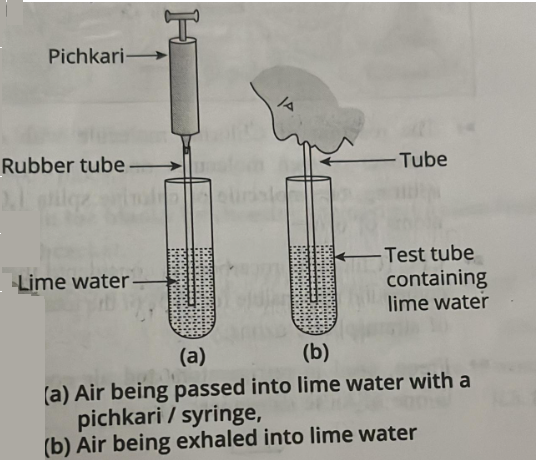
Procedure :
→ Take some freshly prepared lime water in a test tube.
→ Blow air through this lime water.
→ Note how long it takes for the lime water to turn milky.
Image

⇒ Observation : Lime water turns milky.
⇒ Conclusion : Exhaled gas contains presence of $CO _2$ gas.
Questions :
1. What does this tell us about the amount of carbon dioxide in the air that we breathe out?
Ans. It can be seen from the experiment that exhaled air contains more $CO _2$. So $CO _2$ makes lime water milky.
View full question & answer
Question 54 Marks
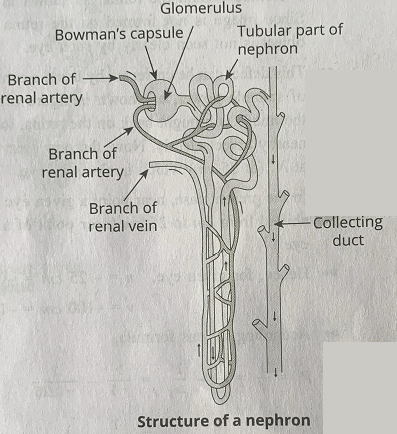
Write the structure of a nephron and its work.
Answer
→ The excretory system of human beings includes a pair of kidneys, a pair of ureters, a urinary bladder and a urethra. Kidneys are located in the abdomen, one on either side of the backbone.
→ Urine produced in the kidney passes through the ureters into the urinary bladder where it is stored until it is released through the urethra.
→ How is urine produce? The purpose of making urine is to filter out waste products from the blood. Just as $CO _2$ is removed from the blood in the lungs, nitrogenous waste such as urea or uric acid are removed from blood in the kidneys.
→ It is then no surprise that the basic filtration unit in the kidneys, like in the lungs, is a cluster of very thin - walled blood capillaries. Each capillary cluster in the kidney is associated with the cup-shaped end a coiled tube called Bowman's capsule that collects the filtrate. Each kidney has large number of these filtration units called nephrons packed close together.
→ Some substances in the initial filtrate, such as glucose, amino acids, salts and a major amount of water are selectively re-absorbed as the urine flows along the tube. The amount of water re-absorbed depends on how much excess water there is in the body and on how much of dissolved water there is to excreted.
→ The urine forming in each kidney eventually enters a long tube, the ureter, which connects the kidneys with the urinary bladder.
→ Urine is stored in the urinary bladder until the pressure of the expanded bladder leads to the urge to pass it out through the urethra. The bladder is muscular.
→ So, it is under nervous control, as we have discussed elsewhere. As a result, we can usually control the urge to urinate.
Image
View full question & answer
Question 64 Marks
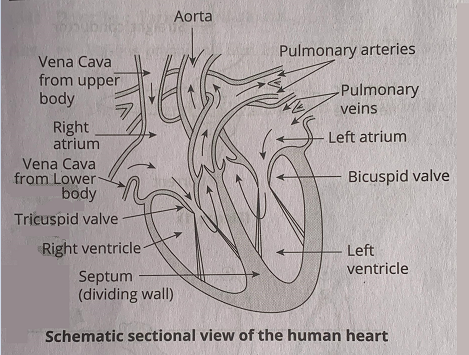
Explain the circulation path of blood in human heart (Figure is necessary)
Answer
Our Pump Heart :
→ The heart is a muscular organ which is as big as our fist. Because both oxygen and carbon dioxide have to be transported by the blood, the heart has different chambers to prevent the oxygen-rich blood from mixing with the blood containing carbon dioxide. The carbon dioxide-rich blood has to reach the lungs for the carbon dioxide to be removed and the oxygenated blood from the lungs has to be brought back to the heart. This oxygen-rich blood is then pumped to the rest of the body.
→ We can follow this process step by step. Oxygen-rich blood from the lungs comes to the thin-walled upper chamber of the heart on the left, the left atrium. The left atrium relaxes when it is collecting this blood. It then contracts, while the next chamber the left ventricle relaxes so that the blood is transferred to it.
Image
→ When the muscular left ventricle contracts in its turn, the blood is pumped out to the body. De-oxygenated blood comes from the body to the upper chamber on the right, the right atrium, as it relaxes. As the right atrium contracts the corresponding lower chamber, the right ventricle dilates. This transfer blood to the right ventricle, which in turn pumps it to the lungs for oxygenation.
→ Since ventricles have to pump blood into various organs, they have thicker muscular walls than the atria do. Valves ensure that blood does not flow backwards when the atria or ventricles contract.
View full question & answer
Question 74 Marks
Describe the human digestive organs.
Answer
The various organs of human digestive system are as follows :
$(1)$ Buccal cavity opens into the mouth. It contains teeth and tongue. It contains salivary glands. Digestion occurs through saliva.
$(2)$ Mouth opens into oesophagus. Food moves further in the oesophagus through peristaltic movement.
$(3)$ Oesophagus opens into stomach. The wall of the stomach contain gastric gland. Gastric juice converts the food into acidic medium for the digestion of food.
$(4)$ Stomach opens into small intestine. The exit of food from the stomach is regulated by a sphincter muscle.
$(5)$ It receives secretions of the liver in form of bile juice and bile salts and from pancreas in form of pancreatic enzyme. It is the site for complete digestion of food.
$(6)$ The walls of the intestine contains villi which absorbs digested food and increase the surface area for absorption. The villi are richly supplied with blood vessels.
$(7)$ Small intestine opens into large intestine.
$(8)$ Large intestine opens into anus. Water is absorbed into large intestine. The rest of the material is removed from the body via the anus. The exit of this waste material is regulated by the anal sphincter.
View full question & answer
Question 84 Marks
Define Heterotrophic Nutrition and explain its types in detail.
Answer
The method of obtaining nutrition from organic matter sources is called Heterotrophic Nutrition. There are three types of it as follows :
(1) Saprophytic Nutrition : Organisms obtain nutrition from other dead organisms or decayed organic substance. They produce enzymes. Its releases enzymes outside the body and also digest the food outside the body. Digestion absorbs simple substance from it and takes it insides the body for eg. Mushroom, fungi, bacteria, yeast, bread mould.
(2) Parasitic Nutrition : In this type of nutrition organism obtain nutrition from other organism. Some organisms obtain nutrition by living in the body of other organisms called endoparasites. Some organisms obtain nutrition by living outside the body of other organisms. It is called ectoparasite for eg. Tapeworms, mosquitoes, round worms, cuscutta, lice, leeches, termites etc.
(3) Holozoic Nutrition : Normally this method of nutrition is found in all animals. It has several stages.
1. Food ingestion : The process of taking in food.
2. Digestion : The process of converting complex organic substance into simple organic substance with the help of enzymes.
3. Absorption : The act of absorbing digested simple organic substance in the body.
4. Assimilation : Storage of simple substances in the cell in various forms or the process of using the substance is known as Assimilation.
5. Excretion : The process of removing undigested food out of the body.
View full question & answer
Question 94 Marks
Explain the process of nutrition in an unicellular organism.
Answer
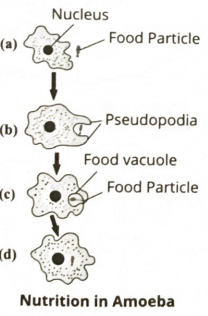
Nutrition in Unicellular organism : In single - celled organisms the food may be taken in by the entire surface. Amoeba takes in food using temporary finger-like extensions of the cell surface which fuse over the food particle forming a food vacuole. Fig (c)
Image
→ Inside the food vacuole, complex substances are broken down into simpler ones which then diffuse into the cytoplasm. fig. (d)
→ The remaining undigested material is moved to the surface of the cell and thrown out.
• Nutrition in Paramoecium :
→ Paramoecium is also an unicellular organism. Its cell has a definite shape and food is taken in at a specific spot. Food is moved to this spot by the movement of cilia which cover the entire surface of the cell. After that food particle make food vacuole and food is digested there. After that undigested food is removed out of the body.
View full question & answer
Question 104 Marks
What is Autotrophic Nutrition? Explain the process of photosynthesis in short.
Answer
In Autotrophic Nutrition, plants use chlorophyll and in presence of sunlight use inorganic substances such as carbon dioxide and water and converts into carbohydrates. Generally starch is a concentrated organic compound. When plants need energy they make use of the starch. These whole process is known as photosynthesis. It can be explained with the help of below equation.
$6 CO _2+12 H _2 O \xrightarrow[\text { Sunlight }]{\text { Chlorophyll }} \underset{\text { (Glucose) }}{ C _6 H _{12} O _6+}+\begin{array}{r}6 O _2+ \\ 6 H _2 O \end{array}$
→ The main stages of photosynthesis process are as follows :
(1) Absorption of light energy by chlorophyll.
(2) Conversion of light energy to chemical energy and splitting of water molecules into hydrogen and oxygen.
(3) Reduction of carbon dioxide to carbohydrates.
Image
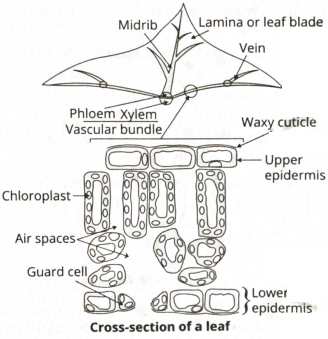
→ Plant cells contain chloroplast and chloroplast contains chlorophyll which absorbs light energy and converts it into chemical energy.
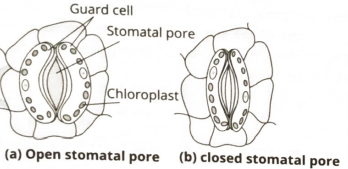
→ Plants obtain carbon dioxide necessary for the process of photosynthesis through stomata. In day time as $CO _2$ is required so the stomatal pores open up. In some desert plants these stomatal pores open at night. They take $CO _2$ at night and at daytime use it in the presence of sunlight.
→ This is seen in such plants because transpiration also occurs through this pores. Plant closes these pores when it does not need carbon dioxide for photosynthesis.
→ Apart from gas exchange, stomata also performs the function of transpiration. The opening and the closing of stomatal pore is carried out by guard cells. The guard cells swell when water flows into them, causing the stomatal pore to open. Similarly the pore closes if the guard cells shrink.
Image
View full question & answer
Question 114 Marks
Explain the contribution of Mendeleev in the classification of elements.
Answer
  • After the rejection of Newlands’ law of octaves, attempts were made to search for a pattern that correlated the properties of elements with their atomic masses.
  • The main credit for classifying elements goes to Dmitri Ivanovich Mendeleev, a Russian chemist.
  • Mendeleev arranged the elements on the basis of their fundamental property like the atomic mass and also on the similarity in chemical properties.
  • When Mendeleev started his work on classification of elements, only $63$ elements were known.
  • Mendeleev examined the relationship between the atomic masses of the elements and their physical and chemical properties.
  • Mendeleev concentrated on the compounds formed by the elements with hydrogen and oxygen, as hydrogen and oxygen were very reactive and formed compounds with most of the elements.
  • The formulae of the hydrides and oxides of the various elements were treated as one of the basic properties of an element for its classification.
  • Thereafter, Mendeleev took $63$ cards and on each card, he wrote down the properties of each element.
  • He sorted out the elements with similar properties and pinned the cards together on a wall one after the other in a vertical column.
  • Mendeleev observed that most of the elements accommodated in a periodic table and elements were arranged in the order of their increasing atomic masses.
  • Mendeleev also observed that that there occurs recurrence of elements with similar physical and chemical properties after certain regular intervals.
  • On the basis of these similarities, Mendeleev proposed his periodic law.
  • Mendeleev’s periodic law:
  • “The properties of elements are the periodic function of their atomic masses.”
  • Mendeleev’s periodic table consists of vertical columns called ‘groups’ and horizontal rows called ‘periods’.
Table 3 : Mendeleev’s Periodic Table
Group I II III IV V VI VII VIII
Oxide
Hydride
$\mathrm{R}_2 \mathrm{O}$
RH
Ro
$\mathrm{RH}_2$
$\mathrm{R}_2 \mathrm{O}_3$
$\mathrm{RH}_3$
$\mathrm{RO}_2$
$\mathrm{RH}_4$
$\mathrm{R}_2 \mathrm{O}_5$
$\mathrm{RH}_34$
$\mathrm{RO}_3$
$\mathrm{RH}_2$
$\mathrm{R}_2 \mathrm{O}_7$
RH
$RO_`$
Periods
A B A B A B A B A B A B A B Transition
Series
1 H
1.008
                           
2 Li
6.939
  Be
9.012
  B
10.81
  C
12.011
  N
14.007
  O
15.999
  F
18.998
   
3 Na
22.99
  Mg
24.31
  Al
29.98
  Si
28.09
  P
30.974
  S
32.06
  Cl
35.453
   
4 First
series:
K
39.102
  Ca
40.08
    Sc
44.96
  Ti
47.90
  V
50.94
  Cr
50.20
  Mn
54.94
Fe Co Ni 55.85 58.93 58.71
Second
series:
  Cu
63.54
  Zn
65.37
Ga
69.72
  Ge
72.59
  As
74.92
  Se
78.96
  Br
79.909
   
5 First
series:
Rb
85.47
  Sr
87.62
    Y
88.91
  Zr
91.22
  Nb
92.91
  Mo
95.94
  Tc
99
Ru Rh Pd 101.07 102.91 106.4
Second
series:
  Ag
107.87
  Cd
112.40
In
114.82
  Sn
118.69
  Sb
121.75
  Te
127.60
  I
126.90
   
6 First
series:
Cs
132.90
  Ba
137.34
    La
138.91
  Hf
178.49
  Ta
180.95
  W
183.85
    Os Ir Pt 190.2 192.2 195.09
Second
series:
  Au
196.97
  Hg
200.59
Tl
204.37
  Pb
207.19
  Bi
208.98
           
View full question & answer
Question 124 Marks
Explain the pattern of Mendeleev’s periodic table.
Answer
  • After the rejection of Newlands’ law of octaves, attempts were made to search for a pattern that correlated the properties of elements with their atomic masses.
  • The main credit for classifying elements goes to Dmitri Ivanovich Mendeleev, a Russian chemist.
  • Mendeleev arranged the elements on the basis of their fundamental property like the atomic mass and also on the similarity in chemical properties.
  • When Mendeleev started his work on classification of elements, only $63$ elements were known.
  • Mendeleev examined the relationship between the atomic masses of the elements and their physical and chemical properties.
  • Mendeleev concentrated on the compounds formed by the elements with hydrogen and oxygen, as hydrogen and oxygen were very reactive and formed compounds with most of the elements.
  • The formulae of the hydrides and oxides of the various elements were treated as one of the basic properties of an element for its classification.
  • Thereafter, Mendeleev took $63$ cards and on each card, he wrote down the properties of each element.
  • He sorted out the elements with similar properties and pinned the cards together on a wall one after the other in a vertical column.
  • Mendeleev observed that most of the elements accommodated in a periodic table and elements were arranged in the order of their increasing atomic masses.
  • Mendeleev also observed that that there occurs recurrence of elements with similar physical and chemical properties after certain regular intervals.
  • On the basis of these similarities, Mendeleev proposed his periodic law.
  • Mendeleev’s periodic law:
  • “The properties of elements are the periodic function of their atomic masses.”
  • Mendeleev’s periodic table consists of vertical columns called ‘groups’ and horizontal rows called ‘periods’.
Table 3 : Mendeleev’s Periodic Table
Group I II III IV V VI VII VIII
Oxide
Hydride
$\mathrm{R}_2 \mathrm{O}$
RH
Ro
$\mathrm{RH}_2$
$\mathrm{R}_2 \mathrm{O}_3$
$\mathrm{RH}_3$
$\mathrm{RO}_2$
$\mathrm{RH}_4$
$\mathrm{R}_2 \mathrm{O}_5$
$\mathrm{RH}_3$
$\mathrm{RO}_3$
$\mathrm{RH}_2$
$\mathrm{R}_2 \mathrm{O}_7$
RH
$RO_`$
Periods
A B A B A B A B A B A B A B Transition
Series
1 H
1.008
                           
2 Li
6.939
  Be
9.012
  B
10.81
  C
12.011
  N
14.007
  O
15.999
  F
18.998
   
3 Na
22.99
  Mg
24.31
  Al
29.98
  Si
28.09
  P
30.974
  S
32.06
  Cl
35.453
   
4 First
series:
K
39.102
  Ca
40.08
    Sc
44.96
  Ti
47.90
  V
50.94
  Cr
50.20
  Mn
54.94
Fe Co Ni 55.85 58.93 58.71
Second
series:
  Cu
63.54
  Zn
65.37
Ga
69.72
  Ge
72.59
  As
74.92
  Se
78.96
  Br
79.909
   
5 First
series:
Rb
85.47
  Sr
87.62
    Y
88.91
  Zr
91.22
  Nb
92.91
  Mo
95.94
  Tc
99
Ru Rh Pd 101.07 102.91 106.4
Second
series:
  Ag
107.87
  Cd
112.40
In
114.82
  Sn
118.69
  Sb
121.75
  Te
127.60
  I
126.90
   
6 First
series:
Cs
132.90
  Ba
137.34
    La
138.91
  Hf
178.49
  Ta
180.95
  W
183.85
    Os Ir Pt 190.2 192.2 195.09
Second
series:
  Au
196.97
  Hg
200.59
Tl
204.37
  Pb
207.19
  Bi
208.98
           
View full question & answer
Question 134 Marks
How could the modern periodic table remove various anomalies of Mendeleev’s periodic table?
Answer
  • The modern periodic table removed three main anomalies of Mendeleev’s periodic table as discussed below:
  • $(1)$ Position of isotopes :
  • All the isotopes of an element have the same atomic number.
  • Therefore, they are placed at one place in the same group of the periodic table.
  • $(2)$ Anomalous position of some pairs of elements :
  • In the Mendeleev’s periodic table, elements with similar properties are placed in the same group.
  • For example, cobalt (atomic mass $58.9 ~u$) placed first and nickel (atomic mass $58.7 ~u$) placed later while.
  • In the modern periodic table elements are arranged in increasing order of their atomic numbers, therefore, cobalt with atomic number $27$ placed first and nickel with atomic number $28$ placed later.
  • $(3)$ Uncertainty in discovery of new elements :
  • Since atomic masses do not increase in a regular manner in going from one element to the next, therefore, in Mendeleev’s periodic table, it was not possible to predict as to how many new elements could be discovered between two known elements.
  • Since, modern periodic table is formed on the basis of atomic numbers of elements, discovery of new element become easy.
View full question & answer
Question 144 Marks
The position of three elements $A, B$ and $C$ in the periodic table are shown below:
Group $16$ Group $17$
$-$ $-$
$-$ $A$
$-$ $-$
$B$ $C$
$(a)$ State whether $A$ is a metal or non- metal.
$(b)$ State whether $C$ is more reactive or less reactive than $A.$
$(c)$ Will $C$ be larger or smaller in size than $B?$
$(d)$ Which type of ion, cation or anion, will be formed by element $A?$
Answer
  • $(a)$ Element A is an element of group $17.$
  • There are $7$ electrons in their valence shell and thus by gaining one more electron it acquire a complete octet.
  • Thus, an element $A$ is a non-metal.
  • $(b)$ On going down in a group, the atomic size increases.
  • Therefore, the force of attraction of the nucleus on the incoming electron decreases.
  • As a result, reactivity decreases down the group.
  • Since element $C$ has larger atomic size than $A$ , the element $C$ is less reactive than the element $A .$
  • In reference of forming positive ion, element $C$ is more reactive than the element $A .$
  • $(c)$ Elements $B$ and $C$ belong to the same period.
  • On moving left to right in a period, atomic size (volume) decreases.
  • Thus, the atomic size of $C$ is smaller than $B$.
  • $(d)$ Since element $A$ has $7$ electrons in the valence shell, it has a tendency to gain one electron to complete its octet.
  • Thus, element A forms an anion.
  • $A+\bar{e} \rightarrow A^{-}$
View full question & answer
Question 154 Marks
Write the general information of the modern periodic table.
Answer
  • In $1913$, Henry Moseley showed that the atomic number of an element is a more fundamental property than its atomic mass.
  • Accordingly, 'Mendeleev's periodic law' was modified to 'Modern periodic law' and atomic number was adopted as basis to form modern periodic table.
  • Modern periodic law :
  • "Properties of elements are a periodic function of their atomic number."
  • The atomic number of any element is equal to the number of protons in the nucleus of the atom.
  • In modern periodic table, elements are arranged in order of increasing atomic numbers, hence prediction of properties of elements could be made with more accuracy.
  • Modern periodic table accounted the all three limitations of Mendeleev's periodic table.
View full question & answer
Question 164 Marks
Explain the trends of the metallic character in a period and a group.
Answer
  • Electropositive elements possesses metallic character.
  • Metals have a strong tendency of losing the electrons during bond formation process.
  • Trend of the metallic character in a group :
  • On moving down in a group, the effective nuclear charge experienced by valence electrons decreases because the outermost electrons are far away from the nucleus.
  • Therefore tendency of the element to lose electrons increases and electrons can be lost easily.
  • Hence, the metallic character increases on moving down in a group.
Table Variation in metallic character of the elements of group $1$
Element Symbol Metallic character
Lithium $Li$ Least metallic
Sodium $Na$ $\downarrow$ Metallic character and electropositivity increase on moving down the group
Potassium $K4$
Rubidium $Rb$
Cesium $Cs$
Francium $Fr$ Most metallic
  • Metallic elements possess $1, 2$ or $3$ electrons in their outermost shells.
  • Trend of the metallic character in a period:
  • On moving from left to right in a period, the effective nuclear charge experienced by valence electrons increases. Therefore, the tendency to lose electrons will decrease.
  • Thus, metallic character decreases in a period on moving from left to right.
  • Elements of second period :
$\underbrace{ Li \quad Be }_{\text {Motole }} \underbrace{ B \quad C \quad N \quad O \quad F }_{\text {Nnn-metale }}$
View full question & answer
Question 174 Marks
Explain the outline of the modern periodic table.
Answer
  • In the modern periodic table, the elements are arranged in the increasing order of atomic numbers.
  • The atomic number of any element is equal to the number of protons in the nucleus.
  • The number of protons in the nucleus is equal to the total number of electrons in the atom.
  • In the modern periodic table, elements having same number of valence electrons are placed in vertical columns called groups.
  • The vertical columns of elements in a periodic table are called groups.
  • The horizontal rows of elements in a periodic table are called periods.
  • The modern periodic table consists of 18 groups and 7 periods.
  • Electronic configuration of elements in a period :
  • Period number indicate the value of 'n' or shell (orbit) number 'n' is the number of the given shell starting from the nucleus.
  • The maximum number of electrons that can be accommodated in any shell is $2n_2$, where 'n' is the number of the given shell.
Table
Period number Number of valence shell Type of complete shell and elements Number of elements
First 1 $\mathrm{K}\left({ }_1 \mathrm{H} \text { to }{ }_2 \mathrm{He}\right)$ 2
Second 2 $\mathrm{L}\left({ }_3 \mathrm{Li}\right.$ to $\left.{ }_{10} \mathrm{Ne}\right)$ 8
Third 3 $\mathrm{M}\left({ }_{11} \mathrm{Na}\right.$ to $\left.{ }_{18} \mathrm{Ar}\right)$ 8
Fourth 4 $\mathrm{N}\left({ }_{19} \mathrm{~K}\right.$ to $\left.{ }_{36} \mathrm{Kr}\right)$ 18
Fifth 5 $\mathrm{O}\left({ }_{37} \mathrm{Rb}\right.$ to $\left.{ }_{54} \mathrm{Xe}\right)$ 18
Sixth 6 $\mathrm{P}\left({ }_{55} \mathrm{Cs}\right.$ to $\left.{ }_{86} \mathrm{Rn}\right)$ 32
Seventh 7 $- (_{87}Fr$ to $...)$ -
  • Electronic configuration of elements in a group :
  • All the elements in any group of the periodic table have identical outershell electronic configuration.
  • All the elements in a group have same number of electrons in their valence shell as well as they have similar properties.
  • The valence shell electronic configuration of alkali metals is $ns^1$ which is shown below :
Atomic number Symbol of element Name of element Electronic configuration
1 H Hydrogen 1
3 Li Lithium 2, 1
11 Na Sodium 2, 8, 1
19 K Potassium 2, 8, 8, 1
37 Rb Rubidium 2, 8, 8, 18, 1
55 Cs Cesium 2, 8, 8, 18, 18, 1
87 Fr Francium 2, 8, 8, 18, 18, 32, 1
View full question & answer
[4 marks Questions] - Science STD 10 Questions - Vidyadip