| ‘A’ | ‘B’ |
| $Q.1.$ Oxygen, nitrogen | $a.$ Solitary resource |
| $Q.2.$ Land, water, pasture | $b.$ Unattainable resource |
| $Q.3.$ Cryolite mineral | $c.$ Common available resource |
| $d.$ Universal resource |
Question types
NATURAL RESOURCES. question types
183 questions across 8 question groups — pick any mix to generate a Social Science paper with step-by-step answer keys.
183
Questions
8
Question groups
5
Question types
01
Match The Following. [3 Marks]
3 Q→02True-False
39 Q→031 Marks Each
28 Q→04Fill In The Blanks
20 Q→05M.C.Q
53 Q→062 Marks Each
13 Q→073 Marks Each
24 Q→084 Marks Each
3 Q→Sample Questions
NATURAL RESOURCES. questions
One sample from each question group in this chapter. Select any group above to see the full set with answer keys.
| ‘A’ | ‘B’ |
| $Q.1.$ Alluvial soil | $a.$ South Deccan Plateau |
| $Q.2.$ Red soil | $b.$ Terai regions of the Himalayas |
| $Q.3.$ Black soil | $c.$ Plains of North India |
| $d.$ Whole of Maharashtra, West Madhya Pradesh |
| ‘A’ | ‘B’ |
| $Q.1.$ Individual resource | $(a)$ Minerals found at only one or two places in the world. |
| $Q.2.$ National resource | $(b)$ Those available at limited places. |
| $Q.3.$ Rare resource | $(c)$ Public property owned by a country or a region |
| $(d)$ Owned by individual or a family |
Laterite soil is the other name of padkhau soil.
Soil is formed of matter available from vertical and head-ward parts of base rocks.
Solitary resource is found only in one or two places in the world.
Marshy or peaty soll develops in regions of heavy moisture due to accumulation of Igneous elements.
The layer of mountain soil is very thin and underdeveloped.
Explain the following term : Solitary resources
Explain the following term : Soil erosion
Explain the following term : Resources
Explain the following term : National resources
Explain the following term : Rare resources
Red soil is spread over an area of ________________$\%$ of India. $(19, 15, 43)$
View full solution →________________ soil is spread over an area of $19\%$ of india. (Black, Alluvial, Red)
View full solution →________________ soil contains more proportion of potash, phosphoric acid and limestone. (Red, Black, Alluvial)
Alluvial soil is spread over an area of ________________$\%$ of India. $(15, 19, 43)$
View full solution →________________ soil is spread over an area of $43\%$ of India. (Red, Alluvial, Sandy)
View full solution →Recently the soil of India are classified into $.........$ types by Indian Council for Agricultural Research $\text{(ICAR)}$.
- ASeven
- BSixteen
- CFive
- ✓Eight.
Answer: D.
View full solution →Which is the other name of Padkhau soil?
- ✓Alluvial soil
- BLaterite soil
- CBlack soil
- DRed soil
Answer: A.
View full solution →Soil information takes place due to $.........$ elements of parental rocks.
- ✓Weathering and erosion
- BTransportation and stagnancy
- CSequence and non$-$sequence
- DVertical and headwords
Answer: A.
View full solution →The resource available at one or two places in the world is $.........$
- AUniversal resource
- BCommon available resource
- CRare resource
- ✓Solitary resource
Answer: D.
View full solution →Cashews are grown with the help of fertilizers in$.........$soil.
- ABlack
- BMountain
- CRed
- ✓Laterite
Answer: D.
View full solution →Write short note about the Desert Soil.
What is called as Mountain Soil $?$
View full solution →Write notes on Alluvial Soil.
Black soil is called soil of cotton. Give reason.
The black soil is called self-ploughing soil. Give reason.
state the remedies to prevent soil erosion.
Write notes on Black Soil.
Describe the process of soil formation and state on which basis these are classified.
What is meant by soil conservation? State the remedies of soil conservation.
Why is planning and conservation of resources necessary?
What Is meant by resource$?$ Describe its usages.
View full solution → Map-Based Question On an outline map of India show the wildlife reserves.
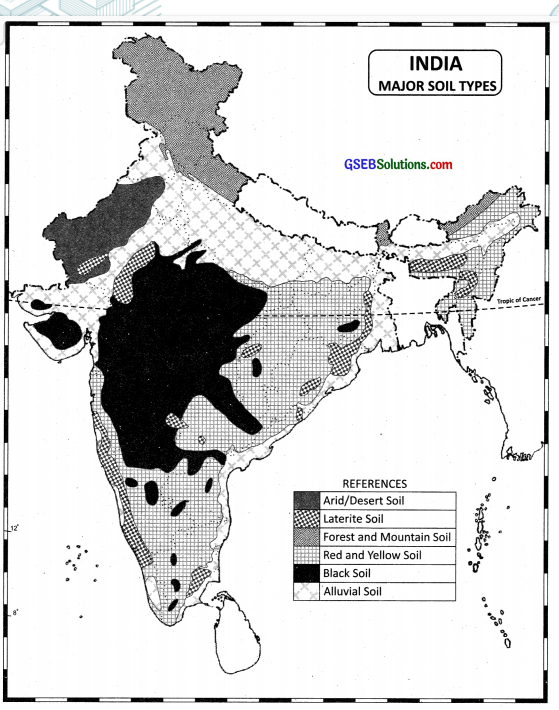
$1.$ I am also known as laterite soil.
$2.$ I am also known as black soil.
$3.$ I am considered as rare resource.
$4.$ I am the soil situated in Vadodara District.
$5.$ I am known as renewable resource.
View full solution →$1.$ I am also known as laterite soil.
$2.$ I am also known as black soil.
$3.$ I am considered as rare resource.
$4.$ I am the soil situated in Vadodara District.
$5.$ I am known as renewable resource.
Which points should be considered for planning and conservation of natural resources?
Generate a NATURAL RESOURCES. paper free
Pick question groups from the list above, set marks and difficulty, and export a branded PDF with step-by-step answer keys. First 3 chapters free — no signup.