Questions

Que-Ans: [5 Marks Each]

🎯

Test yourself on this topic

4 questions · timed · auto-graded

Question 15 Marks
What is physical weathering ? Describe its types.
Answer
  • Rock breaking is caused by temperature, rain, snow, vegetation and human activities.
  • In it their physical form changes.
  • But there is no change in the chemical composition, so it is called physical erosion.
  • Temperature: Exposed rocks are heated by the heat of the sun.
  • Therefore, their size increases as they spread.
  • At night the temperature drops.
  • Thus, this action is continuous.
  • The result is cracks in the rocks.
  • Over time, small and large pieces of rock begin to form.
  • Which is called room separation.
  • Such erosion is especially common on basalt rocks.
  • Minerals differ in their ability to transmit heat and shrink from cold, so dispersion and contraction are uneven,
releasing small and large particles from rocks.
  • It is seen as particle separation.
  • In rocks that are arranged one layer above another, one layer after another separates which is called layer
separation.
  • This type of fission is commonly found in basalt rocks.
View full question & answer
Question 35 Marks
Explain the meaning of plateau and its types.
Answer
  • Highlands are flat landforms with flat peaks as well as steep slopes, with an elevation of about 180 meters above sea level.
  • The height figure is as deceptive as a mountain.
  • Such as the $U.S.$ prairie plain known as its eastern part Tableland.
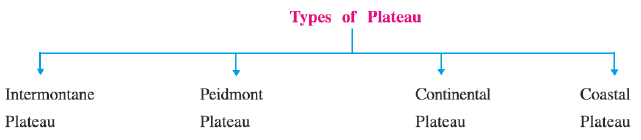
  • Types of plateaus: Highlands are classified into four types based on their geographical location as well as construction.


$(1)$ Inter-mountain plateau: A plateau surrounded by mountain ranges is called an "inter-mountain plateau".
View full question & answer
Question 45 Marks
Give a definition of a mountain; write a detailed note about its types.
Answer
  • According to the construction process, there are two main types of mountains.
$(1)$ Subterranean $($seismic$)$ mountains.
$(2)$ Residual mountains Types of subterranean mountains.
$(1)$ Gad mountain: The pressure generated by geo-movement on horizontal areas with rocky outcrops and applied from the horizontal direction forms wave-like folds in it and that pressure force continues for a long time and some of them raise high in the form of folds.
  • Come on, it's called Gad Mountain.
  • The Gad mountains are made up of rocky cliffs.
  • It contains marine fossils and fossils.
  • Which proves that the Gad mountains originated from the seas.
  • The Gad Mountains, which formed millions of years ago, are called the Old Gad Mountains.
  • Appian in the eastern part of North America, Ural of Russia, $U.K.$ The main ones are No Appenine, Pinine of Italy, Sinlinganshan of China and Aravalli Mountains of India.
  • The Himalayas, the Andes, the Rockies and the Alps, formed about $30$ million years ago, are the new Gad mountains.
$(2)$ Continent Mountain: Due to the internal forces of the earth, sometimes rocks or layers are formed in the surface rocks.
  • The ground between the two vertical parallel level fractures sits down.
  • The continent then forms a mountain, but if its slope is steep on one side and the upper part is like a flat table, it is called a plateau and the middle part which sits below is called a crater.
  • There are continental mountains on both sides of this ridge.
  • The continent is bounded on the west by the Rhine River estuary in Europe, and on the east by the Black Forest.
  • To the north of the Narmada Phatkhin is the Vidhyashreni and to the south is the Satpuda range.
  • The Faust mountain continent of Germany is an example of a mountain.
$(3)$ Curved mountain: The magma in the earth's crust tries to get out, but the solid rocks that come on top of it get in the way.
  • So that the pressure in the magma raises the ground level in the shape of a dome.
  • He calls it the domed mountain.
  • Outside the mountain, rock layers can be seen eroded by erosion factors, and frozen magma can be seen inside.
  • The mountains near the pilgrimage site Sundha Mata in Rajasthan and the $U.S.$ Henny of the state of Utah is an example of this.
$(4)$ Volcanic mountain: At the time of volcanic eruption, lava, ash, rock fragments, etc., are thrown out of the earth's crust and accumulate around the volcano to form high cone-shaped clouds.
  • It is called a volcanic mountain.
  • This mountain is called Sumahit mountain as it forms the accumulation of various substances coming out of the ground.
  • Italy, Vesuvius, Sicilyno Etna, Kenya, Kilimanjaro, Fujia in Japan, Mayon in the Philippines, and Kakatoa in Indonesia, Popocetipail in Mexico and Cotopaxi and Chimborazo in Ecuador are the world's volcanic mountains.
$(5)$ Residual Mountains: High landscapes like mountains, plateaus are eroded by erosion factors and its remains remain on the base of the cone when it is known as eroded or residual or residual mountain.
  • Examples are Vindhyachal in India, Western Ghats, Eastern Ghats, Parasnath, Wales in the $UK,$ Ocarz in the $US$.
View full question & answer
Que-Ans: [5 Marks Each] - Geography STD 11 Arts Questions - Vidyadip