Questions

3 Marks Each

🎯

Test yourself on this topic

13 questions · timed · auto-graded

Question 13 Marks
Give the difference between Monopoly and Monopolistic Competition.
Answer
Monopoly Monopolistic competition
$1$. There are numerous buyers and sellers. $1$. There are numerous buyers and also many sellers.
$2$. Substitute goods are either not available or available rarely. $2$. Substitute goods are available easily.
$3$. Other firms cannot enter the market. $3$. Other firms can easily enter or exit the market.
$4$. The firm can control the price to a very large extent. $4$. Firms cannot control the price much.
View full question & answer
Question 23 Marks
Give the difference between Perfect Competition and Monopoly.
Answer
 
Perfect Competition Monopoly
$1.$ There are numerous buyers and sellers. $1.$ Buyers are numerous but seller or producer is only one.
$2.$ There are several firms In the industry. $2.$ There is only one firm in the industry. So it is said firm is industry.
$3.$ There is no barrier for entry or exit of firms. $3.$ Other firms cannot enter the market.
$4.$ Buyers can affect the market price. $4.$ Buyers cannot affect the market price.
$5.$ The curves of Average Revenue $(AR)$ and Marginal Revenue $(MR)$ are one and the same and parallel to the $X-$axis. $5.$ The curves of Average Revenue $(AR)$ and Marginal Revenue $(MR)$ are different and have negative slope.
View full question & answer
Question 33 Marks
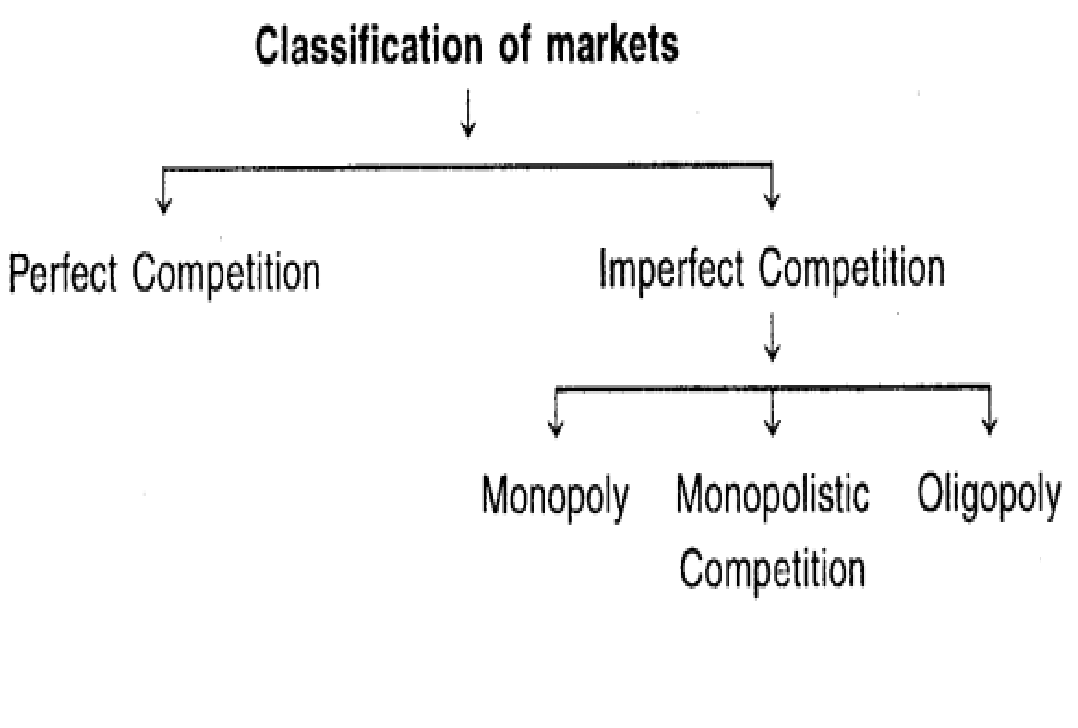
Classify the market according to competition.
Answer

Market classification on the basis on competition:
  • Normally a market based on competition is classified on the basis of number of sellers and buyers. Here, the market of sellers is more important.
  • Classification of market based on competition is shown in the chart below.
View full question & answer
Question 43 Marks
Explain: ‘Price Stickiness’.
Answer
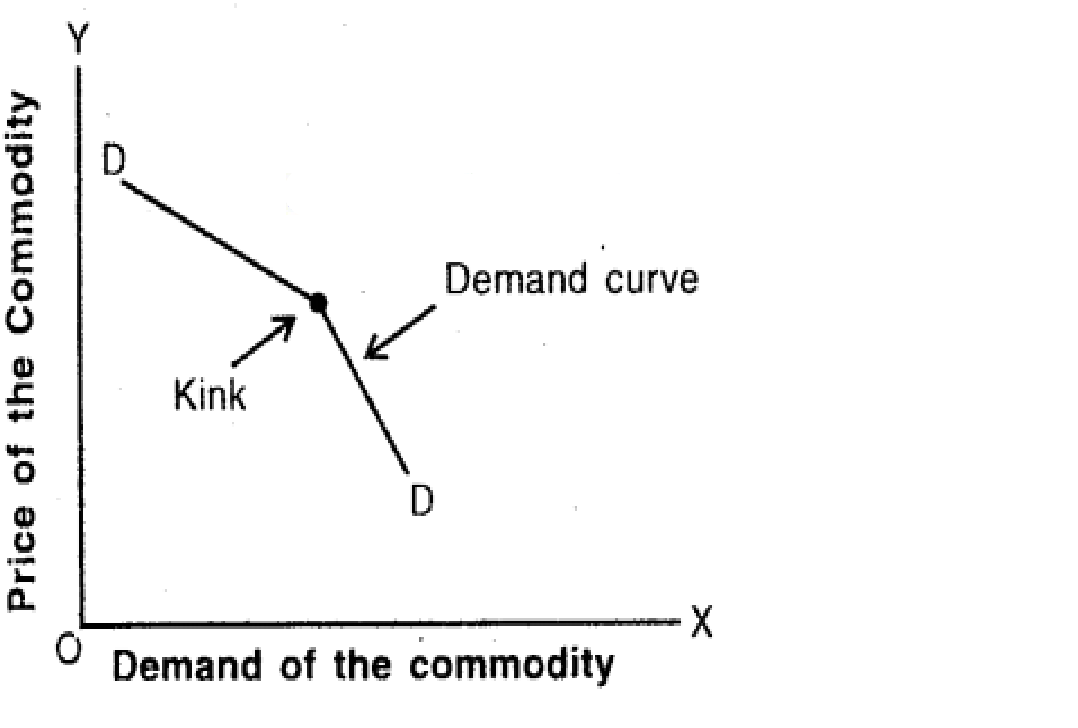
Price stickiness $($Kinked Demand Curve$):$
  • There are a number of theories o Oligopoly. The Kinked-domand theory is one of them.
  • Price stickiness is a situation where in the firm would tend to stick to the price of its product and not increase or decrease it even if he wish to.
  • In oligopoly market, the number of firms is less and they are interdependent on each other.
  • Even if onc of the firm decreases the price of a product, its product
  • Even if on of the firm decreases the price of a product, its product will become cheaper than other products. So, according to the law of demand due to comparatively cheaper price of the product its demand will be more compared to the product of other firms. This will result in decroaseing the demand of the products sold by other firms.
  • In order to avoid such situation, the competitive firms will also have to decrease ihe price of their product in order to stay in the competition.
  • At the end, the price of the product reaches at a nominal level and ¡t becomes impossible to reduce the price lurther.
  • Sticky prices, therefore, are prices in an economy which are resistant to change.
  • On the other hand, if the firm increases the price of the product then the demand of that product decreases, and the competitive firms are profited. Thus, as the nominal price is resistant to change, the demand curve hecomes kinked.

Kinked demand curve
View full question & answer
Question 53 Marks
Explain any three characteristics of Oligopoly.
Answer
Characteristics of oligopoly:
$1.$ Few sellers and numerous buyers:
Under oligopoly, the number of sellers and producers is less in the market.
  • There exists about two to less than ten or twenty firms in the market.
  • Owing to these circumstances, a few number of sellers have a monopoly control over the market.
  • On the other hand, there are numerous buyers in such market. So, neither these buyers have much influence on the market price nor they are given much importance.
$2.$ Similar or substitutable products:
  • Firms sell identical or substitute products in oligopoly. This also means that when the firms in a market, produce and sell identical or substitute products, it is Oligopoly market. For example, products like salt, crude oil, tea, etc.
  • When producers produce identical products there exists imperfect oligopoly in the market. For example, oligopoly exists for products like cold drinks, motorcycle, etc.
$3.$ Admittance of firms:
  • In the market of oligopoly, the entry and exit of firms is free or regulated according to the type of oligopoly followed.
  • If there is free oligopoly in the market, the firms can freely enter or exit the market, whereas if the oligopoly is restricted, then the entry and exit of firms is regulated.
View full question & answer
Question 63 Marks
Explain any three characteristics of Monopolistic Competition.
Answer
Characteristics of monopolistic competition:
$1.$ Large number of sellers and numerous buyers:
  • There are numerous sellers in Perfect Competition. In monopoly there is only one seller, while in monopolistic competition there are many sellers. This means that there are neither numerous sellers, nor there is only one seller, but there are many sellers.
  • There are numerous buyers in monopolistic market and so they cannot individually influence the market. Also they cannot affect the price of the product.
$2.$ Product differentiation:
  • Product differentiation is a distinct characteristic of monopolistic competition. Product differentiation refers to the concept of differentiating a product from another product in terms of form, quality and nature. For example, two different models of bike but built on same basic structure.
  • A producer may produce a product with minor differences in terms of form, fragrance, taste, shape, weight and quality. These minor differences lead to availability of various products under product differentiation in monopolistic competition market.
$3.$ Free entry and exit of firms:
  • In a monopolistic competition it is easy for new firms to enter into an existing firm or to leave the industry.
  • When there is normal profit in the market, the free entry and exit of the firm decreases and stops.
  • The firms are generally not attracted by the normal profit and so the firms do not enter in such markets. Similarly, the existing firms in the market do not exit as they do not suffer losses.
View full question & answer
Question 73 Marks
Clarify the meaning of Oligopoly.
Answer
  • Oligopoly is such a system in which the sellers are very few.
  • This means that there are two or more sellers but not innumerable.
  • It is usually believed that the number of sellers is between to ten or twenty.
  • The entire supply of the industry is distributed among few firm.
  • In English, the oligopoly is made of two roots - 'oligo' and pollien.
  • Oligo means few and pollien means to sell In short, oligopoly means the monopoly of the few sellers or producers.
  • Oligopoly means, when the total supply of industry is in the hands of the few firms, each firm becomes a monopolistic and these firm, can be called oligopoly.
  • " According to Prof. Mayers :
    • "Oligopoly is such a condition in which there is a small number of sellers and so each seller individually places the supply in the market and he is conscious about its effect on the price."
  • It is a market in which there are very few sellers or producers who either produce or sell homogeneous or near substitutes and each firm has substitution supply in the industry.
  • In this market, intense competition between firms.
  • In this market due to less number of firm element of monopoly is enter.
  • Because of number of buyers are unlimited.
  • There is more interdependence of the firms.
  • Producers or sellers has to consider the quality or price of competition while deciding the price or quality of their goods.
  • Because of interdependence, the elements of competition is enter.
  • There is also price rigidity seen in this market.
  • Because of this competition, firm follow the price reduction of a firm and never follow the price rise.
  • In this market, kinky demand curve of the firm is seen.
View full question & answer
Question 83 Marks
What is meant by monopolistic competition $?$ Describe its characteristics.
Answer
  • Monopolistic competition means the competition prevailing among the large group of producers producing close substitutes not perfect substitutes.
  • In this market, co-existence of monopoly and competition elements are seen. Monopolistic competition is one of the concept of imperfect competition.
  • Following characteristics are seen in monopolistic competition.
    • Sellers are in big numbers and unlimited buyers.
    • Product- differentiation.
    • Free entry - exit of the firm in the industry.
    • Necessity of selling cost.
    • Without price competition with price competition.
    • Producers, sellers and customers have complete knowledge of the market.
    • Control over price.
View full question & answer
Question 93 Marks
What is meant by monopoly ? State the feature of monopoly ?
Answer
  • The term monopoly is divided from Greek words 'monos' which means single and 'polein' which means seller.
  • So when there is in whole market only one firm is producer or seller then it called monopoly.
  • The discussion of monopoly is in the context of limited monopoly.
  • 'Monopoly is such a market situation where the monopolists produce the product where close best products are not available and that is why the production of other producers does not affect the sale of monopolistic or its price."
  • Following characteristics are seen m monopoly market.
    • Only one producer or seller and unlimited buyers.
    • Absence of near substitute product.
    • Restriction on the entry for new firm.
    • Control over sells or price.
    • Abnormal profit in long run.
    • Price discrimination can be possible.
    • Concept of one firm only.
View full question & answer
Question 103 Marks
What is perfect competitive market ? State its conditions.
Answer
  • When the prices of homogeneous products are uniform except transfer cost or transport cost, it is called the perfect competitive market.
  • In this type of market, demand of commodity of the firm is perfectly elastic and there is not influence of an individual firm on the price.
  • By accepting the price decided by the industry, firm has to take decision regarding production quantity.
  • In this type of market there are unlimited buyers and sellers and free entry exit of the firm and in long run firm gets equilibrium at normal profit. Following six conditions has to be followed for the existence of perfect competitive market.
    • There must be unlimited buyers and unlimited sellers in the market.
    • Goods sold by producer must be homogeneous.
    • Free entry and exit of the firm in the industry.
    • Producers, sellers and buyers has complete knowledge of the market.
    • Means of production must be completely mobile.
    • There should be absence of transportation cost (zero cost).
View full question & answer
Question 113 Marks
Explain the classification of market on geographical base.
Answer
  • According to the geographical or place base, a market can classified into four parts :
  • Local Market :
    • Generally, the place where commodities or services are produced and sold is called local market. E.g. clay, crockery market.
  • Regional market :
    • The commodities or services which are confined to a region or state is a regional market.
    • Generally it is restricted up to state only. e.g. Fast food market of Ahmedabad and Surat. Gujarati Telefilm market.
  • National Market :
    • Generally, the production of a commodity or services which are confined to a nation is called a national market.
    • This market is spread over the different states of the nation. e.g. Dairy product. Indian Sari market, Hindi Tele-film market.
  • International Market:
    • Generally, the trade of commodities or services which are not confined only to a nation but to many countries of the world are called an international market.
    • It is also called global market.
    • Purchase-sell of this market is known as import-export. e.g. mobile or car market.
    • However now because of scientific research, transportation and communication, development of facilities like cold storage and freeze, classification is not rigid. Regional market of a commodity can become national market.
View full question & answer
Question 123 Marks
Explain the meaning of market.
Answer
  • In economics, the concept of market is very wide.
  • A market has nothing to do with any particular place but it is connected with the direct each h contact of buyers and sellers.
  • Buyers and sellers may not meet directly but they are in contact with ea other through telegram, mail, telephone, telex or fax internet or through website and undertake the process of exchange.
  • Even then, the market comes into existence.
  • According to Samuelson :
    • "A market is a mechanism through which buyers and sellers interact to determine prices and exchange goods and service.
    • " Prof. Benham has explained the meaning of the word 'market' in the following words, "A market is an organization where buyers and sellers exchange goods through direct or indirect contact.
    • The effects of prices prevailing in one part of the market, affect the other part of market and as a result there is a tendency of uniform price for the same commodity in the market.
  • Following are the characteristics of the market.
    • Existence of buyers and sellers.
    • A commodity or service must be available for purchase.
    • The place is not necessary for the market but it is necessary for the buyers and sellers to be in touch with each other directly or indirectly.
    • There should be interaction of exchange between them and both the parties should agree to a price.
    • Buyers and sellers should know the situation of the market.
View full question & answer
Question 133 Marks
Give difference between Monopoly and Monopolistic competition.
Answer
Monopoly Monopolistic competition
Purchasers are unlimited but producer is only one. Purchasers are unlimited and producer firms are more.
Scarcity of nearby substitute commodity. Group of firms produce substitute commodity nearby each other.
Entry of firm is prohibited. Entry of firm is free.
Control on price of firm is more. Control on price of firm is less.
In long run equilibrium firm gets abnormal profit. In long run equilibrium firm gets normal profit.
No near substitute product and only one firm, so selling cost is not necessary. So many firms are producing near substitute products, so selling cost is necessary.
View full question & answer
3 Marks Each - Economics STD 11 Commerce Questions - Vidyadip