Questions

3 Marks Each

Take a timed test

11 questions · self-marked practice — reveal the answer and mark yourself.

Question 13 Marks
Explain increase-decrease of supply along with diagram.
Answer

Increase-decrease in supply:
Assuming price as constant if the supply increase/decrease due -to some other factors, it is known as increase/ decrease in supply.
Rightward shift:
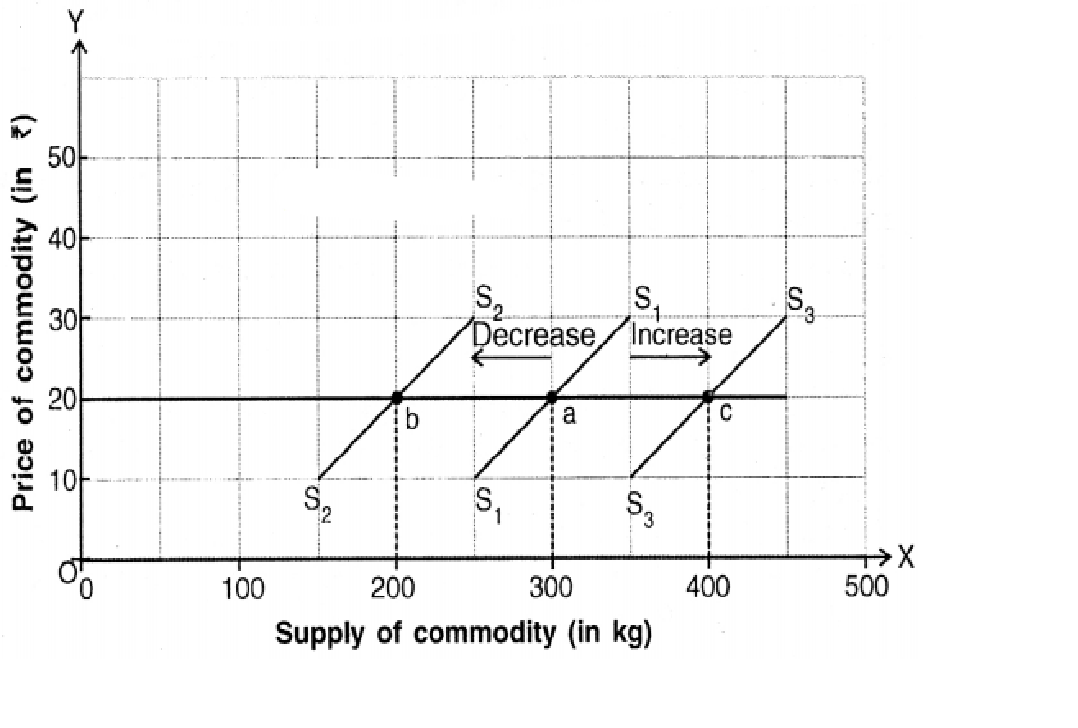
  • Keeping price facto, constant, if supply increases due to any other factor, the supply curve will shift towards right which is called rightward shift in supply curve.
  • The factors responsible for rightward shift could be fall in cost of production, fall in prices of factors of production, improvement in technology, rise in number of suppliers, government policies, etc.
Leftward shift:
  • Keeping price factor as constant, if supply decreases due to any other factor, the supply curve will shift towards left which is called leftward shift in supply curve.
  • Leftward shift takes place when one or more above mentioned factors behaves in a reversed manner.
Let us take an example to understand the increase and decrease in supply:
  • The schedule (table) given below contains data of price of a commodity and its various supply at that constant price.
  • Note that price $₹ 20$ is constant. A supply curve is plotted for the given data.
Price of apples (in ₹) Supply of apples (in kg)
$20$ $100$
$20$ $200$
$20$ $300$
$20$ $400$
$20$ $500$

Increase and decrease of supply
  • In the diagram, price is represented on the ' $Y$-axis and supply on the '$X$-axis.
  • Initial supply curve is represented by $\mathrm{S}_1 \mathrm{~S}_1$. Here, at price of $₹ 20$ the supply of apples is 300 kg . This is plotted as point 'a' on the supply curve $S_1 S_1$.

Increase in supply:
  • When price remains constant at $₹ 20$ but one or some of the other factors change in favour of supply of apples then the supply curve shifts to the right to $S_3 S_3$ and the supply of apples increases to $400 \ kg$ . This is indicated by rightward movement of supply curve from point ' $a$ ' to point ' $c$ ' on $\mathrm{S}_3 \mathrm{~S}_3$.
           Decrease in supply:
  • At constant price, if one or some of the other factors change against the supply of apples then the supply curve shifts to the left to $\mathrm{S}_2 \mathrm{~S}_2$ and the supply of apples decreases to $200 \ kg$ . This is indicated by leftward movement of supply curve from point ' $a$ ' to point ' $b$ ' on $\mathrm{S}_2 \mathrm{~S}_2$.
View full question & answer
Question 23 Marks
Explain expansion-contraction of supply along with diagram.
Answer

Expansion-contraction of supply:
  • Wiien factors other than price are assumed to remain constant and price varies, there occurs expansion and contraction of supply.
  • These other factors may be, change in cost of factors of production, number of sellers, level of technology, government policies, etc.
Example:
  • Let us take an example to understand the expansion and contraction of supply.
  • The schedule given here shows various price of apples and its supply at, that prices.
Price of apples per \ kg (in ₹) Supply of apples (in \ kg)
$50$ $200$
$60$ $400$
$70$ $600$
$80$ $800$
$90$ $1000$

Expansion and contraction of supplyAnalysis:
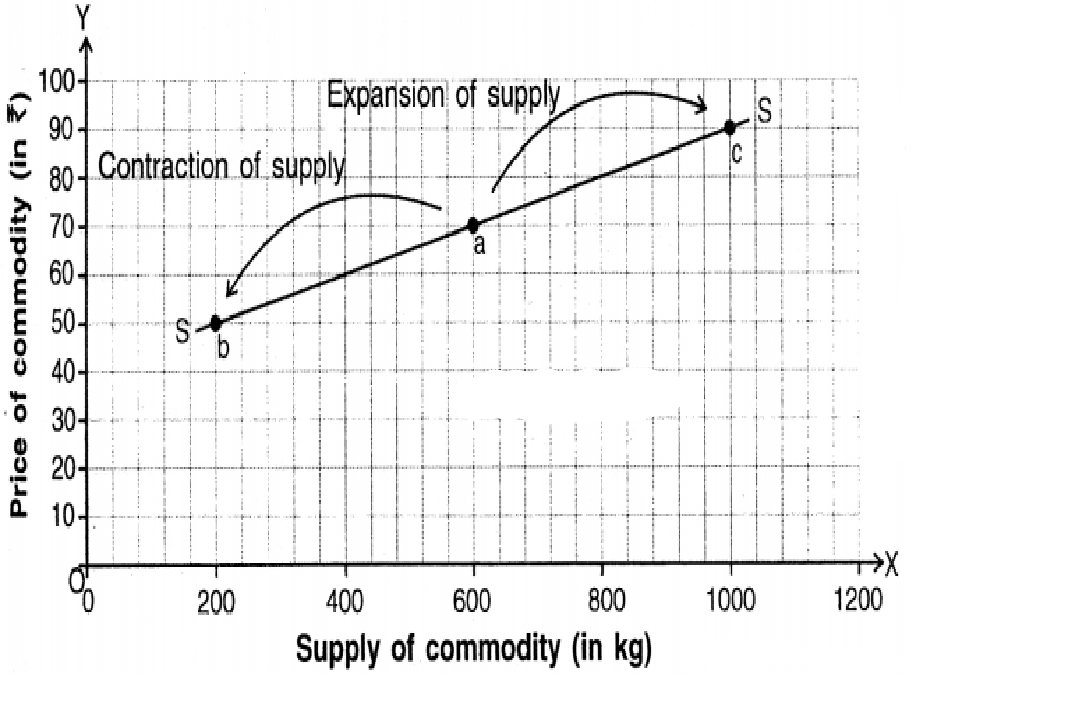
In the diagram, price of apples is represented on ‘$Y$-axis and their supply on ‘$X$-axis. Suppose the initial price of apple is $₹ 70$ per \ kg. At this price, the initial supply is $200 \ kg$. which is plotted as point $‘a’$ on the supply curve.
Expansion:
  • As can be seen in schedule, when price rises to $₹ 80$, supply expands to 800 \ kg. When price further rises to ₹ 90, supply expands to $1,000 \ kg$. which is plotted as point $‘c’$.
  • The movement from point $‘a’$ to point $‘c’$ on supply curve $SS$ is called expansion of supply.
Contraction:
  • Now from the initial point ‘a’ if price falls to $₹ 60$, supply contracts to $400\ kg$. Similarly, if price falls further to $₹ 50$ the supply contracts to $200 \ kg$. which is plotted as point $‘b’$ on the supply curve.
  • The movement from point $‘a’$ to point $‘c’$ on the same supply curve $SS$ is called contraction of supply.
View full question & answer
Question 33 Marks
State exceptions to the law of supply.
Answer
Law of supply:
“When all other factors affecting supply are assumed to be constant, as price increases, supply expands and as price decreases, supply contracts”. The definition tells that there is a direct and positive relationship between price and supply. This relationship is called law of supply.

Assumptions of law of supply:

  • Over and above time, several factors affect the supply of a good at a particular point of time. However, at given point of time, the law of supply assumes the effect of all factors on supply other than the price as constant.
  • In reality, other than price there are some other factors that can influence the supply more. However, we assume these to be constant.

Some important assumptions of law of supply:

  • Prices of factors of production remain constant.
  • There is no change in technology.
  • Level of competition remains the same. In other words, number of sellers in the market remains the same.
  • Expectations regarding future prices are ignored/held constant.
  • Other factors like government policy, transport facilities, natural factors, etc. remain constant.
View full question & answer
Question 43 Marks
Write short note on supply function.
Answer
Supply function:
  • The supply function specifies a functional (mathematical) relationship between supply of a good and its determinants i.e. factors affecting the supply.
  • The supply function represents that the supply of one good is determined by many factors.
Mathematical form of the supply function:
$S_x=f\left(P_x, T, P_f, P_0, U\right)$
where $S_x=$ Supply of commodity $X$
$f=$ Functional notation
$\mathrm{P}_{\mathrm{X}}=$ Price of commodity $X$
$T=$ Level of technology
$P_F=$ Factor prices
$\mathrm{P}_{\mathrm{e}}=$ Expectations regarding future prices
$\mathrm{U}=$ Other factors
View full question & answer
Question 53 Marks
Explain Average Revenue and Marginal Revenue with the help of diagram in imperfect competition market.
Answer
Imperfect competition:
  • A situation where perfect competition is absent is called imperfect competition or imperfectly competitive market.
  • Monopoly, duopoly, oligopoly, monopolistic competition, etc. are examples imperfectly competitive market.
Behaviour of $AR$ and $MR$ in such market:
  • In such market, the seller has to reduce the price in order to sell more units.
  • This means he tries to increase demand of his commodity by increasing its sale (by decreasing prices). So, his total revenue increases at a diminishing rate. This practice results in a difference between the Average Revenue $(AR)$ and Marginal Revenue $(MR).$
  • As price decreases, the Average Revenue decreases and its curve slopes downwards from left to right. Due to reduced Average Revenue, Marginal Revenue also decreases. However, the decrease in Marginal Revenue is rapid in comparison to Average Revenue. Therefore, Marginal Revenue curve is below Average Revenue curve which can be seen in the diagram.
View full question & answer
Question 63 Marks
Explain Average Revenue and Marginal Revenue with the help of diagram in perfect competition market.
Answer
Perfect competitive market:
$1$. Perfect market or perfect competitive market is defined by several characteristics.
Some are:
  • Perfectly competitive market is such a market where firms accepts market price and sell their commodities
  • Commodities are homogeneous $($i.e. the qualities and characteristics of goods or services available in market do not vary between different suppliers$)$
  • There are large number of buyers and sellers
  • Buyers and sellers have complete knowledge of market situation
  • Price is determined by demand and supply of a commodity. Firms sells commodity on this price only and no firm can influence this price. Hence, price is fixed and constant.
  1. In perfect competition, market price $(P) =$ Average Revenue $(AR) =$ Marginal Revenue $(MR)$ i.e. $(P – AR = MR).$
  2. Under such market condition, if price of commodity is $₹ 50$ then Average
    Revenue and Marginal Revenue of firm will also be $₹ 50.$
  3. As a result, the curves of Average Revenue and Marginal Revenue of the firm are same and also parallel to $X-$axis. This curve is represented as $DD$ in the diagram.
In the diagram, revenue curve of a firm is shown. We can see three $7$ things in it. They are:
  1. In perfectly competitive market, Marginal Revenue and Average revenue are constant and same. As a result, both of them can be shown through one line or say curve $DD.$
    All points on $DD$ curve will show Average Revenue $=$ Marginal Revenue.
  2. Average Revenue and Marginal Revenue curve are parallel to $X-$axis as shown by $DD$ curve. Here, Average Revenue and Marginal Revenue curve have merged into one another and since value of both the revenues are same and constant the slope of curve is zero.
  3. Total Revenue curve represented by points $‘OR’$ is at $45^\circ $ angle at zero point i.e. origin point. This curve indicates that as the sale of goods increases, total revenue also increases at equal rate. Hence, the slope of total revenue curve is positive and of equal proportion.
Revenue curve in perfectly competitive market
View full question & answer
Question 73 Marks
Explain with diagram the inter-relationship between average cost and marginal cost.
Answer
Inter-relationship between Average Cost and Marginal Cost:
  • The relationship between the average cost and the marginal cost is quite important for studying production cost.
  • We know that cost per unit of output is called Average Cost $(AC)$ and the cost increased to produce one extra unit of commodity is called the Marginal cost $(MC)$.
A producer in long run decides to continue production if:
Price of a commodity is more than its Average Cost $(AC)$.
On the other hand, in short run, the producer decides to continue production if:
  • Price of commodity is more than Marginal Cost $(MC)$.
  • Thus, the Average Cost $(AC)$ and the Marginal Cost $(MC)$ play important role in taking a decision about production.
Example :
The table below shows Total cost, Average Cost and Marginal Cost of a firm for an output of a particular commodity.
  • As shown in the schedule, as output increases, initially the Average Cost $(AC)$ and the Marginal Cost $(MC)$ both decrease upto $3rd$ unit produced because of the law of increasing returns to scale is applicable.
  • At the $4th$ unit of output Average Cost and the Marginal Cost both become equal. Moreover, $AC$ is minimum at 4th unit.
  • After this point due to the decrease returns to scale law, both $AC$ and $MC$ increase.
Diagram of relationship between average cost and marginal cost
Diagram: The output unit is shown on $X-$axis. Average Cost $(AC)$ and Marginal Cost $(MC)$ are shown on $Y-$axis and their curves are plotted.
Relation between $AC $ and $MC:$
$1.$ Marginal Cost $ < $ Average Cost $(MC < AC)$:
Initially, as average cost decreases marginal cost also decreases but, marginal cost decreases more rapidly than the Average Cost. Hence, when marginal cost is decreasing its curve remains below the curve of average cost i.e. $MC < AC.$
  1. Marginal Cost $=$ Average Cost $(MC = AC)$:
    When Average Cost is minimum, the Marginal Cost curve intersects the Average Cost curve from below. At the point of intersection the Marginal Cost and Average Cost become equal i.e. $MC = AC.$
  2. Marginal Cost $ > $ Average Cost $(MC > AC)$:
  • When Marginal Cost curve intersects the Average Cost curve, both the costs start increasing. After this point increase in Marginal Cost is rapid than the increase in Average Cost.
  • Hence, Marginal Cost curve goes above Average Cost curve i.e. $MC > AC.$
View full question & answer
Question 83 Marks
Explain different concepts of the cost of production.
Answer
There are three important concepts regarding cost of production. They are:
  1. Real cost
  2. Opportunity cost and
  3. Monetary cost.
$1.$ Real cost:
  • According to Marshall, the labourers, capitalists and entrepreneurs who are involved in the process of production bear psychological and physical burden. Such burden is called real cost.
  • Money spent by producers for production work of goods is not the only cost of production. Mental factors such as fatigue, boredom tension, stress faced by the labourers, the anxiety faced by entrepreneur or investors who risk their saving and capital, insecurity of wrong decisions, etc. are also the factors included in the real cost.
  • Owing to the monetary as well as various other factors, real cost cannot be actually measured in monetary terms. Hence, real cost is also called non-monetary cost.
  • As per Marshall, the factors of production have to bear this real cost. So, to attract these factors return is given in the form of wage, interest and profit.
Problems in measuring real cost:
  • As per the concept of real cost psychological factors such as fatigue, boredom, pain, sacrifice and anxiety are a part of production of goods. It is quite
    difficult to measure the real cost of goods which face these psychological factors during production.
  • Moreover, other factors such as the smoke emitted by factories, the polluted water released in rivers, streams, etc. create adverse effect on health of the people of surrounding area. From the perspective of society this adverse effect is also a cost which cannot be measured.
$2.$ Opportunity cost:
  • The concept of opportunity cost was presented by Austrian economist but it was properly presented by Marshall. We know that the means of production have alternative uses i.e. more than one use. The concept of opportunity cost is based on the particular characteristic of factor of production which says that when a factor is used for a particular use, the other use is left out or the same cannot be used for other purpose. Under such circumstances, the best alternative which remains is the opportunity cost of production.
  • If a factor of production is used in the production of one commodity which seems the best, the next best or say the second best alternative is left out.
  • Assuming the best choice is made, opportunity cost is the ‘cost’ incurred by not enjoying the benefit that would have been had by taking the second best available choice
Example:
$(a)$ If someone is producing wheat on one piece of land, then at the same time on the same piece of land other food grain $(crop)$ cannot be produced.
$(b)$ A worker working in textile mill cannot at the same time work in any other industry.
  • Suppose if wheat is produced on a piece of land one can earn an income of $₹ 2$ lakh can be earned and if rice is produced the income of $₹ 3.5$ lakh can be earned.
  • The farmer decides produce rice in which he earns more.
  • So, to get the income of $₹ 3.5$ lakh from the production of rice, farmer loses out income of $₹ 2$ lakh from the production of wheat. This left out income of $₹ 2$ lakh from the production of wheat is called the opportunity cost of $₹ 3.5$ lakh earned from the production of rice.
Problems in measuring opportunity cost:
$(I)$ Factors with one use:
If a factor of production has only one use then its opportunity cost cannot be decided.
Example:
$(a)$ Suppose if a piece of land is used only to produce grass so far than we cannot calculate the opportunity cost of that land.
$(b)$ The same applies for a person who is currently unemployed. Since the person does not have any work how can we calculate alternative cost?
$(II)$ Factors having specific use:
If factors of production have only a specific use then the concept of opportunity cost is not useful. Returns of these factors are not decided by their alternative uses but on the basis of their demand.
Example:
$(a)$ Persons having expertise over computers, scientist having knowledge of atomic power, etc. These people do not know any other work except their own.
$(b)$ Machine for making ice can only produce ice i.e. it has no alternative use and so no opportunity cost is involved.
$3.$ Monetary cost:
Generally, the amount that the producer pays monetarily for the process of production is called its monetary cost. Thus, the cost of production in terms of money is known as monetary cost. Monetary cost includes wages, rent, raw material, fuel and the total of all the expenditure made by the producer.
Example:
  • If a factory producing pens incur the cost of $₹ 50,000$ to produce $1000$ units of pen, the monetary cost to produce $1,000$ units of pen is $₹ 50,000.$
  • Real cost and opportunity cost have many limitations which make their calculation very difficult. Hence, the concept of monetary cost is widely used in economic analysis, for decisions related to production and in price determination. Since cost of production is calculated in terms of money, the concept of monetary cost is important.
View full question & answer
Question 93 Marks
Give reasons for the direct relation p between the supply and price.
Answer
  • Normally, when the price of any product goes up , the supply goes up when the price goes down the supply tends to go down.
  • Thus, the supply and price are directly and positively related.
  • For this, the following reasons are responsible:
  • The seller's motive is to earn maximum profit.
  • When the profit goes up, the producer tries to increase production to the maximum level and tries to earn more profit Therefore, the supply goes up.
  • Conversely, when the profit goes down or becomes zero, the producer tries to reduce production and therefore, the supply goes down.
  • When the price of a commodity goes up, more profit is earned by the producing firm. Then other firms enters in the market of that product and hence, the supply of that product goes up and price goes down and as a result profit goes down.
  • Also very few efficient firms leave the market in the zero profit situation or they reduce production and therefore, the supply goes down.
  • When the price goes up, many times the sellers reduce the old stock and increase only saleable stock.
  • In this case, supply goes up.
  • On the Contrary, with the expectation of price increase in the future, many sellers increase the stock and therefore, the supply goes down.
  • Many times, when the producer tries to increase production and factors of production are scarce, then their price goes up and as a result production cost goes up.
  • In this situation, price goes up, profits goes up and more production becomes more profitable. And therefore, the supply goes up.
View full question & answer
Question 103 Marks
'Price is jointly determined by its demand and supply.' - Explain.
Answer
  • Price determination in the market is defined by the purchase and sale at a particular price.
  • Market price means price at which a commodity or a service is sold in the market at a particular point of time and place.
  • In fact, price of a product is always determined by the demand of the supply of a product and their interaction.
  • Price is never determined only by the demand of the consumer or only by the supply of the procedure alone.
  • It is always jointly determined by the demand and supply.
  • According to Alfered Marshall, "Price of a product is jointly determined by demand and supply as the two parts of a scissors jointly work for the cutting.
  • Demands and supply are essential for the determination of price of the product.
  • " Many believe the price of the product is always determined by the producer.
  • But the firm cannot decide the price of the product which it desires.
  • If the consumer is not ready to buy the product at price determined by the producer, then there is no demand in the market and therefore, product will not be sold in the market.
  • In the same way, if the consumers are ready to buy a product at a particular price, but the producer is not ready to sell the product at that price, then the product cannot be purchased by the consumers, because sale does not happen.
  • Thus, demand or supply of a product cannot determine the price of the product independently.
  • Demand and supply both are essential to determine the price and jointly they can decide the price.
  • Only therefore, Alferd Aarshall has given the example of two parts of the scissors jointly work to cu the paper or cloth.
  • Both are equally important. In this way, demand and supply both are equally important determine the price.
  • Therefore, when the producer decides side should equally be active.
View full question & answer
3 Marks Each - Economics STD 11 Commerce Questions - Vidyadip