Question 13 Marks
How many $5$ digit numbers can be formed using all the digits $2, 5, 0, 7$ and $9$ ?
Answer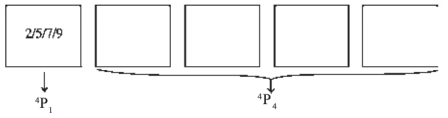
If 5 digit numbers are to be formed using all the digits $2,5,0,7,9$ then digit $0$ should not be in the first place.
Therefore, excluding digit $0$ , one of the four digits can be placed in the first place in ${ }^{4} P_{1}$ ways.
Now, after arranging one digit from $2,5,7$ or $9$ in the first place, remaining $4$ digits (including $0$ ) can be arranged in remaining $4$ places in ${ }^{4} \mathrm{P}_{4}$ ways.
$ \therefore \text { Total Permutations } ={ }^{4} \mathrm{P}_{1} \times{ }^{4} \mathrm{P}_{4}$
$ =4 \times 4 !$
$ =4 \times 24$
$ =96 $ View full question & answer→Question 23 Marks
Expand $(1+x)^{6}$ and verify it by putting $x=1$ on both the sides.
Answer$(1+x)^{6}$
$={ }^{6} \mathrm{C}_{0}(1)^{6}(x)^{0}+{ }^{6} \mathrm{C}_{1}(1)^{5}(x)^{1}+{ }^{6} \mathrm{C}_{2}(1)^{4}(x)^{2}+{ }^{6} \mathrm{C}_{3}(1)^{3}(x)^{3} $
$ +{ }^{6} \mathrm{C}_{4}(1)^{2}(x)^{4}+{ }^{6} \mathrm{C}_{5}(1)^{1}(x)^{5}+{ }^{6} \mathrm{C}_{6}(1)^{0}(x)^{6} $
$=1+6 x+15 x^{2}+20 x^{3}+15 x^{4}+6 x^{5}+x^{6}$
$\text { Thus, } $
$(1+x)^{6}=1+6 x+15 x^{2}+20 x^{3}+15 x^{4}+6 x^{5}+x^{6} \\ \text { Putting } x=1$
$ \text { L.H.S. }=(1+x)^{6}=(1+1)^{6}=(2)^{6}=64 $
$ \text { R.H.S. }=1+6 x+15 x^{2}+20 x^{3}+15 x^{4}+6 x^{5}+x^{6}$
$=1+6(1)+15(1)^{2}+20(1)^{3}+15(1)^{4}+6(1)^{5}+(1)^{6} $
$ =1+6+15+20+15+6+1$
$ =64$
$ \text { Thus, L.H.S. }=\text { R.H.S. }$
View full question & answer→Question 33 Marks
Expand $\left(\sqrt{a}+\frac{1}{\sqrt{a}}\right)^{4}$
Answer$
\begin{aligned}
&\left(\sqrt{a}+\frac{1}{\sqrt{a}}\right)^{4} \\
&={ }^{4} \mathrm{C}_{0}(\sqrt{a})^{4}\left(\frac{1}{\sqrt{a}}\right)^{0}+{ }^{4} \mathrm{C}_{1}(\sqrt{a})^{3}\left(\frac{1}{\sqrt{a}}\right)^{1}+{ }^{4} \mathrm{C}_{2}(\sqrt{a})^{2}\left(\frac{1}{\sqrt{a}}\right)^{2} \\
&+{ }^{4} \mathrm{C}_{3}(\sqrt{a})^{1}\left(\frac{1}{\sqrt{a}}\right)^{3}+{ }^{4} \mathrm{C}_{4}(\sqrt{a})^{0}\left(\frac{1}{\sqrt{a}}\right)^{4} \\
&=a^{2}+4(\sqrt{a})^{2}+6+4 \frac{1}{(\sqrt{a})^{2}}+\frac{1}{a^{2}} \\
&=a^{2}+4 a+6+\frac{4}{a}+\frac{1}{a^{2}}
\end{aligned}
$
View full question & answer→Question 43 Marks
Expand $\left(\frac{a}{b}-\frac{b}{a}\right)^{4}$.
Answer$
\begin{aligned}
&\left(\frac{a}{b}-\frac{b}{a}\right)^{4} \\
&={ }^{4} \mathrm{C}_{0}\left(\frac{a}{b}\right)^{4}\left(\frac{b}{a}\right)^{0}-{ }^{4} \mathrm{C}_{1}\left(\frac{a}{b}\right)^{3}\left(\frac{b}{a}\right)^{1}+{ }^{4} \mathrm{C}_{2}\left(\frac{a}{b}\right)^{2}\left(\frac{b}{a}\right)^{2}-{ }^{4} \mathrm{C}_{3}\left(\frac{a}{b}\right)^{1}\left(\frac{b}{a}\right)^{3}+{ }^{4} \mathrm{C}_{4}\left(\frac{a}{b}\right)^{0}\left(\frac{b}{a}\right)^{4} \\
&=\frac{a^{4}}{b^{4}}-4\left(\frac{a^{3}}{b^{3}}\right)\left(\frac{b}{a}\right)+6\left(\frac{a^{2}}{b^{2}}\right)\left(\frac{b^{2}}{a^{2}}\right)-4\left(\frac{a}{b}\right)\left(\frac{b^{3}}{a^{3}}\right)+\frac{b^{4}}{a^{4}} \\
&=\frac{a^{4}}{b^{4}}-\frac{4 a^{2}}{b^{2}}+6-\frac{4 b^{2}}{a^{2}}+\frac{b^{4}}{a^{4}}
\end{aligned}
$
View full question & answer→Question 53 Marks
$2$ cards are selected from a pack of $52$ cards. In how many ways, this selection can be done such that
$(1)$ One is a face card and the other is a number card ?
$(2)$ both are of different colours ?
$(3)$ both are of same suit ?
Answer$(1)$ There are $12$ face cards (king, Queen, Jack) and $40$ number cards in a pack of $52$ cards. One face card can be selected in ${ }^{12} \mathrm{C}_{1}$ ways and one number card can be selected in ${ }^{40} \mathrm{C}_{1}$ ways.
$ \therefore \text { Total Combinations } ={ }^{12} \mathrm{C}_{1} \times{ }^{40} \mathrm{C}_{1}$
$ =12 \times 40$
$ =480 $
$(2)$ There are $26$ black and $26$ red cards in a pack of $52$ cards. One black card can be selected in ${ }^{26} \mathrm{C}_{1}$ ways and one red card can be selected in ${ }^{26} \mathrm{C}_{1}$ ways.
$ \therefore \text { Total Combinations } ={ }^{26} \mathrm{C}_{1} \times{ }^{26} \mathrm{C}_{1}$
$ =26 \times 26$
$ =676 $
$(3)$ There are $4$ suits, spade, diamond, club and heart, in a pack of $52$ cards and each suit has $13$ cards. $2$ cards are of same suit i.e. $2$ of spade or $2$ of diamond or $2$ of club or $2$ of heart.
$ \therefore \text { Total Combinations } ={ }^{13} \mathrm{C}_{2}+{ }^{13} \mathrm{C}_{2}+{ }^{13} \mathrm{C}_{2}+{ }^{13} \mathrm{C}_{2}$
$ =78+78+78+78$
$ =312 $
View full question & answer→Question 63 Marks
In a company $2$ male managers and $1$ female manager are to be selected from $3$ male managers and $2$ female managers for training. How many ways this selection can be done ?
Answer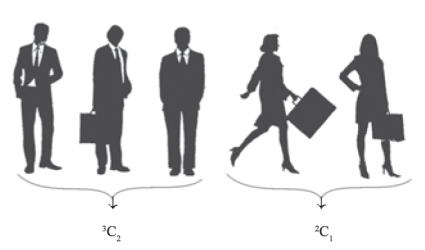
$2$ male managers out of $3$ male managers can be selected in ${ }^{3} \mathrm{C}_{2}$ ways and $1$ female manager out of $2$ female managers can be selected in ${ }^{2} \mathrm{C}_{1}$ ways.
$ \therefore \text { Total Combinations } ={ }^{3} \mathrm{C}_{2} \times{ }^{2} \mathrm{C}_{1}$
$ =3 \times 2$
$ =6 $ View full question & answer→Question 73 Marks
In how many ways can all the letters of the word $SURAT$ be arranged such that vowels are at even places only ?
Answer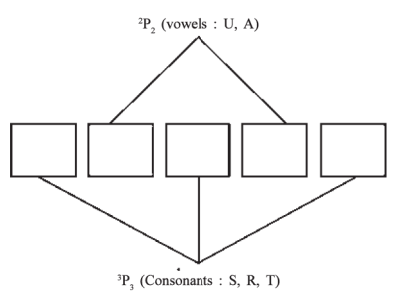
There are two vowels $U$ and $A$ in word $SURAT$. Now, they can be arranged in even places i.e the $2$ nd and the 4 th places in ${ }^{2} \mathrm{P}_{2}$ ways. Remaining $3$ letters (consonants) can be arranged in remaining $3$ places (odd places) in ${ }^{3} \mathrm{P}_{3}$ ways.
$ \therefore \text { Total Permutations } ={ }^{2} \mathrm{P}_{2} \times{ }^{3} \mathrm{P}_{3}$
$ =2 ! \times 3 !$
$ -2 \times 6$
$ =12 $ View full question & answer→Question 83 Marks
Obtain the value of $(\sqrt{7}+1)^3-(\sqrt{7}-1)^3$ using binomial expansion method.
Answer$(\sqrt{7}+1)^3-(\sqrt{7}-1)^3$
$=\left(3 C_0(\sqrt{7})^3 \times 1 \left.+3 C_1( \sqrt{7})^2\right) \times 1 +3 C_2(\sqrt{7})^1 \times 1 +3 C_3(\sqrt{7})^0 \times 1 \right)$$-\left(3 C_0(\sqrt{7})^3 \times 1 \left.-3 C_1 \sqrt{7}\right)^2 \times 1 +3 C_2(\sqrt{7})^1 \times 1 -3 C_3(\sqrt{7})^0 \times 1\ \right)$
$=(\sqrt{7})^3+3(\sqrt{7})^2+3(\sqrt{7})+1-(\sqrt{7})^3+3(\sqrt{7})^2-3(\sqrt{7})+1$
$=6 \times 7+2$
$=42+2=44$
View full question & answer→Question 93 Marks
There are $4$ different books of Statistics and $3$ different books of Economics on a table.
In how many ways can $2$ books be selected such that
$(i)$ both the books are of the same subject ?
$(ii)$ both the books are of different subject ?
$(iii)$ no book of Economics is selected ?
AnswerThere are $4$ different books of Statistics and $3$ different books of Economics on a table.
$(i)$ Both the books are of the same subjects: $2$ books of Statistics out of $4$ books can be selected in ${ }^4 \mathrm{C}_2$ ways or $2$ books of Economics out of $3$ books can be selected in ${ }^3 \mathrm{C}_2$ ways.
$\therefore \text { Total combinations }={ }^4 \mathrm{C}_2+{ }^3 \mathrm{C}_2=\frac{4 \times 3}{2 \times 1}+\frac{3 \times 2}{2 \times 1}$
$=6+3$
$=9$
$(ii)$ Both the books are of different subject:
one book of Statistics out of $4$ books can be selected in ${ }^4 \mathrm{C}_1$ ways and one book of Economics out of $3$ books can be selected in ${ }^3 \mathrm{C}_1$ ways.
Total combinations $={ }^4 \mathrm{C}_1 \times{ }^3 \mathrm{C}_1=4 \times 3=12$
$(iii)$ No book of Economics is selected: All two books of statistics out of $4$ books can be selected in ${ }^4 \mathrm{C}_2$ ways and no book of Economics in $3C0$ ways.
$\text { Total combinations }={ }^4 \mathrm{C}_2 \times{ }^3 \mathrm{C}_0$
$=6 \times 1=6$
View full question & answer→Question 103 Marks
If all the arrangements formed using all the letters of the word $WAKEFUL$ are arranged in the order of dictionary then what will be the rank of the word $WAKEFUL$ ?
Answer$7$ letters of the word $WAKEFUL$ are $W, A,K,E,F,U,L.$
These $7$ letters can be arranged in $7=7=5040$ ways.
Alphabetical order of the letters of the word $WAKEFUL$ is $A, E, F, K, L, U, W.$
Arrangements with either $A, E, F, K$, $L$ or $U$ at the first place $=6[1 \times 6]=6=6[1 \times 6]=6 \times 720=4320$
Arrangements with $W$ at first place, A at the second and $E$ at third $=1 \times 1 \times 1 \times 4=1 \times 4=24$
Arrangements with $W$ at first place, A at the second and $F$ at third $=1 \times 1 \times 1 \times 4=1 \times 4=24$
$L$ at the sixth and $U$ at the seventh is $WAKEFUL.$
The next word is $WAKEFUL.$
Dictionary order of the word $WAKEFUL$ is $4320+24+24+1+1=4370$
View full question & answer→Question 113 Marks
In how many ways can $3$ boys and $2$ girls be arranged in a row such that,
$(i)$ both the girls remain together ?
$(ii)$ boys and girls are alternately arranged ?
$(iii)$ all the three boys remain together ?
Answer$3$ boys and $2$ girls are to be arranged in a row.
$(i)$ Both the girls remain together :
$BBB$ $GG \rightarrow 2P_2$
$3 + 1 \rightarrow 4P_4$
$∴$ Total permutations in which both the girls remain together $= 4P_4 x 2P_2 = 4! x 2! = 24 x 2 = 48$
$(ii)$ Boys and girls are alternatively arranged :
$\therefore $ Total permutations in which boys and girls are alternatively arranged $= 3P_3 x 2P_2 = 3! x 2! = 6 x 2 = 12$
$(iii)$ All the there boys remain gether :
$BBB$ $GG \rightarrow 3P_3$
$1 + 2 \rightarrow 3P_3$
$\therefore$ Total permutations in which all the the three boys remain to gether $= 3P_3 x 3P_3 = 3! x 3! = 6 x 6 = 36$
View full question & answer→Question 123 Marks
In how many ways can $4$ boys and $4$ girls be arranged in a row such that no two boys and no two girls appear together ?
Answer$4$ boys and $4$ girls can be arranged in a row in the following order of arrangements in which two boys and two girls do not appear together.
$B \ G \ B \ G \ B \ G \ B \ G \ Or \ G \ B \ G \ B \ G \ B \ G \ B$ Thus, total number of ways of arrangement
$=4!\times 4!=24 \times 24=576 \text { OR } 4!\times 4!=24 \times 24=576$
Hence, the total number of ways of arranging $4$ boys and $4$ girls in a row, so that two boys and two girls do not appear together.
$=576+576=1152$
View full question & answer→Question 133 Marks
Obtain the value of $(\sqrt{3}+1)^6+(\sqrt{3}-1)^6$ using binomial expansion method.
Answer$(\sqrt{3}+1)^6+(\sqrt{3}-1)^6$
$=\left(6 C_0(\sqrt{3})^6 \times 1^0 +6 C_1(\sqrt{3})^5 \times 1^1 +6 C_2(\sqrt{3})^4 \times 1^2 6 C_3(\sqrt{3})^3 \times 1^3 6 C_4(\sqrt{3})^2 \times 1^4 6 C_5(\sqrt{3})^1 \times 1^5 6 C_6(\sqrt{3})^0 \times 1^6 \right)$
$+\left( 6 C_0(\sqrt{3})^6 \times 1^0 \\ -6 C_1(\sqrt{3})^5 \times 1^1 +6 C_2(\sqrt{3})^4 \times 1^2 -6 C_3(\sqrt{3})^3 \times 1^3 +6 C_4(\sqrt{3})^2 \times 1^4 -6 C_5(\sqrt{3})^1 \times 1^5 +6 C_6(\sqrt{3})^0 \times 1^6 \right)$
$=(\sqrt{3})^6+6(\sqrt{3})^5+15(\sqrt{3})^4+20(\sqrt{3})^3+15(\sqrt{3})^2+6(\sqrt{3})+1$$+(\sqrt{3})^6-6(\sqrt{3})^5+15(\sqrt{3})^4-20(\sqrt{3})^3+15(\sqrt{3})^2-6(\sqrt{3})+1$
$=2(3)^3+30(3)^2+30(3)+2 $
$=2 \times 27+30 \times 9+90+2$
$=54+270+92$
$=416$
View full question & answer→Question 143 Marks
$(1)$ Using all the first five natural numbers,
$(i)$ how many numbers can be formed ?
$(ii)$ how many numbers greater than $30,000$ can be formed ?
$(iii)$ how many numbers divisible by $5$ can be formed ?
AnswerFirst five natural numbers are $12345$
$(i)$ Total numbers can be formed $={ }^5 P_5$
$=5!=120$
$(ii)$ For the numbers greater than $30,000$ , the digit at the first place can by any one of the digits $3, 4, 5$ and remaining $4$ places can be arranged from the remaining $4$ digits.
$\therefore \text { Total permutations }={ }^3 P_1 \times{ }^4 P_4$
$=3 \times 4!$
$=3 \times 24=72$
$(iii)$ For the number divisible by $5$ . the last digit in the number should be $5.$ Remaining $4$ places can be arranged from the remaining $4$ digits accept digit $5.$
$\therefore \text { Total permutations }={ }^1 P_1 \times{ }^4 P_4$
$=1 \times 4!$
$=1 \times 24=24$
View full question & answer→Question 153 Marks
Expand $(1+a)^6$ and verify by putting $a=2$ on both sides.
Answer$(1+a)^6={ }^6 C_0 1 a^0+{ }^6 C_1 \cdot 1 \cdot a^1+{ }^6 C_2 \cdot 1 \cdot a^2+{ }^6 C_3 \cdot 1 \cdot a^3+{ }^6 C_4 \cdot 1 \cdot a^4+{ }^6 C_5 \cdot 1 \cdot a^5+{ }^6 C_6 1 \cdot a^6$
$=1+6 a+15 a^2+20 a^3+15 a^4+6 a^5+a^6$
$\text { LHS }=(1+a)^6$
Putting $\mathrm{a}=2$.
$\text { LHS }=(1+2)^6=(3)^6=729$
$\text { RHS }=1+6 a+15 a^2+20 a^3+15 a^4+6 a^5+a^6$
Putting $\mathrm{a}=2$.
$\text { RHS }=1+6 \times 2+15(2)^2+20(2)^3+15(2)^4+6(2)^5+(2)^6$
$=1+12+(15 \times 4)+(20 \times 8)+(15 \times 16)+6(32)+64$
$=13+60+160+240+192+64$
$=729$
Hence, $LHS = RHS$
View full question & answer→Question 163 Marks
Expand $(1+x)^5$ and verify by putting $x=1$ on both sides.
Answer$(1+x)^5={ }^5 C_0 \cdot 1 \cdot x^0+{ }^5 C_1 \cdot 1 \cdot x^1+{ }^5 C_2 1 x^2+{ }^5 C_3 \cdot 1 \cdot x^3+{ }^5 C_4 1 x^4+{ }^5 C_5 \cdot 1 \cdot x^5$
$=1+5 x+10 x^2+10 x^3+5 x^4+x^5$
$\text { LHS }=(1+x)^5$
Putting $x=1$,
$\text { LHS }=(1+1)^5=(2)^5=32$
$\text { RHS }=1+5 x+10 x^2+10 x^3+5 x^4+1$
Putting $x=1$.
$\mathrm{RHS}=1+5(1)+10(1)^2+10(1)^3+5(1)^4+1^5$
$=1+5+10+10+5+1=32$
Hence, $LHS = RHS$
View full question & answer→Question 173 Marks
Obtain the expansion of following binomial expressions: $\left(\frac{a}{2}-\frac{b}{3}\right)^{5}$
View full question & answer→Question 183 Marks
Expand: $\left(\frac{3}{x}-\frac{4 x}{3}\right)^4$
Answer$\left(\frac{3}{x}-\frac{4 x}{3}\right)^4= \left(4 C_0\left(\frac{3}{x}\right) 4 \cdot\left(\frac{4 x}{3}\right) 0\right)-4 C_1\left(\frac{3}{x}\right) 3 \cdot\left(\frac{4 x}{3}\right) 1+4 C_0\left(\frac{3}{x}\right) 2 \cdot\left(\frac{4 x}{3}\right) 2-4 C_3\left(\frac{3}{x}\right) 1 \cdot\left(\frac{4 x}{3}\right) 3$
$\quad+4 C_4\left(\frac{3}{x}\right) 0 \cdot\left(\frac{4 x}{3}\right) 4$
$= 1 \cdot \frac{81}{x^4} \cdot 1-4 \cdot \frac{27}{x^3} \cdot \frac{4 x}{3}+\frac{4 x 3}{2 x 1} \cdot \frac{9}{x^2} \cdot \frac{16 x^2}{9}-4 \cdot \frac{3}{x} \cdot \frac{64 x^3}{27}+1 \cdot 1 \cdot \frac{256 x^4}{81}$
$= \frac{81}{x^4}-\frac{144}{x^2}+96-\frac{256 x^2}{9}+\frac{256 x^4}{81}$
View full question & answer→Question 193 Marks
Obtain the expansion of following binomial expressions: $(1+x)^{7}$
View full question & answer→Question 203 Marks
There are $9$ employee in a bank of which $6$ are clerks, $2$ are peons and $1$ is a manager. In how many ways can a committee of $4$ members be formed such that $(1)$ the manager must be selected? $(2)$ two peons are not to be selected and the manager is to be selected ?
AnswerOut of $9$ employces In a bank. $6$ are clerks. $2$ are peons and $1$ Is a manager.
A committee of $4$ members Is to be formed.
$(1)$ The manager must be selected In the committee:
If the manager Is to be selected In the committee of $4$
members, than from the remaining ( $6$ clerks $+2$ peons) $8$
employees, the remaining $3$ members of the committee can be
selected in ${ }^8 \mathrm{C}_3$ ways.
$\therefore$ Total combinations $={ }^1 \mathrm{C}_1 \times{ }^8 \mathrm{C}_3$
$=1 \times \frac{8 \times 7 \times 6}{3 \times 2 \times 1}$
$=56$
$(2)$ Two peons are not be selected and the manager is to be
selected:
If the manager Is to be selected In the committee of $4$
mcmbcrs and two peons are not be selected than from the
remalning $6$ clerks, the remaining $3$ members of the
committee can be selected in ${ }^6 \mathrm{C}_3$ ways.
$\therefore$ Total combinations $={ }^1 \mathrm{C}_1 \times{ }^6 \mathrm{C}_3$
$=1 \times \frac{6 \times 5 \times 4}{3 \times 2 \times 1}$
$=20$
View full question & answer→Question 213 Marks
Two cards are randomly selected from a pack of 52 cards. In how many ways can $2$ cards be selected such that,$(1)$ both are of heart? $(2)$ one is a king and the other is a queen ?
Answer$(1)$ In a pack of $52$ cards, there are $13$ cards of heart. $2$ cards of heart out of $13$ cards of heart can be selected in ways.
$\therefore \text { Total combinations }={ }^{13} \mathrm{C}_2 \times{ }^6 \mathrm{C}_3$
$ =\frac{13 \times 12}{2}$
$ =20$
$(2)$ In a pack of $52$ cards, there are $4$ cards of king and $4$ cards of queen one card of king out of $4$ cards of king can be selected in ${ }^4 C_1$ ways and one card of queen out of $4$ cards of queen can be selected $\ln ^4 C_1$ ways.
$\therefore \text { Total combinations }={ }^4 C_1 \times{ }^4 C_1$
$ =4 \times 4$
$ =16$
View full question & answer→Question 223 Marks
In how many ways can a hotel owner subscribe $3$ newspapers and $2$ magazines from $8$ different newspapers and $5$ different magazines available in the city? If a particular newspaper is to be selected and a particular magazine is not to be selected then in how many ways can this selection be done ?
Answer$8$ different newspapers and $5$ different magazines are available in the city.
A hotel owner can subscribe $3$ newspapers out of $8$ newspapers in ${ }^8 C_3$ Ways and $2$ magazines out of $5$ magazines in ${ }^5 C_2$ ways
$\therefore$ Total combination $={ }^8 C_3 \times{ }^5 C_2=\frac{8 \times 7 \times 6}{3 \times 2 \times 1}+\frac{5 \times 4}{2 \times 1}=56 \times 10=560$
If a particular newspaper is to be selected then $2$ newspapers out of the remaining $7$ newspapers can be subscribed in ${ }^7 C_2$ on Ways and a particular
magazine is not to be selected then $2$ magazines out of the remaining $4$ magazines can be selected in ${ }^4 C_2$ ways.
$\therefore$ Total combinations $={ }^7 C_2 \times{ }^4 C_2=\frac{7 \times 6}{2 \times 1} \times \frac{4 \times 3}{2 \times 1}=21 \times 6=126$
View full question & answer→Question 233 Marks
A student in $12th$ standard commerce stream has to appear for exam in $7$ subjects. It is necessary to pass in all the subjects to pass an exam. Certain minimum marks must be obtained to pass in a subject. In how many ways can a student appearing for the exam fail ?
AnswerA student has to appear for exam in $7$ subjects. Certain minimum marks are required to pass in the subject. He fails if he does not reach to the level of minimum marks required in at least one of $7$ subjects.Total combinations in which a student can fail
$={ }^7 C_1+{ }^7 C_2+{ }^7 C_3+{ }^7 C_4+{ }^7 C_5+{ }^7 C_6+{ }^7 C_7$
$ =7+\frac{7 \times 6}{2 \times 1}+\frac{7 \times 6 \times 5}{3 \times 2 \times 1}+\frac{7 \times 6 \times 5 \times 4}{4 \times 3 \times 2 \times 1}+\frac{7 \times 6 \times 5 \times 4 \times 3}{5 \times 4 \times 3 \times 2 \times 1}+7+1$
$ =7+21+35+35+21+7+1$
$ =127$
View full question & answer→Question 243 Marks
In an office, there are $8$ employees of which $3$ are females and remaining are males. $3$ employees are to be selected from the office for training. In how many ways can the selection be done so that at least one male is selected ?
AnswerIn an office, out of $8$ employees $3$ are females and $5$ are males. $3$ employees are to be selected for training.
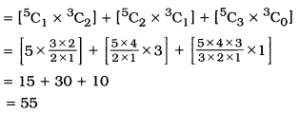
The different options for selecting $3$ employees so that at least one male is selected are as follows:
- One male and $2$ females $OR$
- Two males and $1$ female $OR$
- Three males and no female
View full question & answer→Question 253 Marks
If $3 .{ }^{(n+3)} P_{4}=5{ }^{(n+2)} P_{4}$, then find the value of $n$.
Answer
$
\begin{aligned}
& 3 \cdot{ }^{(n+3)} p_4=5 \cdot{ }^{(n+2)} p_4 \\
& \therefore 3 \cdot(n+3)(n+3-1)(n+3-2)(n+3-3)[\text { According }
\end{aligned}
$
to definition of $\mathrm{nPr}$ ]
$
=5 \cdot(n+2)(n+2-1)(n+2-2)(n+2-3) 3 \cdot(n+3)(n+
$
2) $(n+1)(n)$
$
\begin{aligned}
& =5 \cdot(n+2)(n+1)(n)(n-1) \\
& \therefore 3(n+3)=5(n-1) \\
& \therefore 3 n+9=5 n-5 \\
& \therefore 9+5=5 n-3 n \\
& \therefore 14=2 n \\
& \therefore n=\frac{14}{2}=7
\end{aligned}
$
View full question & answer→Question 263 Marks
How many total arrangements can be made using all letters of the following words ?
$(1)$ $STATISTICS$ $(2)$ $BOOKKEEPER$ $(3 )$ $APPEARING$
View full question & answer→Question 273 Marks
Expand the following : $\left(3+x^{2}\right)^{6}$
Answer$\frac{729+1458 x^{2}+1215 x^{4}+540 x^{6}+135 x^{8}+}{18 x^{1} 0+x^{1} 2}$
View full question & answer→Question 283 Marks
Expand the following : $\left(1-x^{3}\right)^{5}$
Answer$1-5 x^{3}+10 x^{6}-10 x^{9}+5 x^{1} 2-x^{1} 5$
View full question & answer→Question 293 Marks
Expand the following: $(2-x)^{7}$
Answer $128-448 x+672 x^{2}-560 x^{3}+280 x^{4}-$ $84 x^{5}+14 x^{6}-x^{7}$
View full question & answer→Question 303 Marks
Expand the following: $(3 x+y)^{4}$
Answer$81 x^{4}+108 x^{3} y+54 x^{2} y^{2}+12 x y^{3}+y^{4}$
View full question & answer→Question 313 Marks
In how many ways $3$ things can be selected from different $10$ things such that one particular thing $(1)$ is selected? $(2)$ is not selected?
View full question & answer→Question 323 Marks
An individual has $10$ friends of whom $4$ are women. He wants to invite $5$ friends. If the invitees Include at least $2$ women then In how many ways he can Invite $5$ friends?
View full question & answer→Question 333 Marks
A question paper contains $7$ questions. In how many ways any five questions can be selected to answer? In how many ways $5$ questions can be selected in such a way that there are at least $2$ questions from the first three questions?
View full question & answer→Question 343 Marks
In how many ways $5$ ball pens can be selected out of $8$ different ball pens such that $(1)$ it Includes always a specific ball pen? $(2)$ it does not include always a specific ball pen?
View full question & answer→Question 353 Marks
In how many ways a committee of $5$ members can be selected from $10$ students and $4$ teachers such that the committee has $(1)$ exactly three teachers? $(2)$ at least three teachers?
Answer$(1)180$ $(2)$ $190$
View full question & answer→Question 363 Marks
In a beg there are $4$ green and $5$ red bails. From it in how many ways $2$ balls can be selected such that $(1)$ one ball of each colour appears $(2)$ all balls of the same colour appear.
View full question & answer→Question 373 Marks
From a pack of $52$ cards in now many ways $(1)$ $2$ cards of red colour $(2)$ $2$ cards of same suit $(3)$ $2$ cards of the same colour can be selected?
Answer$(1)325$ $(2)312$ $(3)650$
View full question & answer→Question 383 Marks
In how many ways $6$ different books can be arranged in a row on a shelf such that $(1)$ two specified books always appear together. $(2)$ two specified books do not appear together.
View full question & answer→Question 393 Marks
In how many ways $8$ students can be arranged in a row? Of these In how many ways $(1)$ two specified students appear together? $(2)$ two specified students do not appear together?
Answer$40320;$ $(1)10080$ $(2)30240$
View full question & answer→Question 403 Marks
One number Is $734569$. How many numbers can be formed using all the digits of its? Of these how many numbers can be divisible by $2$ without remainder?
View full question & answer→Question 413 Marks
If the number of words formed using all the letters of the word $VARUN$ are arranged in the order of dictionary, what will be rank of the word $‘VARUN’$?
View full question & answer→Question 423 Marks
Using all the letters of the word $RAHUL$, how many new words can be formed? What will be the rank of the word ‘$RAHUL$ in dictionary order?
View full question & answer→Question 433 Marks
Using all the letters of the word $‘RONALD’$ $(1)$ How many words can be formed? $(2)$ How many words begin with letter $D$? $(3)$ Of these how many words begin with $AR$?
Answer$(1)720$ $(2)120$ $(3)24$
View full question & answer→Question 443 Marks
Using all the letters of the word $‘SUNDAY’$ $(1)$ How many new words can be formed? $(2)$ In how many words the letter $S$ will be at the first place? $(3)$ How many words begin with $S$ and end with $Y$?
Answer$(1)719\ (2)119\ (3)23$
View full question & answer→Question 453 Marks
Write the following binomial expansion: $\left(\frac{y}{3}-\frac{3}{y}\right)^{4}$
Answer $\frac{y^{6}}{729}+\frac{\left(2 y^{1}\right)}{27}+\frac{\left(5 y^{2}\right)}{3}+20+\frac{135}{y^{2}}+\frac{486}{y^{4}}+\frac{729}{y^{6}}$
View full question & answer→Question 463 Marks
Write the following binomial expansion: $\left(2 x-\frac{1}{x}\right)^{4}$
Answer$16 x^{4}-32 x^{2}+24-\frac{8}{x^{2}}+\frac{1}{x^{4}}$
View full question & answer→Question 473 Marks
In how many ways $3$ directors and $2$ managers can be selected from $8$ directors and $5$ managers? If a particular director is to be selected and a particular manager is not be selected, then find the number of selections.
View full question & answer→Question 483 Marks
In a question paper there are $10$ questions. How many ways any $6$ questions can be answered. If first two questions are compulsory, then in how many ways $6$ questions can be answered?
View full question & answer→Question 493 Marks
In an examination there are $7$ question papers in which $2$ question papers are of language. In how many ways they can be arranged such that $(1)$ both the question papers of language remain together and $(2)$ they do not remain together.
Answer$(1)1440$ $(2)3600$
View full question & answer→Question 503 Marks
In how many ways $2$ patients of asthma, $3$ patients of jaundice and $4$ patients of typhoid of a hospital can be placed in $9$ rooms in a row so that the patients of each disease are in the room besides to each other and one patient In each room?
View full question & answer→