Question 14 Marks
Obtain the value of $(\sqrt{3}+\sqrt{2})^{4}+(\sqrt{3}-\sqrt{2})^{4}$ using binomial expansion method.
Answer$ (\sqrt{3}+\sqrt{2})^{4}+(\sqrt{3}-\sqrt{2})^{4} $
$ =\left[\begin{array}{c} { }^{4} \mathrm{C}_{0}(\sqrt{3})^{4}(\sqrt{2})^{0} \\ +{ }^{4} \mathrm{C}_{1}(\sqrt{3})^{3}(\sqrt{2})^{1} \\ +{ }^{4} \mathrm{C}_{2}(\sqrt{3})^{2}(\sqrt{2})^{2} \\ +{ }^{4} \mathrm{C}_{3}(\sqrt{3})^{1}(\sqrt{2})^{3} \\ +{ }^{4} \mathrm{C}_{4}(\sqrt{3})^{0}(\sqrt{2})^{4} \end{array}\right]+\left[\begin{array}{c} { }^{4} \mathrm{C}_{0}(\sqrt{3})^{4}(\sqrt{2})^{0} \\ -{ }^{4} \mathrm{C}_{1}(\sqrt{3})^{3}(\sqrt{2})^{1} \\ +{ }^{4} \mathrm{C}_{2}(\sqrt{3})^{2}(\sqrt{2})^{2} \\ -{ }^{4} \mathrm{C}_{3}(\sqrt{3})^{1}(\sqrt{2})^{3} \\ +{ }^{4} \mathrm{C}_{4}(\sqrt{3})^{0}(\sqrt{2})^{4} \end{array}\right] $
(As there is a positive sign between two bincmial expressions, the signs of terms of the second expression will not change. As a result, the second, fourth terms in the expansion of both the expressions will be cancelled.)
$ \begin{aligned} &=2\left[4_{C_{0}}(\sqrt{3})^{4}(2)^{0}+4_{C_{2}}(\sqrt{3})^{2}(\sqrt{2})^{2}+4_{C_{4}}(\sqrt{3})^{0}(\sqrt{2})^{4}\right] \\ &=2[9+6(3)(2)+4] \\ &=2[9+36+4] \\ &=2[49] \\ &=98 \end{aligned} $
View full question & answer→Question 24 Marks
Obtain the value of $(\sqrt{3}+2)^{5}-(\sqrt{3}-2)^{5}$ using binomial expansion method.
Answer$ (\sqrt{3}+2)^{5}-(\sqrt{3}-2)^{5} $
$ =\left[\begin{array}{c} { }^{5} C_{0}(\sqrt{3})^{5}(2)^{0} \\ +{ }^{5} C_{1}(\sqrt{3})^{4}(2)^{1} \\ +{ }^{5} C_{2}(\sqrt{3})^{3}(2)^{2} \\ +{ }^{5} C_{3}(\sqrt{3})^{2}(2)^{3} \\ +{ }^{5} C_{4}(\sqrt{3})^{1}(2)^{4} \\ +{ }^{5} C_{5}(\sqrt{3})^{0}(2)^{5} \end{array}\right]-\left[\begin{array}{c} { }^{5} C_{0}(\sqrt{3})^{5}(2)^{0} \\ -{ }^{5} C_{1}(\sqrt{3})^{4}(2)^{1} \\ +{ }^{5} C_{2}(\sqrt{3})^{3}(2)^{2} \\ -{ }^{5} C_{3}(\sqrt{3})^{2}(2)^{3} \\ +{ }^{5} C_{4}(\sqrt{3})^{1}(2)^{4} \\ -{ }^{5} C_{5}(\sqrt{3})^{0}(2)^{5} \end{array}\right] $
(As there is a negative sign between two binomial expressions, the signs of terms of the second expression will change. As a result, the first, third and the fifth terms in the expansion of both expressions will get cancelled.)
$ \begin{aligned} &=2\left[{ }^{5} \mathrm{C}_{1}(\sqrt{3})^{4}(2)^{1}+{ }^{5} \mathrm{C}_{3}(\sqrt{3})^{2}(2)^{3}+{ }^{5} \mathrm{C}_{5}(\sqrt{3})^{0}(2)^{5}\right] \\ &=2[5(9)(2)+10(3)(8)+32] \\ &=2[90+240+32] \\ &=2[362] \\ &=724 \end{aligned} $
View full question & answer→Question 34 Marks
Find the values of the following :
$(1)$ ${ }^{8} \mathrm{C}_{3}$
$(2)$ ${ }^{20} \mathrm{C}_{3}$
$(3)$ ${ }^{5} \mathrm{C}_{4}$
$(4)$ ${ }^{6} \mathrm{C}_{6}$
Answer$(1)$ ${ }^{n} \mathrm{C}_{r}=\frac{n !}{r !(n-r) !}$
$\therefore{ }^{8} C_{3}=\frac{8 !}{3 !(8-3) !}$
$ =\frac{8 !}{3 ! \times 5 !}$
$ =\frac{8 \times 7 \times 6 \times 5 !}{3 \times 2 \times 1 \times 5 !}$
$ =56 $
$(2)$ According to the definition of ${ }^{n} C_{r^2}$
$ { }^{n} \mathrm{C}_{r} =\frac{{ }^{n} P_{r}}{r !}$
$\therefore{ }^{20} \mathrm{C}_{3} =\frac{{ }^{20} P_{3}}{3 !}$
$ =\frac{20 \times 19 \times 18}{3 \times 2 \times 1}$
$ =1140 $
$(3)$ According to the definition of ${ }^{n} \mathrm{C}_{r}$,
$ { }^{n} \mathrm{C}_{r} =\frac{{ }^{n} P_{r}}{r !}$
$\therefore{ }^{5} \mathrm{C}_{4} =\frac{{ }^{5} P_{4}}{4 !}$
$ =\frac{5 \times 4 \times 3 \times 2}{4 \times 3 \times 2 \times 1}$
$ =5 $
$(4)$ According to the definition of ${ }^{n} \mathrm{C}_r$,
$ { }^{n} \mathrm{C}_{r} =\frac{{ }^{n} P_{r}}{r !}$
$\therefore{ }^{6} \mathrm{C}_{6} =\frac{{ }^{6} P_{6}}{6 !}$
$ =\frac{6 \times 5 \times 4 \times 3 \times 2 \times 1}{6 \times 5 \times 4 \times 3 \times 2 \times 1}$
$ =1 $
View full question & answer→Question 44 Marks
In how many ways can $5$ boys and $2$ girls be arranged in a row such that,
$(1)$ both the girls are together ?
$(2)$ both the girls are not together ?
Answer$(1)$
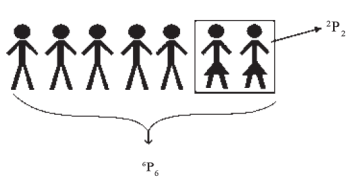
Two girls are to be arranged together, so considering them as one person, total $6$ persons can be arranged in ${ }^{6} \mathrm{P}_{6}$ ways and in each of these arrangements, two girls can be arranged among themselves in ${ }^{2} P_{2}$ ways.
$ \therefore \text { Total Permutations } ={ }^{6} \mathrm{P}_{6} \times{ }^{2} \mathrm{P}_{2}$
$ =6 ! \times 2 !$
$ =720 \times 2$
$ =1440 $
$(2)$
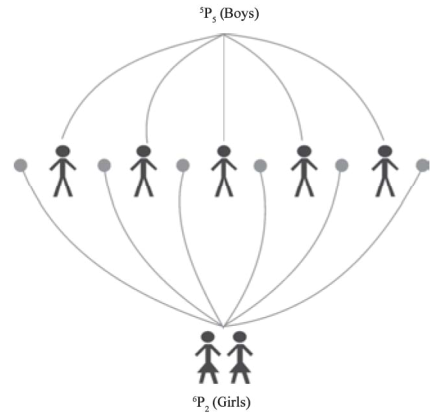
As the two girls are not to be arranged together, they can be arranged between $5$ boys and on either sides. So, two girls can be placed in total 6 places in ${ }^{6} \mathrm{P}_{2}$ ways. Moreover $5$ boys can be arranged in ${ }^{5} \mathrm{P}_{5}$ ways.
$ \therefore \text { Total Permutations } ={ }^{6} \mathrm{P}_{2} \times{ }^{5} \mathrm{P}_{5}$
$ =6 \times 5 \times 5 !$
$ =30 \times 120$
$ =3600 $ View full question & answer→Question 54 Marks
Find the values of the following :
$(1)$ ${ }^{8} \mathbf{P}_{3}$
$(2)$ ${ }^{60} P_{2}$
$(3)$ ${ }^{7} \mathbf{P}_{6}$
$(4)$ ${ }^{5} \mathbf{P}_{5}$
Answer$(1)$ ${ }^{n} \mathrm{P}_r =\frac{n !}{(n r) !}$
${ }^{8} \mathrm{P}_{3} =\frac{8 !}{(8-3) !}$
$ =\frac{8 !}{5 !}$
$ =\frac{8 \times 7 \times 6 \times 5 !}{5 !}$
$ =336 $
$(2)$ According to the definition of ${ }^{n} P_{p}$
$ { }^{n} \mathrm{P}_{2} =n(n-1)$
$\therefore \quad{ }^{60} \mathrm{P}_{2} =60(60-1)$
$ =60 \times 59$
$ =3540 $
$(3)$ According to the definition of ${ }^{n} \mathrm{P}_{r^{2}}$
${ }^{n} \mathrm{P}_{6} =n(n-1)(n-2)(n-3)(n-4)(n-5)$
$\therefore \quad{ }^{7} \mathrm{P}_{6} =7 \times 6 \times 5 \times 4 \times 3 \times 2$
$ =5040 $
$(4)$ According to the definition of $^{n}$$P_{r^{2}}$
$ ^{n}{\mathrm{P}}_{5} =n(n-1)(n-2)(n-3)(n-4)$
$\therefore \quad{ }^{5} \mathrm{P}_{5} =5 \times 4 \times 3 \times 2 \times 1$
$ =120 $
View full question & answer→Question 64 Marks
Obtain the values using binomial expansion: $(\sqrt{5}+$ $\sqrt{3})^{4}+(\sqrt{5}-\sqrt{3})^{4}$
View full question & answer→Question 74 Marks
Obtain the values using binomial expansion: $(\sqrt{2}+$ 1) $^{6}+(\sqrt{2}-1)^{6}$
View full question & answer→Question 84 Marks
Expand: $\left(\frac{\sqrt{x}}{3}+\frac{3}{\sqrt{x}}\right)^6$
Answer$={ }^6 C _0\left(\frac{\sqrt{x}}{3}\right)^6 \cdot\left(\frac{3}{\sqrt{x}}\right)^0+{ }^6 C _1\left(\frac{\sqrt{x}}{3}\right)^5 \cdot\left(\frac{3}{\sqrt{x}}\right)+{ }^6 C _2\left(\frac{\sqrt{x}}{3}\right)^4 \cdot\left(\frac{3}{\sqrt{x}}\right)^2+{ }^6 C _3\left(\frac{\sqrt{x}}{3}\right)^3 \cdot\left(\frac{3}{\sqrt{x}}\right)^3$
$+{ }^6 C _4\left(\frac{\sqrt{x}}{3}\right)^2 \cdot\left(\frac{3}{\sqrt{x}}\right)^4+{ }^6 C _5\left(\frac{\sqrt{x}}{3}\right)^1 \cdot\left(\frac{3}{\sqrt{x}}\right)^5+{ }^6 C _6\left(\frac{\sqrt{x}}{3}\right)^0 \cdot\left(\frac{3}{\sqrt{x}}\right)^6$
$=1 \cdot \frac{x^3}{729} \cdot 1+6 \cdot \frac{(\sqrt{x})^5}{243} \cdot \frac{3}{\sqrt{x}}+\frac{6 \times 5}{2 \times 1} \cdot \frac{(\sqrt{x})^4}{81}: \frac{9}{(\sqrt{x})^2}+\frac{6 \times 5 \times 4}{3 \times 2 \times 1} \frac{(\sqrt{x})^3}{27} \cdot \frac{27}{(\sqrt{x})^3}$
$+\frac{6 \times 5 \times 4 \times 3}{4 \times 3 \times 2 \times 1} \cdot \frac{(\sqrt{x})^2}{9} \cdot \frac{81}{(\sqrt{x})^4}+\frac{6 \times 5 \times 4 \times 3 \times 2}{5 \times 4 \times 3 \times 2 \times 1} \cdot \frac{\sqrt{x}}{3} \cdot \frac{243}{(\sqrt{x})^5}+1 \cdot 1 \cdot \frac{729}{(\sqrt{x})^6}$
$=\frac{x^3}{729}+\frac{6(\sqrt{x})^4}{81}+\frac{15(\sqrt{x})^2}{9}+20+\frac{15 \times 9}{(\sqrt{x})^2}+\frac{6 \times 81}{(\sqrt{x})^4}+\frac{729}{(\sqrt{x})^6}$
$=\frac{x^3}{729}+\frac{2 x^2}{27}+\frac{5 x}{3}+20+\frac{135}{x}+\frac{486}{x^2}+\frac{729}{x^3}$
View full question & answer→Question 94 Marks
$7$ speakers $A, B, C, D, E, F$ and $G$ are invited to deliver a speech in a program. Speakers have to deliver speech one after the other. In how many ways, speeches of $7$ speakers can be arranged if the speaker $B$ has to deliver his speech immediately after the speaker $A ?$
Answer$7$ speakers $A, B, C, D, E. F, K, G$ have to deliver speech one after the other.
If the speaker $A$ delivers his speech first, the remaining $6$ speakers can be arranged for their speech in ${ }^6 P_1$ ways.
If $B$ delivers his speech after the speaker $A$.
the remaining $5$ speakers can be arranged for their speech in ${ }^5 P_1$ ways.
If $C$ delivers his speech after the speakers $A$ and $B$, the remaining $4$ speakers can be arranged for their speech in ${ }^4 P_1$ ways.
If $D$ delivers his speech after the speakers $A , B$ and $C,$ the remaining $3$ speakers can be arranged for their speech in ${ }^3$ $P_1$ ways.
If $E$ delivers his speech after the speakers $A, B, C$ and $D,$ the remaing $2$ speakers can be arranged for their speech in $2 p_1$ ways.
Not, at the last the speaker $F$ can deliver his speech after the speakers $A, B. C, D$ and $E.$ have delivered their speech in ${ }^5 P_1$ ways.
$\therefore$ Total permutations $={ }^6 P_1 \times{ }^5 P_1 \times{ }^4 P_1 \times{ }^3 P_1 \times{ }^2 P_1 \times{ }^1 P_1$
$=6 \times 5 \times 4 \times 3 \times 2 \times 1=720$
View full question & answer→Question 104 Marks
Obtain the middle term in the expansion of $\left(2 x+\frac{3}{x}\right)^{4}$
View full question & answer→Question 114 Marks
Find the middle term in the expansion of $\left(\frac{x^{2}}{2}-\frac{2}{x}\right)^{8}$
View full question & answer→Question 124 Marks
Obtain the 3rd term in the expansion of $\left(\sqrt{x}-\frac{1}{\sqrt{x}}\right)^{4}$.
View full question & answer→Question 134 Marks
Obtain the $3 \mathrm{rd}$ term in the expansion of $\left(2 x-\frac{2}{x}\right)^{6}$
View full question & answer→Question 144 Marks
Putting $x=4$ in the expansion of $(2+\sqrt{x})^{5}$ verify both side.
View full question & answer→Question 154 Marks
Obtain the $4th$ term in the expansion of $(2 x+y)^{5}$
View full question & answer→Question 164 Marks
Putting $a=-1$ in the expansion of $(3-2 a)^{3}$ verify both side.
View full question & answer→Question 174 Marks
Expand the following: $\left(\sqrt{x}+\frac{1}{\sqrt{x}}\right)^{4}$
Answer$x^{2}+4 x+6+\frac{4}{x}+\frac{1}{x^{2}}$
View full question & answer→Question 184 Marks
Expand the following: $\left(2 x+\frac{1}{y}\right)^{6}$
Answer$64 x^{6}+\frac{192 x^{5}}{y}+\frac{240 x^{4}}{y^{2}}+\frac{160 x^{3}}{y^{3}}+\frac{60 x^{2}}{y^{4}}+\frac{12 x}{y^{5}}+\frac{1}{y^{6}}$
View full question & answer→Question 194 Marks
Expand the following:( $\left.x-\frac{1}{x^{2}}\right)^{5}$
Answer$x^{5}-5 x^{2}+\frac{10}{x}-\frac{10}{x^{4}}+\frac{5}{x^{7}}-\frac{1}{x^{1} 0}$
View full question & answer→Question 204 Marks
Expand the following: $\left(x^{2}+\frac{1}{x}\right)^{7}$
Answer$\frac{1}{x^{1}} 4+7 x^{1} 1+21 x^{8}+35 x^{5}+35 x^{2}+\frac{21}{x}+\frac{7}{x^{4}}+$
View full question & answer→Question 214 Marks
Expand the following: $\left(\frac{3}{x}-\frac{x}{3}\right)^{6}$
Answer$\frac{729}{x^{6}}-\frac{486}{x^{4}}+\frac{135}{x^{2}}-20+\frac{\left(5 x^{2}\right)}{3}-\frac{\left(2 x^{4}\right)}{27}+\frac{x^{6}}{729}$
View full question & answer→Question 224 Marks
Using all the letters of the word $\text{MAMAJI}$ once, how many words can be formed? If all these words are arranged in the order of dictionary; what will be the rank of the word $\text{‘MAMAJI’}$?
View full question & answer→Question 234 Marks
With the help of binomial expansion show that, $(x+$ $1)^{5}-5(x+1)^{4}+10(x+1)^{3}-10(x+1)^{2}+$ $5(x+1)-1=x^{5}$
View full question & answer→Question 244 Marks
Putting $x=-1$ in the expansion of $(2 x+1)^{5}$, verify both the sides.
View full question & answer→Question 254 Marks
Find the values of the following using binomial expansion: $(\sqrt{2}-3)^{5}-(\sqrt{2}+3)^{5}$
View full question & answer→Question 264 Marks
Find the values of the following using binomial expansion: $(\sqrt{5}+2)^{6}+(\sqrt{5}-2)^{6}$
View full question & answer→Question 274 Marks
Find the values of the following using binomial expansion: $(\sqrt{3}+1)^{5}-(\sqrt{3}-1)^{5}$
View full question & answer→Question 284 Marks
Obtain the value of $(\sqrt{3}+1)^{6}+(\sqrt{3}-1)^{6}$ using binomial expansion method.
View full question & answer→Question 294 Marks
Obtain the value of $(\sqrt{7}+1)^{3}-(\sqrt{7}-1)^{3}$ using binomial expansion method.
View full question & answer→Question 304 Marks
Obtain the expansion of following binomial expressions: $\left(\frac{\sqrt{x}}{3}+\frac{3}{\sqrt{x}}\right)^{6}$
Answer$\frac{x^{3}}{729}+\frac{2 x^{2}}{27}+\frac{5 x}{3}+20+\frac{135}{x}+\frac{486}{x^{2}}+\frac{729}{x^{3}}$
View full question & answer→Question 314 Marks
In how many ways can a hotel owner subscribe $3$ newspapers and $2$ magazines from $8$ different newspapers and $5$ different magazines available in the city? If a particular newspaper is to be selected and a particular magazine is not to be selected then in how many ways can this selection be done?
View full question & answer→