Question 15 Marks
Using all the digits $2, 5, 7, 8$, four digit numbers are to be formed.
$(1)$ How many such numbers can be made ?
$(2)$ How many of them will be even numbers ?
$(3)$ How many of them will be divisible by $5 ?$
$(4)$ How many of them will be greater than $5000 ?$
$(1)$ How many such numbers can be made ?
$(2)$ How many of them will be even numbers ?
$(3)$ How many of them will be divisible by $5 ?$
$(4)$ How many of them will be greater than $5000 ?$
Answer
View full question & answer→Using all the digits $2, 5, 7, 8$ i.e. $4$ digits, total number 0f $4$ digit
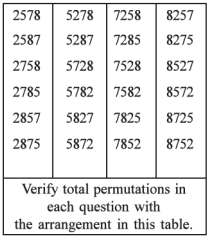
numbers that can be formed is${ }^{4} \mathrm{P}_{4}$
$ \therefore \text { Total permutations } ={ }^{4} \mathrm{P}_{4}$
$ =4 !$
$ =24 $
(2)
If even numbers are to be formed using all the digit $2,5,7,8$ then digit $2$ or $8$ should be in unit place.
This arrangement can be done in ${ }^{2} P_{1}$ ways. After arranging $2$
or $8$ in unit place, remaining $3$ digits can be arranged in remaining $3$ places in ${ }^{3} P_{3}$ ways.
$ \therefore \text { Total Permutations } ={ }^{2} \mathrm{P}_{1} \times{ }^{3} \mathrm{P}_{3}$
$ =2 \times 3 !$
$ =2 \times 6$
$ =12 $
$(3)$
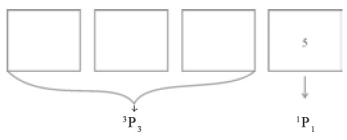
If numbers divisible by $5$ are to be formed using all the digits $2,5,7,8$ then digit $5$ should be in unit place.
This arrangement can be done in ${ }^{1} P_{1}$ ways. After arranging $5$ in unit place,
remaining $3$ digits can be arranged in remaining $3$ places in ${ }^{3} \mathrm{P}_{3}$ ways.
$ \therefore \text { Total Permutations } ={ }^{1} \mathrm{P}_{1} \times{ }^{3} \mathrm{P}_{3}$
$ =1 ! \times 3 !$
$ =1 \times 6$
$ =6 $
$(4)$
If numbers greater then $5000$ are to be formed using all digits $2,5,7,8$
then digit $5,7$ or $8$ should be in thousands place (first place).
This arrangement can be done in ${ }^{3} P_{1}$ ways.
After arranging $5,7$ or $8$ in thousands place,
remaining $3$ digits can be arranged in remaining $3$ places in ${ }^{3} \mathrm{P}_{3}$ ways :
$ \therefore \text { Total Permutations } ={ }^{3} P_{1} \times{ }^{3} P_{3}$
$ =3 \times 3 !$
$ =3 \times 6$
$ =18 $
numbers that can be formed is${ }^{4} \mathrm{P}_{4}$
$ \therefore \text { Total permutations } ={ }^{4} \mathrm{P}_{4}$
$ =4 !$
$ =24 $
(2)
If even numbers are to be formed using all the digit $2,5,7,8$ then digit $2$ or $8$ should be in unit place.
This arrangement can be done in ${ }^{2} P_{1}$ ways. After arranging $2$
or $8$ in unit place, remaining $3$ digits can be arranged in remaining $3$ places in ${ }^{3} P_{3}$ ways.
$ \therefore \text { Total Permutations } ={ }^{2} \mathrm{P}_{1} \times{ }^{3} \mathrm{P}_{3}$
$ =2 \times 3 !$
$ =2 \times 6$
$ =12 $
$(3)$
If numbers divisible by $5$ are to be formed using all the digits $2,5,7,8$ then digit $5$ should be in unit place.
This arrangement can be done in ${ }^{1} P_{1}$ ways. After arranging $5$ in unit place,
remaining $3$ digits can be arranged in remaining $3$ places in ${ }^{3} \mathrm{P}_{3}$ ways.
$ \therefore \text { Total Permutations } ={ }^{1} \mathrm{P}_{1} \times{ }^{3} \mathrm{P}_{3}$
$ =1 ! \times 3 !$
$ =1 \times 6$
$ =6 $
$(4)$
If numbers greater then $5000$ are to be formed using all digits $2,5,7,8$
then digit $5,7$ or $8$ should be in thousands place (first place).
This arrangement can be done in ${ }^{3} P_{1}$ ways.
After arranging $5,7$ or $8$ in thousands place,
remaining $3$ digits can be arranged in remaining $3$ places in ${ }^{3} \mathrm{P}_{3}$ ways :
$ \therefore \text { Total Permutations } ={ }^{3} P_{1} \times{ }^{3} P_{3}$
$ =3 \times 3 !$
$ =3 \times 6$
$ =18 $