Questions

3 Marks Question

Take a timed test

34 questions · self-marked practice — reveal the answer and mark yourself.

Question 13 Marks
What are the difficulties that you would face in classification of animals, if common fundamental features are not taken into account?
Answer
For the classification of living organisms, common fundamental characteristics are considered. If we consider specific characteristics, then each organism will be placed in a separate group and the entire objective of classification would not be achieved. Classification of animals is also important in comparing different organisms and judging their individual evolutionary significance. If only a single characteristic is considered, then this objective would not be achieved.
View full question & answer
Question 23 Marks
What are the modifications that are observed in birds that help them fly?
Answer
The modifications modifications in birds help them fly:
  1. Streamlined body for rapid and smooth movement
  2. Covering of feathers for insulation
  3. Forelimbs modified into wings and hind limbs used for walking, perching, and swimming
  4. Presence of pneumatic bones to reduce weight
  5. Presence of additional air sacs to supplement respiration.
View full question & answer
Question 33 Marks
What are the reasons that you can think of for the arthropods to constitute the largest group of the animal kingdom?
Answer
The phylum, Arthropoda, consists of more than two-thirds of the animal species on earth. The reasons for the success of arthropods are as follows:
  1. Jointed legs that allow more mobility on land
  2. Hard exoskeleton made of chitin that protects the body
  3. The hard exoskeleton also reduces water loss from the body of arthropods making them more adapted to terrestrial conditions.
View full question & answer
Question 43 Marks
How useful is the study of the nature of body cavity and coelom in the classification of animals?
Answer
The presence or absence of the body cavity gives a clue about a particular animal’s position in evolutionary ladder. The absence of coelom indicates that the animal is yet to develop a functional dividion of labor to carry out various activities. This indicates towards simplicity of activities going on inside the body. The presence of coelom paves the way for evolution of a more complex and more efficient organ system for various activities.
View full question & answer
Question 53 Marks
What is the difference between direct and indirect development?
Answer
Direct development
Indirect development
It is a type of development in which an embryo develops into a mature individual without involving a larval stage.
It is a type of development that involves a sexually-immature larval stage, having different food requirements than adults.
Metamorphosis is absent.
Metamorphosis involving development of larva to a sexually-mature adult is present.
It occurs in fishes, reptiles, birds, and mammals.
It occurs in most of the invertebrates and amphibians.
View full question & answer
Question 63 Marks
Organ systems in different groups of animals exhibit various patterns of complexities. Explain.
Answer
In animals like annelids, arthropods, molluscs, echinoderms and chordates, organs have associated to form functional systems, where each system is concerned with a specific physiological function. This pattern is called organ system level of organisation. Organ systems in different groups of animals exhibit various patterns of complexities. For example, the digestive system in platyhelminthes has only a single opening to the outside of the body that serves as both mouth and anus and is hence called incomplete. A complete digestive system has two separate openings, mouth and anus.
View full question & answer
Question 93 Marks
Differentiate between the animals of Chondrichthyes and Osteichthyes. Give six points.
Answer
 
Chondrichthyes
Osteichthyes
1.
The endoskeleton is cartilaginous.
The endoskeleton is bony.
2.
Mouth is ventral.
Mouth is terminal.
3.
Placoid scales cover the skin
Cycloid/ ctenoid scales cover the skin.
4.
Air bladder is absent.
Air bladder is present.
5.
Operculum is absent.
Operculum is present.
6.
Fertilisation is internal.
Fertilisation is external.
View full question & answer
Question 103 Marks
List out any six general features of cartilaginous fishes.
Answer
Features of cartilaginous fishes:
  1. Cartilaginous endoskeleton is present.
  2. These are mostly marine, poikilothermic animals.
  3. Notochord is persistent throughout the life.
  4. Placoid scales are present.
  5. Heart is two-chambered with one auricle and one ventrical.
  6. Tail fin is always heterocercal.
View full question & answer
Question 113 Marks
Vicky's mother was very concerned about his son. She always used to give him advices on how he should study, what is good for his health, and about everything. One day Vicky saw some, birds flying independently and asked his mother that why don't animals take care of their young ones like humans. Her mother smiled and explained that parental care is also well-developed in some animals.
  1. Explain parental care in mammals.
  2. Which other animals show parental care and how?
  3. What does parental care indicate? bine
  4. What values are shown by Vickey's mother?
Answer
  1. Mammals are well-known for their care to the young ones. They feed them on their milk and protect them from enemies. They also train their young ones to live.
  2. Most of the birds also show parental care. The parents guard and sit on the eggs till they hatch and look after, their young ones till they are independent.
  3. The parental care is well-developed in higher animals. It shows advancement in features which helps in better survival of species.
  4. Vicky's mother is caring, concerned, intelligent, patient and knowledgeable.
View full question & answer
Question 123 Marks
Write any four characteristics of class, ‘Aves’.
Answer
  1. Body is covered by feathers and they can fly except a few like ostrich.
  2. Jaws are modified into beaks and teeth are absent.
  3. Endoskeleton is bony and bones are pneumatic (with air cavities).
  4. Forelimbs are modified into wings and covered by feathers; hindlimbs have scales and are modified for walking, perching, swimming, etc.
  5. Digestive tract has two additional chambers, crop and gizzard.
  6. Heart is four chambered and there is double circulation.
View full question & answer
Question 133 Marks
Honeybees lead a highly socially organized life and thus are able to convert the nectar into sweet honey. Which of the following is similar to this statement? Which type of benefits those animals get which live a social life?
  1. If we learn to cooperate among ourselves then we can create immense value not only for us but also for others
  2. Teamwork is a dream-work
  3. All human beings are dependent on each other for their survival
Answer
  1. If we learn to cooperate among ourselves then we can create immense value not only for us but also for others.
Explantion:
Animals which live a social life get various benefits. Let us take example of the honeybees. In spite being small creatures, they make wonderful and considerably big beehives. The beehive is not just a home for the honeybees, but also a kind of factory where honey is produced. Segregation of work among different types of bee results in specialization and a particular task is carried by a particular type of honeybee. In case of attack or danger, all the worker bees unite to ward off the danger. We can also take example of humans, who have become all powerful because of a complex social life. A human does not have sharp fangs or claws and he is not very strong like some big animals. Yet a human being can tame even the most ferocious animal on this earth because of cooperation.
View full question & answer
Question 143 Marks
  1. List out some flightless birds.
  2. Describe briefly any four with their important features.
  3. Write the name of any two extinct flightless birds.
Answer
  1. The flightless birds are ostrich, rhea, kiwi, penguin, cassowary, emu, and Island rail.
  2.  
  1. Ostrich: (Struthio) is the largest living flightless bird also called as Shutarmurg (in Hindi). It has largest eyes of any land animal. It swallows small stones to aid their digestion of vegetable matter. It can run at the speed to 60 km/hr. Ostrich lays In the largest egg produced by any living bird. It is commonly found in deserts of Africa and Arabia
  2. Rhea: is smaller than ostrich but similar to it in many habits. Its head and neck are feathered not naked as in ostrich. It is found in South America.
  3. Emu: (Dromaius) is the second largest living bird. (STOT It is confined to Australia.
  4. Kiwi: (Apteryx) has most sensitive beak among the birds. It can detect worms in the ground. It lays largest egg in proportion to its own size. It is the New Zealand's Emblem bird.
  1. Extinct flightless birds are:
  1. Dodo of Mauritius became extinct in 1681.
  2. Moais of New Zealand.
View full question & answer
Question 153 Marks
How is cephalisation considered as an asset in an adjustment with the environment?
Answer
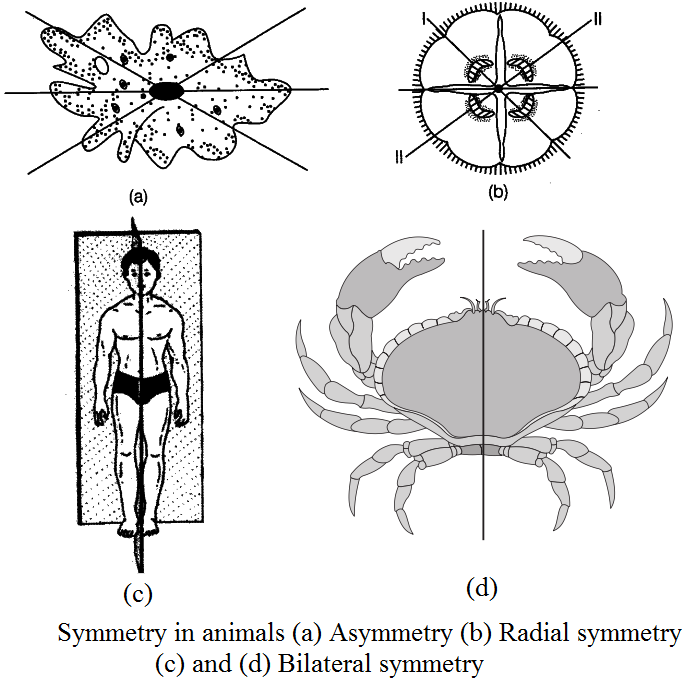
The animals having bilateral symmetry move with their anterior end forward. This has led to cephalisation, i.e., differentiation of a definite head at the anterior end. Cephalisation involves the concentration of nervous tissue (brain) and sense organs in the head. This arrangement is an asset in an adjustment with the environment, as the anterior end of a moving animal is the first to encounter changes in the area it is entering.
View full question & answer
Question 183 Marks
How are animals of Platyhelminthes different from those of Annelida?
Answer
 
Platyhelminthes
Annelida
1.
Animals are dorso-ventrally flattened.
Animals are cylindrical.
2.
Body may be non-metamerically segmented in some.
Body is matamerically segmented.
3.
They have organ level of organization.
They have organ system level of organization.
4.
Flame cells carry out excretion and osmoregulation.
Nephridia carry out excretion and osmoregulation.
5.
Circulatory system is absent.
Circulatory system is well-developed.
6.
Self-fertilisation occurs.
Cross-fertilisation occurs.
View full question & answer
Question 193 Marks
Describe the canal system of sponges.
Answer
  • The characteristic canal system through which water circulates, helps in nutrition, respiration and excretion of the animal.
  • Body wall has a number of small openings, called ostia, through which water enters the body.
  • Through radial canals, the water reaches the spongocoel.
  • Water carrying wastes comes out through a large terminal opening, called osculum.
  • Spongocoel and the canals are lined by flagellated collar cells, called choanocytes.
View full question & answer
Question 203 Marks
The presence of vertebral column provides additional strength to the body and thus very big animals can be found among vertebrates. Which of the following is similar to this in our surroundings? How important is the proper use of materials and technologies in making buildings? Explain.
  1. A tent can be erected with the support of bamboo or iron poles
  2. Use of RCC frames makes it possible to build big buildings
  3. The weight of the roof stays on the central beam in the house
Answer
  1. Use of RCC frames makes it possible to build big buildings.
Explanation:
Buildings are an integral part of our life. House is one of the basic needs for humans. We need house to save ourselves from the sun and rain and from the vagaries of nature. A building made from proper material and with suitable technology would be strong and durable. A strong building can withstand natural calamities; like earthquakes and floods. It is important to remember that people do not die because of earthquakes but because of the damage to buildings. Similarly, a properly designed house can save people during floods. So, it is clear that proper use of materials and technologies in making a building is quite important.
View full question & answer
Question 213 Marks
Endoparasites are found inside the host body. Mention the special structure, possessed by these and which enables them to survive in those conditions.
Answer
The special structures possessed by endoparasites are as follows:
  1. Hooks and suckers,
  2. Dorsoventrally flattened body,
  3. High reproductive potential,
  4. Indirect development.
View full question & answer
Question 223 Marks
What is the basic body plan of animals?
Answer
Animals have three basic body plan as given below:
  1. Cell aggregate body plan: Cells are loosely arranged and do not organise to form tissues, e.g., sponges.
  2. Blind sac body plan: Body has a cavity that helps in digestion with a single opening, the mouth, e.ge coelenterates.
  3. Tube within tube body plan: It is found in higher animal groups from nematodes to chordates. The body consists of two openings, i.e., one for ingestion and one for egestion.
It is further divided into two types:
  1. Protostomous plan: (Proto-first; stoma-mouth) found in non-chordates like flatworms, roundworms, annelids, molluscs and arthropods. In this, mouth is derived from the blastopore of the embryo and anus is formed later.
  2. Deuterostomous plan: It is found in echinoderms, hemichordata and chordates. In To this, anus is derived from the blastopore and mouth arises at the opposite end.
View full question & answer
Question 233 Marks
Write the types of following structures in mammals:
  1. Kidneys
  2. Fertilisation
  3. RBCS
  4. Brain
  5. Parental care
  6. Sexual dimorphism
Answer
S.No.
 
 
(i)
Kidneys
Metanephric
(ii)
Fertilisation
Internal
(iii)
RBCs
Small, circular and non-nucleated
(iv)
Brain
Highly developed
(v)
Parental care
Well-developed
(vi)
Sexual dimorphism
Well-marked
View full question & answer
Question 243 Marks
Write four differences between the animals of Platyhelminthes and those of Aschelminthes. Give an example of each.
Answer
 
Platyhelminthes
Aschelminthes
1.
Animals are acoelomates.
Animals are pseudocoelomates.
2.
They are hermaphrodite/ bisexual.
They are unisexual and sexually dimorphic.
3.
Body is dorsoventrally flat.
Body is cylindrical and thread-like.
4.
Alimentary canal is incomplete with only one opening. e.g., Planaria, Taenia.
Alimentary canal is complete with a mouth opening and an anal opening. e.g., Ascaris, Wuchereria.
View full question & answer
Question 253 Marks
How are animals of Porifera different from those of Cnidaria?
Answer
 
Porifera
Cnidaria
1.
Animals are asymmetrical.
Animals are radially symmetrical.
2.
They show cellular level of organization.
They show tissue level of organisation.
3.
Water canal system is well-developed.
Water canal system is absent.
4.
Cnidoblasts are absent.
Cnidoblasts are present.
5.
They have a skeleton of spicules or sponging fibres.
Only some have a skeleton of calcium carbonate.
View full question & answer
Question 263 Marks
Write an account on skeleton of sponges.
Answer
The body of sponges contains a supporting exoskeleton. It is made up of either spicules or spongin fibres or both. Spongin fibres are protein fibres. They are either highly branched or show anastomosis. Spicules are calcareous or siliceous with hard spine-like structures.
  1. Depending on the branching the spicules are:
  2. Monoaxons (single axis).
  3. Triaxons (three axis forming six rays of hexactinal spicules).
  4. Tetraxons (four rays or tetra actinal).
  5. Polyaxons (several rays).
View full question & answer
Question 283 Marks
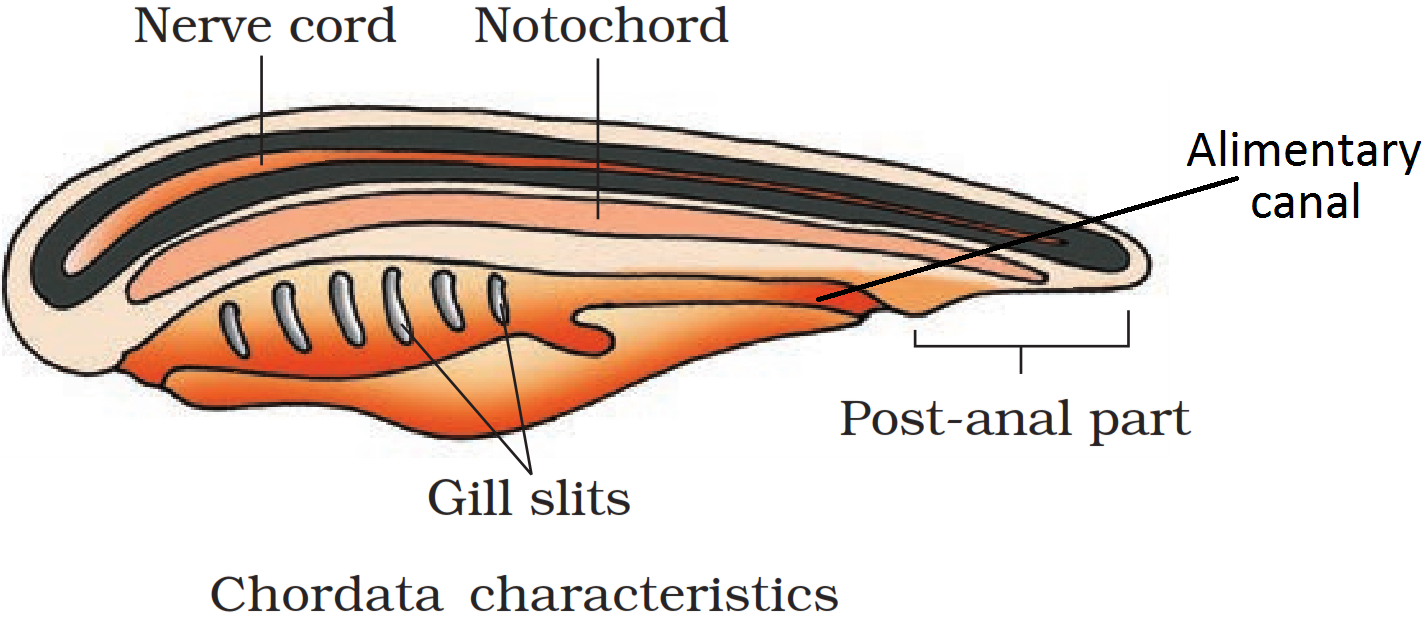
  1. Draw a labelled diagram of the basic body plan of chordates.
  2. Mention the four characteristic features which all chordates possess.
Answer
  1.  
  1. Following are the characteristics of chordates:
  1. All chordates possess a notochord either in the embryonic stage only or in the adult life too; it is replaced by vertebral column in vertebrates.
  2. The nerve cord is dorsal, single, hollow and tubular.
  3. Pharyngeal gill slits are present.
  4. Post-anal tail is present.
  5. Heart is muscular and ventral.
View full question & answer
Question 293 Marks
Differentiate between a diploblastic and a triploblastic animal.
Answer
 
Diploblastic Animals
Triploblastic Animals
1.
The cells are arranged in two embryonic layers- external ectoderm and internal endoderm.
The cells are arranged in two embryonic layers- external ectoderm, middle layer of mesoderm and internal endoderm.
2. Mesoglea is present between the ectoderm and the endoderm Mesoglea is absent. Instead, the mesoderm is present between the endoderm and the ectoderm.
3.
Examples: Cnidaria and Ctenophora.
Examples: Platyhelminthes to Chordata.
View full question & answer
Question 303 Marks
Arya went to a bird sanctuary with her family. She saw numerous birds there and was amazed by the colourful and vibrant world of flying birds. She also saw ostriches there but they were not flying seeing this, she asked her mother who is an ornithologist) why only birds can fly, while all other animals cannot. She also asked her mother about the birds that cannot fly.Her mother explained Arya about birds and their characteristic features. Arya felt happy knowing knowledge:
  1. Which characteristic features of Aves.
  2. What are the flight adaptations of birds?
  3. Name few flightless birds.
  4. What values are shown by Arya?
Answer
  1.  
  1. Birds have aerial mode of life. They spend most of the time in air. Characteristic features of Aves are the presence of feathers.
  2. The body is usually streamlined. It is divided into
  3. Beaky rieckpiered and hailight feathers. It acts as insulator and helps in flight. Most of them fly except the flightless birds (e.g., ostrich). The skin is dry without glands except the oil gland at the base of the tail.
  1. Endoskeleton is fully ossified (i.e., bony) and is made up of delicate and light bones with air cavities (pneumatic bones).
  2. Flightless birds are emu, kiwi, rhea, Struthio, penguin, etc.
  3. It reflects her curiosity to know and correlate the information.
View full question & answer
Question 313 Marks
Write any four differences between chordates and non-chordates.
Answer
 
Chordates
Non-chordates
1.
They possess a notochord at some stage in life.
They do not possess a notochord.
2.
Pharynx is perforated by gill slits.
Gill slits are absent.
3.
Heart is ventral.
Heart (if present) is dorsal.
4.
Single, hollow tubular nerve cord is dorsal.
Nerve cord is solid tubular, single/ double and ventral.
5.
A post anal tail is present.
A post-anal tail is absent.
View full question & answer
Question 323 Marks
Write an account on modes of respiration in animals with examples.
Answer
Different modes of respiration in animals are given in the table below:
Respiratory Organ
Mode of Respiration
Examples
Body surface
Body surface respiration
Sponges and coelenterate
Gills
Branchial respiration
Fishes
Book gills
Book gill respiration
Limulus (king crab)
Skin
Cutaneous respiration
Annelids and amphibians
Trachea
Tracheal respiration
Insects
Lungs
Pulmonary respiration
Most of the tetrapods
Book lungs
Book lungs respiration
Arachnids (spiders and scorpion)
 
View full question & answer
Question 333 Marks
Prakhar, a class XI student went out after rains in the garden. He saw earthworms on the ground and wondered how they are able to move, eat and perform various function of life Next day, he went to his biology teacher and asked her about the same. Her biology teacher politely explained him about how different animals have various levels of organisation of cells. She also told her that except sponges and coelenterates, all the animals of the kingdom-Animalia have organ- system level of organisation.
  1. What kind of body organisation are present in sponges and coelenterates?
  2. Write about the organisation type in lower animals, like protozoans.
  3. In which phylums organ system level organisation is found?
  4. What values are shown by Prakhar?
Answer
  1. In sponges, cellular level organisation and in coelenterates, tissue level organisation is present.
  2. In protozoans, organisation is at the level of protoplasm.
  3. Organ system level organisation is found in Platyhelminthes, Ascheheminthes, Annelida, Arthropoda, Mollusca, Echinodermata and hemichordata.
  4. Parkhar is an intelligent, enthusiastic, a good observer boy and is keen to know about various things that goes around him.
View full question & answer
Question 343 Marks
List any six features of cartilaginous fishes. Give four examples of these.
Answer
  1. They are mostly marine called poikilothermic animals (i.e., they have the capacity to regulate their body temperature).
  2. The body is laterally compressed and spindle-shaped.
  3. Notochord is persistent throughout the life.
  4. Mouth is ventral in position, skin is tough containing minute placoid scales and teeth are modified placoid scales. They have strong jaw and are predaceous by nature.
  5. Gill slits are generally five pairs and gill cover (operculum) are absent.
  6. Heart is two-chambered with one auricle and one ventricle.
View full question & answer