Questions

1 Marks Question

Take a timed test

107 questions · self-marked practice — reveal the answer and mark yourself.

Question 11 Mark
Name the blood component which is viscous and straw coloured fluid.
Answer
Plasma is straw coloured, viscous fluid, slightly alkaline and aqueous solution which constitutes about 55% of the blood.
View full question & answer
Question 21 Mark
Where does the cardiac impulse originate?
Answer
The cardiac impulse originates in cardiac muscle fibres and is not brought to the heart by any nerve fibres. The origin of cardiac impulse is said to be myogenic.
View full question & answer
Question 31 Mark
How is the rate of heart beat determined from the ECG?
Answer
By counting the number of QRS complexes in an ECG in given period of time.
View full question & answer
Question 41 Mark
A fish's heart pumps only deoxygenated blood, why?
Answer
A fish's heart pumps only deoxygenated blood as it is a two-chambered heart with an atrium and a ventricle. The heart pumps out deoxygenated blood which is oxygenated by the gills and supplied to other body parts, from where deoxygenated blood is returned to the heart.
View full question & answer
Question 51 Mark
Give the path of pulmonary circulation.
Answer
In this, the blood completes its circulation from right ventricle to the left atria through the lungs.
View full question & answer
Question 61 Mark
  1. Name the iron-containing complex protein present in human blood and mention its location.
  2. What is its quantity in the blood of a normal healthy adult human?
Answer
  1. Haemoglobin; it is present in the red blood cells.
  2. 12-16g in every 100ml of blood.
View full question & answer
Question 71 Mark
Name the following:
  1. The embryonic germ layer, which the human heart develops from.
  2. The double-walled membranous bag/ sac, covering the heart.
Answer
  1. Mesoderm.
  2. Pericardium.
View full question & answer
Question 81 Mark
Given below are the abnormal conditions related to blood circulation. Name the disorders.
  1. Acute chest pain due to failure of oxygen supply to heart muscles.
  2. Increased systolic pressure.
Answer
  1. Angina.
  2. High blood pressure.
View full question & answer
Question 101 Mark
Why is blood group identification not needed for serum transfusion?
Answer
Because serum does not have the coagulation/ clotting factor.
View full question & answer
Question 121 Mark
Which coronary artery disease is caused due to narrowing of the lumen of arteries?
Answer
Atherosclerosis is coronary artery disease (CAD) which results in narrowing of lumen of arteries. It occurs due to deposition of fatty substances specially chloesterol and triglycerides in wall of arteries, which grow to form plaques and reduces the blood flow.
View full question & answer
Question 131 Mark
Name the following:
  1. The largest artery in our body.
  2. The thick-walled partition between the right and left ventricles.
Answer
  1. Aorta.
  2. Interventricular septum.
View full question & answer
Question 141 Mark
Why is the closed circulatory system considered to be advantageous for the animals?
Answer
Since the flow of body fluids can be precisely regulated according to the needs, it is considered advantageous to animals.
View full question & answer
Question 151 Mark
State the functions of the following in blood, Lymphocytes.
Answer
Lymphocytes – The leucocytes are agranulocytes and are non motile and non phagocytic. They are responsible for immune responses in the body (B-and T-lymphocytes).
View full question & answer
Question 161 Mark
State the functions of the following in blood, Neutrophils.
Answer
Neutrophils – These are the most abundant WBCs and are granulocytes. They destroy foreign organisms entering the body and thus are phagocytic cells.
View full question & answer
Question 171 Mark
Name the enzyme that converts:
  1. Prothrombin into thrombin
  2. Fibrinogen into fibrin.
Answer
  1. Thrombokinase.
  2. Thrombin.
View full question & answer
Question 191 Mark
Mention the two functions, the eosinophils perform.
Answer
  • Eosnophils resist infections.
  • They are also involved in allergic reactions.
View full question & answer
Question 201 Mark
Comment. Blood is called river of life.
Answer
It is called so, because blood plasma helps in transportation of biologically important materials for life processes like nutrients, gases, wastes, hormones, etc. within the body, which is very essential for the survival of life.
View full question & answer
Question 211 Mark
Answer the following, Which part of heart is responsible for initating and maintaining its rhythmic activity?
Answer
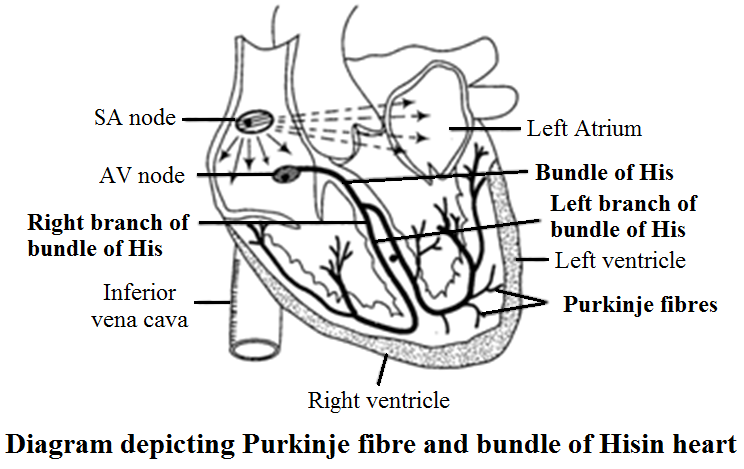
The heart beat originates from the sinoatrial node (SA node) known as the pace maker of the heart. The SA node is a mass of neuromuscular tissue, which lies in the wall of the right atrium near the opening of the superior vena cava.
View full question & answer
Question 221 Mark
Mention the stages of cardiac cycle.
Answer
Stages of cardiac cycle are joint diastoleatrial systole ventricular systole.
View full question & answer
Question 231 Mark
What is the role of pulmonary vein and how is it different from other veins?
Answer
Pulmonary vein carries oxygenated blood from lungs to the heart. Other veins in the body carry deoxygenated blood, hence pulmonary vein is different from hem.
View full question & answer
Question 241 Mark
Why are some individuals/ persons known as Rh-positive and some others as Rh-negative?
Answer
  • Individuals who have Rh-factor or Rh-antigen on the surface of RBCs, are called Rh-positive.
  • Individuals who do not have Rh-factor or Rh-antigen on the surface of RBCs, are called Rh-negative.
View full question & answer
Question 251 Mark
Where do you find open circulatory system among the following?
  1. Birds.
  2. Cockroach.
  3. Man.
  4. Frog
Answer
  1. Cockroach.
View full question & answer
Question 261 Mark
Name the vessels that enter and leave the heart.
Answer
Superior and inferior vena cava enter the heart whereas aorta leaves the heart.
View full question & answer
Question 271 Mark
Define systole and diastole.
Answer
Contraction of heart muscles brings right and left atria at systole and relaxation of heart muscles brings them at diastole.
View full question & answer
Question 291 Mark
It is seen that RBC count is more in the persons living at high altitudes. Indicate the reason behind this.
Answer
It is due to the low concentration of $O _2$ in the air, which enables less $O _2$ binding capacity of the haemoglobin, this increases RBC count in persons living at high altitude.
View full question & answer
Question 301 Mark
A cardiologist observed an elevated ST segment in the ECG of a patient. What is it indicative of?
Answer
An elevated ST segment in the ECG of a patient is indicative of acute myocardial infarction (heart attack).
View full question & answer
Question 311 Mark
What is the effect of dengue fever on the platelets of blood in humans?
Answer
One of the major effect of dengue fever is the low platelet counts. It leads to life threatening condition if left untreated.
View full question & answer
Question 321 Mark
How is the rate of heart beat determined from the ECG?
Answer
By counting the number of QRS complex that occurs in a given time period in an ECG.
View full question & answer
Question 341 Mark
What are chordae tendinae?
Answer
Chordae tendinae are the fibres, which attach the AV valves to the wall of the ventricle.
View full question & answer
Question 351 Mark
A person's blood group is AB positive. What does it mean?
Answer
AB positive means that both A and B antigens are present and Rh factor is also present in the blood of that person.
View full question & answer
Question 361 Mark
A person has a blood group AB positive. What does it mean?
Answer
AB positive means that a person has both A and B antigens and also has Rh factor in his blood.
View full question & answer
Question 371 Mark
Name one animal whose heart pumps only deoxygenated blood. How many chambers does this heart have?
Answer
  • Fish heart-pumps only deoxygenated blood.
  • It has two chambers, a ventricle and an auricle.
View full question & answer
Question 381 Mark
State the functions of the following in blood, Fibrinogen.
Answer
Fibrinogen – It is present in blood plasma and” helps in clotting.
View full question & answer
Question 391 Mark
Why are persons with blood group ‘AB' known as universal recipients?
Answer
Since persons with blood group ‘AB'can receive blood of any group (A or B or AB or O), they are called universal recipients.
View full question & answer
Question 411 Mark
Name the phase of the cardiac cycle in which both atria and the ventricles are relaxed simultaneously.
Answer
Joint diastole.
View full question & answer
Question 431 Mark
Mitral valve is present between right atrium and right ventricle. State yes or no. If no explain why?
Answer
No, mitral valve or bicuspid valve is the type of cardiac valve that guards the opening between left atrium and left ventricle of the heart.
View full question & answer
Question 441 Mark
State the functions of the following in blood, Globulin.
Answer
Globulin – It is a plasma protein which helps in defense mechanism.
View full question & answer
Question 451 Mark
Name two groups of animals, whose ventricle pumps mixed blood.
Answer
Amphibians and reptiles (except crocodiles).
View full question & answer
Question 461 Mark
Give the location of septa in the heart.
Answer
The septa (atrioventricular septa) is present between the right auricle-ventricle and the left auricle-ventricle.
View full question & answer
Question 481 Mark
Name the vascular connection that exists between the digestive tract and liver.
Answer
Hepatic portal system is the vascular connection between the digestive tract and liver. The flow of deoxygenated blood from the digestive organs to the liver before returning to the heart is called hepatic portal circulation.
View full question & answer
Question 491 Mark
Heart failure is also called congestive heart failure. Why?
Answer
Because congestion of lungs is a symptom of heart failure, it is also called congestive heart failure.
View full question & answer
Question 501 Mark
Your friend has gone for blood test and his haemoglobin count is 17gm per 100mL. What should he do?
  1. No need to worry.
  2. Take rest.
  3. Take rest and prescribed medicines.
  4. Take rest and lots of leafy vegetables.
Answer
  1. No need to worry.
Explanation:
If haemoglobin count is 17gm per 100mL, then there is no need to get worried as the normal haemoglobin count in human blood should be between 12-17gm/mL.
View full question & answer
Question 511 Mark
Given below are the abnormal conditions related to blood circulation. Name the disorders. Acute chest pain due to failure of $O _2$ supply to heart muscles.
Answer
Acute chest pain due to failure of $O _2$ supply to heart muscles causes angina, also/ called angina pectoris. In this disorder enough oxygen does not reach the heart muscles, resulting in acute chest pain.
View full question & answer
Question 521 Mark
How many action potentials can be generated by the SA node in a minute?
Answer
70-75 number of action potentials can be generated by the SA node in a minute.
View full question & answer
Question 531 Mark
Why does lymph contain less proteins than plasma?
Answer
Because the wall of the capillaries is not permeable to all plasma proteins.
View full question & answer
Question 551 Mark
Name the fluid matrix of blood. What percent of blood is constituted by it?
Answer
  • Plasma is the fluid matrix of blood.
  • It constitutes 55% of the blood.
View full question & answer
Question 571 Mark
Define the following terms and give their location. Purkinje fibre.
Answer
Purkinje fibres are the impulse conducting fibres which relay the contraction impulses from AV node into the walls of ventricles.
View full question & answer
Question 581 Mark
From where does the hepatic portal system brings the blood?
Answer
Hepatic portal system brings blood from the alimentary canal, pancreas and spleen to the liver.
View full question & answer
Question 601 Mark
Indicate the blood vessel that transports hormones from the hypothalamus to the anterior pituitary.
Answer
Hypophyseal portal vein.
View full question & answer
Question 611 Mark
Given below are the abnormal conditions related to blood circulation. Name the disorders. Increased systolic pressure.
Answer
Increased systolic pressure results in hypertension (high blood pressure). The normal blood pressure is 120/ 80mmHg (120- systolic and 80-diastolic pressure). Blood pressure persistently higher than normal, e.g., 140/ 90mmHg (140-systolic pressure) or higher causes hypertension.
View full question & answer
Question 641 Mark
Where are semilunar valves present in the heart?
Answer
At the origin of pulmonary artery from right ventricle and at the origin of aorta from the left ventricle.
View full question & answer
Question 651 Mark
Mention the total amount of normal leucocyte count in human?
Answer
6000-8000 per cubic mm is the normal leucocyte count in human.
View full question & answer
Question 661 Mark
What is the role of WBCs?
Answer
WBCs play an important role in immune system. They engulf and destroy foreign materials entering our body and thus help in warding off disease.
View full question & answer
Question 671 Mark
What is the coronary system of blood vessels meant for?
Answer
The coronary system of blood vessels is meant for circulation of blood in the cardiac musculature.
View full question & answer
Question 681 Mark
Due to developmental abnormality, the wall of the left ventricle of an infant's heart is as thin as that of right ventricle. What would be its specific effect in circulation of blood?
Answer
It may not be able to develop sufficient pressure to pump blood in all distant parts of the body.
View full question & answer
Question 691 Mark
What is the significance of time gap in the passage of action potential from sino-atrial node to the ventricle?
Answer
The time gap of the passage of action potential from SA node to AV node is significant to provide sufficient time for the relaxation of ventricles. This causes fall in ventricular pressure and closing of semi lunar valves that in turn prevents back flow of blood into ventricles.
View full question & answer
Question 711 Mark
Write (a) duration of a cardiac cycle and (b) the average number of heart beats in a healthy human being.
Answer
  1. 0.8 second.
  2. 70-75 (average 72).
View full question & answer
Question 721 Mark
How will you interpret an electrocardiogram (ECG) in which time taken in QRS complex is higher?
Answer
The QRS complex in an electro-cardiogram (ECG) represents ventricular depolarization, i.e., spread of impulse of contraction from atrio-ventricular node (AVN) to ventricles through Purkinje fibres and Bundle of His. Duration of normal QRS complex is less than 0.10 sec and the enlarged Q and R waves indicate myocardial infarction.
View full question & answer
Question 731 Mark
Name the plasma proteins which.
  1. Help in maintaining osmotic balance of body fluids.
  2. Are involved in the defence mechanism of the body.
Answer
  1. Albumins.
  2. Globulins.
View full question & answer
Question 741 Mark
What happens in haemophilia?
Answer
The person suffering from haemophilia lacks clotting factors in blood and as a result the clotting mechanism is defective. So in case of injury the person is at a risk of blood loss.
View full question & answer
Question 751 Mark
Due to developmental abnormality, the wall of the left ventricle of an infant's heart is as thin as that of right ventricle. What would be its specific effect in circulation of blood?
Answer
It may not be able to develop sufficient pressure to pump blood to all distant parts.
View full question & answer
Question 761 Mark
Why are veins provided with valves along their length?
Answer
Valves are present in the heart and veins to prevent the backward flow of blood.
View full question & answer
Question 771 Mark
What does the T-wave in a normal electrocardiogram indicate?
Answer
It indicates the return of ventricles from excited to normal state (repolarisation).
View full question & answer
Question 781 Mark
Name the most abundant among the formed elements of human blood. Mention its number in the blood.
Answer
  • Erythrocytes or red blood cells are the most abundant formed elements.
  • About 5 million $RBCs / mm ^3$ of blood.
View full question & answer
Question 791 Mark
Name the leucocytes involved in:
  1. Immune response.
  2. Allergic reactions.
Answer
  1. Lymphocytes.
  2. Eosinophils.
View full question & answer
Question 801 Mark
Name the cells which form thrombocytes. Where are they located in our body?
Answer
  • Megakaryocytes form thrombocytes.
  • They are located in the bone marrow
View full question & answer
Question 811 Mark
What is average number of thrombocytes in human blood? What is their function?
Answer
  • $1,50,000$ to $3,00,000 / mm ^3$ of blood.
  • They release substances that are concerned with the clotting of blood.
View full question & answer
Question 821 Mark
Name the following:
  1. The artery that carries deoxygenated blood.
  2. The vein which carries oxygenated blood.
Answer
  1. Pulmonary artery.
  2. Pulmonary vein.
View full question & answer
Question 841 Mark
What is meant by autoexcitability of SA node?
Answer
Since the muscles of sinoatrial node can generate action potentials without any external stimuli, it is called autoexcitable.
View full question & answer
Question 861 Mark
Heart failure is called congestive heart failure. Why?
Answer
The congestion of lungs is a symptom of heart failure. Thus, it is also called congestive heart failure.
View full question & answer
Question 871 Mark
Why is blood group identification not needed for serum identification?
Answer
Because serum does not have the coagulation/ clotting factor.
View full question & answer
Question 881 Mark
What is the reason of veins being thinner than arteries?
Answer
Tunica media is thinner in veins than in arteries. Hence veins are thinner than arteries.
View full question & answer
Question 891 Mark
Define the following terms and give their location. Bundle of His.
Answer

Bundle of His are mass of specialised fibres that originates from the AV node.

View full question & answer
Question 911 Mark
A person with blood group O can be transfused blood of only O group. Why?
Answer
Since blood group O has both anti-a and anti-b antibodies, no other blood group with any antigen can be accepted by it; only blood group O, which lacks an antigen can be transfused.
View full question & answer
Question 921 Mark
It is said that arteries are more elastic and more contractile than veins. Comment.
Answer
It is so, because tunica media of an artery is formed of smooth muscle fibres and elastic fibres.
View full question & answer
Question 931 Mark
You must have observed a dark-reddish brown scum formed at the site of a cut or an injury in the body. What is it made of?
Answer
It is the blood clot or coagulum formed of a network of fibrin in which the dead and damaged formed elements of blood are trapped.
View full question & answer
Question 941 Mark
What is the significance of valves in the heart?
Answer
The valves allow flow of blood only in one direction and prevent any backward flow.
View full question & answer
Question 951 Mark
What is hypertension?
Answer
When blood pressure is more than normal blood pressure the condition is called hypertension.
View full question & answer
Question 971 Mark
Explain the consequences of a situation in which blood does not coagulate.
Answer
Inability of blood to coagulate due to absence of clotting factors can prolong the bleeding time and thus leads to loss of large amount of blood, which might led to death of the person.
View full question & answer
Question 981 Mark
Why are persons with blood group 'O' known as‘universal donors'?
Answer
Since blood of 'O'group can be transfused to persons of any blood group, persons with blood group 'O' are called universal donors.
View full question & answer
Question 1001 Mark
Answer the following, Name the major site where RBCs are formed.
Answer
In the early few weeks of embryonic life, primitive nucleated RBCs are produced in the yolk sac. In later embryonic stage, RBCs are mainly produced by the liver and spleen. But from birth onwards, RBCs are produced by bone marrow.
View full question & answer
Question 1021 Mark
Why are erythrocytes red in colour?
Answer
Erythrocytes are red in colour due to the iron containing protein, haemoglobin present in them.
View full question & answer
Question 1041 Mark
Why are leucocytes also known as white blood cells (WBCs)?
Answer
They lack any pigment and are colourless; hence, called white blood cells.
View full question & answer
Question 1061 Mark
Why blood transfusion is necessary in case of heavy blood loss?
Answer
In case of heavy blood loss the oxygen carrying capacity of body is reduced drastically. Blood being the carrier of oxygen and carbon dioxide is transfused to restore normal metabolic functions of the body.
View full question & answer