Questions

2 Marks Questions

Take a timed test

57 questions · self-marked practice — reveal the answer and mark yourself.

Question 12 Marks
Why do we call our heart myogenic?
Answer
Heart is called myogenic because all the normal activities of the heart are regulated intrinsically or the activities are auto regulated by specialised muscles known as nodal tissues without the need for an external stimulus to be delivered by the nervous system.
View full question & answer
Question 22 Marks
Explain heart sounds.
Answer
Two prominent sounds are produced during each cardiac cycle. The first heart sound (lub) is associated with the closure of the tricuspid and bicuspid valves whereas the second heart sound (dub) is associated with the closure of the semilunar valves. These sounds are of clinical diagnostic significance.
View full question & answer
Question 32 Marks
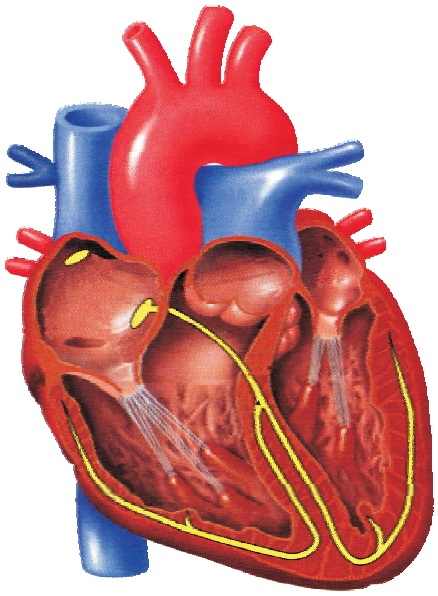
In the diagrammatic presentation of heart given below, mark and label, SAN, AVN, AV bundles, bundle of His and Purkinje fibres.
View full question & answer
Question 42 Marks
Name the unique vascular connection between digestive tract and the liver. What is its significance?
Answer
Hepatic portal vein is the unique vascular connection between digestive tract and the liver. Significance: It brings blood from intestine to the liver, before it is delivered to the systemic circulation due to which the liver gets its nutrients.
View full question & answer
Question 52 Marks
Radhika's aunt has a five year old daughter and is pregnant for the second time. Her first daughter is $\mathrm{Rh}^{+}$and she is Rh: When her doctor came to know about that she is Rh; she gave her an anti-Rh antibodies injection. She felt depressed and asked her neighbour (who was a biology professor). She councilled Radhika's aunt and explained her that it is all about Rh factor and Rh incompatibility. She told Radhika's aunt that medicines are now available to take care of consequences of incompatibility.
    i. What do you mean by $\mathrm{Rh}^{-}$and $\mathrm{Rh}^{+}$?
   ii. What problems Radhika's aunt can be face in the second pregnancy? Explain with reasons.
  iii. What value(s) is/ are shown by Radhika's neighbour in explaining?
Answer
i. During the delivery of the first child $\left(\mathrm{Rh}^{+}\right)$, the Rh-antigen would have entered the blood of the mother and generated Rh-antibodies. These antibodies linger in the blood for months/ years.
ii. If a second $\mathrm{Rh}^{+}$foetus is conceived, they attack the RBCs of the foetus and destroy them. This would lead to the birth of the child with either anaemia and jaundice or may be fatal to the child.
iii. Radhika's neighbour has concern for her, was alert and had practical knowledge for the issue.
View full question & answer
Question 62 Marks
Differentiate between auricles and ventricles.
Answer
S. No Auricles ventricles
(a) They are the receiving chambers. They are the pumping chambers.
(b) They are thin-walled. They are thick-walled.
(c) Their systole always precedes ventricular systole. Their systole always follows auricular systole.
View full question & answer
Question 72 Marks
Answer the following.
  1. Name the major site where RBCs are formed.
  2. Which part of heart is responsible for initiating and maintaining its rhythmic activity?
  3. What is specific in the heart of crocodiles among reptilians?
Answer
  1. Bone marrow.
  2. Sinoatrial node (SA node).
  3. Reptiles have three-chambered heart except crocodile, which has four chambered heart.
View full question & answer
Question 82 Marks
What is stroke volume? What is its relation with cardiac output?
Answer
During one cardiac cycle or one heart beat the volume of blood pumped by the heart is called stroke volume. This is normally 70mL. In one minute the heart beats about 72 times and the amount of blood pumped per minute is called cardiac output. This is usually 4900ml - 5 litres.
View full question & answer
Question 92 Marks
What is meant by P-Q interval and S-T interval in electrocardiography?
Answer
In electrocardiography, P-Q interval (also called PR interval) is the time taken by the impulse to travel through atria, AV node and the rest of the conducting tissues. The normal PR interval lasts for about 0.16s. The ST interval is the representation of time between the end of the spread of impulse through ventricles and its repolarisation.
View full question & answer
Question 102 Marks
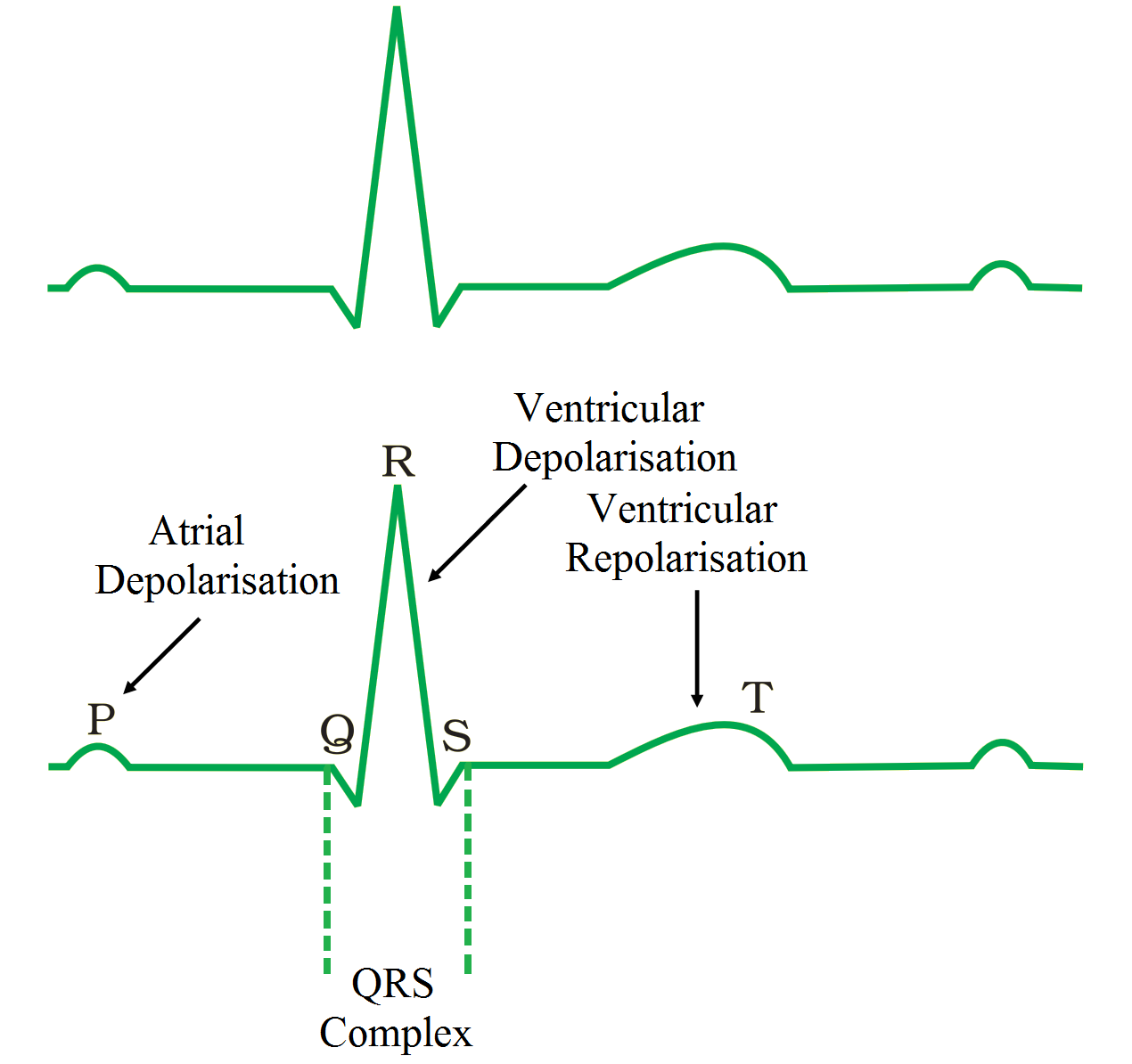
Given below is the diagrammatic representation of a standard ECG. Label its different peaks.
Answer

Fig.: Diagrammatic representation of standard ECG.
View full question & answer
Question 112 Marks
Differentiate between RBCs and WBCs.
Answer
S. No
RBCs
WBCs
(a)
They do not have nucleus at maturity.
They have a large characteristic nucleus.
(b)
They possess haemoglobin and are red.
They are colourless as they have no pigment.
(c)
They help in transport of respiratory gases.
They help in defence mechanism.
(d)
They are about 5 million/ $mm ^2$ of blood.
They are about 7000/ $mm ^2$ of blood.
View full question & answer
Question 122 Marks
Match the items listed in column I with appropriate items from column II.
S.No.
column I
S.No.
column II
(A)
SA node
(i)
Fishes
(B)
Right AV aperture
(ii)
Right auricle
(C)
Interstitial
(iii)
Tricuspid valve
(D)
Single circulation
(iv)
Intercellular spaces
Answer
S.No.
column I
S.No.
column II
(A)
SA node
(ii)
Right auricle
(B)
Right AV aperture
(iii)
Tricuspid valve
(C)
Interstitial
(iv)
Intercellular spaces
(D)
Single circulation
(i)
Fishes
View full question & answer
Question 132 Marks
Give the reason for reduced blood flow to the heart muscles leading to their death.
Answer
When the blood supply to myocardium of the heart is greatly reduced, then the cardiac muscle fibres die. This reduced blood supply can be due to the blockage of the coronary muscles by the thrombus (blood clot formed in the coronary artery).
View full question & answer
Question 142 Marks
Bring out the effects of sympathetic and parasympathetic nerves on the heart functioning.
Answer
  • Sympathetic nerves increase the rate of heart beat, the strength of ventricular contraction and thereby the cardiac output.
  • Parasympathetic neural signals decrease the rate of heart beat, speed of conduction of action potential and thereby the cardiac output.
View full question & answer
Question 152 Marks
The heart keeps on beating; tirelessly; throughout the life. What lesson can be drawn from this property of the heart? Explain, which kind of diet should be taken to maintain a healthy heart?
  1. We should study continuously to excel in life.
  2. We should work tirelessly to attain our goal.
Answer
  1. We should work tirelessly to attain our goal.
Explanation:
We should avoid taking oily food and should also avoid taking too much of carbohydrate in our diet. Excess fat in the diet changes into harmful cholesterol. Even excess carbohydrate is changed into fat and stored in the body. Excess fat in the body changes into cholesterol. Cholesterol gets deposited in arteries and clogs them. This results in increased workload on the heart and manifests as different diseases of the heart. We should take lot of fruits and green vegetables in our food. We should develop a habit of eating light.
View full question & answer
Question 162 Marks
One of the ABO blood groups is sometimes called the universal donor. Which group do you think it is and why?
Answer
Individuals with blood group O are called universal donors. These individuals do not have either A or B antigens on the surface of their RBCs, but their blood serum contains antibodies against both A and B antigens. Therefore, group individuals can only receive blood from a group O individual, but they can donate blood to individuals of any ABO blood group (i.e., A, B, O or AB).
View full question & answer
Question 172 Marks
What happens to the mitral valve and the related blood flow during ventricular systole?
Answer
At the start of the ventricular systole, the mitral valve closes to prevent the flow of blood back into the atrium. As systole continues, blood from the right ventricle enters the pulmonary artery and blood from the left ventricle enters the aorta.
View full question & answer
Question 182 Marks
Briefly describe the following: Anaemia.
Answer
Anemia: It is due to the less amount, of haemoglobin. It may be caused by loss of blood (haemorrhage), destruction of RBCs (haemolysis or faulty formation of blood).
View full question & answer
Question 192 Marks
If a patient's ECG reveals an abnormally long delay between the P-wave and the QRS deflection, what does this suggest?
Answer
If a patient's ECG reveals an abnormally long delay between P-wave and the QRS deflection, it suggests that there is a delay of conduction from the atria to the ventricles. Hence, the stimulation from SA nodes are conducting stimuli to the ventricles very slowly.
View full question & answer
Question 202 Marks
List the location of each of the valves of the heart.
Answer
The tricuspid valves are present between right atrium and ventricle. Bicuspid valves are present between the wall of left atrium and left ventricle. The semilunar valves are present in the inner wall of aorta.
View full question & answer
Question 212 Marks
Give a chart of different blood groups.
Answer
S. No
Blood Group
Antigens on RBCs
Antibodies in Plasma
Donor's Group
(a)
A
A
Anti- B
A, O
(b)
B
B
Anti- A
B, O
(c)
AB
A, B
NIL
AB, A, B, O
(d)
O
NIL
Anti- A, B
O
View full question & answer
Question 222 Marks
Differentiate between, Basophils and Eosinophils.
Answer
Differentiate between basophils and eosinophils are as follows.
Basophils Eosinophils
These possess 3 lobed nucleus, with less number of coarse granules. These take basic stain. These are normally 0-1% is the blood. These possess bilobed nucleus and coarse granules in cytoplasm These take acidic stain These are 1-6% is the blood.
View full question & answer
Question 232 Marks
Define stroke volume. What is its value?
Answer
  • The volume of blood pumped by each ventricle during one cardiac cycle, is known as stroke volume.
  • It is about 70ml.
View full question & answer
Question 242 Marks
Why is closed circulatory system more efficient than the open system?
Answer
The closed circulatory system considerably enhances the speed, precision and efficiency of circulation. The blood flows far more rapidly, it takes less time to circulate through the closed system and return to the heart. This fastens the supply and removal of materials to and from the tissues by the blood.
View full question & answer
Question 252 Marks
What are the two heart sounds heard through stethoscope? How is each of these produced?OR
What are two heart sounds? When and how are these sounds produced?OR
Explain heart sounds.
Answer
We can hear with a stethoscope, the two main heart sounds (i.e., lubb and dupp), which repeat rhythmically. These sounds result from the closure of the heart valves. The first sound (lubb), which is of longer duration (0.16-0.90s) and a louder one is created by the closure of the atrioventricular valves immediately after the start of the ventricular systole. The second sound is of shorter duration (0.10s) and is created by the closure of the semilunar valve at the end of the ventricular systole.
View full question & answer
Question 262 Marks
Mention the causes of high blood pressure.
Answer
Causes of high blood pressure are as follows:
  1. A diet full of oily and greasy products, increase cholesterol level, which can cause thickening of the arteries due to which BP may rise.
  2. Tobacco smoking also speeds up the heart rate and contracts blood vessels.
  3. Mental tension is also one of the main causes of hypertension.
View full question & answer
Question 272 Marks
Describe systemic circulation.
Answer
The oxygenated blood entering the aorta is carried by a network of arteries, arterioles and capillaries to the tissues from where the deoxygenated blood is collected by a system of venules, veins and vena cava and emptied into the right atrium. This is the systemic circulation. The systemic circulation provides nutrients, O, and other essential substances to the tissues and takes co, and other harmful substances away for elimination.
View full question & answer
Question 282 Marks
Match Column I with Column II.
S. No
Column I
S. No
Column II
(a)
Basophils
1.
6-8%
(b)
Lymphocytes
2.
60-65%
(c)
Neutrophils
3.
0.5-1.0%
(d)
Monocytes
4.
20-25%
Answer
S. No
Column I
S. No
Column II
(a)
Basophils
3.
0.5-1.0%
(b)
Lymphocytes
4.
20-25%
(c)
Neutrophils
2.
60-65%
(d)
Monocytes
1.
6-8%
View full question & answer
Question 292 Marks
Briefly describe the following:
Erythroblastosis foetalis.
Answer
Erythroblastosis foetalis: It is the destruction of foetal erythrocytes in pregnancy resulting from $\mathrm{Rh}^{+}$male and $\mathrm{Rh}^{\prime \prime}$ female where foetus blood is Rh+, resulting in formation of anti Rh antibodies in maternal blood.
View full question & answer
Question 302 Marks
Explain thrombocytes.
Answer
Platelets are also called thrombocytes, are cell fragments produced from megakaryocytes (special cells in the bone marrow). Blood normally contains 1,500,00-3,500,00 platelets $mm ^{-3}$. Platelets can release a variety of substances most of which are involved in the coagulation or clotting of blood. A reduction in their number can lead to clotting disorders which will lead to excessive loss of blood from the body.
View full question & answer
Question 312 Marks
Answer the following, What is specific in the heart of crocodiles among reptilians?
Answer
Reptiles have 3-chambered heart (2 atria and 1 ventricle) with exception of crocodiles, which have four chambered heart (2 atria and 2 ventricles) like birds and mammals which does not allow mixing of oxygenated and deoxygenated blood due to the presence of inter atrial and inter ventricular septum between atria and ventricles respectively.
View full question & answer
Question 322 Marks
Differentiate between monocytes and eosinophils.
Answer
Differences:
S. No
Monocytes
Eosinophils
(a)
They are agranulocytes.
They are granulocytes.
(b)
They are phagocytic.
They are not phagocytic.
(c)
They destroy the foreign microbes by phagocytosing them.
They are involved in allergic reactions and also resist infections.
(d)
They constitute about 6-8 percent of leucocytes.
They constitute about 2-3 percent of leucocytes.
View full question & answer
Question 332 Marks
How do arteries and veins differ in regard to:
  1. Presence of semilunar valves.
  2. Presence of blood.
Answer
  1. Arteries do not have valves, but the veins are provided with valves all along their length.
  2. Arteries (except pulmonary artery) carry oxygenated blood from the heart and veins (except pulmonary vein) carry deoxygenated blood towards the heart.
View full question & answer
Question 342 Marks
Why does the fish heart pump only deoxygenated blood?
Answer
  • The single atrium receives deoxygenated blood from all parts of the body.
  • It is pumped into the ventricle from where it is pumped to the gills for oxygenation. The oxygenated blood flows from the gills to various parts.
View full question & answer
Question 352 Marks
Name the two types of lymphocytes and write one difference between the two.
Answer
  • B-lymphocytes and T-lymphocytes.
  • B-lymphocytes produce antibodies and provide humoral immunity.
  • T-lymphocytes provide cell-mediated immunity.
View full question & answer
Question 362 Marks
Match Column I with Column II.
S. No
Column I
S. No
Column II
(a)
Neutrophils
1.
Allergic reactions.
(b)
Erythrocytes
2.
Inflammatory reactions.
(c)
Basophils
3.
Phagocytosis.
(d)
Eosinophils
4.
Transport of oxygen.
Answer
S. No
Column I
S. No
Column II
(a)
Neutrophils
3.
Phagocytosis.
(b)
Erythrocytes
4.
Transport of oxygen.
(c)
Basophils
2.
Inflammatory reactions.
(d)
Eosinophils
1.
Allergic reactions.
View full question & answer
Question 372 Marks
Differentiate between, Blood and Lymph.
Answer
Differentiate between blood and lymph are as follows.
Blood Lymph
Blood is a connective tissue which has erythrocytes leucocytes and platelet present in fluid called plasma. It-flows in all blood vessels. Lymph is also a connective tissue which, is devoid of RBC but has large number of WBC (leucocytes) in plasma. It flows only in lymphatic system and is also found extracelluarly inside the tissue.
View full question & answer
Question 382 Marks
Briefly describe the following: Angina pectoris.
Answer
Angina pectoris: It is also called angina. It causes chest pain. In this disease enough oxygen does not reach the heart muscles and the patient experiences heart pain usually in front of the chest. It is more common among the middle aged and elderly people.
View full question & answer
Question 392 Marks
Why is it essential to have an efficient circulatory system in the body of animals?
Answer
An efficient circulatory system is necessary because:
  1. All the cells in the body have to be provided with oxygen, nutrients and other substances essential for metabolism.
  2. The waste materials like $CO _2$ and other harmful substances produced during metabolism have to be removed continuously for the healthy functioning of the body.
View full question & answer
Question 402 Marks
How is heart attack different from heart failure?
Answer
Heart Attack Heart Failure
It is the condition where the heart muscle is suddenly damaged due to inadequate blood supply. It is the condition heart is not pumping effectively enough blood to meet the needs of the body.
View full question & answer
Question 412 Marks
Where are bicuspid and tricuspid valves located in human? What is their function?
Answer
  • Bicuspid valve guards the opening in the atrio ventricular septum between the left atrium and left ventricle.
  • Tricuspid valve guards the opening in the atrio ventricular septum between the right atrium and right ventricle.
View full question & answer
Question 422 Marks
Write the features that distinguish between the two, Sino-atrial node and Atrio-ventricular.
Answer
Differences between sinoatrial node and atrio-ventricular node are:
  Sinoatrial node Atrioventricular node
(i) It is present in the right atrium near the opening of superior vena cava. It is also present in the right atrium but near the base of the inter atrial septum.
(ii) It is called pacemaker. It is called pacesetter.
(iii) Impulse of cantraction is intiated and activated by SA node. Impulse initated by SA node is transmitted to all parts of ventricles by AV node.
(iv) It is regulated by the cardiac centres present in the medulla oblongata of the brain. It is stimulated by cardiac impulses originated in the SA node.
View full question & answer
Question 432 Marks
Differentiate between, Tricuspid and bicuspid valve.
Answer
Differentiate between tricuspid valve and bicuspid valve are as follows.
Tricuspid Valve Bicuspid Valve
This valve separates the right atria from right ventricle. It is made of 3 cusps or flaps. This is also known as right atrio ventricular valve. This valve separates the left atria from left ventricle. It has 2 cups or flaps. This is also called mitral valve or left atrio ventricular valve.
View full question & answer
Question 442 Marks
A person suffering from fever is advised to take blood test. What may happen to his WBC count and why?
Answer
His WBC count may show an increase from the normal range. As pathogens may be present in his body so the body is producing more WBCs to fight against those pathogens. WBC count is a good tool to asses presence of infection in a sick person.
View full question & answer
Question 452 Marks
Mention the phases of blood pressure, when are they seen?
Answer
Phases of blood pressure are:
  1. Systolic blood pressure: It is seen during the contraction of left ventricle.
  2. Diastolic blood pressure: It is seen during the relaxation of left ventricle.
View full question & answer
Question 462 Marks
What is the significance of time gap in the passage of action potential from sinoatrial node to the ventricle?
Answer
The time gap in the passage of action potential from sinoatrial node to the ventricles allows ventricles to relax. The ventricular pressure falls, causing the closure of semilunar valves, this prevents the back flow of blood into the ventricles.
View full question & answer
Question 472 Marks
Anupriya visited her biology teacher who was hospitalized for setting in artificial pacemaker procedure in her body. She felt surprised to saw those things and asked the doctor about the need for this procedure. He politely explained her that it is related to heart diseases.
  1. What is a use of natural pacemaker in the body?
  2. Why is SA node called the pacemaker?
  3. What values reflects from Anupriya's character?
Answer
  1. Natural pace maker controls and regulates the cardiac cycle.
  2. Natural pace maker is SA node. The rhythmic contraction and relaxation of heart muscles to pump blood into the body is initiated from SA node. So, it is called natural pace maker.
  3. Anupriya is generous and caring girl. She has concerns for her teacher's health. She is curious to know about medical procedures to done with her teachers.
View full question & answer
Question 482 Marks
  1. What is the average life span of RBCs and name their graveyard in our body?
  2. What is their main function?
Answer
  1.  
  • RBCs have an average life span of 120 days.
  • Spleen is their graveyard.
  1. Their main function is transport of respiratory gases, i.e. oxygen and carbon dioxide.
View full question & answer
Question 502 Marks
Describe the incomplete double circulation with an example.
Answer
Incomplete double circulation is the phenomenon in which the atria of the heart of an animal receives oxygenated blood and deoxygenated blood separately, but the two get mixed up in the ventricle, which pumps out the mixed blood. e.g., Amphibians and reptiles except crocodile.
View full question & answer
Question 512 Marks
Mention any four functions performed by WBCs.
Answer
  • Neutrophils and monocytes are phagocytic and protect the body from infections.
  • Basophils are involved in inflammatory reactions.
  • Eosinophils resist infections and are associated with allergic reactions.
  • Lymphocytes are responsible for the immune response.
View full question & answer
Question 522 Marks
How is heart failure different from cardiac arrest?
Answer
Heart Failure
Cardiac Arrest
It is the sate of the heart, when it is not pumping effectively enough blood to meet the needs of the body.
It is the state, when the heart stops beating completely death ensues.
View full question & answer
Question 532 Marks
Write the features that distinguish between the two, Open and closed circulatory system.
Answer
Open and closed system of circulation.
  Open system closed system
(i) In this system, blood is pumped by the heart, through large vessels, into body cavities called sinuses. In this system, blood is pumped by the heart, throuth a closed netwoek of vessels.
(ii) The body tissues are in direct contact with blood. The body tissues are in indirect contact with blood.
(iii) Blood flows at low pressure. Blood flows at high pressure.
(iv) Blood flow cannot be regulated. Blood flow can be regulated.
(v) This is present in arthroponds and molluscs. This is present in annelids, echinoderms, and vertebrates.
View full question & answer
Question 542 Marks
What is interstitial fluid? Mention its importance in the body.
Answer
  • Interstitial fluid is the fluid (water along with many substances dissolved in it) that comes out of the blood capillaries as the blood flows through them.
  • Exchange of materials like nutrients respiratory gases, etc. between the blood and the tissues occurs through this fluid only.
View full question & answer
Question 552 Marks
Indicate the flow of blood in the heart during joint diastole. State whether the semilunar valves are open or closed during this phase.
Answer
  • During joint diastole, blood enters the right atrium through superior and inferior vena cavae; blood also enters the left atrium through pulmonary veins.
  • 70% of the blood enters the ventricles from the respective atria, through the open atrio-ventricular valves.
  • The semilunar valves are closed during the joint diastole.
View full question & answer
Question 562 Marks
The walls of ventricles are much thicker than atria. Explain.
Answer
The Heart is divided into four chambers namely two upper Atria and two lower Ventricle. The atria have comparatively thinner walls than the ventricles because atria only receive blood from the upper parts of the body, i.e., head, etc. and the ventricles have to pump the blood to the farthermost parts of the body, for example, the toes to up to head, i.e., against gravity.
View full question & answer
Question 572 Marks
Differentiate between neutrophils and lymphocytes.
Answer
S. No
Neutrophils
Lymphocytes
(a)
They are granulocytes.
They are agranulocytes.
(b)
They constitute about 60-65 percent of leucocytes.
They constitute about 20-25 percent of leucocytes.
(c)
They are phagocytic.
They are not phagocytic.
(d)
They destroy the foreign organisms/ antigens entering the body.
They are responsible for the immune response of the body.
View full question & answer