Questions

5 Marks Questions

Take a timed test

19 questions · self-marked practice — reveal the answer and mark yourself.

Question 15 Marks
How does cytokinesis in plant cells differ from that in animal cells?
Answer
Differences between plant cytokinesis and animal cytokinesis
  Plant Cytokinesis   Animal Cytokinesis
i. It occurs by cell plate formation. i. It occurs by cleavage.
ii. The cell plate appears at the centre and extends outwards. ii. Cleavage begins at the periphery and proceeds inwards
iii. Fusion of vesicles begins cell plate formation. iii. Cleavage is started by contraction of a peripheral ring of microfilaments.
iv. A midbody is not formed. iv. A midbody of dense material is formed at the middle of the cell.
View full question & answer
Question 25 Marks
List the main differences between mitosis and meiosis.
Answer
Differences between mitosis and meiosis
 
Mitosis
 
Meiosis
i.
Takes place in somatic cells.
i
Takes place in gametic cells.
ii.
Two daughter cells are formed in the end.
ii.
Four daughter cells are formed in the end.
iii.
The number of chromosomes remains the same in daughter cells as compared to those in parent cells.
iii.
The number of chromosomes is halved in daughter cells as compared to those in parent cells.
iv. Chromosomes replicate before each mitotic division. iv. Chromosomes do not replicate before the second meiotic division.
View full question & answer
Question 35 Marks
What is the significance of meiosis?
Answer
Meiosis is the process involving the reduction in the amount of genetic material. It comprises two successive nuclear and cell divisions, with a single cycle of DNA replication. As a result, at the end of meiosis II, four haploid cells are formed. Significance of meiosis
  1. Meiosis maintains the chromosome number from generation to generation. It reduces the chromosome number to half so that the process of fertilisation restores the original number in the zygote.
  2. Variations are caused by the cross-over and the random distribution of homologous chromosomes between daughter cells. Variations play an important role in evolution.
  3. Chromosomal mutations are brought about by the introduction of certain abnormalities. These chromosomal mutations may be advantageous for an individual.
View full question & answer
Question 45 Marks
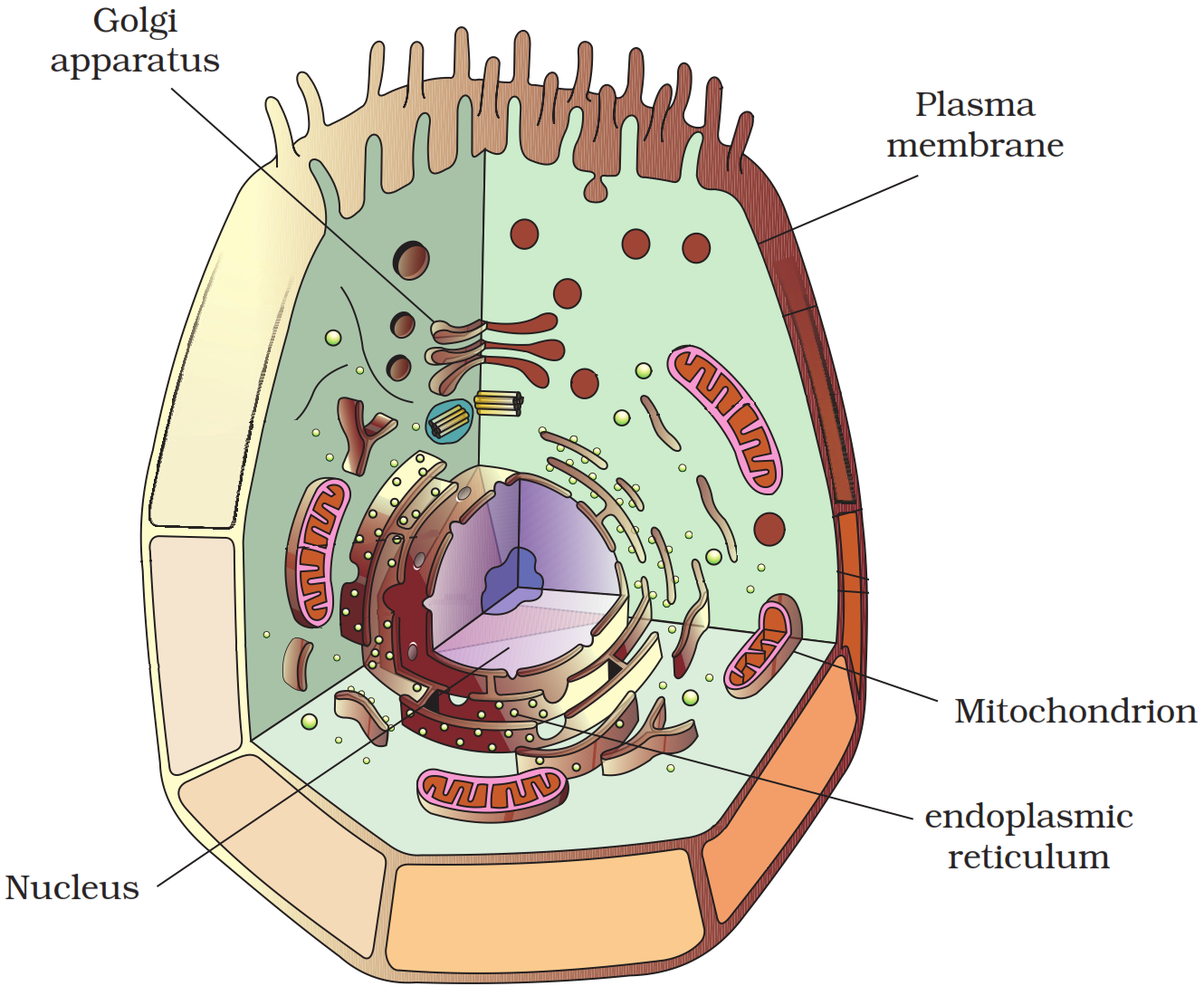
The diagram shows some of the structures present in an animal cell. Which of these structures is responsible for,
  1. Manufacture of lipids and steroids.
  2. Release of energy.
  3. Manufacture of hormones and digestive enzymes.
  4. Production of spindle fibres in cell division.
  5. Endo and exocytosis?
Answer
Structures responsible are:
  1. Smooth endoplasmic Reticulim (SER): SER is responsible for the manufacture of lipids and steroids.
  2. Mitochondrion: Mitochondrion is responsible for the release of energy.
  3. Ribosomes: Ribosomes is responsible for the production of hormones and digestive enzymes.
  4. Centrioles: Centrioles is responsible for production of spindle fibres.
  5. Plasma membrane: Plasma membrane is responsible for endo and exocytosis.
View full question & answer
Question 55 Marks
How does cytokinesis in plant cells differ from that in animal cells?
Answer
Differences between plant cytokinesis and animal cytokinesis
  Plant Cytokinesis   Animal Cytokinesis
i. It occurs by cell plate formation. i. It occurs by cleavage.
ii. The cell plate appears at the centre and extends outwards. ii. Cleavage begins at the periphery and proceeds inwards
iii. Fusion of vesicles begins cell plate formation. iii. Cleavage is started by contraction of a peripheral ring of microfilaments.
iv. A midbody is not formed. iv. A midbody of dense material is formed at the middle of the cell.
View full question & answer
Question 65 Marks
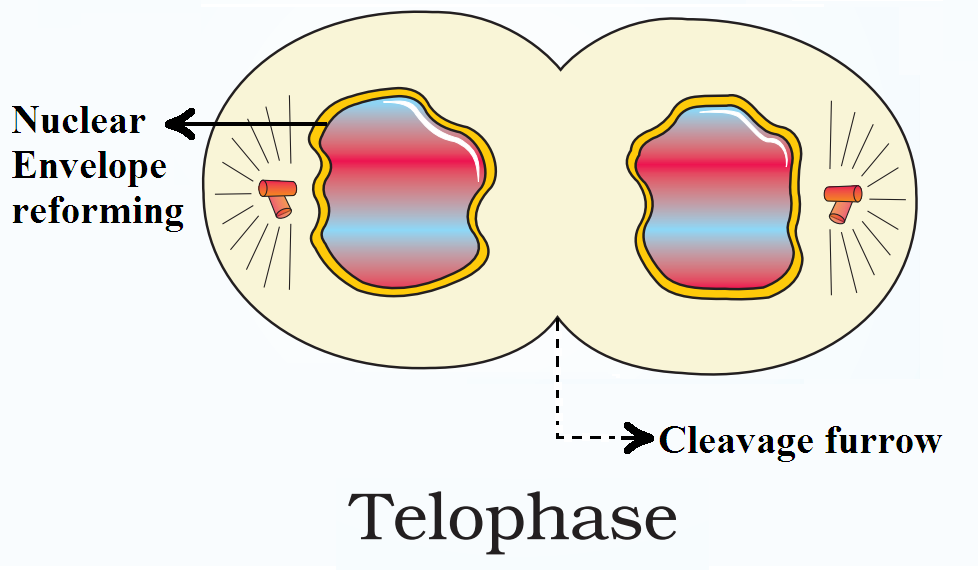
Comment on the statement – Telophase is reverse of prophase.
Answer

The following contrasting differences reveal that telophase is reverse of prophase, in cell division.
Prophase
Telophase
It’s stage of (karyokinesis) in cell division, Viscosity of cytoplasm increases.
Last stage of karyokinesis in cell division. Viscosity of cytoplasm decreases.
The indistinct and interind DNA condense to form elongated chromosomes.
Chromosome groups reorganize themselves into nuclei.
The chromatin disappears and chromosome fibres get shortened and thickened.
Chromosomes elongate and overlap each other to form chromatin.
Spindle fibres appears (awards the poles from the centriole connected in animals with astral rays and in plants without asters Nudeolus degenerate completely.
Spindle fibres disappear around the poles. Astral rays also disappear in plants.
Cell organelles such as ER, Golgi complex disorganise, and difference between cytoplasm and nucleoplasm disappears.
Nuclear envelope appears and two daughter nuclei are formed at the poles. Cell organelles, i.e., ER and Golgi complex are reformed in the cell. Nucleoplasm also appears in the chromatin area. Making it distinct from rest of cytoplasmic area.
 
View full question & answer
Question 75 Marks
Write brief note on the following:
  1. Synaptonemal complex.
  2. Metaphase plate.
Answer
  1. Synaptonemal complex: It is formed when corresponding chromosome becomes intimately associated. The process of pairing is known as synapsis. It is so exact that pairing is not merely occurs between corresponding chromosomes, but between corresponding individual units.
  2. Metaphase plate: The bivalent arrange themselves on the equator of the bipolar spindle. The centromeres slightly project towards the periphery. The distribution of bivalents is at random so that the individual paternal and maternal chromosomes can face either of two poles of the spindle.
View full question & answer
Question 85 Marks
List the main differences between mitosis and meiosis.
Answer
Differences between mitosis and meiosis
 
Mitosis
 
Meiosis
i.
Takes place in somatic cells.
i
Takes place in gametic cells.
ii.
Two daughter cells are formed in the end.
ii.
Four daughter cells are formed in the end.
iii.
The number of chromosomes remains the same in daughter cells as compared to those in parent cells.
iii.
The number of chromosomes is halved in daughter cells as compared to those in parent cells.
iv. Chromosomes replicate before each mitotic division. iv. Chromosomes do not replicate before the second meiotic division.
View full question & answer
Question 95 Marks
What is the significance of meiosis?
Answer
Meiosis is the process involving the reduction in the amount of genetic material. It comprises two successive nuclear and cell divisions, with a single cycle of DNA replication. As a result, at the end of meiosis II, four haploid cells are formed. Significance of meiosis
  1. Meiosis maintains the chromosome number from generation to generation. It reduces the chromosome number to half so that the process of fertilisation restores the original number in the zygote.
  2. Variations are caused by the cross-over and the random distribution of homologous chromosomes between daughter cells. Variations play an important role in evolution.
  3. Chromosomal mutations are brought about by the introduction of certain abnormalities. These chromosomal mutations may be advantageous for an individual.
View full question & answer
Question 105 Marks
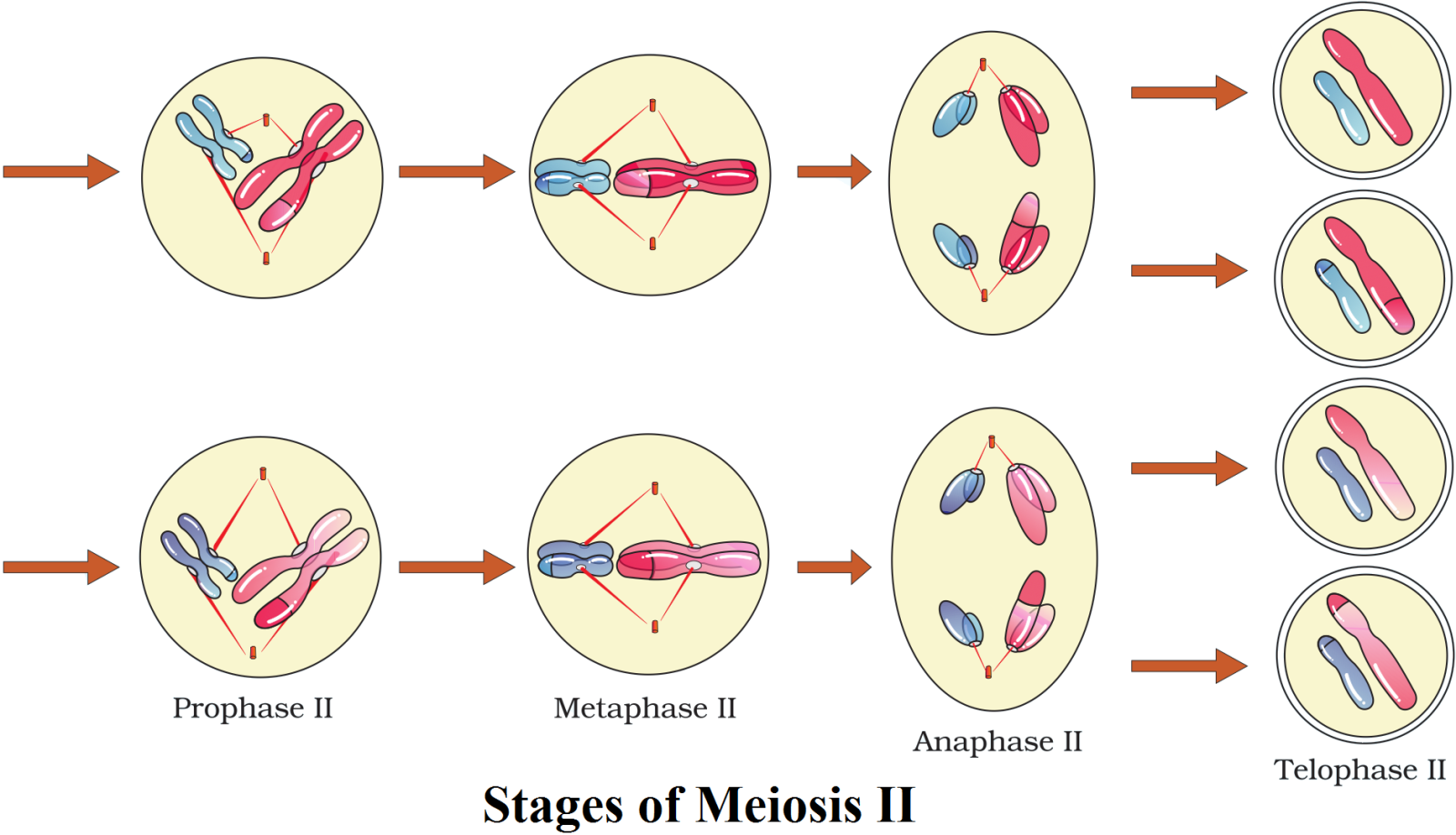
Explain meiosis-II in an animal cell.
Answer
All these happen in the two haploid nuclei simultaneously:
  1. Prophase-II: takes short time. Spindle formation begins and the chromosomes become short. Two chromatids are joined to a single centromere. Nuclear membrane and nucleolus disintegrate.
  2. Metaphase-II: At the equator, the chromosomes align at the equator and spindle is formed. The centromere of every chromosome is joined to the spindle fibre and centromere also divides.
  3. Anaphase-II: The daughter chromosomes are formed. Chromatids move towards their poles with the spindle fibres.
  4. Telophase-II: Reaching at the poles, chromosomes form nuclei which are haploid (n) daughter nuclei. Again nuclear membrane is constructed. Nucleolus now becomes clearly visible.
Cytokinesis: Occurs and four daughter cells are formed which are haploid (n). It may occur once or twice (i.e., in meiosis-I and II) or only after the meiosis-II cell division.
View full question & answer
Question 115 Marks
Name a cell that is found arrested in diplotene stage for months and years. Comment in 2-3 lines how it completes cell cycle?
Answer
Meiotic arrest at diplotene stage commonly occurs in mammalian occytes. In females, meiosis starts in the embryo and proceeds as for as diplotene, when the chromosomes become diffused and the cells are referred to as being in the dictuate stage. This arrest is under hormonal control. In many amphibian oocytes binds and insects with a long period of immaturity, the oocyte may be arrested in the dictyate stage for many years and spend a prolonged period in diplotene. This stage is characterized by formation of lamp brush chromosomes where intense RNA synthesis occurs and most of the genes in the DNA loops are actively transcribed and expressed.
View full question & answer
Question 125 Marks
Manish while performing a practical in laboratory on Grams stain observed that one type of bacteria stained dark blue or purple in colour, while the other type of bacteria did not retain the crystal violet dye even after staining again and again. Instead it keeps on loosing the dye on washing. He rushed to his teacher for showing the specimen.His teacher explained that there is nothing to get worried about. As different kinds ofbacteria are found.
  1. What is the basis of classifying bacteria.
  2. What is the basic difference between Gram positive and Gram negative bacteria.
  3. Name one Gram positive and one Gram negative bacteria.
  4. What values are shown by Manish's teacher?
Answer
  1. Bacteria are classified into two groups on the basis of the differences in the cell envelopes and the manner in which they respond to Gram stain. Staining of bacteria with Gram stain revealed the basis to differentiate bacteria into two categories, i.e., Gram positive and Gram negative bacteria.
  2. The basic difference between the two types of bacteria lies in their cell wall. The Gram positive bacteria contains peptidoglycan and teichoic acid in their cell wall while, the cell wall of Gram negative bacteria is not composed of peptidoglycan (in high amount), instead they have an outer layer made up of lipids. They also do not contain teichoic acid.
  3. Gram positive Clostridium and Gram negative Acetobacter.
  4. Values shown by Manish's teacher are awareness about types of bacteria, critical thinking, patience, understanding and right attitude.
View full question & answer
Question 135 Marks
Describe prophase I of meiotic cell division. How is it different from prophase II of meiosis?
Answer
Prophase I: Prophase of the first meiotic division is typically longer and more complex when compared to prophase of mitosis.It has been further subdivided into the following five phases based on chromosomal behaviour:
Leptotene:
  • During leptotene stage the chromosomes become gradually visible under the light microscope. The compaction of chromosomes continues throughout leptotene.
Zygotene:
  • During this stage chromosomes start pairing together and this process of association is called synapsis. Such paired chromosomes are called homologous chromosomes.
  • Electron micrographs of this stage indicate that chromosome synapsis is accompanied by the formation of complex structure called synaptonemal complex.
  • The complex formed by a pair of synapsed homologous chromosomes is called a bivalent or a tetrad.
  • However, these are more clearly visible at the next stage. The first two stages of prophase I are relatively short-lived compared to the next stage that is pachytene.
Pachytene:
  • During this stage bivalent chromosomes now clearly appear as tetrads.
  • This stage is characterised by the appearance of recombination nodules, the sites at which crossing over occurs between non-sister chromatids of the homologous chromosomes.
  • Crossing over is the exchange of genetic material between two homologous chromosomes. Crossing over is also an enzyme-mediated process and the enzyme involved is called recombinase.
  • Crossing over leads to recombination of genetic material on the two chromosomes.
  • Recombination between homologous chromosomes is completed by the end of pachytene, leaving the chromosomes linked at the sites of crossing over.
Diplotene:
  • The beginning of diplotene is recognised by the dissolution of the synaptonemal complex and the tendency of the recombined homologous chromosomes of the bivalents to separate from each other except at the sites of crossovers. These X-shaped structures, are called chiasmata. In oocytes of some vertebrates, diplotene can last for months or years.
Diakinesis:
  • The final stage of meiotic prophase I is diakinesis. This is marked by terminalisation of chiasmata. During this phase the chromosomes are fully condensed and the meiotic spindle is assembled to prepare the homologous chromosomes for separation. By the end of diakinesis, the nucleolus disappears and the nuclear envelope also breaks down. Diakinesis represents transition to metaphase.
Difference between prophase I and prophase II:
  • During prophase I recombination of genes takes place, while in prophase II no such event happens. Prophase I is longer and more complicated compared to prophase II.
View full question & answer
Question 145 Marks
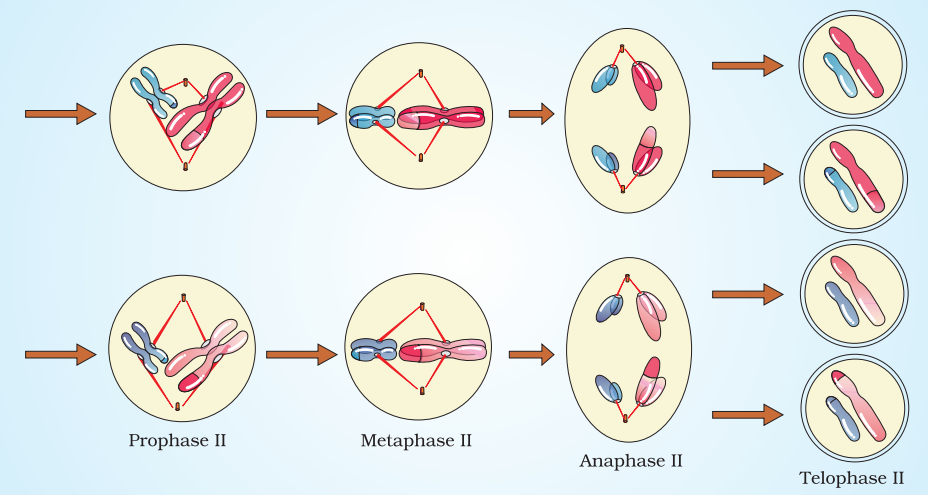
Describe meiosis II with the help of suitable diagrams.
Answer
Meiosis II:
  • Prophase II: Meiosis II is initiated immediately after cytokinesis, usually before the chromosomes have fully elongated. In contrast to meiosis I, meiosis II resembles a normal mitosis. The nuclear membrane disappears by the end of prophase II. The chromosomes again become compact.
  • Metaphase II: At this stage the chromosomes align at the equator and the microtubules from opposite poles of the spindle get attached to the kinetochores of sister chromatids.
  • Anaphase II: It begins with the simultaneous splitting of the centromere of each chromosome (which was holding the sister chromatids together), allowing them to move toward opposite poles of the cell.
  • Telophase II: Meiosis ends with telophase II, in which the two groups of chromosomes once again get enclosed by a nuclear envelope; cytokinesis follows resulting in the formation of tetrad of cells i.e., four haploid daughter cells.
View full question & answer
Question 155 Marks
An organism has two pair of chromosomes (i.e., chromosome number = 4). Diagrammatically represent the chromosomal arrangement during different phases of meiosis-II.
Answer
The diagramatic representation of meiosis II for the organism having two pairs of chromosomes is as under: Meiosis II − Resembles Mitosis
  • Prophase II− Chromosomes become compact and nuclear membrane disappears.
  • Metaphase II− Chromosomes align on equatorial plate and spindle fibres appear and attach to kinetochores of sister chromatids.
  • Anaphase II− Centromere of each chromosome splits and sister chromatids move towards opposite poles of the cell.
  • Telophase II− Nuclear envelope reappears and cytokinesis follows, resulting in formation of a tetrad (4 haploid cells).
View full question & answer
Question 165 Marks
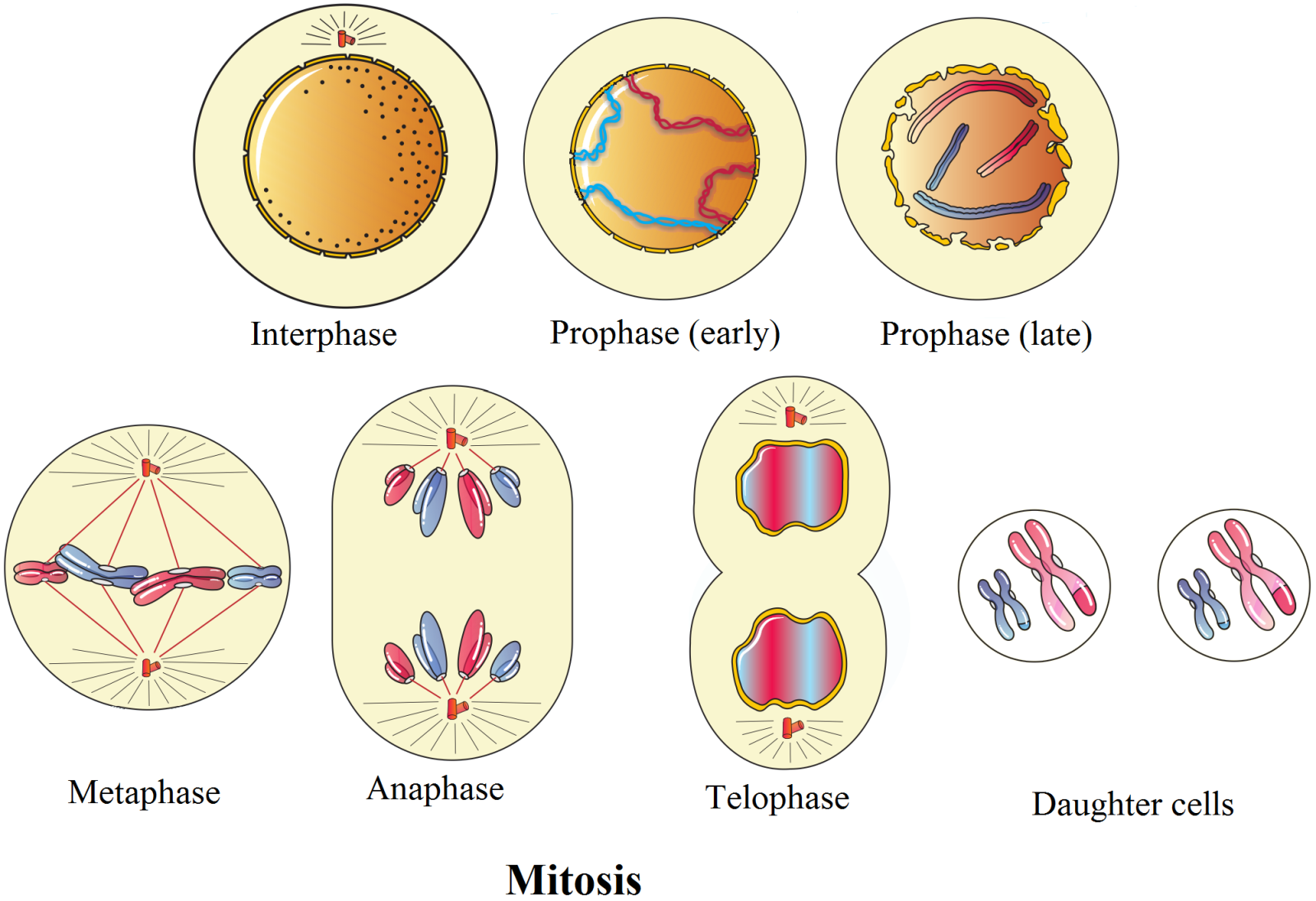
With the help of suitable diagrams describe mitosis.
Answer
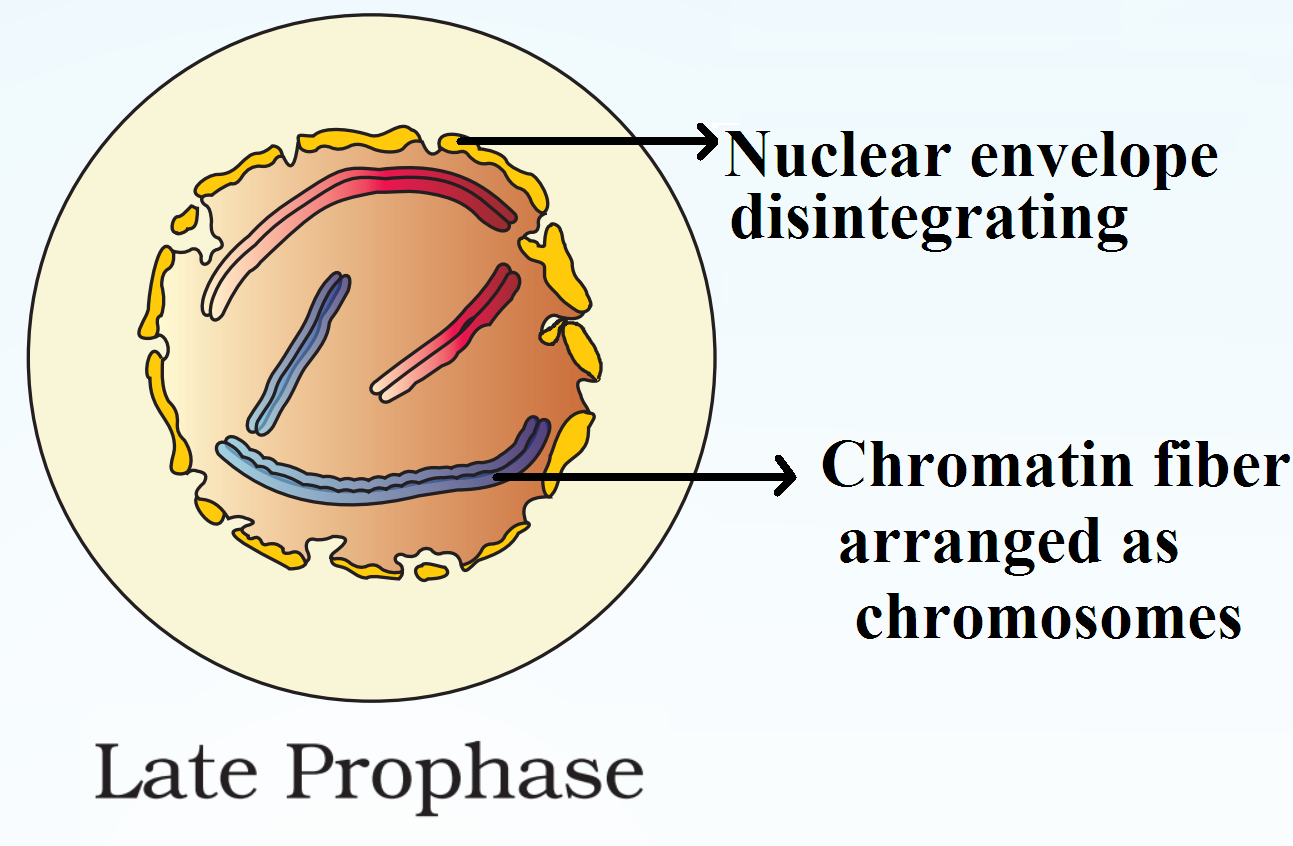
Mitosis is divided into the following four stages:Prophase:
  • Prophase is marked by the initiation of condensation of chromosomal material. The chromosomal material becomes untangled during the process of chromatin condensation.
  • The centriole, which had undergone duplication during S phase of interphase, now begins to move towards opposite poles of the cell.
  • Cells at the end of prophase, when viewed under the microscope, do not show golgi complexes, endoplasmic reticulum, nucleolus and the nuclear envelope.

Metaphase:
  • The metaphase is characterised by all the chromosomes coming to lie at the equator.
  • One chromatid of each chromosome connected by its kinetochore to spindle fibres from one pole and its sister chromatid connected by its kinetochore to spindle fibres from the opposite pole.
  • The plane of alignment of the chromosomes at metaphase is referred to as the metaphase plate.
Anaphase:
  • At the onset of anaphase, each chromosome arranged at the metaphase plate is split simultaneously and make the two daughter chromatids.
  • They are now referred to as chromosomes of the future daughter nuclei, and begin their migration towards the two opposite poles.
  • As each chromosome moves away from the equatorial plate, the centromere of each chromosome is towards the pole and hence at the leading edge, with the arms of the chromosome trailing behind.
Telophase: This is the stage which shows the following key events:
  • Chromosomes cluster at opposite spindle poles and their identity is lost as discrete elements.
  • Nuclear envelope assembles around the chromosome clusters.
  • Nucleolus, golgi complex and ER reform.
Cytokinesis:
  • Mitosis accomplishes not only the segregation of duplicated chromosomes into daughter nuclei (karyokinesis), but the cell itself is divided into two daughter cells by a separate process called cytokinesis at the end of which cell division is complete.
View full question & answer
Question 175 Marks
Write briefly the significance of mitosis and meiosis in multicellular organism.
Answer
Significance of Mitosis: Mitosis or the equational division is usually restricted to the diploid cells only. However, in some lower plants mitosis usually results in the production of diploid daughter cells with identical genetic complement. The growth of multicellular organisms is due to mitosis. A very significant contribution of mitosis is cell repair. The cells of the upper layer of the epidermis, cells of the lining of the gut, and blood cells are being constantly replaced. Mitotic divisions in the meristematic tissues the apical and the lateral cambium, result in a continuous growth of plants throughout their life. Significance of Meiosis: Meiosis is the mechanism by which conservation of specific chromosome number of each species is achieved across generations in sexually reproducing organisms, even though the process, per se, paradoxically, results in reduction of chromosome number by half. It also increases the genetic variability in the population of organisms from one generation to the next. Variations are very important for the process of evolution.
View full question & answer
Question 185 Marks
What are the various stages of meiotic prophase-I? Enumerate the chromosomal events during each stage?
Answer
Meiosis-I:
Prophase-I:
Prophase of the first meiotic division is typically longer and more complex when compared to the prophase of mitosis. It has been further subdivided into the following five phases based on chromosomal behavior, i.e. Leptotene, Zygotene, Pachytene, Diplotene and Diakinesis. During leptotene stage, the chromosomes become gradually visible under the light microscope.
  1. The compaction of chromosomes continues throughout leptotene. This is followed by the second stage of prophase-I called zygotene. During this stage chromosomes start pairing together and this process of association is called synapsis. Such paired chromosomes are called homologous chromosomes. Electron micrographs of this stage indicate that chromosome synapsis is accompanied by the formation of complex structure called synaptonemal complex.
  2. The complex formed by a pair of synapse homologous chromosomes is called a bivalent or a tetrad. However, these are more clearly visible at the next stage. The first two stages of prophase-I are relatively short-lived compared to the next stage that is pachytene. During this stage bivalent chromosome now clearly appears as tetrads. This stage is characterized by the appearance of recombination nodules, the sites at which crossing over occurs between non-sisters chromatids of the homologous chromosomes. Crossing over is the exchange of genetic material between two homologous chromosomes.
  3. Crossing over is also an enzyme-mediated process and the enzyme involved is called recombines. Crossing over leads to the recombination of genetic material on the two chromosomes. Recombination between homologous chromosomes is completed by the end of pachytene, leaving the chromosomes linked at the sites of crossing over.
  4. The beginning of diploteneis recognized by the dissolution of the synaptonemal complex and the tendency of the recombined homologous chromosomes of the bivalents to separate from each other except at the sites of crossovers. These X-shaped structures are called chiasmata. In oocytes of some vertebrates, diplotene can last for months or years.
  5. The final stage of meiotic prophase-I is diakinesis. This is marked by terminalisation of chiasmata. During this phase the chromosomes are fully condensed and the meiotic spindle is assembled to prepare the homologous chromosomes for separation. By the end of diakinesis, the nucleolus disappears and the nuclear envelope also breaks down.
View full question & answer
Question 195 Marks
Differentiate between the events of mitosis and meiosis.
Answer
Differences between Mitosis and Meiosis.
  1. Cell Division
  • Mitosis: A somatic cell divides once. Cytokines is (the division of the cytoplasm) occurs at the end of telophase.
  • Meiosis: A reproductive cell divides twice. Cytokines is happens at the end of telophase I and telophase II.
  1. Daughter Cell Number
  • Mitosis: Two daughter cells are produced. Each cell is diploid containing the same number of chromosomes.
  • Meiosis: Four daughter cells are produced. Each cell is haploid containing one-half the number of chromosomes as the original cell.
  1. Genetic Composition
  • Mitosis: The resulting daughter cells in mitosis are genetic clones (they are genetically identical). No recombination or crossing over occurs.
  • Meiosis: The resulting daughter cells contain different combinations of genes. Genetic recombination occurs as a result of the random segregation of homologous chromosomes into different cells and by the process of crossing over (transfer of genes between homologous chromosomes).
  1. Length of Prophase
  • Mitosis: During the first mitotic stage, known as prophase, chromatin condenses into discrete chromosomes, the nuclear envelope breaks down, and spindle fibers form at opposite poles of the cell. A cell spends less time in prophase of mitosis than a cell in prophase I of meiosis.
  • Meiosis: Prophase I consist of five stages and lasts longer than prophase of mitosis. The five stages of meiotic prophase I are leptotene, zygotene, pachytene, diplotene, and diakinesis. These five stages do not occur in mitosis. Genetic recombination and crossing over take place during prophase I.
  1. Tetrad Formation
  • Mitosis: Tetrad formation does not occur.
  • Meiosis: In prophase I, pairs of homologous chromosomes line up closely together forming what is called a tetrad. A tetrad consists of four chromatids (two sets of sister chromatids).
  1. Chromosome Alignment in Metaphase
  • Mitosis: Sister chromatids (duplicated chromosome comprised of two identical chromosomes connected at the centromere region) align at the metaphase plate (a plane that is equally distant from the two cell poles).
  • Meiosis: Tetrads (homologous chromosome pairs) align at the metaphase plate in metaphase I.
  1. Chromosome Separation
  • Mitosis: During anaphase, sister chromatids separate and begin migrating centromere first toward opposite poles of the cell. A separated sister chromatid becomes known as daughter chromosome and is considered a full chromosome.
  • Meiosis: Homologous chromosomes migrate toward opposite poles of the cell during anaphase I. Sister chromatids do not separate in anaphase I.
View full question & answer