Questions

2 Marks Questions

Take a timed test

74 questions · self-marked practice — reveal the answer and mark yourself.

Question 12 Marks
Answer briefly: How does bile help in the digestion of fats?
Answer
The bile released into the duodenum contains bile pigments (bilirubin and biliverdin), bile salts, cholesterol and phospholipids but no enzymes. Bile helps in emulsification of fats, i.e. breaking down of fats into small micelles. It also activates lipases which carry out the digestion of fats.
View full question & answer
Question 22 Marks
Answer briefly: How does pepsinogen change into its active form?
Answer
The proenzyme pepsinogen, on exposure to hydrochloric acid, gets converted into the active enzyme pepsin, the proteolytic enzyme of the stomach. Pepsin converts proteins into proteoses and peptones (peptides). Pepsinogen → Pepsin + Protein → Proteose + Peptone.
View full question & answer
Question 32 Marks
Give the dental formula of human beings.
Answer
The dental formula expresses the arrangement of teeth in each half of the upper jaw and the lower jaw. The entire formula is multiplied by two to express the total number of teeth. The dental formula for milk teeth in humans is: $\frac{2102}{2102}\times2=20$ Each half of the upper jaw and the lower jaw has 2 incisors, 1 canine, and 2 molars. Premolars are absent in milk teeth. The dental formula for permanent teeth in humans is: $\frac{2123}{2123}\times2=32$ Each half of the upper jaw and the lower jaw has 2 incisors, 1 canine, 2 premolars, and 3 molars. An adult human has 32 permanent teeth.
View full question & answer
Question 42 Marks
Give the name along with the function of each of the three major kinds of cells of the gastric glands.
Answer
Gastric glands include three major types of cells. These are as follows:
S.No.
 
 
1.
Mucus (neck) cells
Secrete mucus
2.
Peptic or chief cells
Secrete pepsinogen
3.
Parietal or oxyntic cells.
Secrete hydrochloric acid and intrinsic factor.
View full question & answer
Question 52 Marks
Why is the egestion process of food necessary?
Answer
As the digestive waste reaches the rectum, it gets accumulated in rectum. If it is not excreted out through egestion process, it will intoxicate the whole body.
View full question & answer
Question 62 Marks
Name the four electrolytes and the two enzymes present in saliva.
Answer
  • The electrolytes in saliva are $Na ^{+}, K ^{+}, Cl ^{-}$and $HCO _{-3}$, ions.
  • The enzymes are salivary amylase and lysozymes.
View full question & answer
Question 72 Marks
Mention the two important functions performed by large intestine.
Answer
  1. Absorption of water, minerals and certain drugs.
  2. Secretion of mucus that helps in adhering the undigested wastes into coherent faeces and lubricating it for easy passage.
View full question & answer
Question 82 Marks
Name the part of the alimentary canal, where major absorption of digested food takes place. What are the absorbed forms of different kinds of food materials?
Answer
The maximum absorption of digested food occurs in the small intestine of alimentary canal. The absorbed form of different food materials are:
S.No. Food Material Absorbed Form
1. Carbohydrate Glucose
2. Protein Amino acid
3. Fat Fatty acid
View full question & answer
Question 92 Marks
What are the causes of kwashiorkar?
Answer
Causes of Kwashiorkar: Protein deficiency unaccompanied by calorie deficiency can lead to kwashiorkar. It results from the replacement of mother's milk by a high calorie low protein diet in child more than one year in age.
View full question & answer
Question 102 Marks
In which part of the alimentary canal major absorption of digested food takes place? What are the absorbed forms of different kinds of food materials?
Answer
  • Absorption occurs in the jejunum and ileum of small intestine.
  • Carbohydrates are absorbed as glucose, fructose and galactose, proteins as amino acids, and lipids as fatty acids and glycerol.
  • Mineral ions such as $Na ^{+}, K ^{+}, Ca , Mg ^{++}, Cl ^{-}$, etc. are also absorbed in this region.
  • Water is absorbed by osmosis.
View full question & answer
Question 122 Marks
Bile juice contains no digestive enzymes. Yet, it is essential for digestion. Why?OR
Bile juice has no digestive enzymes, yet, it is important for digestion. Give reason.
Answer
Bile juice has no digestive enzymes, yet, it performs the following functions to facilitate digestion of fats in the food:
  1. Bile emulsifies fats and increases the surface area for action of lipases.
  2. Bile activates lipases, the enzymes which digest fats.
View full question & answer
Question 132 Marks
How is the nucleic acid fraction of our food digested?
Answer
  • Nucleases present in the pancreatic juice convert the nucleic acids into nucleotides.
  • Nucleotidases present in the intestinal juice convert the nucleotides into nucleosides and phosphates.
  • Nucleosidases present in the intestinal juice convert the nucleosides into nitrogen bases and sugars.
View full question & answer
Question 142 Marks
Why is it so, that food does not pass through the digestive system by 'gravity', but still we are able to digest food even when we are lying down? Explain how food passes through our digestive system?
Answer
The lining of the oesophagus, stomach and intestine is muscular, these help in pushing food through it easily by its own by peristalsis movements. These movements of muscles help the food to pass through along the whole alimentary canal.
View full question & answer
Question 152 Marks
How does the nervous system control the activities of gastro-intestinal tract?
Answer
The sight, smell and/ or presence of food in the oral cavity can stimulate the secretion of saliva. Gastric and intestinal secretions are also stimulated by similar neural signals. Muscular activities of alimentary canal is coordinated by both local and CNS neural mechanisms. Hormonal control of secretion of digestive enzymes is carried out by local hormones.
View full question & answer
Question 162 Marks
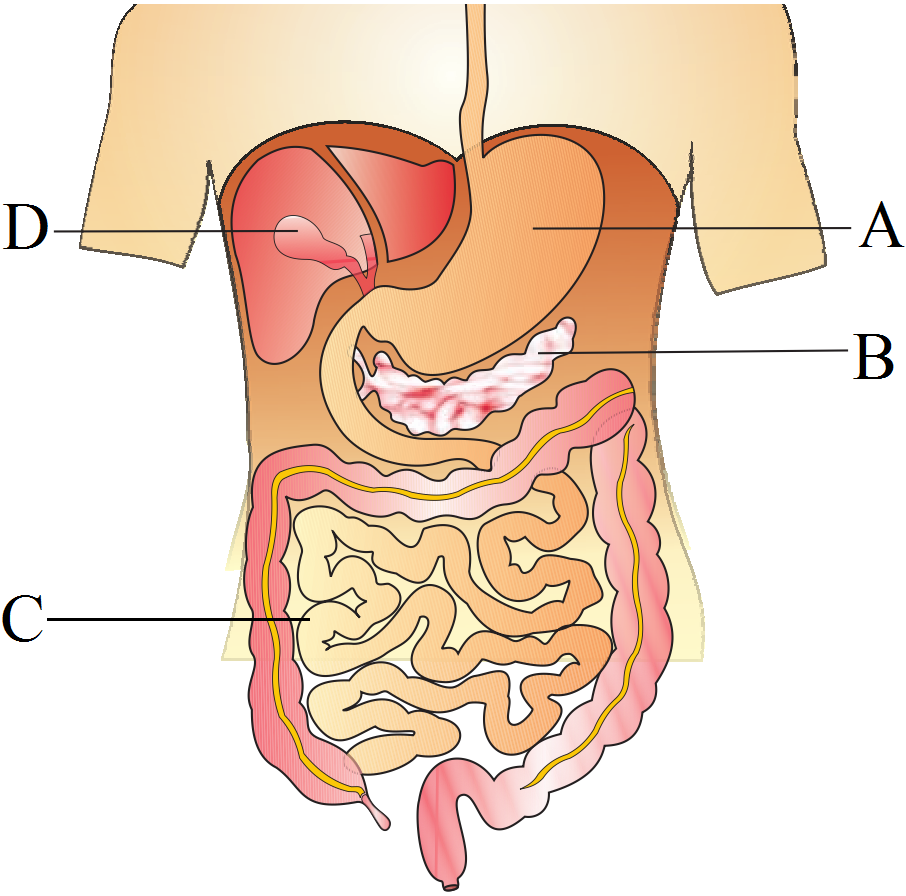
  1. The diagram below shows part of the human digestive system. Label the parts marked as A, B, C and D.
  2. Which part secretes the acidic digestive juice containing protease?
Answer
  1. Gall bladder.
  2. Stomach.
  3. Pancreas.
  4. Deuodenum.
View full question & answer
Question 172 Marks
What is the role of tongue in digestion?
Answer
Tongue helps in mixing the food properly with salivary enzymes. Moreover, tongue has tastebuds which give the sense of different tastes. Eating is a complex process which needs involvement of olfactory and visual senses as well. Alongwith tongue all these senses help in picking the right food.
View full question & answer
Question 182 Marks
Lalit, student of class XI always likes to have junk food. His mother insists him to have fibre rich fruits and vegetables, because they are good for health. Lalit always ignored his mother's advise. One day, while his biology teacher was teaching about the digestive system and mechanism of digestion. She also explained about the food one should eat (Le., balanced diet) Lalit remembered his mother's advice and asked his teacher about the importance of fibre rich food in one's diet.
  1. According to you, what is the advantage of having fibrous material in our food?
  2. Name the term used to describe fibrous materials which is indigestible in nature.
  3. Name any four fibre rich fruits.
  4. What values are reflected through Lalit's character?
Answer
  1. Fibrous food material expands the gut and softens the stool volume (faecal matter), stimulates peristalsis and also prevents constipation.
  2. Indigestible fibrous food material is known as roughage.
  3. Raspberries, avocado, apple, peach and green leafy vegetables are good sources of the fibre.
  4. Lalit, is a good and obedient student, patient listener and a good learner.
View full question & answer
Question 192 Marks
Describe the accessory digestive glands in human.
Answer
The accessory digestive glands include the salivary glands, the liver and the pancreas.
  1. Humans have three pairs of salivary glands, i.e., the parotids, subinandibulars and sublinguals. They secrete major amount (about 1L) of the saliva, each day. The parotids are the largest glands in the cheek region near the ears. The submandibular glands are located towards the posterior end of the lower jaw. Sublingual glands are the smallest, present at the anterior part of the floor of the mouth.
  2. The liver is the largest gland in the body. It weighs about 1.5 kg. It lies immediately under the diaphragm. The gall bladder is a small and elongated muscular sac situated below the liver.
  3. The pancreas is an elongated gland, that is situated near the junction of the stomach and the duodenum. Both the liver and pancreas act as glands whereas, the gall bladder acts as a storing organ.
View full question & answer
Question 202 Marks
What do you mean by digestive waste and how is it removed from the body?
Answer
After digestion and absorption of food is over, the residue left makes the digestive waste. The digestive wastes, solidified into coherent faeces in the rectum initiate a neural reflex causing an urge or desire for its removal. The egestion of faeces to the outside through the anal opening (defaecation) is a voluntary process and is carried out by a mass peristaltic movement.
View full question & answer
Question 212 Marks
Water is not a nutrient but is very important for digestion. If a person does not drink enough water, it can lead to which of these problems? Explain the possible problems which can arise because of the situation as per your answer.
  1. There will be less secretion of digestive enzymes.
  2. The person may suffer from poor bowel movement; leading to constipation.
Answer
  1. The person may suffer from poor bowel movement; leading to constipation. Constipation is a condition in which the patient does not passes stool at regular intervals. It can lead to accumulation of waste products in the large intestine. As we know; removal of waste products is necessary for the body because such substances can prove very harmful for the body. Moreover, constipation can also lead to overall discomfort in the body. The person may lose his appetite. Too much strain during passing the stool can put extra workload on the heart. Constipation can also result in aggravation of piles. One should drink lot of water and take lot of fibre in food to avoid constipation.
View full question & answer
Question 222 Marks
How would it affect the digestion of fats and carbohydrates, if there is a blockade in the pancreatic duct? Explain.
Answer
  • The pancreatic juice contains amylase, for digestion of starch and lipases for digestion of fats.
  • Since these enzymes cannot reach the duodenum, the digestion of these nutrients, will be impaired.
View full question & answer
Question 232 Marks
What are the causes of marasmus?
Answer
Causes of marasmus: Simultaneous deficiency of proteins and calories can lead to marasmus. In infants less than a year in age, if mother's milk is replaced too early by other foods which are poor in both proteins and calorific value; marasmus can be prevalent. This can happen if the mother has second pregnancy or childbirth when the older infant is still too young.
View full question & answer
Question 242 Marks
`Digestion of starch starts in the buccal cavity, but stops in the stomach'. Comment.
Answer
Starch is not digested in the stomach, because the enzyme ptyalin (salivary amylase) that is used in its digestion cannot survive in the acidic (low) pH of the stomach due to the presence of HCI.
View full question & answer
Question 252 Marks
Give the scientific terms for the following:
  1. A protein found in milk that forms curd, it tends to be difficult for infants to digest.
  2. A lymphatic vessel in an intestinal villi, it aids in the absorption of fats.
  3. Sphere formed by bile salts that surround lipids to make them temporarily water soluble.
  4. Fine microscopic, finger-like projections lining the small intestine that serves to increase, the absorptive surface area.
Answer
  1. Caesin.
  2. Lacteal.
  3. Micelle.
  4. Villi.
View full question & answer
Question 262 Marks
Give a comparison of small intestine and large intestine.
Answer
Difference between small and large intestine:
S.No.
Small intestine
Large intestine
1.
Longer in length.
Shorter in length.
2.
Major part of digestion take place here.
No digestion happens.
3.
Absorption of food substances taken place.
Absorption of some water takes place.
View full question & answer
Question 272 Marks
Name the part of the alimentary canal where major absorption of digested food takes place. What are the absorbed forms of different kinds of food materials?
Answer
Major absorption of digested food takes place in the small intestine. This happens in jejunum and ileum which are parts of small intestine and lined by finger like projections called villi. Carbohydrate is absorbed in the form of glucose. Proteins are absorbed in the form of amino acids. Fats are absorbed in the form of fatty acids and glycerol.
View full question & answer
Question 282 Marks
Explain how digestion takes place in mouth?
Answer
Digestion Process in Mouth: The buccal cavity performs two major functions, mastication of food and facilitation of swallowing. The teeth and the tongue with the help of saliva masticate and mix up the food thoroughly. Mucus in saliva helps in lubricating and adhering the masticated food particles into a bolus.
Action of Saliva: The saliva secreted into the oral cavity contains electrolytes $\left( Na ^{+}, K ^{+}, Cl ^{-}, HCO ^{-}\right)$ and enzymes, salivary amylase and lysozyme. The chemical process of digestion is initiated in the oral cavity by the hydrolytic action of the carbohydrate splitting enzyme, the salivary amylase. About 30 percent of starch is hydrolysed here by this enzyme (optimum pH 6.8) into a disaccharide maltose, Lysozyme present in saliva acts as an antibacterial agent that prevents infections.
$\text{Starch}\xrightarrow[\text{pH}6.8\ \ ]{\text{Salivary Amylase}\ \ }\text{Maltose}$
The bolus is then conveyed into the pharynx and then into the oesophagus by swallowing or deglutition. The bolus further passes down through the oesophagus by successive waves of muscular contractions called peristalsis. The gastro oesophageal sphincter controls the passage of food into the stomach.
View full question & answer
Question 292 Marks
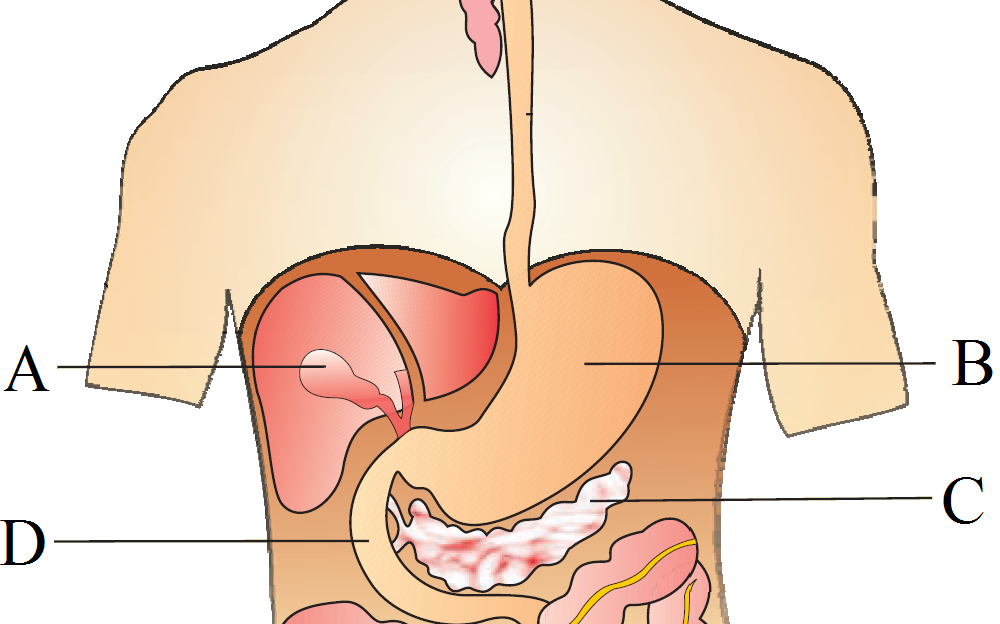
Out of the parts labelled as A, B, C and D of alimentary canal in the diagram below. Where is the enzyme responsible for the first stage of protein digestion produced? Label all parts , i.e., A-D.
Answer

In the labelled part A (i.e., the stomach,) the enzyme responsible for first stage of protein digestion is produced. A-stomach, B-pancrease, C-small intestine, D-gall bladder.
View full question & answer
Question 302 Marks
Mention the causative factors for indigestion.
Answer
Various causative factors for indigestion are:
  1. Inadequate secretion of digestive enzymes and gastrointestinal hormones.
  2. Anxiety.
  3. Food poisoning.
  4. Overeating and spicy food.
View full question & answer
Question 312 Marks
Answer briefly:
  1. How does pepsinogen change into its active form?
  2. How does bile help in the digestion of fats?
Answer
  1. Inactive form of pepsinogen is activated by the action of HCl.
  2. Bile salts help in emulsification of lipids and activate the lipases.
View full question & answer
Question 322 Marks
Which part of the alimentary canal produce local digestive hormones? What would happen if these hormones are not produced?
Answer
The local digestive hormones are produced by gastric and intestinal mucosa e.g., secretin, cholesyctokinine, etc. The hormones stimulate the activity of enzymes. If these are not produced, the process of digestion will be hindered and digestive system will not work properly.
View full question & answer
Question 332 Marks
Kavita (student of class VIII) returned from the school and started counting her teeth. She felt surprised and counted her teeth two more times, but each time she count, she found her teeth to be 28 in number. Then, she started counting his younger brother (student of class I) teeth and found them to 20 in number. She rushed to his father who was a dentist and told him, that her teacher taught her that human beings have 32 teeths. But she has only 28 and his brother has 20. Her father explained that number of teeth are related to the age of a child and also told her about diphyodont and heterodont dentition.
  1. How is number of teeth related to the age of a child?
  2. At what age, a person gets 32 teeth?
  3. What do you understand by heterodont and diphyodont?
  4. What values are reflected from Kavita's behaviour?
Answer
  1. Number of teeth are related to the age, as milk teeth are 20 in number, that shed around the age of 6-8 years, and are replaced by permanent teeth which become 28 in number till a child grows into an adult.
  2. After reaching adulthood, the wisdom teeth appear (two on each jaws, one on right side and one on left side), making the number of teeth to be 32.
  3. Heterodont means that the different types of teeth present in human beings, i.e., incisors, canines, premolars and molars. Diphyodont means development of two sets of teeth during lifetime, i.e., milk teeth (20 in number), permanent teeth (32 in number).
  4. Kavita is curious to know about the things at an early age has capability of applying knowledge practically. She is sincere and has interest in scientific phenomenon.
View full question & answer
Question 342 Marks
It is absolutely not necessary to produce amylase in an inactive form in our body, but it is not so, in the case of trypsin. Give reason.
Answer
Amylase acts on starch which is not a constituent of any tissue lining the gut, so, there is no need for it to be secreted in an inactive form. Whereas, the trypsin is a protease that can hydrolyse the cellular and intercellular proteins of the gut wall in the absence of food. So, it has to be secreted in an inactive form.
View full question & answer
Question 352 Marks
What is Kwashiorkar? Mention any four symptoms characteristic of it.
Answer
  • Kwashiorkar is a form of protein-energy malnutrition (PEM), that arises due to dietary deficiency of proteins in children below the age of five.
  • Its symptoms include:
  1. Extensive oedema and swelling of body parts.
  2. Wasting of muscles.
  3. Thinning of limbs.
  4. Failure of growth and brain development.
View full question & answer
Question 362 Marks
Fill in the blanks a to f in the different columns of the table given below.
Enzyme Site of Action Substrate Product of Action
Salivary amylase Mouth and stomach a Maltose
b Stomach Protiens Proteoss and peptones
Trypsin c Proteins Peptones and proteoses Dipeptides
Lipase Small intestine Fats d
e Small intestine Nucleic acid Nucleotides and Nucleosides
Lactase Small intestine f Glucose and Galactose
Answer
  1. Starch.
  2. Pepsin.
  3. Duodenum.
  4. Fatty acids + Glycerol.
  5. Nucleases.
  6. Lactose.
View full question & answer
Question 372 Marks
List the organs of human alimentary canal and name the major digestive glands with their location.
Answer
Organs of human alimentary canal are mouth, oesophagus, stomach, small intestine and large intestine and anus. The major digestive glands and their location are as follows.
S.No.
Digestive Gland
Location
1.
Salivary glands
Mouth cavity
2.
Liver
In abdominal cavity, just below the diaphragm.
3.
Pancreas
Between the limbs of U-shaped duodenum.
View full question & answer
Question 382 Marks
How do chylomicrons differ from micelles with regard to their structural components?
Answer
Differences between chylomicrons and micelles are:
Chylomicrons
Micelles
Protein coated water soluble tat droplets of about 150mm released into the lymph.
It is formed by combination of fatty acids, monoacylglycerols and the bile salts.
In this form fats/ lipids are put into circulation.
In this form, digested fats are absorbed in intestinal cells in alimentary canal.
View full question & answer
Question 392 Marks
How do chylomicrons differ from micelles?
Answer
S.No.
Micelles
Chylomicrons
1.
The products of fat digestion are incorporated into small, spherical, watersoluble molecules called micelles with the help of bile salts and phospholipids.
The products of fat digestion are used for synthesising new fats, which are released by the intestinal cells into the lymph, in the form of droplets, called chylomicrons.
2.
This is the form in which digested fats are absorbed into the intestinal cells.
This is the form in which the synthesised fats are liberated from the intestinal cells.
View full question & answer
Question 402 Marks
Explain the process of digestion in the buccal cavity.
Answer
The buccal cavity performs the following major functions.
  1. The teeth and the tongue with the help of saliva masticate and mix up the food thoroughly.
  2. Mucus in saliva helps in lubricating and adhering the masticated food particles into bolus.
  3. The bolus is then passed into the pharynx and then into oesophagus for further digestion.
View full question & answer
Question 412 Marks
What is digestive waste and how is it removed from the body?
Answer
After digestion and absorption of food is over the residue left makes the digestive waste. The digestive wastes, solidified into coherent faces in the rectum initiate a neural reflex causing an urge or desire for its removal. The egestion of faces to the outside through the anal opening (defaecation) is a voluntary process and is carried out by a mass peristaltic movement.
View full question & answer
Question 422 Marks
State the role of pancreas in human body. Also mention, what will happen to a person, if the pancreas does not work properly?
Answer
Pancreas contributes in following functions in the body:
  1. It contributes to the digestion of different components of food.
  2. The absorption of food breaken down products from the digestive tract start taking place here.
  3. The metabolism of blood sugar is regulated.
Hence, if any malfunctioning happens to pancreas, it fails to perform these functions properly.
View full question & answer
Question 432 Marks
  1. What is constipation?
  2. What is defaecation?
Answer
  1. Any irregularity in bowel movement leads to a condition when person is not able to defecate. Faeces remain inside the digestive septem. It is called constipation.
  2. Elimination of excreta out of rectum is called defaecation.
View full question & answer
Question 442 Marks
Explain the phenomenon of absorption of water in the body of an organism.
Answer
Absorption of water in the small intestine occurs by osmosis. The water passes the lumen of the small intestine through epithelial cells and then to blood capillaries in the villi. Water absorption in general is accompanied with the absorption of electrolytes and digested food in order to maintain an osmotic balance with the blood.
View full question & answer
Question 452 Marks
What is the function of large intestine?
Answer
Functions of large intestine:
  1. Absorption of some water, minerals and certain drugs.
  2. Secretion of mucus. Mucus helps in adhering the waste particles together and lubricates it for easy passage.
View full question & answer
Question 462 Marks
HCl is a strong acid. Yet it does not corrode the walls of the stomach. Why?
Answer
The HCl produced in the stomach is not as strong as used for industrial purposes. However, acidic behaviour of HCl does not corrode the stomach walls, because the gastric epithelium of stomach is secretory in nature, i.e., it produces mucus, which covers the stomach wall preventing it from corrosive action of gastric juice.
View full question & answer
Question 472 Marks
Give the name of the watery fluid secreted from Brunner's gland in the duodenum. Mention its any two characteristics. What role does it play inside the duodenum?
Answer
The Brunner's gland secretes mucoid fluid. It has the following characteristics:
  1. It is viscous and enzyme-free.
  2. It is alkaline in nature and enables duodenum to withstand the acid chyme.
  3. It also protects its wall from getting digested.
View full question & answer
Question 482 Marks
It is absolutely not necessary to produce amylase in an inactive form in our body, but it is not so in the case of trypsin. Give reason.
Answer
  • Amylase acts on starch which is not a constituent of any tissue that lines the gut, so there is no need de for it to be secreted in an inactive form.
  • Trypsin is a protease that can hydrolyse the cellular and intercellular proteins of the gut wall in the absence of food; so it has to be secreted in an inactive form.
View full question & answer
Question 492 Marks
How is the intestinal mucosa protected from the acidic food passing from stomach?
Answer
The mucosa is secreted by the goblet cells. It also mixes with the bicarbonates from the pancreas. These protect the intestinal mucosa from acid food. It also provides an alkaline medium (pH-7.8) for pancreatic enzyme activities. Submucosal glands (Brunner's glands) also help in this action.
View full question & answer
Question 502 Marks
Mention the modification or structural features of ileum, which make it suitable for absorption of nutrients.
Answer
The mucosa is folded into finger-like projections called villi. The cells lining the villi bear microvilli giving it a brush-bordered appearance. These two features increase the surface area of intestine for absorption. The villi are richly supplied with a network of blood capillaries and a large lymph vessel, lacteal, for easy absorption of nutrients.
View full question & answer
Question 512 Marks
What are the symptoms of marasmus?
Answer
Symptoms of marasmus:
  • Thinning of limbs.
  • Dry and wrinkled skin.
  • Very low body weight.
  • Growth retardation.
  • Impaired development of brain and mental faculty.
View full question & answer
Question 522 Marks
What is the function of different types of cells of gastric glands?
Answer
Gastric glands have three major types of cells namely:
  1. Mucus neck cells which secrete mucus.
  2. Peptic or chief cells which secrete the proenzyme pepsinogen.
  3. Parietal or oxyntic cells which secrete HCl and intrinsic factor (factor essential for absorption of vitamin $B_{12}$).
View full question & answer
Question 532 Marks
How is fat absorbed in the blood?
Answer
Absorption of fat takes place in the following ways:
  1. Digested fat is absorbed in the small intestine.
  2. Bile salts break up bigger molecules of fat into small droplets called micelles that move into intestinal mucosa.
  3. They are reformed into small protein coated fat globules called chylomicrons.
  4. These are transported to lymph vessels (lacteales) in this villi.
  5. These lymph vessels ultimately release the absorbed substances into bloodstream.
View full question & answer
Question 542 Marks
Trypsin acts at an alkaline pH. What provides this alkalinity? Give the two actions of trypsin.
Answer
  • The alkaline pH is provided by:
  1. Secretion of Brunner's glands.
  2. The bicarbonates from the pancreas.
  3. bile.
  • Trypsin:
  1. Activates other proteases.
  2. Acts on the proteins, proteoses and peptones.
View full question & answer
Question 552 Marks
How our gut lining is protected from its own secretion of proteases?
Answer
Gut lining is protected from its own secretion of proteases as:
  1. Proteases are secreted in its inactive form called proenzymes so, that they do not act on gut lining.
  2. Gut secretes mucus which thereby inactivates the proteases and protects the gut lining.
View full question & answer
Question 562 Marks
What are the symptoms of kwashiorkar?
Answer
Symptoms of Kwashiorkar:
  • Wasting of muscles.
  • Thinning of limbs.
  • Impaired physical growth.
  • Impaired brain development.
  • Extensive oedema and swelling of body parts.
View full question & answer
Question 572 Marks
What is pancreas? Mention the major secretions of pancreas that are helpful in digestion.
Answer
Pancreas is a gland having exocrine and endocrine portions involved in secreting digestive enzymes as well as hormones. Major secretions of pancreas involved in digestion are inactive enzymes listed below:
  1. Trypsinogen.
  2. Chymotrypsinogen.
  3. Procarboxypeptidases.
  4. Amylases.
  5. Lipases.
  6. Nucleases.
View full question & answer
Question 582 Marks
Mention the importance of chemical analysis of liver in postmortem.
Answer
The food which has been digested and absorbed by the blood passes through the liver. A person, who consumed some poisonous substance, its traces would naturally go to the liver. Hence, liver cells are chemically examined during postmortem to know the contents of the cells of liver.
View full question & answer
Question 592 Marks
In which part of the alimentary canal major absorption of digested food takes place? What are the absorbed forms of different kinds of food materials?
Answer
Major absorption of food occurs in the ileum of small intestine. Carbohydrates are absorbed as glucose, fructose and galactose, proteins as amino acids and lipids as fatty acids and glycerol. Mineral ions such as $Na ^{+}, K ^{+}, Ca ^{2+}, mg ^2, Cl ^{-}$, etc., are also absorbed in this region and water is absorbed by osmosis.
View full question & answer
Question 602 Marks
Highlight the contribution of Succus entericus in the digestion of (a) proteins and (b) disaccharides.
Answer
  1. Proteins:
  • Succus entericus contains enzymes enterokinase and dipeptidases for protein digestion.
  • Enterokinase activates trypsinogen into its active form, trypsin and initiates protein digestion in the intestine.
  • Dipeptidases catalyses the breakdown of dipeptides into the constituent amino acids.
  1. Disaccharides:
  • Maltase, sucrase and lactase are the enzymes to digest the disaccharides into their component monosaccharides; their actions are as follows:
  1. ​​​​​​​$\text{Maltose}\xrightarrow{\text{Maltase}}\text{Gluecose}+\text{Gluecose}$
  2. $\text{Sucrose}\xrightarrow{\text{Surcase}}\text{Gluecose}+\text{Fructose}$
  3. $\text{Lactose}\xrightarrow{\text{Lactase}}\text{Gluecose}+\text{Gluecose}$
View full question & answer
Question 612 Marks
Trypsin acts at an alkaline pH. What provides this alkalinity? Give the two actions of trypsin.
Answer
The alkaline pH is provided by the following type of secretions:
  1. Secretion of Brunner's glands.
  2. The bicarbonates from the pancreas.
  3. Bile.
Actions of trypsin are as follows:
  1. Activates other proteases.
  2. Acts on the proteins. proteases and peptones.
View full question & answer
Question 622 Marks
What are the different types of cells present in the gastric gland?
Answer
Types of cells in gastric glands:
  1. Mucus neck cells secrete mucus.
  2. Peptic or chief cells secrete proenzyme pepsinogen.
  3. Parietal or oxyntic cells secrete HCl and intrinsic factor. Infrinsic factor is essential for absorption of vitamin $B _{12}$.
View full question & answer
Question 632 Marks
Why does our mouth become watery sometimes when we eat or think about the food we like?
Answer
The salivary glands present in our mouth produce saliva, which makes our mouth watery. The brain registers, that food is coming and instructs the salivary gland present underneath the tongue to produce saliva, which helps in breakdown of food as we chew it. Thus, making it softer as it enters the gut.
View full question & answer
Question 642 Marks
How would it affect the digestion of fats and carbohydrates, if there is a blockage in the pancreatic duct? Explain.
Answer
As the pancreatic juice contains amylase, for the digestion of starch and lipases for digestion of fats. Thus, if there is any blockage in the pancreatic duct, these enzymes would not be able to reach the duodenum of small intestine which will ultimately impair the digestion of these nutrients.
View full question & answer
Question 652 Marks
Mention the function of saliva other than digestion.
Answer
Apart from taking part in digestion of starch, saliva also helps to lubricate the food for swallowing.
View full question & answer
Question 662 Marks
Name of the largest gland present in human body. Describe its role in digestion of food.
Answer
Liver is the largest gland in human body which is mainly responsible for the digestion of food. Role of liver in digestion of food:
  1. Its hepatic cells secrete bile juice which passes through the hepatic duct into the gall bladder.
  2. It has its major role in processing of proteins, i.e., formation of urea.
  3. Bile secreted by it is mainly responsible for digestion of fats for easy absorption in the body.
  4. Also responsible for the removal of toxins from blood.
View full question & answer
Question 672 Marks
Name one enzyme of gastric juice and one of pancreatic juice that are released as proenzymes in the human alimentary canal. Give the substrate and the end products of each.
Answer
  • Pepsinogen in gastric juice and trypsinogen in pancreatic juice are the proenzymes.
  • Pepsinogen is activated by hydrochloric acid into pepsins that acts on proteins and converts them into peptones and proteoses.
  • Trypsinogen is activated by enterokinase into trypsin, which acts on proteins, peptones and proteoses and converts them into smaller peptides.
View full question & answer
Question 682 Marks
What is the source of enterokinase? Mention its action.
Answer
  • Enterokinase is secreted by the intestinal mucosa in the succus entericus.
  • It activates trypsinogen into active trypsin.
View full question & answer
Question 692 Marks
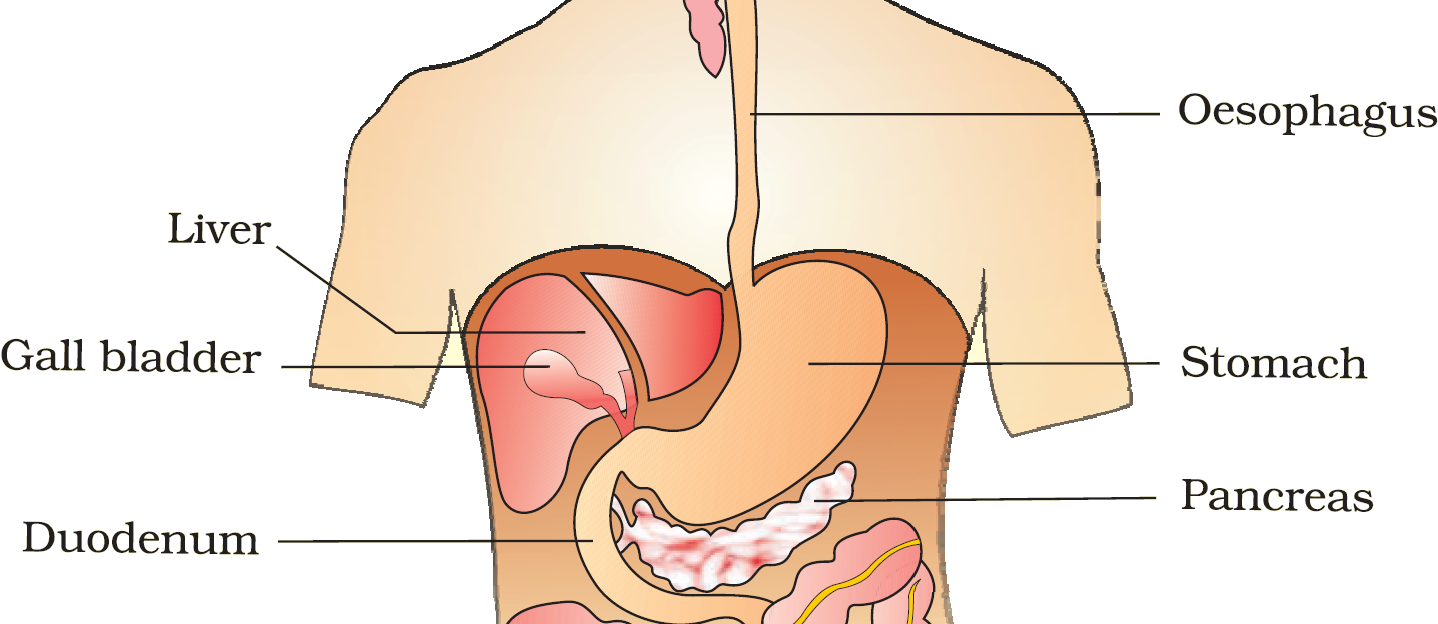
The diagram shows part of the human alimentary canal. Which two structures produce substances involved in the digestion of fats?
Answer
Bile is produced by the liver and pancreatic juice is secreted by pancreas. Liver and pancreas are the two glands of alimentary canal these produce substances (enzymes and bile free) involved in the digestion of fat.
View full question & answer
Question 702 Marks
Name any two enzymes of saliva and also mention their functions.
Answer
Lysozyme and salivary amylase. Lysozyme kills bacteria and amylase digest carbohydrate, specially starch.
View full question & answer
Question 712 Marks
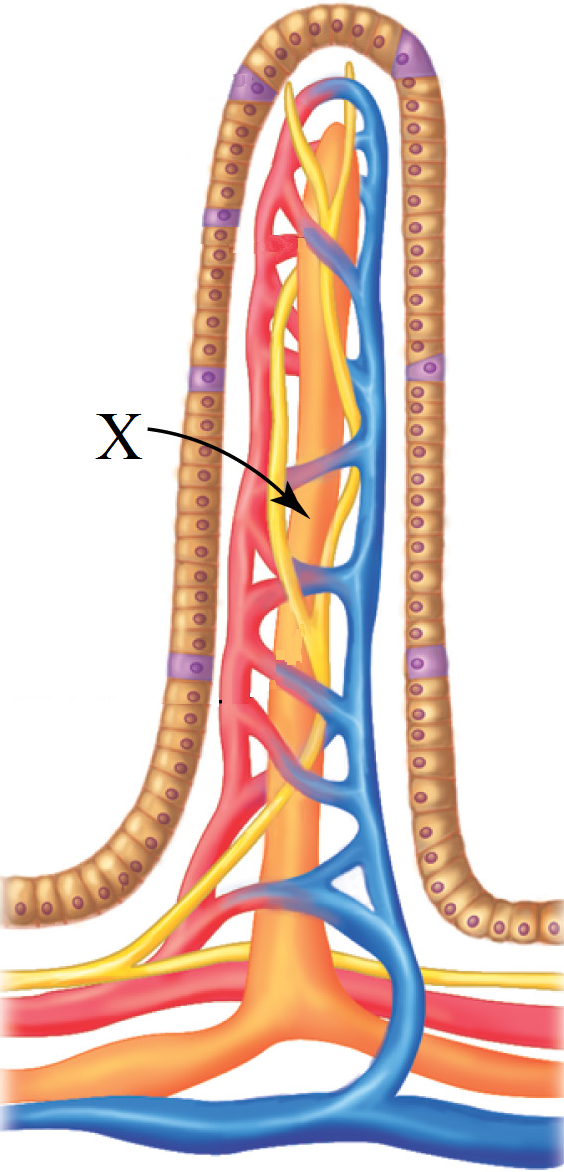
The diagram shows a section through a villus. What is the function of structure X?
  1. To absorb amino acids.
  2. To carry blood.
  3. To transport fats.
  4. To transport glucose.
Answer
The lacteal absorbs the end products of fat digestion, i.e., fatty acids and glycerol. This, transports them to the lymphatic vessels that eventually empty these products into the blood circulation.
View full question & answer
Question 722 Marks
  1. As a digestive gland, what does liver secrete and where is this secretion stored? Also name the enzymes secreted by liver.
  2. Digestive secretion of liver contains which salts? What is their function?
Answer
  1. Liver secretes bile juice. It is stored in gall bladder.Bile secretion contains no enzymes.
  2. Bile contains salts, namely, sodium glycolate and sodium taurocholate. These reduce the surface tension of large fat droplets and break them into many small ones. The process is called emulsification. Bile salts also form a thin coating around tiny fat droplets to keep them free from each other.
View full question & answer
Question 732 Marks
Correct the following statements by deleting one of the options (given in bracket).
  1. Gastric glands of stomach mucosa have (oxyntic cell/ chief cells) which secrete HCI.
  2. Saliva contains enzymes that digest (starch/ protein).
Answer
  1. Gastric glands of stomach mucosa have oxyntic cells which secrete HCl.
  2. Saliva contains enzymes that digest starch.
View full question & answer
Question 742 Marks
Distinguish between constipation and indigestion. Mention their major causes.
Answer
Constipation: Difficult, delayed and infrequent defecation (elimination of solid, semisolid or liquid waste material from the digestive tract via the anus) caused by insufficient water in the feces is called constipation. It is caused by a decrease in intestinal tract motility leading to dry, potentially painful fecal evacuation. It may results from stress, lack of exercise, or insufficient fiber in the diet.Indigestion: Indigestion also known as dyspepsia refers to condition of impaired digestion and uncomfortable sensations which affect the upper abdomen with burning or pain. It can appear with heartburn, belching, bloating, or nausea. The symptoms of indigestion include a feeling of fullness during a meal and bothersome fullness after a meal, burning or pain in the upper abdomen etc. It could be caused by a condition in the digestive tract such as gastro esophageal reflux disease (GERD).
View full question & answer