Questions

2 Marks Questions

Take a timed test

42 questions · self-marked practice — reveal the answer and mark yourself.

Question 12 Marks
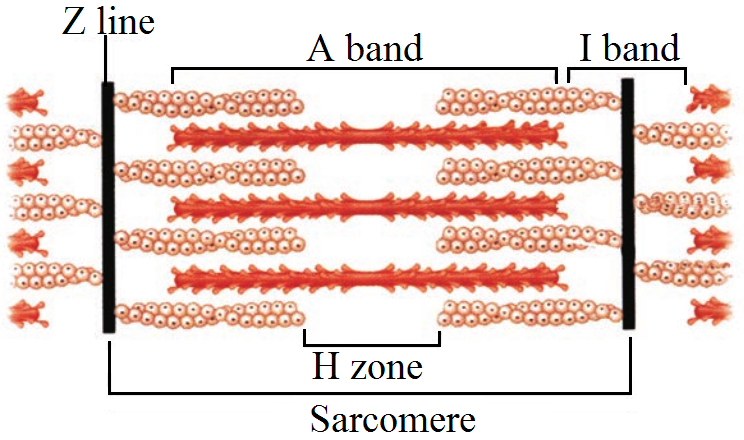
Draw the diagram of a sarcomere of skeletal muscle showing different regions.
Answer
Different regions of a sarcomere of skeletal muscle:
View full question & answer
Question 22 Marks
Write the difference between: Actin and Myosin
Answer
Actin and Myosin:
Actin Myosin
Actin is a thin contractile protein. Myosin is a thick contractile protein.
The light bands called I-band or Isotropic band contain actin. The dark band called ‘A’ or Anisotropic band contains myosin.
View full question & answer
Question 32 Marks
What are the points for articulation of Pelvic and Pectoral girdles?
Answer
The components of pelvic girdle are ilium, is chium and pubis. It articulates with, femur through acetabulum. The components of pectoral girdle are scapula and clavicle. It is the glenoid cavity of pectoral girdle in which head of humerus articulates.
View full question & answer
Question 42 Marks
Suggest the reasons for Gout, Tetany, Osteoporosis and myasthenia gravis.
Answer
  1. Gout: Accumulation of uric acid crystals in the joints.
  2. Tetany: Low levals of $\mathrm{Ca}^{2+}$ in body fluids.
  3. Osteoporosis: Low levels of estrogen.
  4. Myasthenia gravis: Auto immunity
View full question & answer
Question 52 Marks
List the different types of ribs found in our body. How many pairs of ribs are present in human beings?
Answer
  1. The types of ribs in a human body:
  • True ribs.
  • Vertebro-chondral ribs.
  • Floating ribs.
  1. There are 12 pairs of ribs in a human being.
View full question & answer
Question 62 Marks
Which tissue is afflicted by Myasthenia gravis? What is the underlying cause?
Answer
Myasthenia gravis: Auto-immune disorder affecting neuromuscular junction leading to fatigue, weakening and paralysis of skeletal muscle.
View full question & answer
Question 72 Marks
Rahul exercises regularly by visiting a gymnasium. Of late he is gaining weight. What could be the reason? Choose the correct answer and elaborate.
  1. Rahul has gained weight due to accumulation of fats in body.
  2. Rahul has gained weight due to increased muscle and less of fat.
  3. Rahul has gained weight because his muscle shape has improved.
  4. Rahul has gained weight because he is accumulating water in the body.
Answer
  1. Rahul has gained weight due to increased muscle and less of fat.
Explanation:
Rahul has gained weight because with regular exercise, myofibrils increase in thickness and protein synthesis also increases resulting in increase in volume of muscles. Thus, muscles become denser. With regular exercise the body fat burns.
View full question & answer
Question 82 Marks
Why do organisms exhibit locomotion?
Answer
Locomotion is performed:
  1. In search of food.
  2. To move to suitable breeding grounds.
  3. To move to favourable climatic conditions.
  4. in search of a mate.
View full question & answer
Question 92 Marks
Give the names of the bones present in the lower limb or leg in humans.
Answer
The bones in the leg are as follows:
Thigh
-
Femur (1)
Knee cap
-
Patella (1)
Shank
-
Tibia (1)
 
-
Fibula (1)
Ankle
-
Tarsals (7)
Foot
-
Metatarsals (5)
Toes
-
Phalanges (14)
View full question & answer
Question 102 Marks
Differentiate between fibrous joints and cartilaginous joints with an example of each.
Answer
S.No.
Fibrous Joints
Cartilaginous Joints
(i)
These joints do not allow any movement.
These joints allow limited movements.
(ii)
The bones are joined end-to-end with dense fibrous connective tissue.
The bones are joined together with the help of cartilages.
(iii)
e.g. skull bones.
e.g. between succesessive vertebrae.
View full question & answer
Question 112 Marks
Why are skeletal muscles also called (a) striated muscles and (b) voluntary muscles?
Answer
  1. Skeletal muscles show striations, i.e. alternate dark and light bands; hence, called striated musecls.
  2. Since their movements are under the voluntary control of nervous system, they are called voluntary muscles.
View full question & answer
Question 122 Marks
How do our bone joints function without grinding noise and pain?
Answer
In cartilaginous joints, white fibro cartilage present between the ends of bones and in synovial joints, synovial fluid present’ between articulating surface of two bones enclosed within synovial cavity make our joints to function without grinding noise and pain.
View full question & answer
Question 132 Marks
Mention the three types of joints found in human body. Which of these play a significant role in locomotion?
Answer
The three types of joints are:
  1. Fibrous joints.
  2. Cartilaginous joints.
  3. Synovial joints.
Synovial joints play a major role in locomotion.
View full question & answer
Question 142 Marks
Write the names of the bones in the forelimb (hand) of a human being. Mention the respective number of each of them.
Answer
A forelimb contains the following bones:
Upper arm
-
Humerus (1)
Forearm
-
Radius (1)
 
-
Ulna (1)
Wrist
-
Carpals (8)
Palm
-
Metacarpals (5)
Fingers
-
Phalanges (14)
 
View full question & answer
Question 152 Marks
Name the type of movement found in majority of multicellular animals. Explain.
Answer
Muscular movement is the type of movement found in majority of multicellular organisms. This occurs with the help of muscles. These are brought about by movement of myofilaments present within the muscle fibres.
View full question & answer
Question 162 Marks
Differentiate between: Non-muscular and muscular movements.
Answer
Differences between non-muscular and muscular movements:
S. No.
Non-muscular Movement
Muscular Movement
1.
These movements include pseudopodial and ciliary movements.
These movements are brought about by movement of myofilaments within muscle firbres.
2.
They persist in the animals in some of their cells.
These are found in majority of animals.
View full question & answer
Question 172 Marks
Name the type of joint between the following:
  1. Altas and axis.
  2. Carpal and metacarpal.
  3. Public bones in the pelivic giodle.
  4. Fernur and Acetabulum.
Answer
  1. Pivot joint.
  2. Saddle joint.
  3. Cartilaginous joint.
  4. Ball and socket joint.
View full question & answer
Question 182 Marks
Mention any four functions of the human vertebral column.
Answer
  1. It protects the spinal cord.
  2. It supports the head.
  3. It serves as the point of attachment for the ribs.
  4. It also provides place for attachment of muscles of the back.
View full question & answer
Question 192 Marks
Name the different types of synovial joints and give an example of each.
Answer
There are five different types of synovial joints:
  1. Ball and socket joint e.g., between humerus and pectoral girdle, between femur and pelvic girdle.
  2. Hinge joint e.g., knee joint and elbow joint.
  3. Pivot joint e.g., between atlas and axis.
  4. Gliding joints e.g., between the carpals, between the tarsals.
  5. Saddle joint e.g., between carpal and metacarpal of thumb.
View full question & answer
Question 202 Marks
Describe the structure of the human skull.
Answer
The skull is composed of two sets of bones-cranial and facial, that totals to 22 bones. Cranial bones are 8 in number. They form the hard protective outer covering, cranium for the brain. The facial region is made up of 14 skeletal elements which form the front part of the skull. A single U-shaped bone called hyoid is present at the base of the buccal cavity and it is also included in the skull. Each middle ear contains three tiny bones-Malleus, Incus and Stapes, collectively called Ear Ossicles. The skull region articulates with the superior region of the vertebral column with the help of two occipital condyles (dicondylic skull).
View full question & answer
Question 212 Marks
How do you distinguish between a skeletal muscle and a cardiac muscle?
Answer
S.No.
Skeletal Muscles
Cardiac Muscles
(i)
They are found attached to bones (skeletal elements).
They are found only in the heart.
(ii)
They are under the direct voluntary control of nervous system.
Nervous system does not directly control their activity.
(iii)
Striations are prominent.
Striations are faint.
(iv)
Intercalated discs are absent.
Intercalated discs are present.
View full question & answer
Question 222 Marks
  1. Which bones of the skull are movable?
  2. How many vertebrae are there in vertebral column?
  3. Why is atlas vertebra called yes bone?
Answer
  1. Mandible and ear ossicles are the movable joints.
  2. There are 33 vertebrae in vertebral column.
  3. Atlas vertebra is also called 'yes' bone as it provides up and down movement to the skull.
View full question & answer
Question 232 Marks
Give two organs in our body, where ciliary movement occurs and mention their significance.
Answer
  1. The coordinated movements of cilia in our trachea help us in removing the dust or other particles inhaled with the air, towards the larynx.
  2. The movements of cilia of the epithelial cells lining the fallopian tube facilitate the movement of ova towards the uterus.
View full question & answer
Question 242 Marks
The vertebral column has four articulation points for the four limbs. This is similar to which of the following? What do you understand by ‘spineless’in the literal sense?
  1. A four wheeler has four articulation points for the four wheels.
  2. A two wheeler has two articulation points for the two wheels.
  3. A snake's vertebral column has no articulation point because it has no limb.
Answer
  1. A four wheeler has four articulation points for the four wheels.
Explanation:
The word 'spineless' is often used in the literal sense also. A person with no self respect and no self-confidence can be termed as spineless. It is said that such person can go to any low to fulfill his selfish goals. Such people are usually dishonest and lack the initiative. They are afraid of taking responsibilities. We should develop strong ‘spine' so that we can live with our head held high.
View full question & answer
Question 252 Marks
  1. What is the other name given to false ribs? How many of them are present in human skeleton.
  2. Why are the last two $\left(11^{\text {th }}\right.$ and $\left.12^{\text {th }}\right)$ pairs of ribs called floating ribs?
Answer
  1. Vertebrochondral ribs; there are three pairs of them.
  2. Since they are not attached ventrally to the sternum, they are called floating ribs.
View full question & answer
Question 262 Marks
The following parts in our body has specific names in osteology. Write the name for each.
  1. Knee cap.
  2. Collar bone.
  3. Skull.
  4. Spine.
  5. Shoulder bone.
  6. Coxal bone.
Answer
  1. Patella.
  2. Clavicle ISTO.
  3. Cranium.
  4. Vertebral column.
  5. Scapula.
  6. Innominate.
View full question & answer
Question 272 Marks
What is the difference between the matrix of bones and cartilage?
Answer
A bone is a hard connective tissue, while cartilage is soft connective tissue. Bones form the skeletal structure of the body, whereas cartilage is present in nose, ear, ribs, larynx, and joints and also act as a shock absorber in these joints.
View full question & answer
Question 282 Marks
What is locomotion? Mention any four forms of locomotory movements.
Answer
  1. Locomotion refers to the voluntary movements which result in a change of place or location.
  2. Walking, swimming, flying, climbing, running.
View full question & answer
Question 292 Marks
How many bones form the facial part of skull? Name them.
Answer
Eight bones form the facial part of skull. They are as follows:
  1. Lacrimal bone (1),
  2. Nasal bones (2),
  3. Zygomatic bones (2),
  4. Maxilla (2),
  5. Mandible (1).
View full question & answer
Question 302 Marks
Give a brief explanation of the human skeletal system.
Answer
Bones and cartilages constitute our skeletal system. The skeletal system is divisible into axial and appendicular. Skull, vertebral column, ribs and sternum constitute the axial skeleton. Limb bones and girdles form the appendicular skeleton. Three types of joints are formed between bones or between bone and cartilage - fibrous, cartilaginous and synovial. Synovial joints allow considerable movements and therefore, play a significant role in locomotion.
View full question & answer
Question 312 Marks
Name atleast two hormones which result in fluctuation of $Ca ^{++}$ level.
Answer
Calcitonin and parathyroid hormones affect the level of calcium ion in blood. When plasma level of calcium rises beyond a certain point, it is controlled by calcitonin. When plasma level of calcium falls below a certain point, it is controlled by parathryroid hormone.
View full question & answer
Question 322 Marks
Exchange of calcium between bone and extracellular fluid takes place under the influence of certain hormones. What will happen if more of $Ca ^{++}$ is in extracellular fluid?
Answer
If more of $Ca ^{++}$ is in extracellular fluid then it will be accumulated on the bones under the influence of thyrocalcitonin (TCT).
View full question & answer
Question 332 Marks
Avantika, who works in a publication house suffered from severe back pain, for the last three months. She visited a doctor, who explained that it was due to her wrong sitting posture during the office hours. He also suggested her that she should avoid long working hours continuously.
  1. List two disorders that may be caused by wrong sitting posture.
  2. Write the vertebral formula of humans.
  3. What precautions should be taken to avoid such problem?
  4. What value is shown by Avantika?
Answer
  1. Spondylitis vieno.
  2. $C_7 ~T_{12} ~L_5 ~S_5 ~C_{(3-5)}$.
  3. One should maintain proper sitting posture and avoid long sitting hour in the same positions.
  4. Avantika is concerned about her health.
View full question & answer
Question 342 Marks
The skull bones are the strongest bones in the body and thus the brain gets the best protection in the body. In the light of this statement, which of these is true? How will you raise awareness about wearing helmet?
  1. We do not need a helmet because skull is enough to take care of the brain.
  2. We can manage with a poor quality helmet so that the police does not catch us.
  3. Helmets are very important because they help in saving the most important organ; the brain.
Answer
  1. Helmets are very important because they help in saving the most important organ; the brain.
Explanation:
I can raise awareness about wearing helmet by following methods:
I will carry out poster campaigns, highlighting the dangers of not wearing a helmet. I will take help from doctors and police authorities to educate people; about benefits of wearing helmet. I will request my teachers to arrange for a guest lecture by eminent neurophysician to educate students about the issue.
View full question & answer
Question 352 Marks
Differentiate between fibrous joints and cartilaginous joints, with an example for each.
Answer
S.No.
Fibrous Joints
Cartilaginous Joints
(i)
These joints do not allow any movement.
These joints allow limited movements.
(ii)
The bones are joined end-to-end with dense fibrous connective tissue. e.g. skull bones.
The bones are joined together with the help of cartilages. e.g. between successive vertebrae.
View full question & answer
Question 362 Marks
How are synovial joints different from cartilaginous joints? Give an example of each of them.
Answer
S.No.
Synovial Joints
Cartilaginous Joints
(i)
These are freely movable joints.
These joints permit only limited movement.
(ii)
There is a cavity filled with synovial fluid which reduces friction. e.g. Ball and socket joint, knee joint, etc.
They are joined by cartilages and there is no synovial fluid between articulating bones, e.g. joint between successive vertebrae.
View full question & answer
Question 372 Marks
Bring out the differences between cardiac muscles and visceral muscles.
Answer
S.No.
Cardiac Muscles
Visceral Muscles
(i)
They are found only in the the wall of the heart.
They are found in wall of visceral organs like alimentary canal, uterus, ureters, etc.
(ii)
Striations are faintly seen.
Striations are absent.
(iii)
Cells are cylindricall and branched.
Cells are spindle shaped.
(iv)
Intercalated discs are present.
Intercalated discs are absent.
View full question & answer
Question 382 Marks
Akhil, a class XI student is very casual regarding his studies. One day, his classes were suppose to commence from 8:00 AM. But he left his home at 7:45 AM. He started running on his way, but after 400-500m, he felt a severe cramp in his leg. Due to this cramp, he had to stop and he missed his morning class.
  1. What is the reason of the muscle cramp?
  2. How could one get rid off the cramp?
  3. Name the oxygen carrying pigment of muscles.
  4. What values are displayed by Akhil?
Answer
  1. Due to lack of oxygen, anaerobic respiration starts in the muscle. This leads to accumulation of lactic acid in the muscle which results in muscle cramp.
  2. One can get rid off it by resting for some time, so that normal breathing rate resumes.
  3. Myoglobin or muscle haemoglobin is the oxygen o carrying pigment of muscles.
  4. Akhil is a lazy, irresponsible student. He is very casual about his studies and classes.
View full question & answer
Question 392 Marks
Differentiate between: A-band and I-band.
Answer
Differences between A-band and l-band:
S. No.
A-Band
I-Band
1.
It is formed of myosin filaments.
It is formed of only actin filaments.
2.
It gives dark appearance.
It gives light appearance.
3.
It has a light H-zone, in the centre.
It has dark Krause's membrane, in the centre.
4.
It is anisotropic band which possesses two type of proteins.
It is isotropic band which possesses only one type of proteins.
View full question & answer
Question 402 Marks
Write a few lines about Gout.
Answer
Gout occurs due to accumulation of uric acid crystals in the joints and causes in inflammation of joints which results in inflammation of joints and pain. Gout it self is a form of artheritis. The primary cause of pain is accumulation of uric acid which is not seen in other forms of artheritis.
View full question & answer
Question 412 Marks
What is arthritis and what are the causes of arthritis?
Answer
Arhtritis is inflammation of joints. This happens mostly in synovial joints. Because of ageing and wear and tear the synovial fluid dries up. This leads to corrosion of cartilage. At the end the movement of joints is not as smooth as it should be. This results in general discomfort while doing normal tasks and causes swelling and pain of the affected joint.
View full question & answer
Question 422 Marks
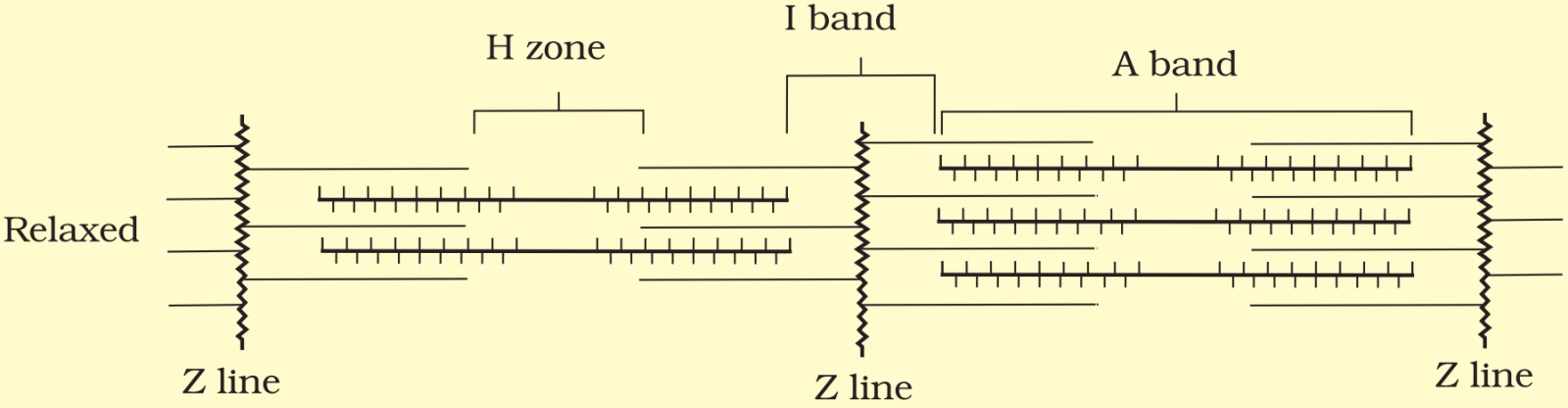
How does a muscle return to its original form during relaxation? Also draw a diagram showing relaxation of muscle. What causes muscle fatigue?
Answer
  1. The calcium ions after contraction are quickly pumped back to the sarcoplasmic cisternae. This leads to blocking of active sites on actin. The Z-line returns to the original position. Causing muscles to return to its original position, i.e., relaxation form.
  1. Repeated activation of the muscles leads to accumulation of lactic acid due to anaerobic breakdown of glycogen in them which causes fatigue.
View full question & answer