Questions

3 Marks Question

Take a timed test

23 questions · self-marked practice — reveal the answer and mark yourself.

Question 13 Marks
What are the different types of movements exhibited by the cells of human body?
Answer
Movement is a characteristic feature of living organisms. The different types of movement exhibited by cells of the human body are:
  • Amoeboid movement: Leucocytes present in the blood show amoeboid movement. During tissue damage, these blood cells move from the circulatory system towards the injury site to initiate an immune response.
  • Ciliary movement: Reproductive cells such as sperms and ova show ciliary movement. The passage of ova through the fallopian tube towards the uterus is facilitated by this movement.
  • Muscular movement: Muscle cells show muscular movement.
View full question & answer
Question 23 Marks
Differentiate between skeletal muscles and visceral muscles.
Answer
S.No.
Skeletal Muscles
Visceral Muscles
(i)
These are found attached to the skeletal elements.
They are found in the wall of visceral organs.
(ii)
Striations are prominent.
Striations are absent.
(iii)
They are voluntary in function.
They are involuntary in function.
(iv)
Cells are multinucleate.
Cells are uninucleate.
(v)
They are innervated by voluntary nervous system.
They are innervated by autonomic nervous system.
View full question & answer
Question 33 Marks
Explain the structure of the vertebral column of human.
Answer
Vertebral Column: Our vertebral column is formed by 26 serially arranged units called vertebrae and is dorsally placed. It extends from the base of the skull and constitutes the main framework of the trunk. Each vertebra has a central hollow portion (neural canal) through which the spinal cord passes. First vertebra is the atlas and it articulates with the occipital condyles. The vertebral column is differentiated into following regions starting from the skull:
  1. Cervical (7).
  2. Thoracie (12).
  3. Lumbar (5).
  4. Sacral (1-fused).
  5. Coccygeal (1-fused) regions.
The number of cervical vertebrae are seven in almost all mammals including human beings. The vertebral column protects the spinal cord, supports the head and serves as the point of attachment for the ribs and musculature of the back. Sternum is a flat bone on the ventral midline of thorax.
View full question & answer
Question 43 Marks
Differentiate between red muscle fibres and white muscle fibres.
Answer
S.No.
Red Muscle Fibres
White Muscle Fibres
(i)
They have large quantity of myoglobin, that gives the red colour.
They have very little amount of myoglobin, hence are not red in colour.
(ii)
They have a number of mitochondria and blood capillaries.
They have less number of mitochondria and blood capillaries.
(iii)
Sarcoplasmic reticulum is less.
Sarcoplasmic reticulum is more.
(iv)
They can work for longer periods, without getting fatigued, as they are aerobic muscles.
They can work for shorter periods only, as they are anaerobic muscles.
(v)
These muscle fibres are thinner.
These muscle fibres are thicker.
View full question & answer
Question 53 Marks
What is the role of sarcoplasmic reticulum, myosin head and F-actin during contraction of striated muscles of humans?
Answer
  1. Sarcoplasmic reticulum stores $Ca ^{2+}$ions and releases them when necessary for muscle contraction; the calcium ions bind to troponin and unmasks the active site on actin for myosin to bind with.
  2. Myosin head functions as enzyme ATPase and hydrolyses ATP to release energy; it also binds to the actin filament to form actin-myosin bridge for muscle contraction.
  3. The active sites on the F-actin are specific for myosin heads, for formation cross bridge.
View full question & answer
Question 63 Marks
Name any three disorders related to bones/ skeletal system and describe them.
Answer
Disorders of bones:
  1. Arthritis: It is the inflammation of joints.
  2. Osteoporosis: It is an age-related disorder of the bones, characterised by low bone mass, and increased chances of fracture.
  3. Gout: It is the inflammation of the joints due to accumulation of uric acid crystals.
View full question & answer
Question 73 Marks
What is osteoporosis? Why are women at a greater risk of suffering from osteoporosis? Suggest some precautionary means to avoid osteoporosis.
Answer
Osteoporosis is the condition in which the bone mass is decreased. This leads to general weakening of bones. Even a minor slip can result in fractures if a person is suffering from osteoporosis. Women are at greater risk of suffering from osteoporosis because of several reasons. During child bearing major part of calcium from their body is utilized in formation of the skeleton of the foetus. Additionally during lactation there is further depletion of the calcium reserve of the body because of milk formation A calcium rich diet can help prevent the progression of osteoporosis. Milk and eggs are good source of calcium. During pregnancy oral calcium supplement is also given to prevent osteoporosis.
View full question & answer
Question 83 Marks
There are 26 bones in the vertebral column of a human adult. Categorise them on the basis of their location and mention the specific number in each of the categories.
Answer
The categories of vertebrae are as follows:
  1. Cervical vertebrae are in the neck region; they e are seven in number.
  2. Thoracic vertebrae are present in the thoracic region of the trunk; they are twelve in number.
  3. Lumbar vertebrae are present in the abdominal region of the trunk; they are five in number.
  4. Sacrum is the large triangular bone at the end of 19 vertebral column in the hip region; it is only one.
  5. Coccyx is the small bone at the end, which is the vestigeal tail bone in human being.
View full question & answer
Question 93 Marks
Explain the pelvic girdle of human skeleton.
Answer
Pelvie Girdle: Pelvic girdle consists of two coxal bones. Each coxal bone is formed by the fusion of three bones-ilium, ischium and pubis. At the point of fusion of the above bones is a cavity called acetabulum to which the thigh bone articulates. The two halves of the pelvic girdle meet ventrally to form the pubic symphysis containing fibrous cartilage.
View full question & answer
Question 103 Marks
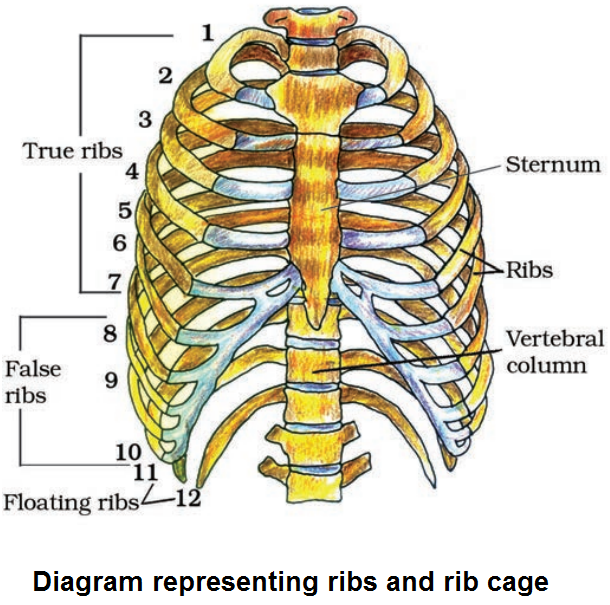
With respect to rib cage, explain the following: Bicephalic ribs. True ribs. Floating ribs.
Answer
Bicephalic ribs, each ribs has two articulating surfaces on its dorsal end hence are called as bicephalic ribs. True ribs are the first seven pairs of ribs dorsally these ribs are attached to the thoracic vertebrae and ventrally connected to the sternum with the help of hyaline cartilage. Floating ribs are the last two pair (11th and 12th) of ribs and are not-connected ventrally to the sternum therefore, called as floating ribs.
View full question & answer
Question 113 Marks
Differentiate between: Actin and myosin filament.
Answer
Differences between actin and myosin filament are:
S. No.
Actin Filaments
Myosin Filaments
1.
These are found in l-band.
These are found in A-band.
2.
These are thin.
These are thick.
3.
Cross-bridges (heads) are present.
Cross-bridges (heads) are absent.
4.
It is a globular protein with low molecular weight.
It is a heavy molecular weight polymerised protein.
View full question & answer
Question 123 Marks
  1. Name the bones of pectoral giodle.
  2. Give an example of fibrous joint.
  3. What is the role of $\mathrm{Ca}^{2+}$ (calcium ions) in muscle DE contraction?
Answer
  1. Clavicle and scapula.
  2. Between skull bones.
  3. Role of $\mathrm{Ca}^{2+}$ (calcium ions).
$\mathrm{Ca}^{2+}$​​​​​​​ ions bind to a subunit of troponin and unmask the active site on actin for binding of myosin, to form actin myosin bridge.
View full question & answer
Question 133 Marks
What is the source of energy for muscle contraction?
Answer
ATP is the source of energy for muscle contraction. The head of each myosin molecule contains an enzyme, myosin ATPase. In the presence of ATPase, $Ca ^{2+}, Mg ^{2+}$ ions, ATP breaks down into ADP and inorganic phosphate, releasing energy in the head of myosin. Energy from ATP causes energized myosin cross bridges to bind to actin. The energised cross-bridges move, causing thin myofilaments to slide along the thick myofilaments, thus initiating muscle contraction.
View full question & answer
Question 143 Marks
How are muscles classified based on their location? Mention their important functions.
Answer
  1. Skeletal muscles, visceral muscles and cardiac muscles.
  2. Skeletal muscles are primarily involved in locomotory activities and change of body postures.
  3. Visceral muscles assist in movement of substances/ materials in the hollow visceral organs.
  4. Cardiac muscles are involved in the pumping of blood by the heart.
View full question & answer
Question 153 Marks
Abhay, a police officer, discovered a human pelvis from the jungle. After checking the reports of missing people, he found that a couple had been missing from that area since a month. Abhay was confused as to whom the pelvis belonged to and therefore, took it to the forensic investigator. The forensic expert reported it to be a female pelvis. Afterwards, the DNA from the missing female's mother and pelvis was matched. Since, both the DNA matched. It confirmed that out of the couple, the lady had died.
  1. How did the investigator opened it to be a female pelvis?
  2. What other bones of human can be used for sex identification?
  3. Give a possible reason for the change in female pelvis.
  4. What values are shown by Abhay?
Answer
  1. As the female pelvis is larger, has a broader front and larger bottom opening than the male pelvis, it can be identified easily.
  2. Apart from pelvis, skull can also be used for sex identification due to remarkable differences between male and female skull.
  3. The changes in femals pelvis are an adaptation for childbirth.
  4. Abhay is intelligent, cautious, aware, responsible and devoted to his duties.
View full question & answer
Question 163 Marks
Radha was running on a treadmill at a great speed for 15 minutes continuously. She stopped the treadmill and abruptly came out. For the next few minutes, she was breathing heavily/ fast. Answer the following questions.
  1. What happened to her muscles when she did strenuously exercised?
  2. How did her breathing rate change?
Answer
  1. Due, to continuous exercise her muscles got fatigues because of the accumulation of lactic acid within skeletal muscles. Pain is also oftenly experienced in the fatigued muscles.
  2. Her breathing rate changes from normal to high as during exercise, her body muscle require more oxygen for the ATP production, than the normal value, hence her breathing enhances, to lake most oxygen from the atmosphere.
View full question & answer
Question 173 Marks
Where are calcium ions stored in a muscle fibre? How do calcium ions affect the process of muscle contraction?OR
Bring out the role of calcium ions and ATP in muscle contraction.
Answer
  1. Calcium ions are stored in the sarcoplasmic reticulum of a muscle fibre.
  2. When calcium ion binds to the troponin of the actin (thin) filament, the masking of the active site for myosin is removed.
  3. This allows the binding of myosin to the active site on actin and formation of actin-myosin bridge.
  4. ATP is the source of energy for muscle contraction; myosin head functions as enzyme ATP are and hydrolyses ATP to release energy.
  5. The formation of cross bridge leads to pulling of thin filaments into a band and muscle contraction is effected.
View full question & answer
Question 183 Marks
Give answer for the following:
  1. Female pelvis is larger and has a broader front than male pelvis. Why?
  2. Name the different curves of vertebral column.
  3. What is a seasmoid bone? Name it.
  4. Which bones have become modified to form ear ossicles?
Answer
  1. Female pelvis is larger and has a broader front. This is an adaptation for childbirth.
  2. Vertebral column forms four curves, i.e., cervical, thoracic, lumbar and sacral located in the neck, thorax, abdomen and pelvis, respectively.
  3. A bone embedded within a tendon is called a seashoid bone,s patella which cover the knee ventrally.
  4. Articular bone of lower jaw modifies to be malleus. Quadrate bone of upper jaw becomes incus and hyomandibular gets modified to become stapes.
View full question & answer
Question 193 Marks
Give a description of the appendicular skeleton in human.
Answer
Appendicular Skeleton: The bones of the limbs alongwith their girdles constitute the appendicular skeleton. Each limb is made of 30 bones. Bones of Limbs:
Fore Limb Hind Limb
Humerus Femur,
Radius Tibia,
Ulna Fibula,
Carpals (8) Tarsals (7)
Metacarpals (5) Metatarsals (5)
Phalanges (14) Phalanges (14)
  Patella
View full question & answer
Question 203 Marks
Describe the structure of an actin filament.
Answer
  1. Each actin filament is made of two 'F' (filamentous) actins that are helically wound to each other.
  2. Each 'F' actin is a polymer of many 'G' (globular) actins.
  3. Two filaments of protein, tropomyosin also run close to the F-actins through out their length.
  4. Another complex protein, troponin, is distributed at regular intervals on the tropomyosin; a subunit of troponin masks the active/binding site for myosin on the actin filaments.
View full question & answer
Question 213 Marks
Describe the pectoral girdle of human skeleton.
Answer
Pectoral Girdle: Each half of pectoral girdle consists of a clavicle and a scapula. Scapula is a large triangular flat bone situated in the dorsal part of the thorax between the second and the seventh ribs. The dorsal, flat, triangular body of scapula has a slightly elevated ridge called the spine which projects as a flat, expanded process called the acromion. The clavicle articulates with this. Below the acromion is a depression called the glenoid cavity which articulates with the head of the humerus to form the shoulder joint. Each clavicle is a long slender bone with two curvatures. This bone is commonly called the collar bone.
View full question & answer
Question 223 Marks
Explain anaerobic breakdown of glycogen in muscles and its effect.
Answer
Anaerobic Breakdown of Glycogen: The reaction time of the fibres can vary in different muscles. Repeated activation of the muscles can lead to the accumulation of lactic acid due to anaerobic breakdown of glycogen in them, causing fatigue.
View full question & answer
Question 233 Marks
In old age, people often suffer from stiff and inflamed joints. What is this condition called? What are the possible reasons for these symptoms?
Answer
The condition is called arthritis. It is of two types:
  1. Rheumatoid arthritis is the most common arthritis. It is an inflammation of the synovial membrane in synovial joints. When this membrane, which is a source of synovial fluid, becomes inflamed, it produces too much fluid. The joints swell and become very painful.
  2. Osteoarthritis affects the articular carti-lage at the synovial joints. The cartilage erodes and due to proliferation new bone is deposited. It is a degenerative joint disease in which joints become painful and stiff with restricted movement.
View full question & answer